
Soft Care Labels for a Comfort-Focused Clothing Collection
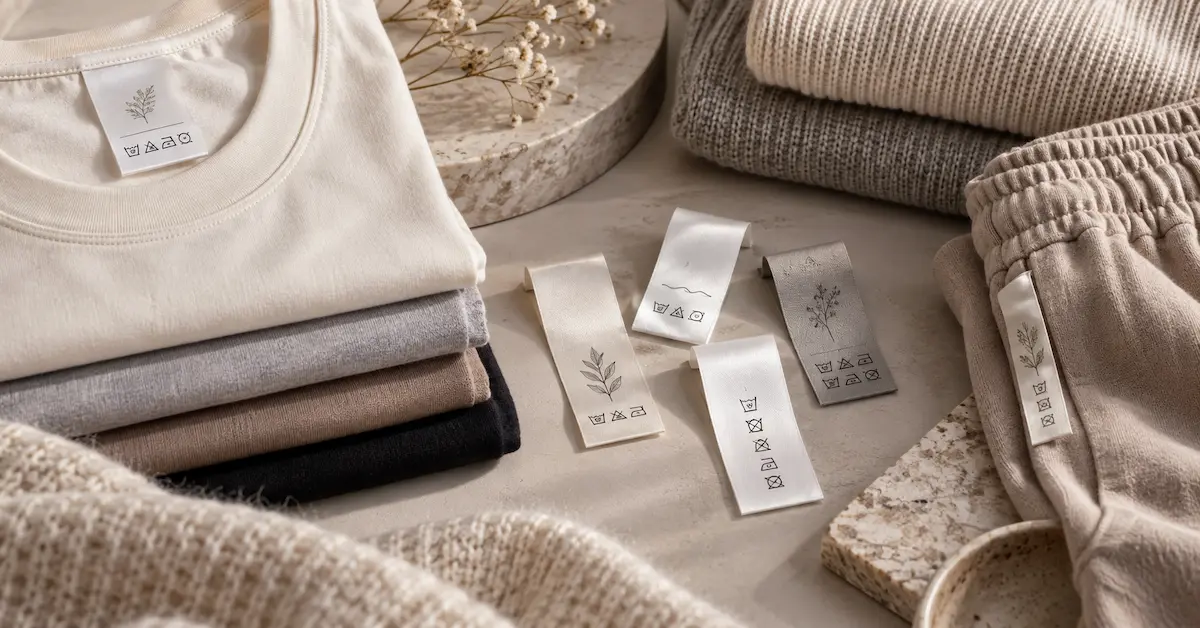
A care label may be small, but its material, edges, thickness and placement can influence how a garment feels against the skin. For clothing brands developing comfortable T-shirts, underwear, loungewear or lightweight fashion collections, choosing the right care label deserves as much attention as selecting the fabric itself.
Care labels also perform an essential information function. They may need to communicate fiber composition, washing instructions, drying guidance and other details required for the intended market. These details should remain legible throughout the required service life of the garment.
This soft care label case study brief explores how apparel brands can balance skin comfort, label material selection, printing clarity and wash durability before approving production samples.
The objective is not simply to choose the softest-feeling material. It is to develop a label construction that feels appropriate on the garment, carries the necessary information and performs consistently after sewing and laundering.
Project status: This article is a representative product-development brief. Specific customer requirements, actual QTTAG production samples and finished project results must be verified before presenting it as a completed customer case study.
Project Overview: Developing Soft Care Labels for Comfortable Clothing
A comfort-focused clothing collection presents several practical labeling challenges.
Lightweight materials, fitted garment shapes and repeated skin contact can make poorly positioned or rigid labels more noticeable to the wearer.
A suitable care label should be evaluated as part of the complete garment rather than as an isolated printed fabric strip.
For this project scenario, the development objective is to establish an appropriate soft care label specification for a coordinated clothing collection.
| Project Element | Development Requirement |
|---|---|
| Product | Custom printed care labels |
| Application | Comfort-focused apparel |
| Main objective | Balance wearing comfort and readable garment information |
| Material considerations | Surface feel, flexibility, thickness and edge finishing |
| Printing requirements | Clear text, symbols and necessary product information |
| Construction | Suitable dimensions, folding and attachment |
| Performance review | Legibility and appearance after laundering |
| Sampling | Material samples and finished garment evaluation |
| Production target | Repeatable labeling across garment styles |
For apparel purchasing teams, the central question is how to choose a care label construction that meets the garment's comfort and information requirements without introducing unnecessary production problems.
The Main Challenge: Comfort Without Compromising Information
Care labels serve two functions that sometimes compete.
They must provide useful garment information, but their physical presence should not interfere unnecessarily with the intended wearing experience.
A material can feel soft when handled separately yet behave differently when folded, cut or stitched into a garment.
Skin Contact and Surface Feel
Labels positioned near the waist, neckline or side seams may come into contact with the wearer.
The surface of the printed material, cut edges and stitching can all influence comfort.
For products where skin contact is an important consideration, buyers should evaluate a sample after it has been attached to the garment.
Label Thickness and Flexibility
A thick or rigid label may be more noticeable on a lightweight garment.
A thinner, more flexible material may be suitable for certain applications, provided that it can support the required printing and expected wear conditions.
The most appropriate construction depends on the garment rather than thickness alone.
Information Legibility
Care labels may need to contain several lines of text, symbols and fiber information.
Reducing label dimensions without adjusting the layout can make this information difficult to read.
Buyers should review the finished print at its actual production size.
Durability After Laundering
A label that feels comfortable when new may change after repeated washing.
Printed information can become less legible, while the label material itself may curl, distort or develop rough edges.
Sampling should address both comfort and performance.
Choosing Materials for Soft Care Labels
Care label fabric selection is one of the most important decisions in a comfort-focused apparel project.
Different materials offer different combinations of texture, flexibility, print appearance and durability.
No single care label material is the best choice for every garment.
Satin-Style Care Labels
Satin-style label materials may be considered when a smooth surface appearance is desired.
They are often evaluated for softness, printing compatibility and their behavior after cutting and sewing.
Actual performance depends on the material construction and finishing process.
A smooth initial surface does not automatically guarantee long-term comfort or wash durability.
Polyester Care Label Materials
Polyester-based materials are used in various printed garment-label constructions.
Available options may differ in thickness, texture, coating and printing compatibility.
Buyers should not assume that all polyester labels have the same feel or performance.
The specific material should be evaluated using physical samples.
Nylon-Based Label Materials
Nylon-based materials may be available for selected garment labeling applications.
Their suitability depends on the actual construction, print process and intended use.
Ask the supplier for samples and relevant technical information before selecting a material.
Cotton-Based Care Label Materials
Cotton-based labels may be considered when a textile-like surface is desired.
However, print definition, dimensional behavior and laundering performance must be checked for the selected construction.
A natural fiber composition does not automatically make a label softer, more durable or more appropriate for sensitive skin.
Comparing Care Label Materials
| Material Option | Potential Advantage | Main Evaluation |
|---|---|---|
| Satin-style material | Smooth surface appearance | Feel, flexibility and print quality |
| Polyester-based material | Range of available constructions | Thickness, finish and wash performance |
| Nylon-based material | Selected textile labeling applications | Texture and printing compatibility |
| Cotton-based material | Textile-like surface | Shrinkage, print quality and edge behavior |
These comparisons are screening considerations rather than verified performance rankings.
The final selection should follow garment testing and supplier-specific material evaluation.
How to Design a Soft Care Label for Better Wearing Comfort
Material selection alone does not determine how a finished care label feels.
Dimensions, folding, cutting, placement and stitching can also affect the result.
Choose Appropriate Label Dimensions
The label should be large enough to carry the required information without making the printed text difficult to read.
At the same time, unnecessary size can increase material bulk.
If substantial care information is required, consider a suitable multi-panel or folded construction rather than reducing the font excessively.
Review Edge Finishing
Cut edges may be noticeable when they contact the skin.
The finished edge condition depends on the label material and cutting process.
Request samples that show the actual proposed edge finish.
Consider Fold Construction
A folded care label may reduce exposure to certain cut edges or provide additional space for information.
However, folding also adds layers of material.
Evaluate whether the selected fold improves the finished garment application.
Avoid Unnecessary Bulk
Large label stacks, heavy seams and multiple folded panels can create a bulky attachment.
Where several labels must be included, review how the components sit together after sewing.
Select the Placement Carefully
A soft label placed directly against a sensitive area may still be noticeable.
Some garments offer alternative attachment locations that better support the intended comfort and information requirements.
Placement must also satisfy applicable labeling rules.
Printed Wash Label Comfort: Why Attachment Matters
A care label is typically evaluated by the buyer before it is sewn into clothing.
However, the final garment application can change how it feels.
Seam Placement
Labels inserted into a side seam may behave differently from labels attached near a neckline.
Seam thickness, fabric layers and label orientation affect the finished construction.
Stitching Method
Stitching should secure the label without causing unnecessary distortion or creating avoidable roughness.
The appropriate attachment method depends on the garment and label construction.
Label Orientation
A folded label may sit against the garment differently depending on its orientation.
A label that twists or projects outward could become more noticeable during wear.
Garment Movement
Fitted garments may stretch and move repeatedly.
The label should not interfere excessively with the expected garment movement.
For underwear, activewear and other close-fitting products, finished garment evaluation is especially useful.
Printing Clear Care Instructions on Soft Materials
Care label comfort should not come at the expense of readable and accurate garment information.
The material and printing method must be evaluated together.
Fine text, closely spaced symbols and multiple languages can make care-label artwork more challenging.
Fiber Composition
Care labels may contain fiber content information appropriate to the garment and destination market.
The wording should be based on verified fabric information.
Do not assume that an unconfirmed fabric composition is suitable for printing.
Washing Instructions
Washing guidance should reflect the actual garment's care requirements.
Care instructions may involve washing temperature, bleaching, drying, ironing and professional textile care.
The instructions must be appropriate to the intended market and product.
Laundry Care Symbols
Care symbols can help communicate instructions, but the appropriate symbol system and legal requirements vary by market.
The buyer should confirm that the selected symbols are accurate and permitted for the intended distribution region.
Text Size and Spacing
Small typography should be checked on a physical print sample.
Digital artwork may look clear when enlarged, but the finished label can be difficult to read.
The supplier should evaluate text reproduction at the intended production dimensions.
Multiple Languages
Garments sold in different markets may require different languages or information arrangements.
Buyers should establish the target markets before finalizing the label layout.
This can prevent costly artwork changes after sampling.
What Printing Methods Should Buyers Evaluate?
The appropriate printing process depends on the material, artwork and performance requirements.
Common approaches may include thermal transfer, screen printing or other textile-label printing technologies.
The exact suitability must be confirmed for the proposed label construction.
| Printing Consideration | What Buyers Should Review |
|---|---|
| Fine typography | Clarity at actual label size |
| Care symbols | Complete and recognizable details |
| Dark and light inks | Contrast against label material |
| Printed area | Effect on surface feel |
| Material compatibility | Ink adhesion and printing suitability |
| Laundering | Continued legibility after washing |
| Repeat production | Consistent results across orders |
Why Printed Coverage Matters
Large printed areas may affect surface appearance or feel differently from a label containing mostly small text.
When comfort is particularly important, inspect the complete printed design rather than an unprinted material sample.
Why Ink and Material Compatibility Matters
Different printing systems behave differently on various textile surfaces.
A supplier should confirm whether the selected material supports the required artwork and laundering conditions.
From Material Selection to Physical Sample Approval
This soft care label case study brief places particular emphasis on physical sampling because comfort cannot be fully evaluated from specifications or digital previews alone.
A structured sampling process helps brands compare alternatives using the same garment requirements.
Step 1: Prepare the Garment Information
Provide the garment type, fabric composition, intended placement, care instructions and destination markets.
All printed content should be approved before production.
Step 2: Review Material Samples
Compare the surface feel, thickness, flexibility and edge condition of available label materials.
If possible, examine both printed and unprinted samples.
Step 3: Confirm the Artwork
Check the approved text, symbols, languages, typography and final label dimensions.
The supplier should identify potential readability or manufacturing issues before printing.
Step 4: Produce Printed Samples
Develop representative printed care labels using the proposed material and printing process.
Inspect print quality and physical construction.
Step 5: Attach Samples to Garments
Sew the labels into representative garments using the intended attachment method.
Evaluate the complete construction rather than the loose label alone.
Step 6: Review Comfort and Laundering Performance
Check how the label behaves after garment handling and laundering appropriate to the intended product.
Retain an approved reference when the sample meets the agreed requirements.
Quality Control: What Should Be Checked Before Bulk Production?
Comfort-focused care labels require quality checks covering both the physical material and printed information.
| Quality Item | Inspection Requirement | Approval Reference |
|---|---|---|
| Material feel | Surface texture and flexibility | Approved physical sample |
| Label dimensions | Finished width and height | Approved drawing |
| Print accuracy | Text, symbols and information | Approved artwork |
| Print clarity | Legibility of small details | Approved print sample |
| Edge finishing | Cut or folded edge quality | Approved construction |
| Sewing placement | Position and orientation | Garment reference |
| Wash performance | Print and material changes | Defined laundering test |
| Batch consistency | Variation between inspected labels | Agreed inspection criteria |
Material Consistency
Different production batches should be evaluated against the agreed material reference.
Changes in coating, thickness or surface treatment may affect feel and print performance.
Printed Information Accuracy
Incorrect care instructions or fiber information can create problems beyond appearance.
The buyer should verify the content, while the supplier should reproduce the approved artwork correctly.
Edge and Fold Quality
A soft material may still feel uncomfortable if it has poorly finished edges or an unsuitable fold arrangement.
Inspect the actual finished construction.
Printing Durability
After laundering, check whether the text and symbols remain sufficiently readable.
Testing should follow defined conditions and acceptance criteria.
How to Evaluate Wash Durability
A care label should continue to communicate the required information after expected garment laundering.
Wash resistance depends on the label material, printing system, garment care conditions and production quality.
No universal wash-cycle claim should be accepted without product-specific supporting tests.
Define the Test Conditions
Agree on the laundering procedure before testing.
Relevant variables may include washing temperature, detergent, mechanical action and drying method.
Inspect Legibility
Compare the printed content before and after laundering.
Pay attention to small lettering, care symbols and fine lines.
Check Label Deformation
Evaluate curling, excessive distortion, shrinkage or changes in edge appearance.
These issues can influence both readability and comfort.
Review the Finished Garment
A label may remain attached but become more noticeable after washing.
Inspect the actual garment rather than evaluating only loose label samples.
Record the Results
Document the test conditions and observed changes.
An approved sample should be connected to an identifiable material and printing specification.
Common Problems With Soft Care Labels
Several defects can affect the success of a care label project.
| Problem | Possible Cause | Recommended Check |
|---|---|---|
| Rough edges | Unsuitable cutting or finishing | Review finished edges |
| Label feels too stiff | Inappropriate material or construction | Compare alternative samples |
| Print becomes unclear | Material and printing incompatibility | Review artwork and wash results |
| Label curls after washing | Dimensional changes or construction | Perform laundering evaluation |
| Label irritates at the seam | Position, stitching or label bulk | Inspect finished garment |
| Care symbols are unreadable | Excessively small artwork | Revise print dimensions |
| Inconsistent batches | Changes in materials or processes | Review approved specifications |
These are possible failure mechanisms, not evidence that any specific QTTAG product has experienced these defects.
A useful investigation compares the affected garment against the approved reference and available production records.
How to Keep Care Labels Consistent Across a Clothing Collection
Comfort-focused brands often develop multiple garment styles using different fabrics.
A single care label specification may not be suitable for all products.
Establish Material References
Identify the approved label material and important construction characteristics.
Maintain Artwork Versions
Care content may vary depending on the garment's fiber composition, care requirements and destination market.
Each artwork version should be clearly identified.
Coordinate Dimensions and Placement
Different garment styles may require different label sizes or sewing positions.
Document these variations rather than relying on informal production instructions.
Control Printing Specifications
If printing materials or processes change, the results should be reviewed against the approved reference.
Plan for Repeat Orders
Retain approved samples and specifications.
This supports consistent sourcing when a collection expands or a previous garment style is reordered.
What Determines the Cost of Custom Soft Care Labels?
Care label pricing depends on the final material, printing and order requirements.
Important factors may include:
-
Label material and construction
-
Finished dimensions
-
Printing colors and artwork complexity
-
Number of languages
-
Quantity
-
Number of care-information variations
-
Cutting and folding requirements
-
Sampling and development work
-
Packaging and delivery
Material Selection
Different label materials have different manufacturing and finishing requirements.
The lowest material price does not necessarily provide the most suitable label for the garment.
Print Complexity
Labels containing extensive information, multiple layouts or numerous artwork versions may involve additional preparation and production control.
Order Quantity
Quantity influences manufacturing planning, but minimum order requirements and pricing vary by supplier.
Request a quotation for the exact specification.
Total Garment Labeling Cost
Consider the cost of the label together with sewing, inspection and potential rework.
A material that performs inconsistently may create costs beyond its purchase price.
What Should Buyers Include in a Soft Care Label RFQ?
A detailed request for quotation helps suppliers evaluate the project more accurately.
| RFQ Information | Recommended Details |
|---|---|
| Garment type | T-shirt, loungewear, underwear, activewear, etc. |
| Garment fabric | Verified composition and relevant properties |
| Label material | Preferred option or sample reference |
| Printed information | Approved care text, symbols and languages |
| Label size | Finished width and height |
| Construction | Straight cut, folded or other |
| Placement | Intended garment location |
| Quantity | Total order volume |
| Artwork versions | Different compositions, sizes or markets |
| Performance | Intended laundering and legibility requirements |
| Sampling | Physical sample and approval process |
| Delivery | Destination and required schedule |
If the buyer has not selected a material, the garment and comfort requirements should be included so the supplier can discuss suitable options.
Frequently Asked Questions About Soft Care Labels
What material is best for soft care labels?
The most suitable material depends on the garment, desired feel, printing method and laundering requirements. Satin-style, polyester, nylon and selected cotton-based materials may be considered, but physical sampling is essential.
Are satin care labels comfortable against the skin?
Some satin-style constructions have a smooth surface, but comfort depends on material construction, edge finishing, placement and stitching. Evaluate the complete garment rather than assuming that all satin labels feel the same.
Can printed care labels remain readable after washing?
They can remain readable when the material, printing system and care conditions are compatible. Buyers should verify performance through defined laundering tests.
Can care labels be made softer without reducing durability?
Material and construction changes may improve the intended feel, but each option should be tested for printing clarity, attachment and laundering performance. Softness and durability should be evaluated together.
What is the difference between care labels and woven brand labels?
Care labels primarily communicate garment information, while woven brand labels are commonly used for brand identification. They can use different materials, printing or weaving methods, and attachment constructions.
Can soft care labels be used for underwear and children's clothing?
They may be considered for these applications, but comfort suitability, product safety and applicable labeling requirements must be evaluated for the specific garment and destination market.
What is the minimum order quantity for custom care labels?
Minimum quantities depend on the material, printing method, artwork variations and supplier. Request confirmation using the complete product specification.
Developing Soft Care Labels With QTTAG
For comfortable clothing, the care label should be evaluated alongside the garment fabric, seam construction and intended wearing experience.
Material feel, accurate information, print quality and laundering durability all contribute to an acceptable final result.
The considerations in this soft care label case study brief can help apparel buyers compare materials, prepare clearer specifications and establish an effective sample approval process.
QTTAG supports custom clothing labeling projects, including printed care labels and coordinated garment branding solutions.
When preparing a project, share your garment type, verified fiber content, care artwork, preferred label dimensions, expected quantity and comfort requirements.
These details provide a starting point for evaluating suitable customization and sampling options.
Ready to Create Soft Care Labels for Your Clothing Collection?
Share your garment specifications, care label artwork, preferred materials, dimensions and estimated order quantity with QTTAG.
Our team can discuss suitable care label customization and sampling options for your apparel collection.
Request a Quote
Author
Founder at QTTAG
Jason Qiao is the founder of QTTAG, focusing on garment branding and packaging solutions. With years of experience in the apparel industry, he shares practical insights on custom labels, hang tags and sustainable packaging to help global brands grow.
Written By
Jason Qiao