Apparel Packaging Cost Guide: What Changes Price, MOQ and Lead Time
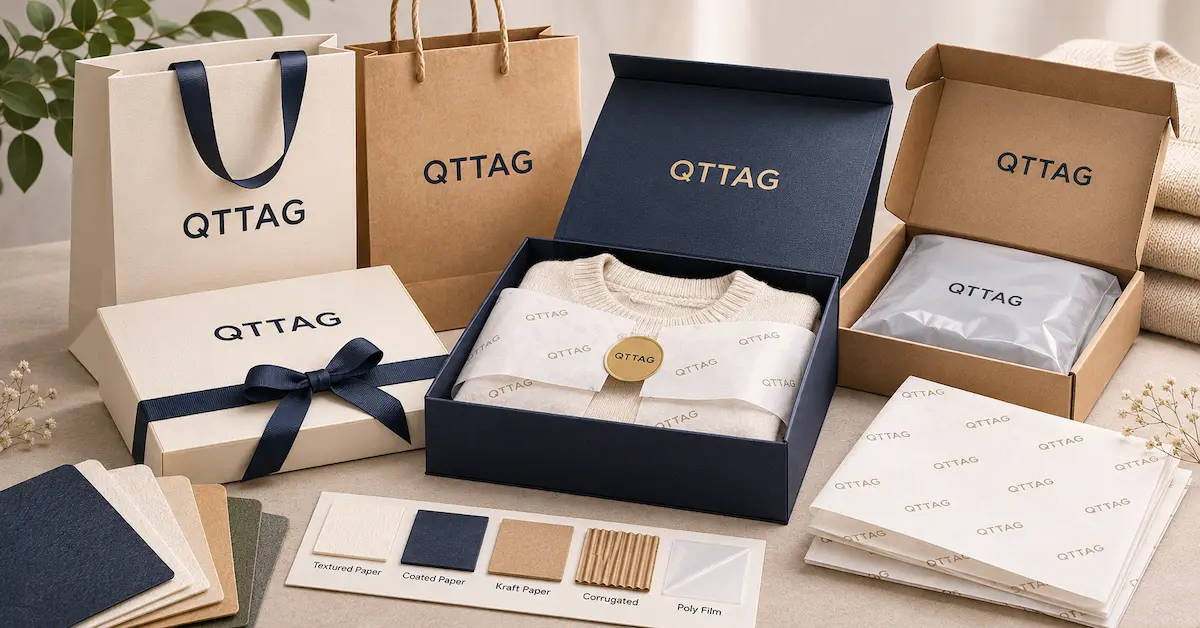
A clothing brand asks three packaging suppliers to quote 2,000 custom boxes. The dimensions are the same, and each box will carry the same logo. Yet the quotations come back at very different prices.
One supplier has priced a folding carton. Another has proposed a rigid box with a wrapped finish. The third includes an insert, tissue paper and individual packing.
All three products could be suitable for the collection. They are not the same packaging specification.
Apparel packaging cost depends on the packaging structure, materials, dimensions, printing, finishing, order quantity and assembly requirements. Minimum order quantity (MOQ) is often calculated differently for each packaging type, while lead time depends on artwork approval, material availability, sampling and production complexity.
There is also the cost of moving the packaging. A lightweight box that occupies a large amount of shipping space can be expensive to transport and store.
For apparel buyers, the real comparison is not simply the price per bag or box. It is the total cost of packaging a garment, preparing it for the intended sales channel and getting it to the right location.
This guide examines those costs across custom boxes, paper bags, poly bags, mailer boxes and tissue paper. It also explains how to compare supplier quotations, clarify MOQ and avoid delays before a collection launches.
What Makes Apparel Packaging Expensive?
A supplier needs more than a logo and a desired quantity to prepare an accurate quotation.
The first question is what the packaging will be used for.
A paper shopping bag for boutique customers has different requirements from a poly bag used to protect garments during warehouse handling. A rigid gift box has a different construction and cost structure from a corrugated mailer.
The same clothing brand may need all three.
A useful starting point is to divide packaging expenditure into four parts:
Materials: Paper, paperboard, plastic film, ribbons, handles, adhesives and other components.
Manufacturing: Printing, cutting, folding, forming, finishing and assembly.
Development: Artwork preparation, tooling, prototypes, samples and any agreed testing.
Logistics: Packing, freight, storage, handling and delivery to the garment factory or distribution center.
These components are related, but they should be visible in the quotation.
For instance, one manufacturer may quote an assembled rigid box. Another may offer a foldable construction that requires assembly at the destination. The second design could use less transportation space, but the buyer must also consider assembly work.
A supplier offering a lower price is not necessarily providing a cheaper complete solution.
Packaging Type Makes a Difference
| Packaging Type | Typical Apparel Use | Main Cost Drivers |
|---|---|---|
| Paper shopping bag | Boutique and retail purchases | Paper, printing, handles, reinforcement |
| Rigid gift box | Premium garments and gift sets | Board, wrapping, structure, finishing |
| Folding clothing box | Apparel presentation and selected retail uses | Paperboard, cutting, printing, folding |
| Poly bag | Garment protection and handling | Film, dimensions, thickness, closure |
| Corrugated mailer box | E-commerce dispatch | Board construction, size, printing, strength |
| Tissue paper | Wrapping and presentation | Paper, sheet size, printing, quantity |
| Custom insert | Product positioning and presentation | Material, cutting, fitting, assembly |
The table describes general manufacturing considerations, not fixed price rankings.
A relatively simple box can become expensive if its dimensions, materials or finishing requirements are unusual. A more elaborate-looking package may sometimes be economical when an appropriate standard construction is available.
The final specification determines the comparison.
How Do Packaging Materials Change the Cost?
Material selection influences appearance, protection, manufacturing and freight.
A brand might select a heavy textured paper because it feels premium. Another might prefer a lighter stock because its products ship in high volumes.
Neither choice is automatically correct.
Paper and Paperboard
Paper weight is commonly expressed in grams per square metre, or GSM.
It is useful information, but it does not describe every material characteristic.
Two paper stocks with similar weights may differ in thickness, stiffness, texture and printing behavior.
For a paper shopping bag, the material needs to suit the size and expected load. For a folding carton, the board must work with the creases and assembled structure.
A rigid gift box may use thick board covered with decorative paper. Its specification is therefore different from that of an ordinary printed folding carton.
When reviewing material options, ask for representative samples made using the proposed construction.
An unprinted paper swatch can help show texture, but it cannot demonstrate the final printed and assembled product.
Coated and Uncoated Stocks
Coated paper can provide a particular printed appearance. Uncoated stock creates a different surface texture and may suit restrained branding.
Both can be used in premium packaging.
However, artwork that looks sharp on one substrate may appear different on another.
Deep colors, small lettering and specialty finishes deserve particular attention.
If a brand wants consistent colors across shopping bags, gift boxes and hang tags, approve the appearance on each actual material. The same digital color reference may not produce an identical physical result across different substrates.
Recycled and Certified Materials
Some apparel brands request recycled-content paper or certified fiber-based packaging.
Those requirements should be specified separately from visual preferences.
A brown kraft appearance does not prove recycled content. Similarly, using paper from a certified source does not automatically authorize every environmental claim or certification logo.
Documentation and chain-of-custody requirements may affect material sourcing and supplier eligibility.
The buyer should identify what evidence is required before choosing the material and releasing artwork.
Plastic Films
Poly bags and certain mailing bags may use different polyethylene films or other suitable plastic constructions.
Thickness, closure design, transparency, surface printing and intended handling conditions can affect the specification.
A thicker bag is not automatically the best option. The material should be suitable for its purpose without introducing unnecessary cost or weight.
For garment packaging, check the actual folded garment, not only the nominal bag dimensions.
Rigid Boxes vs Folding Boxes: Which Costs More?
Rigid boxes are frequently associated with premium clothing packaging. They can provide a structured presentation for gift sets, knitwear and selected luxury garments.
Folding boxes use a different construction and may be supplied flat, depending on the design.
The difference matters commercially.
A rigid box generally requires board preparation, wrapping and assembly operations appropriate to its structure. A folding carton uses cutting and creasing to create panels that are folded into shape.
That doesn't mean the price relationship is identical for every project.
Box size, material, finishing, quantity and supplier capacity all influence the quotation.
Think About Storage and Freight
An assembled rigid box occupies its full volume even when empty.
A suitable folding construction may be transported or stored in a flatter form.
The advantage depends on the final dimensions, assembly process and transportation arrangements.
A buyer should consider both factory price and the cost of getting the packaging to the location where garments are packed.
For an international apparel brand, the space occupied by empty packaging can become an important purchasing consideration.
Magnetic Closures and Drawer Structures
Some premium boxes use magnetic closures, sliding drawers or other decorative constructions.
These features can change the material and assembly requirements.
They also need physical testing.
A magnetic closure that looks attractive in a product rendering may not operate properly once the box has been assembled. A drawer-style box needs suitable clearance and alignment.
For large production orders, reliable operation matters as much as appearance.
Box Construction Comparison
| Factor | Rigid Gift Box | Folding Carton |
|---|---|---|
| Structure | Stiff, typically assembled form | Creased and folded board |
| Storage | Depends on structure; often bulky | Often suitable for flat storage |
| Presentation | Structured premium appearance | Flexible retail presentation |
| Assembly | Supplier- or buyer-dependent | Folding or forming required |
| Main cost questions | Board, wrapping, construction, finishing | Paperboard, printing, cutting, assembly |
| Best buying method | Approve finished box and garment fit | Approve folded sample and garment fit |
The key is to choose a construction that matches the garment and sales channel.
A premium sweater gift set may justify a structured presentation box. A high-volume T-shirt collection might need a simpler packaging arrangement.
Neither choice should be made from appearance alone.
What Determines the Cost of Custom Paper Bags?
Paper shopping bags are often visible beyond the retail store. They carry the brand identity into the customer's shopping experience.
That makes design important, but a bag must also hold the purchased products safely.
The paper, dimensions and handle construction need to work together.
Bag Dimensions
A bag that is unnecessarily large uses more material and occupies more storage space.
A bag that is too small may not accommodate the folded garment or its retail box.
Measure the intended contents before selecting a standard size or developing a custom format.
If the store sells several garment categories, determine whether a small range of bag sizes can cover them.
Handles and Reinforcement
Paper handles, cotton cords, ribbons and other options produce different appearances.
They can also involve different materials and assembly operations.
A premium ribbon may be suitable for a boutique gift bag, but it should still be evaluated for the intended load.
Handle attachment and the bag's bottom construction matter more than a photograph can show.
Printing and Finishing
A simple one-color logo may require different manufacturing work from a bag printed with large solid colors and decorative finishes.
Foil stamping, lamination or textured paper can add separate processes.
Ask whether the supplier has included those operations in the unit price.
If the brand needs several bag sizes, clarify whether artwork and production setup are priced separately for each size.
One shared logo does not necessarily mean one shared manufacturing setup.
Custom Poly Bags: Why Price per Piece Is Not Enough
Poly bags are common in clothing production and distribution because they provide a practical way to separate and protect garments.
They are often purchased in large quantities, which can make small differences in specification commercially important.
The first decision should be the intended use.
Will the bag protect folded clothing during storage? Will it be used for warehouse sorting? Does it need adhesive closure, resealing capability or a printed warning?
These requirements change the finished product.
Size and Film Specification
The bag must accommodate the actual folded garment.
A wide sweatshirt and a lightweight T-shirt may not need the same bag dimensions.
Film thickness also needs to be specified using the agreed unit and material definition.
Comparing two bags solely by an informal description such as "medium thickness" can be misleading.
Ask the supplier to identify the proposed film construction and thickness measurement.
Printed vs Unprinted Poly Bags
Printing adds artwork preparation and manufacturing considerations.
A plain bag with a suitable closure may be enough for internal garment handling.
A branded retail bag may require a different surface finish, printing process or construction.
The buyer should determine whether printing provides a useful business function before adding it.
Closure and Handling
Adhesive strips, resealable flaps, ventilation holes and other features affect use.
Not every garment needs every feature.
The buyer should also review any packaging warnings, market-specific obligations or customer requirements relevant to the actual product.
A low unit price offers little value if the bag is difficult to use, unsuitable for the garment or fails to meet a retailer's packaging specification.
Mailer Boxes and E-Commerce Packaging Costs
E-commerce packaging has a different job from boutique presentation packaging.
A retail gift box is often designed primarily for product presentation. A shipping mailer also needs to survive the intended distribution process.
Corrugated materials, box dimensions and structural design are therefore important.
Corrugated Board Selection
Corrugated packaging uses a fluted structure between liner materials.
Different board constructions provide different physical characteristics.
The appropriate selection depends on the product, the expected shipment and the required protective performance.
A heavier or more expensive board is not automatically necessary.
The package should be specified according to the actual product and distribution conditions.
Why Oversized Boxes Cost More
Empty space can create unnecessary packaging and transportation costs.
A very large mailer may require additional cushioning to restrict garment movement or protect other packaged items.
It also occupies more space during shipping.
Major carriers may use dimensional weight when calculating freight charges, meaning the size of a parcel can affect the price even when the contents are lightweight.
For clothing brands selling online, box dimensions should therefore be evaluated alongside material cost.
Test the Complete Package
A corrugated box that feels rigid in the factory isn't automatically suitable for every delivery system.
The complete packed product may need to be evaluated for the intended handling conditions.
The International Safe Transit Association (ISTA) publishes different testing procedures for packaged products and distribution environments.
Testing should be chosen for the actual use case rather than treating any one procedure as universally necessary.
For a brand shipping individual apparel orders, the intended carrier and fulfillment arrangement should inform the packaging assessment.
How Do Printing and Special Finishes Affect Price?
Printing can account for a meaningful part of the packaging specification, particularly when designs involve multiple colors or special effects.
The effect on cost depends on the printing process, artwork and quantity.
Digital Printing
Digital printing may be suitable for certain shorter runs, detailed designs or projects with artwork variations.
The economics depend on the provider's equipment and order format.
Offset and Other Conventional Printing
Other processes may be appropriate for different materials and production quantities.
They can involve preparation requirements that influence smaller and larger orders differently.
A supplier should recommend the process based on the finished packaging specification rather than simply offering the lowest advertised unit price.
Foil Stamping
Metallic foil can create a decorative highlight on suitable paper and board.
The size of the stamped area, artwork detail, material and quantity affect manufacturing requirements.
Fine lettering may need technical review before production.
Embossing and Debossing
Raised or recessed effects add another physical dimension to packaging.
The process must work with the selected material and design.
A deep emboss on a thin or unsuitable substrate may not produce the intended result.
Lamination and Coatings
Matte, gloss and specialty coatings can change the surface appearance.
Some constructions also affect later folding, recycling considerations or other finishing operations.
These characteristics should be reviewed as part of the complete product.
A well-designed package does not need every decorative finish.
For a simple fashion collection, precise printing on an appropriate material may be more effective than multiple competing effects.
Why Custom Dimensions Can Increase Packaging Costs
The finished dimensions influence more than the amount of material used.
They affect manufacturing layout, cutting, folding, storage and shipment.
Consider a custom clothing box.
The buyer may specify dimensions based on how the garment looks when folded. But the supplier also needs to account for the internal space, board thickness, closure and any inserts.
The external dimensions can differ from the usable internal dimensions.
That distinction is important.
A box that looks correctly sized in a drawing may not accommodate the garment once wrapping, tissue paper or inserts are added.
Standard Sizes vs Custom Sizes
An available standard format may reduce certain development requirements.
Custom dimensions may require new cutting tools, different material layouts or additional setup.
Not every custom size requires completely new tooling, and the actual cost depends on the supplier's production system.
Ask whether the requested dimensions can use an existing construction.
If a custom size is necessary, confirm the finished dimensions and whether tooling charges apply.
Reducing Unnecessary Empty Space
A brand should not automatically select the largest box that could accommodate every garment in its collection.
That may create unnecessary material, storage and freight costs.
It may be more useful to group compatible garments into a limited number of packaging sizes.
The best approach depends on product dimensions, order volume and logistics.
Test representative garments rather than estimating box sizes from photographs.
How Does MOQ Work for Custom Apparel Packaging?
MOQ is one of the most misunderstood parts of custom packaging quotations.
A supplier may define it by material, design, colorway, size or manufacturing run.
Different packaging products may have completely different minimums.
A paper bag supplier might quote one minimum for a standard rectangular bag and another for an unusual construction.
A rigid-box manufacturer may have different preparation requirements from a supplier producing plain poly bags.
The category name alone doesn't establish the MOQ.
One Brand, Multiple Packaging Sizes
Consider a hypothetical clothing collection.
The brand needs small paper bags for accessories, medium bags for shirts and larger bags for outerwear.
All three carry the same logo.
Can the supplier combine the quantities under one MOQ?
Possibly, but the sizes may require separate manufacturing arrangements.
The buyer should obtain a clear answer for each size.
Same Structure, Different Artwork
A brand might use one box dimension for several seasonal collections but change the printed design.
Those versions may affect setup, production scheduling or minimum quantities.
Some suppliers can accommodate mixed artwork under particular conditions. Others require separate runs.
The buyer should not assume that one combined purchase order means one combined production minimum.
A Hypothetical Order
| Packaging Item | Quantity | Main Variation |
|---|---|---|
| Small paper bags | 500 | Small format |
| Medium paper bags | 700 | Medium format |
| Large paper bags | 300 | Large format |
| Total | 1,500 | Three sizes |
The total order is 1,500 bags.
But a supplier may calculate the minimum separately for each format.
Another may offer a combined commercial arrangement.
Neither approach can be assumed without a quotation.
Is a Lower MOQ Always Better?
For a startup brand, a low MOQ can reduce the amount of packaging purchased before demand is known.
It may also allow the brand to test a design before committing to a larger order.
But lower quantities can have higher unit prices.
Development and preparation work may be spread across fewer finished products.
Ordering substantially more packaging simply to reduce the unit price can create excess inventory.
Unused bags and boxes still occupy space. They may also become obsolete if the brand changes its logo, product dimensions or packaging strategy.
Buyers should compare realistic quantity requirements, not only the lowest price tier.
How Should Buyers Calculate Total Apparel Packaging Cost?
The factory unit price is an important number, but it doesn't describe the entire purchasing cost.
For a custom packaging program, it helps to calculate a landed cost and an applied cost.
The landed cost covers the packaging purchased and delivered to the agreed destination.
The applied cost includes the work required to use that packaging with the clothing.
A practical budgeting framework is:
Total packaging cost = packaging production + applicable development and tooling + samples and testing + assembly + packing and freight + other agreed charges.
If the garment factory charges separately to fold boxes, insert tissue paper, attach seals or pack garments, include that work in the finished-product budget.
Example: Two Different Box Quotations
Imagine two suppliers offering suitable boxes for the same clothing collection.
Supplier A offers a lower factory price for a box delivered flat.
Supplier B quotes an assembled box with additional accessories.
The quotations cannot be compared accurately until the buyer considers assembly, shipping volume and other included services.
Supplier A might be the better commercial choice if the garment factory can assemble the boxes efficiently.
Supplier B might be preferable if ready-to-use boxes reduce handling or simplify the packing process.
There isn't a universally correct answer.
Calculate the Cost per Packed Garment
For a clothing brand, the useful unit is often one completed, packed garment rather than one empty packaging component.
A garment might use a protective poly bag, one sheet of tissue paper and a mailer box.
Another product might use a rigid gift box and an outer shipping carton.
The packaging cost per garment should reflect the combination actually used.
Don't add accessories to the calculation if they are not part of the intended product.
Similarly, don't omit them merely because another supplier lists them separately.
Why Freight and Storage Can Change the Best Packaging Choice
Apparel packaging often has low weight relative to its physical volume.
This is particularly relevant for assembled boxes and certain bulky packaging constructions.
A shipment of empty boxes can occupy considerable space.
The freight cost may therefore be influenced by volume rather than weight alone.
Carriers such as FedEx explain dimensional-weight pricing as a method that considers the space occupied by a package relative to its actual weight.
The applicable shipping rules depend on the carrier and service.
Flat-Pack vs Assembled Packaging
A suitable folding box may occupy less space during transport and storage than an assembled rigid box.
However, the buyer may need to account for assembly work at the destination.
A custom paper bag may also have its own packing format and storage requirements.
Ask the supplier for packed-carton dimensions, quantities per carton and gross weight.
That information can be more useful for freight planning than the individual product dimensions alone.
Pallet and Carton Planning
Packaging suppliers may use different carton sizes and packing methods.
For a large order, carton count, pallet configuration and warehouse space can affect handling.
These details should be discussed before shipment, especially if packaging is being sent directly to a garment factory.
Protect the Packaging During Transport
Decorative packaging is itself a product that can be damaged.
Rigid boxes may develop marks or crushed corners. Paper bags can become creased. Printed surfaces may be scratched.
The supplier should use a suitable packing method for the finished construction.
A premium packaging product that arrives damaged may create more rework than the original price difference between suppliers.
What Determines Apparel Packaging Production Lead Time?
A packaging supplier's published production time may start after final artwork or sample approval.
It may not include the period spent preparing the design, selecting materials or revising prototypes.
This distinction matters when the clothing collection has a fixed launch schedule.
The Development Stage
For a new packaging design, the supplier may need to review dimensions, artwork and structural feasibility.
If the design uses a custom die-cut shape, special materials or complex finishing, additional preparation may be required.
A rigid box may need a structural sample before the printed finish is finalized.
A paper bag may need handle and load testing.
A printed poly bag may require artwork and material compatibility review.
These are different development tasks.
Approval Can Affect the Schedule
If the first physical sample is not accepted, the buyer may request changes.
Those changes can affect dimensions, artwork or material selection.
A new sample may then be needed.
This is why the production schedule should identify the expected approval milestones.
A Typical Custom Packaging Workflow
| Stage | Main Activity |
|---|---|
| Product brief | Confirm garment, packaging type and intended use |
| Material selection | Review paper, board, film or other materials |
| Structural design | Confirm dimensions, folding and construction |
| Artwork review | Check printing and finishing files |
| Prototype | Produce representative samples where required |
| Sample approval | Confirm the finished reference |
| Tooling and setup | Prepare required manufacturing processes |
| Bulk production | Print, cut, form or manufacture packaging |
| Finishing and assembly | Complete closures, handles or accessories |
| Quality inspection | Check against the approved reference |
| Packing | Protect and identify finished packaging |
| Dispatch | Ship to the agreed destination |
Not every packaging product follows every stage.
A repeat order using unchanged materials, tooling and artwork may require less development than a completely new design.
Material availability, production capacity and delivery arrangements still need confirmation.
Production Time Is Not Arrival Time
A packaging supplier might finish production before the garment factory receives the order.
Shipping and any applicable customs procedures may add time.
The buyer should ask for the expected production completion date, dispatch date and estimated arrival arrangements.
A supplier quoting a short turnaround doesn't necessarily guarantee that packaging will be ready for the garment factory's packing schedule.
Is Physical Sampling Worth the Cost?
Physical samples can reveal issues that aren't visible in a rendering.
For a rigid gift box, the lid may be too tight. A drawer may slide poorly. The chosen insert may leave insufficient room for the garment.
A paper shopping bag could look attractive but have unsuitable handles or dimensions.
A printed poly bag may need its closure, size or material reviewed.
These aren't problems that can be fully assessed from artwork alone.
Test the Actual Garment
A packaging sample should be evaluated with the product it will hold.
Place a representative folded garment inside the box or bag.
Check whether it fits without unacceptable compression or excessive empty space.
For a box, examine the opening and closing behavior.
For a shopping bag, review handle attachment using the intended contents.
For a mailer, assess whether the product needs suitable protection during shipment.
Artwork and Printing Approval
Printed samples should also be inspected for logo placement, color and finishing quality.
The physical appearance can differ from a digital mockup.
Foil and embossing are especially useful to review as finished samples.
Keep the Approved Reference
Once the buyer approves a packaging construction, retain the sample and relevant production specification.
That gives the supplier a clear reference for bulk manufacturing and repeat orders.
A digital file alone may not communicate all the intended physical details.
Packaging Quality Control: What Should Buyers Inspect?
Quality control should reflect the product's actual use.
A decorative paper bag and a corrugated shipping box need different inspections.
For a paper bag, the buyer may prioritize dimensions, printing, handles and overall construction.
For a rigid gift box, lid fit, wrapping and finishing may be particularly important.
For a poly bag, material specification, closure and relevant printed information may need attention.
For a mailer box, structural suitability and shipment protection are central.
Practical Inspection Points
| Packaging | Quality Checks |
|---|---|
| Paper bag | Dimensions, printing, handles, bottom construction |
| Rigid box | Structure, lid fit, corners, wrapping, inserts |
| Folding carton | Creases, assembly, print registration, shape |
| Poly bag | Film specification, size, seals, closures |
| Mailer box | Board construction, assembly, protection |
| Tissue paper | Sheet size, paper, printing, packing |
| Branded accessories | Correct artwork, material and quantity |
For shipping applications, relevant distribution testing may be needed.
The International Safe Transit Association publishes procedures for different packaged-product transportation conditions.
The appropriate test should be chosen based on the actual packed product and distribution system.
A packaging supplier should not claim that a product has passed an ISTA procedure without a relevant test report.
The same principle applies to other performance or compliance claims.
Sustainable Apparel Packaging: What Can Buyers Actually Claim?
Packaging sustainability is an important purchasing topic, but it is also an area where unsupported claims can create risk.
A brand may want recycled paper, less plastic, recyclable packaging or certified fiber sources.
Those objectives should be translated into specific material and design requirements.
Recycled Content
A supplier may offer materials containing recycled content.
The buyer should confirm the percentage, the relevant component and the available supporting evidence.
A bag described as "recycled" without further detail may not provide enough information for an accurate marketing claim.
Recyclability
A material's theoretical recyclability does not necessarily mean that the finished packaging can be recycled through the systems available to its customers.
Lamination, coatings, mixed materials and accessories can affect the claim.
The United States Federal Trade Commission's Green Guides explain that environmental marketing claims should be truthful, substantiated and appropriately qualified.
FSC-Certified Packaging
For paper-based packaging, some brands request FSC certification.
The Forest Stewardship Council operates a chain-of-custody system covering the handling and sale of eligible forest-based materials.
Use of an FSC claim or logo involves applicable certification and trademark requirements.
A brand should verify the supplier's relevant certification scope and product documentation rather than assume that any paper packaging can display the mark.
The EU Packaging and Packaging Waste Regulation
For businesses placing packaging on the European Union market, regulatory requirements also need consideration.
Regulation (EU) 2025/40, commonly called the Packaging and Packaging Waste Regulation (PPWR), began applying generally on 12 August 2026, with various provisions and deadlines implemented in stages.
The regulation addresses matters including packaging waste prevention, material requirements, recyclability and other packaging-related obligations.
Specific duties depend on the packaging and the relevant provisions.
A supplier's general statement that its packaging is "EU compliant" is not enough to identify which requirements have been assessed.
Environmental Claims and Cost
A certified or documented material option may involve different sourcing or production arrangements.
That does not justify assuming a universal price premium.
Ask for the actual material specification, documentation and quotation.
Compare the complete design, including any unnecessary materials or decorative components that could be removed without compromising function.
How Can Apparel Brands Reduce Packaging Costs?
Reducing packaging cost does not always mean using thinner material or removing every decorative feature.
Sometimes the most valuable saving comes from choosing a simpler structure or eliminating unnecessary size variations.
A brand should first understand how the packaging will be used.
Standardize Where It Makes Sense
If several garment styles can use one suitable packaging format, standardization may simplify purchasing and inventory management.
But one size should not be forced onto every product.
Oversized packaging can create unnecessary material and freight costs.
Simplify the Finish
A carefully printed logo on an appropriate material may be enough for a premium presentation.
Foil stamping, embossing and other specialty effects should have a clear role.
If the finish does not improve the intended product, the added manufacturing work may not be justified.
Review Order Quantities by Design
Avoid requesting a total quantity without identifying different sizes, materials and artwork versions.
That can lead to misleading MOQ comparisons.
Approve Artwork Before Production
Late changes to logos, colors or dimensions may require new preparation and samples.
Clear version control can reduce avoidable development work.
Compare Fully Finished Products
A plain box, a printed box and an assembled box with inserts are different products.
Compare quotations that use equivalent specifications.
Include Freight and Assembly
A lower factory price can be offset by additional storage, transportation or garment-packing work.
The useful cost is the amount the brand actually spends to deliver a correctly packaged product.
How to Compare Apparel Packaging Suppliers
The best supplier for one packaging type may not be the best choice for another.
A company specializing in corrugated mailers might offer different capabilities from a manufacturer focused on rigid gift boxes.
The buyer should evaluate the supplier against the specific project.
Manufacturing Capability
Can the supplier produce the requested materials, construction, printing and finishes?
Sampling
Can the supplier provide a representative physical sample before bulk production?
Quality Control
How will finished products be inspected against the approved specification?
MOQ and Commercial Terms
Are minimum quantities based on each size, artwork version or total order?
Production Planning
When does the quoted lead time begin? What happens if a sample requires revision?
Documentation
Can the supplier provide the relevant material and claim-related documents where required?
Freight and Packing
How are finished packaging products packed, identified and shipped?
A useful supplier comparison should document these answers rather than rely only on photographs or general claims about quality.
What Should Buyers Include in an Apparel Packaging RFQ?
An accurate RFQ needs enough information to define the finished product.
| RFQ Item | What to Provide |
|---|---|
| Packaging type | Paper bag, poly bag, rigid box, mailer or other |
| Garment | Intended apparel product |
| Application | Retail, gifting, storage or shipping |
| Dimensions | Required internal and external measurements |
| Material | Preferred paper, board, film or reference |
| Printing | Approved logo, colors and artwork |
| Finishing | Foil, embossing, lamination or coating |
| Structure | Fold, closure, handle or box construction |
| Accessories | Tissue, ribbon, inserts, seals or handles |
| Quantity | Total units and quantity per version |
| Sampling | Prototype and physical approval requirements |
| Performance | Relevant carrying or distribution requirements |
| Documentation | Necessary material or environmental evidence |
| Packing | Flat, assembled or other delivery format |
| Delivery | Destination and required arrival date |
If the final packaging material or construction is not yet selected, begin with the garment, intended sales channel, desired presentation and quantity.
The supplier can then discuss suitable options and the information required for a firm quotation.
Frequently Asked Questions About Apparel Packaging Costs
How much does custom apparel packaging cost?
There is no universal price. Cost depends on the packaging type, materials, dimensions, printing, finishing, accessories, assembly and order quantity. A complete finished specification is needed for an accurate quotation.
Are rigid gift boxes more expensive than folding cartons?
Rigid boxes and folding cartons use different constructions and production methods. Rigid boxes may require additional board wrapping and assembly, but the actual cost comparison depends on the specifications and supplier.
What is the MOQ for custom clothing packaging?
MOQ varies by packaging type and manufacturer. Suppliers may calculate it per material, size, artwork or production run. Confirm how different versions are treated.
Can several packaging sizes share one MOQ?
Sometimes, depending on the supplier and production arrangement. Different dimensions may require separate tooling or manufacturing runs, so the total order quantity cannot automatically be treated as one minimum.
Do custom paper bags cost more with cotton handles?
Cotton handles can introduce different material and assembly requirements from paper handles. Whether they cost more depends on the actual bag specification and supplier quotation.
Are poly bags cheaper than paper bags?
They involve different materials and functions, so unit-price comparisons can be misleading. Compare suitable products based on their intended use, quantity and complete purchasing requirements.
Does foil stamping increase packaging cost?
Foil stamping can introduce additional materials, preparation or manufacturing operations. The effect depends on the artwork, substrate, size of the stamped area and order quantity.
How long does custom apparel packaging production take?
Production time depends on artwork approval, materials, tooling, sampling, manufacturing and finishing. The quoted lead time may not include freight or the period before sample approval.
Do I need a physical packaging sample before bulk production?
Physical samples are strongly recommended for new constructions or important changes. They help verify garment fit, dimensions, printing, closures, material feel and finishing.
How can I reduce packaging shipping costs?
Review packed volume, carton dimensions and the possibility of suitable flat-pack structures. Freight charges may depend on dimensional weight or other carrier rules, not just actual weight.
Is kraft paper automatically sustainable?
No. Kraft appearance does not establish recycled content, recyclability or a particular environmental benefit. Claims require appropriate evidence for the finished product.
Is FSC certification required for all paper packaging?
No. FSC certification is not universally mandatory for paper packaging, but an FSC claim or trademark must follow the applicable certification and authorization rules.
What should be checked for packaging sold in the EU?
The applicable packaging rules depend on the product and relevant provisions. For EU-market packaging, buyers should review Regulation (EU) 2025/40 and obtain suitable supplier documentation for any relevant requirements and claims.
Can one packaging design work across an entire clothing collection?
Sometimes. A shared structure may be suitable for compatible garments, but actual dimensions, material requirements and sales channels must be considered. Standardization should not compromise product fit or packaging function.
How do I compare apparel packaging manufacturers?
Compare equivalent finished specifications, physical samples, MOQ definitions, material documentation, quality procedures, production schedules, packing methods and total delivered cost.
Plan Your Custom Apparel Packaging Order With QTTAG
Before asking for a quotation, prepare the garment dimensions, packaging application, approved logo and estimated quantities.
If the collection includes paper shopping bags, poly bags and boxes, identify the requirements for each product separately.
QTTAG supports custom apparel branding and packaging inquiries, including packaging boxes, paper bags, selected garment packaging products and coordinated branding accessories.
The availability of specific materials, printing finishes, MOQ, testing and production schedules should be confirmed for each project.
Ready to Plan Custom Apparel Packaging for Your Clothing Brand?
Share your logo artwork, garment specifications, preferred packaging materials, box and bag dimensions, printing finishes, estimated order quantity and delivery requirements with QTTAG.
Our team can review your requirements and discuss suitable packaging customization, sampling and quotation options.
Request a Quote
Author
Founder at QTTAG
Jason Qiao is the founder of QTTAG, focusing on garment branding and packaging solutions. With years of experience in the apparel industry, he shares practical insights on custom labels, hang tags and sustainable packaging to help global brands grow.
Written By
Jason Qiao