Custom Woven Labels Explained: Materials, Design and Production Tips
A clothing brand approves a logo on Monday. By Friday, the purchasing team has sent the artwork to a woven label manufacturer and received a quotation.
Everything appears ready until the first physical sample arrives.
The brand name is readable, but the lettering looks heavier than expected. The label is slightly too wide for the neckline. The folding method is different from what the garment factory planned to sew.
None of these problems necessarily means the label was poorly made. The production brief may simply have left too much room for interpretation.
This is where custom woven label development becomes more complicated than selecting a material or uploading a logo.
To develop custom woven labels for bulk apparel production, brands should define technical specifications, prepare approved artwork, review physical samples, document revisions, and establish clear acceptance criteria before authorizing manufacturing.
A successful project needs agreement between the clothing brand, label supplier, garment factory, and anyone responsible for approving the finished product.
This guide follows that process—from the first OEM/ODM inquiry to final production approval.
What Makes a Woven Label a Custom Manufacturing Project?
Custom woven labels are produced according to a buyer's approved branding and technical requirements.
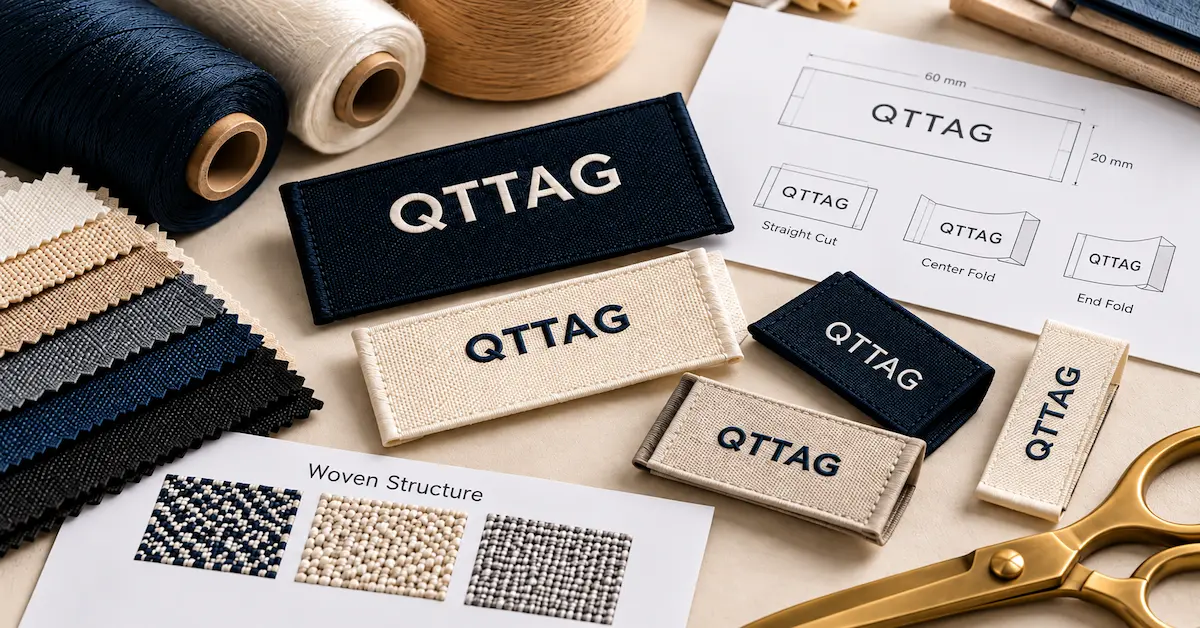
Those requirements may involve a logo, physical dimensions, yarn colors, construction, fold style, edge finish, and packaging instructions.
But customization is not just about choosing more options.
It also means deciding who is responsible for the design, which specifications must be approved, and how the production team will know it is manufacturing the correct version.
Consider two situations.
A clothing brand with completed technical artwork may need a supplier to reproduce a fully defined woven label. Another brand may only have a logo and a reference photograph showing the general look it wants.
The second project requires more development work before manufacturing can begin.
Understanding OEM and ODM Support
In apparel-accessory sourcing, the terms OEM and ODM are commonly used to describe different levels of manufacturing and development involvement.
| Project Approach | Buyer Provides | Supplier May Support | Approval Focus |
|---|---|---|---|
| OEM | Approved artwork and detailed specifications | Manufacturing and sampling against the supplied brief | Specification conformity |
| ODM | Initial concept, artwork or reference material | Design refinement, construction proposals and sample development | Concept, feasibility and final specifications |
| Repeat Order | Previously approved reference and current order details | Reproduction according to the controlled specification | Revision and repeatability |
The exact meaning and scope of OEM/ODM services should be agreed upon with the supplier.
A project should not be called ready for production simply because a logo file has been received.
Start with a Complete Custom Woven Label Development Brief
The most useful first step is preparing a brief that the label manufacturer can evaluate without making major assumptions.
A brand may know precisely how it wants the label to look but still leave out information needed for manufacturing.
For example, the design might specify a finished width of 50 mm without clarifying whether that dimension includes folded ends.
That missing detail affects the label pattern and potentially the way it fits the garment.
Custom Woven Label Development Brief
| Required Information | Buyer Should Provide | Why It Matters |
|---|---|---|
| Brand Artwork | Approved logo or reference file | Establishes design identity |
| Garment Application | Neckline, hem, side seam or accessory | Determines construction requirements |
| Finished Dimensions | Width and height after finishing | Controls garment fit |
| Fold Type | Center fold, end fold, straight cut or other | Defines attachment construction |
| Material Preference | Approved sample or requested characteristics | Guides development |
| Logo Colors | Physical or documented color references | Reduces color ambiguity |
| Design Variations | Different sizes, colors or logo versions | Supports accurate order planning |
| Quantity | Estimated quantity per version | Supports manufacturing quotation |
| Sample Requirements | Required approval samples and tests | Defines approval process |
| Packing Instructions | Bulk or variation-separated packing | Supports garment production |
| Delivery Requirements | Receiving location and target schedule | Supports production planning |
When some specifications remain undecided, identify them openly.
A field marked "supplier recommendation required" is more useful than leaving the manufacturer to guess.
Separate Required Features from Preferences
Buyers should distinguish technical requirements from visual preferences.
For example:
Requirement: The label must fit within the approved neckline seam construction.
Preference: The surface should have a refined, relatively smooth appearance.
A mandatory requirement affects whether the finished label is usable. A preference may allow several suitable alternatives.
This distinction can make the development process faster and reduce disagreement during sample approval.
How to Prepare Artwork for OEM/ODM Woven Labels
Artwork approval involves two different questions.
The first is whether the file represents the brand correctly.
The second is whether the approved design can be manufactured at the required dimensions.
A visually accurate digital file is not automatically a production-ready woven label specification.
Brand Artwork vs Production Artwork
The brand artwork is the reference for the intended logo.
Production artwork represents the design as prepared for the selected manufacturing method.
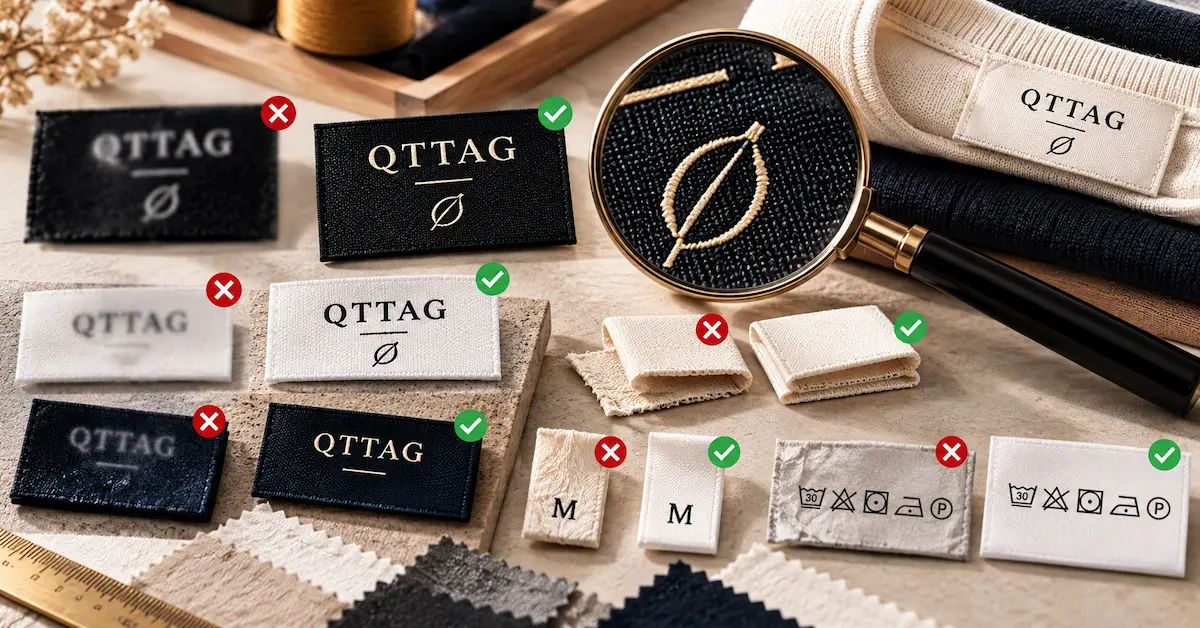
A manufacturer may need to propose adjustments to spacing, line weight, or physical dimensions when small details cannot be reproduced clearly.
Those changes should not be treated as automatic approvals.
The brand owner must review any modification that affects the visual identity.
Artwork File Checklist
Before requesting a sample, confirm:
-
The correct logo version has been supplied.
-
The brand name and spelling are accurate.
-
The symbol and wordmark have the approved proportions.
-
The intended label dimensions are stated.
-
Important lettering remains readable at actual size.
-
Color references are identified.
-
Any required reverse-side information is included.
-
The file has a clear revision identifier.
Vector artwork is often useful when preparing custom labels, although the accepted formats depend on the supplier.
A PDF proof can also help document the agreed visual layout.
Use a Controlled File Name
Instead of sending several files named logo-final.ai, logo-new-final.ai, and logo-final2.ai, use a controlled naming system.
For example:
BRAND_WL-001_ARTWORK_V02.pdf
This example identifies the brand, label code, file purpose, and revision.
The specific convention can vary. What matters is that both parties know which file is current.
Design Feasibility Review: What Should Happen Before Sampling?
A feasibility review connects the brand's design requirements with manufacturing constraints.
This is especially important when artwork contains very small text, narrow line spacing, or complex visual elements.
The review should identify potential problems before the first sample is produced.
Questions for the Label Manufacturer
-
Can the artwork be reproduced at the specified dimensions?
-
Are any details likely to lose clarity?
-
Is the requested fold suitable for the label dimensions?
-
Will the proposed construction work in the garment's attachment position?
-
Are the requested colors practical with the proposed materials?
-
Would an alternative label size improve the result?
-
What information is still missing before sample production?
The supplier may recommend a design adjustment or another construction.
The buyer should evaluate the recommendation against the brand's approved identity and the intended garment.
Example: A Logo That Is Too Detailed
Imagine a small woven neck label containing a symbol, a full brand name, and a fine-line slogan.
At the proposed dimensions, the slogan is difficult to reproduce clearly.
The brand has several choices:
-
Increase the label dimensions, if the garment allows.
-
Simplify the secondary text with brand approval.
-
Use an approved compact logo version.
-
Remove nonessential decorative information.
-
Evaluate another suitable labeling method.
The important decision is not which option looks most sophisticated on screen.
It is which option preserves the brand identity while producing an acceptable physical label.
Planning the Custom Woven Label Sampling Process
Sampling provides evidence that a design can be manufactured.
For OEM/ODM orders, it is also a communication tool.
A sample gives the buyer and supplier something specific to discuss instead of relying only on descriptions such as "a little softer" or "slightly more premium."
A Practical Sampling Workflow
Confirm artwork, dimensions, materials, folding requirements, and unanswered questions.
Agree on the proposed construction and any adjustments required for production feasibility.
Produce a physical sample according to the current approved brief.
Review appearance, dimensions, construction, and suitability for the actual garment.
Record the requested changes and issue an updated sample reference.
Confirm which sample and specification will become the reference for bulk manufacturing.
Not Every Project Needs the Same Number of Samples
A simple repeat design may require less development than a new label containing complex artwork.
However, no supplier should promise a fixed number of revision rounds without reviewing the project.
Sample charges, revision limits, and timing should be agreed upon as part of the quotation.
A brand should also avoid requesting unnecessary sample changes after a technically acceptable version has been approved.
Each change may affect the production schedule.
How to Review the First Custom Woven Label Sample
The first sample should be reviewed against a documented checklist.
A comment such as "the logo looks different" may be valid, but it does not tell the supplier exactly what should change.
Specific feedback is more useful.
Custom Woven Label Sample Approval Checklist
| Review Item | What to Compare | Example Decision |
|---|---|---|
| Logo Geometry | Approved artwork | Approve / Revise |
| Text Legibility | Actual-size text | Approve / Revise |
| Dimensions | Agreed specification | Approve / Revise |
| Color Appearance | Approved reference | Approve / Revise |
| Fabric Feel | Intended garment application | Approve / Revise |
| Fold Construction | Technical brief | Approve / Revise |
| Edge Finish | Agreed appearance and comfort | Approve / Revise |
| Attachment | Garment test application | Approve / Revise |
| Overall Appearance | Brand design intention | Approve / Revise |
It is useful to photograph the sample and record the approval decision.
For measurements, use the tolerances agreed upon with the supplier rather than an arbitrary standard applied to every label.
Review the Sample on the Garment
A woven label resting on a table may appear properly sized.
The same label can look oversized after it is sewn into a narrow neckline.
If a sample is intended for a specific garment, attach it using the proposed sewing method.
Check how much of the label remains visible, whether the edges feel comfortable, and whether the design sits correctly.
This is particularly valuable for labels positioned against the skin.
How to Give Clear Feedback During Sample Revisions
Sample feedback can become inefficient when several people send conflicting instructions.
A designer may request a larger logo while a garment technician asks for a smaller label.
The supplier cannot resolve that conflict without a clear approval decision.
Consolidate Feedback into One Revision Record
A structured revision record might look like this:
| Revision | Finding | Requested Action | Approval Status |
|---|---|---|---|
| V01 | Logo appears too close to the edge | Increase approved margin | Revision requested |
| V01 | Folded dimensions do not match the tech pack | Correct finished construction | Revision requested |
| V02 | Logo and dimensions approved | No further change | Approved |
| V02 | Color differs from reference | Review agreed color match | Pending |
This table is a fictional process example, not an actual QTTAG customer record.
Each revision should identify what changed and why.
Avoid Ambiguous Instructions
Instead of:
"Make it a little smaller."
Use:
"Reduce the finished visible width to the dimension shown in the revised technical drawing."
Instead of:
"Improve the color."
Use:
"Compare the next sample with the approved physical reference supplied with the order."
The more objective the instruction, the easier it is to verify the result.
Appoint One Approval Owner
For projects involving several stakeholders, appoint one person to consolidate feedback.
The designer, purchasing manager, and garment technician may all contribute, but the supplier should receive one approved set of instructions.
This helps prevent conflicting revisions.
Physical Sample Approval vs Digital Artwork Approval
A digital proof and a physical sample serve different purposes.
Neither should automatically replace the other.
Digital Artwork Approval
Digital approval establishes the intended design, wording, layout, and dimensions.
It can help identify spelling errors, incorrect logo versions, or missing information before sampling.
Physical Sample Approval
Physical approval confirms how the design appears after manufacturing.
It allows the buyer to evaluate the actual texture, visual detail, fold construction, and edge finish.
It may also help determine whether the label works on the intended garment.
Approval Comparison
| Approval Type | Can Confirm | Cannot Fully Confirm |
|---|---|---|
| Digital Proof | Artwork, layout, text, stated dimensions | Actual texture, edge feel, physical finish |
| Loose Physical Sample | Manufactured appearance, dimensions, surface feel | Full behavior after garment attachment |
| Garment-Applied Sample | Placement, visible fit, attachment and comfort | Every future production variation |
| Relevant Test Results | Performance under specified test conditions | Unspecified real-world conditions |
A useful approval process combines the checks required by the actual project.
For example, a brand may approve the digital logo, then the loose label, followed by a sample attached to a finished garment.
Establish a Golden Sample Before Bulk Production
A golden sample is an approved physical reference used to compare later production output.
The term is common in manufacturing, but the exact approval method may vary between companies.
For custom woven labels, the sample should be linked to the specification used for production.
What Should Be Included in a Golden Sample Record?
-
Label design code.
-
Approved artwork version.
-
Material and construction.
-
Finished dimensions.
-
Color reference.
-
Fold and edge specifications.
-
Approval date.
-
Reviewer or approving department.
-
Relevant photographs or attached samples.
-
Any agreed performance requirements.
Where practical, the brand and supplier can retain corresponding approved references.
Why the Golden Sample Matters
Imagine that a brand reorders woven labels several months after the original production.
The original purchasing employee has left, and the design folder contains multiple artwork versions.
Without an approved reference, the new order may use the wrong file or specifications.
A controlled golden sample and approval record make it easier to identify the correct version.
This does not guarantee that every batch will be identical. Production should still be checked against agreed acceptance criteria.
What Changes Require New Sample Approval?
Not every order adjustment requires the entire development process to restart.
However, a change affecting the physical label may require additional review.
Change-Control Matrix
| Proposed Change | Potential Impact | Recommended Action |
|---|---|---|
| Logo artwork | Brand appearance | Review updated proof and sample as needed |
| Label dimensions | Garment fit and design layout | Confirm revised physical dimensions |
| Fold type | Attachment and visible area | Review garment compatibility |
| Yarn or material | Texture, color and performance | Evaluate replacement sample |
| Logo color | Brand consistency | Confirm new color reference |
| Edge finishing | Comfort and appearance | Review finished edge |
| Packing quantity | Order handling | Update packing instructions |
| Delivery address | Logistics only | Update order records |
This matrix is a practical decision aid, not a substitute for a supplier's quality-management process.
The buyer and manufacturer should agree on which changes require resampling.
Never Approve a Sample and Change Its Specification Silently
One recurring procurement risk is approving one construction and subsequently requesting another without updating the records.
For example, the brand approves a center-fold label but later asks the supplier to use an end fold.
That is a production-relevant change.
The artwork may remain identical, but the physical result will not.
Record the change and determine whether new sample approval is required.
Transitioning from Approved Sample to Bulk Production
Sample approval is a milestone, not the end of project management.
Before bulk manufacturing begins, the purchasing team should confirm that the commercial order refers to the correct technical documents.
Bulk Production Release Checklist
| Release Item | Required Confirmation |
|---|---|
| Product Code | Correct woven label design |
| Artwork Version | Matches approved proof |
| Sample Reference | Approved physical sample identified |
| Dimensions | Current specifications confirmed |
| Construction | Material, fold and finish approved |
| Quantity | Correct amount per variation |
| Quality Criteria | Inspection requirements agreed |
| Packaging | Sorting and packing instructions approved |
| Delivery | Destination and schedule agreed |
| Authorization | Responsible approval recorded |
Only the authorized production version should be released.
If the purchase order uses a different code or revision from the approved sample, resolve the discrepancy before production.
Pre-Production Approval
For some projects, buyers may also request confirmation immediately before bulk manufacturing starts.
This can be valuable when the order is complex, contains several variations, or has undergone repeated revisions.
The exact approval process should match the risk and value of the project.
How to Evaluate Bulk Production Against the Approved Sample
The production team needs objective criteria for deciding whether finished labels meet the order requirements.
Appearance alone is insufficient.
A batch may look consistent but contain the wrong version, dimensions, or packing allocation.
Physical Quality Checks
Depending on the project, inspection may cover:
-
Logo and lettering reproduction.
-
Finished dimensions.
-
Color consistency.
-
Surface defects.
-
Edge condition.
-
Fold accuracy.
-
Attachment-related requirements.
-
Agreed test performance.
Order Accuracy Checks
Bulk-order inspection may also verify:
-
Label design code.
-
Current revision.
-
Quantity.
-
Different size or color versions.
-
Packing labels.
-
Shipment allocation.
How to Handle Differences
If production differs from the approved specification, the discrepancy should be documented.
The buyer and supplier can then determine whether the product is acceptable, requires correction, or needs replacement.
Acceptance should follow agreed criteria rather than an improvised decision after delivery.
What Should Buyers Include in a Custom Woven Label RFQ?
An RFQ should help the supplier estimate the project realistically.
For OEM/ODM custom development, buyers should include both the desired product specifications and the expected approval procedure.
RFQ Checklist for Custom Woven Labels
| Information | What to Specify |
|---|---|
| Project Type | OEM reproduction or ODM development support |
| Brand Artwork | Approved files or initial concept |
| Garment Application | Intended label position |
| Label Dimensions | Finished dimensions and fold allowances |
| Design Requirements | Logo, colors and important details |
| Material Preferences | Construction requirements or reference sample |
| Variations | Different sizes, colors or designs |
| Quantity | Estimated pieces per version |
| Sample Requirements | Physical sample and review expectations |
| Approval Process | Who approves and what records are needed |
| Quality Criteria | Inspection or testing requirements |
| Packing | Separation and identification needs |
| Delivery | Destination and target timing |
A complete RFQ reduces uncertainty.
However, final MOQ, sampling cost, production price and delivery schedule depend on the manufacturer's actual capabilities and the project specifications.
Do not assume that an estimated quotation is a confirmed production commitment.
Frequently Asked Questions About Custom Woven Labels
What is the first step in ordering custom woven labels?
Prepare a design brief covering the artwork, garment application, dimensions, material preferences, construction, quantity and intended delivery requirements. The supplier can then review feasibility.
Do I need a vector logo for custom woven labels?
Vector artwork is often useful, but accepted formats depend on the manufacturer. Clear artwork and approved dimensions are essential for accurate development.
What is the difference between OEM and ODM woven labels?
OEM generally focuses on manufacturing to buyer-defined specifications. ODM may include additional design and product-development support. The exact service scope should be agreed upon.
Can a woven label manufacturer help adjust my artwork?
A supplier may recommend changes for manufacturing feasibility. Any change affecting the brand identity should be approved by the brand owner.
Is a digital proof enough to approve custom woven labels?
A digital proof can confirm the intended design, but it cannot fully demonstrate the physical texture, edge finish, fold construction or garment compatibility.
How many sampling rounds are needed for custom woven labels?
The number depends on design complexity, initial artwork quality and project requirements. Agree on revision procedures and any related charges with the supplier.
What is a golden sample in woven label production?
A golden sample is an approved physical reference associated with the agreed manufacturing specification. It helps buyers and suppliers compare later production output.
Should I approve the woven label on a finished garment?
It is useful when placement, sewing, comfort or finished appearance are important. A loose sample alone may not show how the label behaves after attachment.
What happens if I change the fold type after sample approval?
The physical construction will change. Update the specification and determine with the manufacturer whether another sample approval is required.
How can I reduce errors in bulk woven label orders?
Use controlled artwork versions, clear technical specifications, documented sample approval, a production-release checklist and agreed inspection criteria.
Can several label designs be approved within one order?
Yes, subject to the supplier's order-management process. Each design and variation should have a clear code, specification and approval reference.
What information should I send for a custom woven label quotation?
Provide artwork, dimensions, construction preferences, quantity per version, sampling expectations, quality requirements, packing instructions and delivery details.
Start Your Custom Woven Label Development with QTTAG
A custom woven label project becomes easier to manage when the design, technical specification and sample approval process are treated as one connected workflow.
Before requesting bulk production, confirm the artwork version, intended garment application and physical construction.
Make sure every change has been reviewed and that the approved sample matches the documents used for manufacturing.
For clothing brands developing several label variations, a clear approval record can also simplify reorders and future collection development.
QTTAG provides custom woven labels and coordinated apparel branding products, with OEM/ODM development and sampling support.
If you have finished artwork, share the technical specifications. If you are still developing the concept, provide references showing the desired appearance and intended garment application.
The next step is to review the project requirements and agree on a practical sampling plan.
Ready to Develop Your Custom Woven Labels?
Share your logo, label dimensions, garment application, material preferences and estimated quantity with QTTAG. Our team can discuss artwork preparation, sample development and suitable production options.
Request a Quote → Create Your Custom Sample
Author
Founder at QTTAG
Jason Qiao is the founder of QTTAG, focusing on garment branding and packaging solutions. With years of experience in the apparel industry, he shares practical insights on custom labels, hang tags and sustainable packaging to help global brands grow.
Written By
Jason Qiao