7 Common Custom Woven Labels Mistakes and How to Avoid Them
Custom woven labels are among the most important physical branding details on clothing. A well-made woven label can reproduce a fashion brand's identity through precise yarn colors, clear lettering and a carefully selected textile construction.
However, a label that looks perfect in a digital mockup may produce a very different result once it is woven, cut, folded and sewn into a garment.
Fine logo details can become unclear. Colors may appear different from the approved artwork. Incorrect dimensions or fold allowances can make the label difficult to sew. Even a technically accurate woven design may feel unsuitable when attached to lightweight clothing.
The seven most common custom woven labels mistakes involve overly detailed artwork, unsuitable weave construction, inaccurate yarn colors, incorrect dimensions and folds, poor edge finishing, overlooked garment comfort, and inadequate sample approval or production quality control.
Most of these problems can be prevented by preparing clearer specifications and evaluating physical samples before bulk manufacturing.
This guide explains each mistake, why it happens and what apparel brands should check when developing woven labels for a new clothing collection.
Why Do Custom Woven Label Mistakes Happen?
Custom woven labels are manufactured by interlacing yarns to form logos, typography and decorative details.
Unlike digital printing, woven production uses physical yarn structures to reproduce the design.
The appearance of the finished label depends on several connected factors:
-
Approved logo artwork
-
Label dimensions
-
Yarn colors and materials
-
Weave construction
-
Weaving density
-
Cutting and finishing
-
Fold type
-
Garment attachment
-
Production consistency
Problems often arise when these decisions are made separately.
For example, a designer may prepare an intricate logo before anyone confirms the proposed label dimensions. The supplier may then discover that the text is too small to reproduce clearly using the selected weave.
Similarly, a buyer may approve the flat woven artwork but overlook the additional material required for folding and sewing.
A Good Digital Design Is Not a Finished Specification
Digital artwork communicates the intended identity, but it does not completely describe the manufacturing requirements.
The buyer and supplier should agree on the final construction before production begins.
A clear specification can help reduce ambiguity and unnecessary revisions.
Mistake #1: Using Logo Artwork That Is Too Detailed
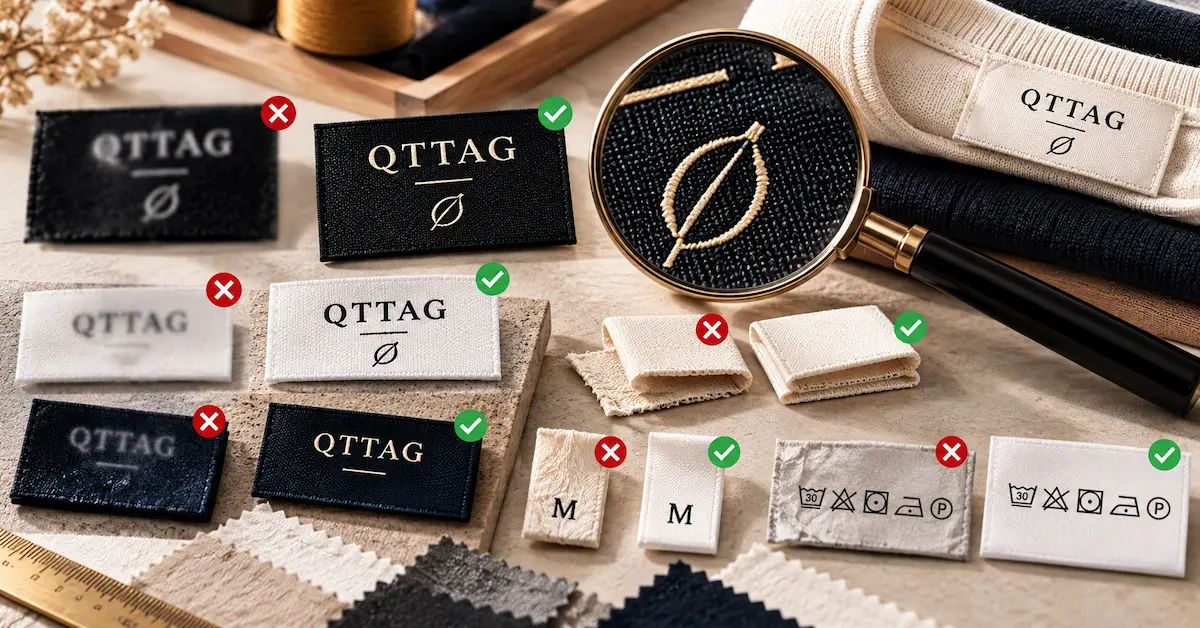
One of the most frequent woven label design mistakes is attempting to reproduce artwork containing details that are too small for the intended physical label.
The logo may include fine serif lettering, narrow lines, small symbols or closely spaced graphic elements.
These features may be perfectly visible on a computer screen but become difficult to distinguish once translated into woven yarns.
Why Small Details Can Become Unclear
Woven labels use yarns rather than printed pixels.
The available detail depends on:
-
Yarn characteristics
-
Weave construction
-
Finished dimensions
-
Artwork geometry
-
Manufacturing capabilities
A complex logo placed on a relatively small label may exceed the practical detail limits of the selected construction.
Typical Artwork Problems
| Artwork Problem | Possible Result | Recommended Action |
|---|---|---|
| Very small lettering | Unclear text | Review size and readability |
| Narrow lines | Incomplete definition | Evaluate line thickness |
| Closely spaced letters | Crowded typography | Review character spacing |
| Intricate symbols | Lost graphic detail | Simplify with brand approval |
| Complex color boundaries | Blended visual appearance | Improve separation |
| Incorrect logo proportions | Distorted brand identity | Use approved master artwork |
How to Avoid This Mistake
Begin with an approved vector logo where available.
Tell the manufacturer the intended finished label dimensions rather than providing only the artwork.
Request a feasibility review of the smallest letters and most complex elements.
If modifications are necessary, compare the alternatives before approving changes.
The supplier should not independently redesign the logo without the brand's permission.
Practical Buying Tip
Ask to see a physical woven sample at the intended production size.
Do not approve logo clarity based only on an enlarged digital rendering.
Mistake #2: Choosing an Unsuitable Weave Construction
Not all woven label constructions produce the same surface appearance or level of detail.
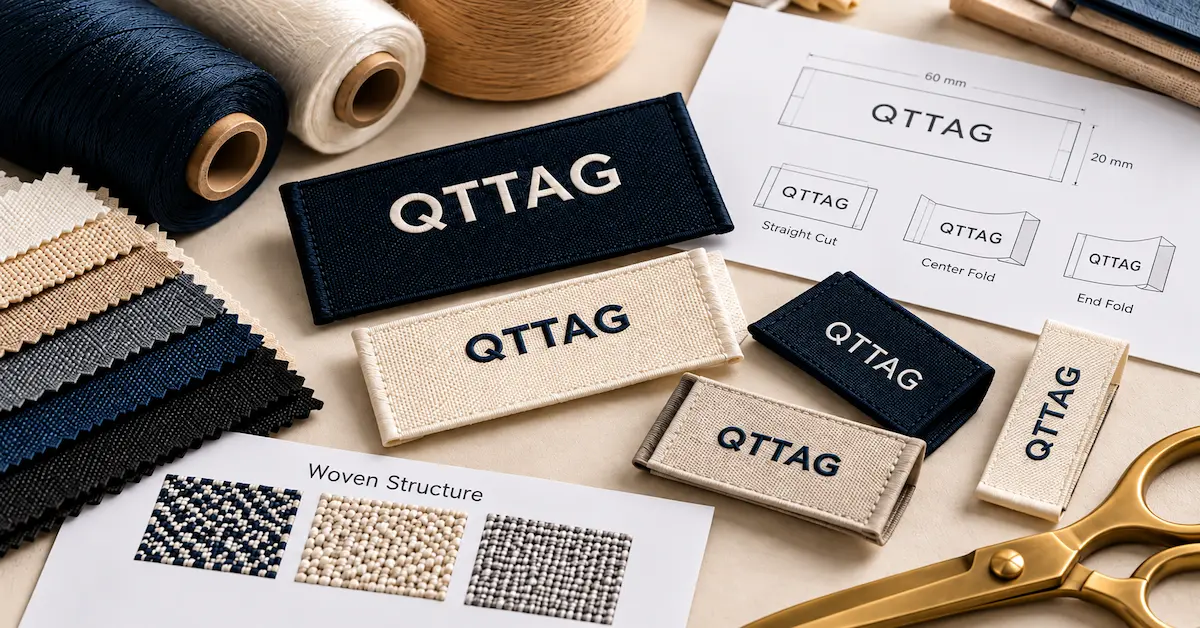
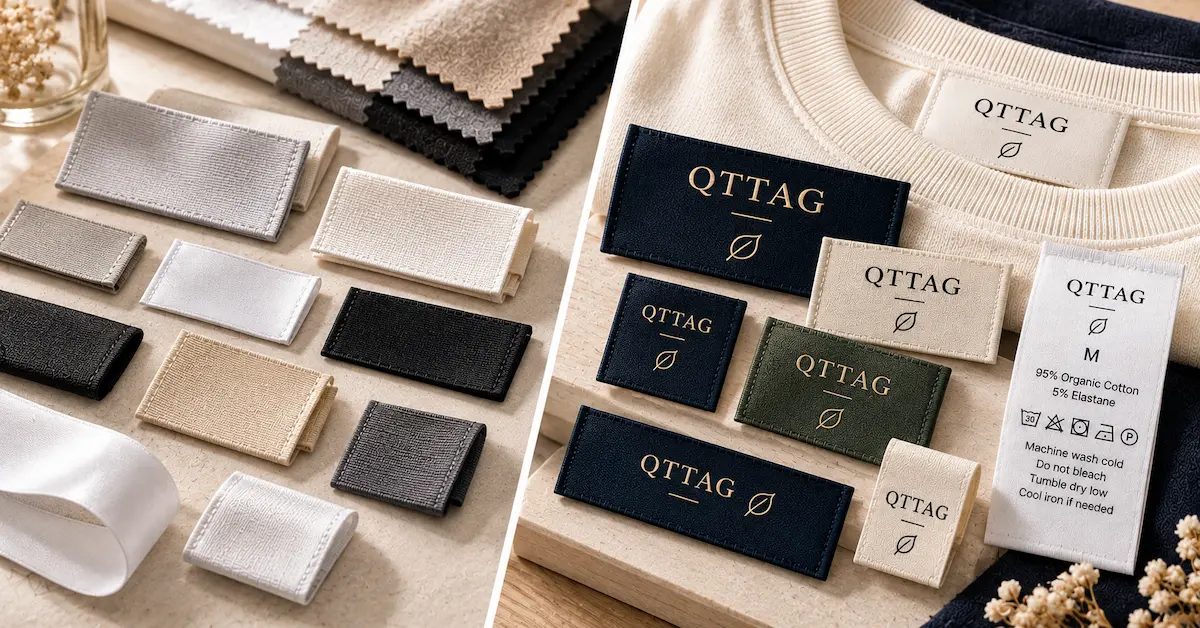
Apparel buyers may encounter damask, satin-style, taffeta-style and high-density woven options.
Choosing a construction solely because it sounds premium can result in a label that does not suit the artwork or garment.
Damask Woven Labels
Damask woven labels are often considered for relatively detailed logos and refined textile branding.
However, the actual result depends on the chosen yarns, weave specifications and artwork.
A damask label is not automatically capable of reproducing every fine design.
Satin Woven Labels
Satin-style woven labels may offer a different surface texture or visual appearance.
Material feel, sheen and weave characteristics should be evaluated through physical samples.
Taffeta Labels
Taffeta-style constructions may be available for particular woven label applications.
The finished material and suitability should be confirmed with the manufacturer.
High-Density Woven Labels
High-density constructions may support certain detailed artwork requirements.
However, the term "high density" does not establish a universal resolution or quality specification.
Manufacturing details must still be confirmed.
Weave Construction Comparison
| Construction | Main Consideration | What Buyers Should Evaluate |
|---|---|---|
| Damask | Refined woven artwork | Small detail and logo clarity |
| Satin-style | Distinct surface appearance | Texture and yarn characteristics |
| Taffeta-style | Specific textile construction | Flexibility and finish |
| High-density weave | Fine-detail capability | Physical resolution and consistency |
How to Avoid This Mistake
Ask suppliers to explain which weave constructions are suitable for the approved artwork.
Compare physical samples using similar dimensions wherever practical.
Do not assume that the most expensive or densest option is always the best.
The correct construction should reproduce the required design while meeting the garment's material and attachment needs.
Mistake #3: Approving Yarn Colors From a Screen Only
Color is one of the most important elements of brand identity.
A fashion brand may use specific colors across its logo, garments, hang tags and packaging.
However, yarn colors do not necessarily reproduce a digital RGB or HEX value exactly.
Why Yarn Colors Look Different
The finished appearance can be affected by:
-
Available yarn colors
-
Yarn surface characteristics
-
Weave construction
-
Adjacent yarn colors
-
Lighting conditions
-
Physical texture
A color reference displayed on a monitor is not the same as a woven sample.
What Can Go Wrong?
A navy brand logo may appear darker or lighter than expected.
Fine color differences may become noticeable when the woven label is placed beside a printed hang tag or packaging box.
These variations do not always indicate a manufacturing defect.
They may reflect differences between materials and production processes.
How to Avoid This Mistake
Provide the supplier with the intended brand color references.
Request available physical yarn samples or woven color references where appropriate.
Evaluate colors under suitable lighting.
When exact visual coordination is important, compare the woven label with other approved branding components.
Color Approval Checklist
| Checkpoint | Question |
|---|---|
| Brand reference | Is the intended color documented? |
| Yarn availability | Is a suitable yarn shade available? |
| Physical sample | Has the actual woven color been reviewed? |
| Background contrast | Is the logo sufficiently recognizable? |
| Material comparison | Does it coordinate with the garment? |
| Repeat production | Is the approved color reference retained? |
Practical Buying Tip
Maintain a physical reference sample for repeat orders.
Do not rely only on a digital artwork file to communicate yarn color expectations.
Mistake #4: Getting Label Dimensions and Fold Allowances Wrong
Incorrect dimensions can make a woven label difficult to attach or visually unsuitable for the garment.
This problem commonly occurs when buyers confuse the visible artwork dimensions with the total material required for cutting, folding and sewing.
Finished Size vs. Artwork Size
A woven label has several potentially different measurements:
-
Visible artwork area
-
Total woven piece dimensions
-
Folded dimensions
-
Sewing allowance
-
Final visible dimensions after attachment
These measurements should not be treated as interchangeable.
Center Fold Labels
A center-fold label is folded through the middle.
The artwork must be arranged so the intended information appears correctly after folding.
The total material length may differ from the visible finished size.
End Fold Labels
End-fold constructions include material folded behind the label.
If sufficient folding allowance is not provided, the final label may be difficult to sew correctly.
Straight Cut Labels
Straight cut labels do not use the same folding arrangement.
Their edges and attachment method need separate consideration.
Mitre Fold Labels
Mitre fold labels have angled folded ends.
Their finished dimensions and symmetry should be defined in the specification.
Fold Comparison
| Fold Type | Main Risk | Prevention |
|---|---|---|
| Center fold | Artwork incorrectly positioned | Approve both visible sides |
| End fold | Insufficient sewing allowance | Confirm fold measurements |
| Straight cut | Unsuitable exposed edges | Review edge finishing |
| Mitre fold | Inconsistent folded shape | Approve finished construction |
How to Avoid This Mistake
Specify the label's intended final appearance.
Provide measurements showing the visible area and any additional construction requirements.
Ask the supplier to prepare a finished sample rather than approving only a flat woven strip.
Test the label on the actual garment or a representative fabric.
Important Detail
Do not use one universal fold allowance for all woven labels.
Actual requirements depend on the label dimensions, construction and manufacturing method.
Mistake #5: Overlooking Woven Label Edge Finishing
The edge of a woven label affects its appearance, handling and attachment.
Poorly selected cutting or finishing methods may create rough edges, fraying or an unsuitable finished shape.
Why Edge Finishing Matters
A label may be manufactured with clear artwork but still feel uncomfortable or look unfinished because of its edges.
The result depends on the yarn composition, cutting process and intended label construction.
Common Edge Considerations
Different woven label constructions may use suitable cutting, sealing or other finishing methods.
The availability and suitability of each method must be confirmed with the supplier.
Heat Cutting
Certain compatible synthetic materials may be cut using heat-based methods.
The finished edge should be inspected for quality and suitability.
Mechanical Cutting
Other constructions may use mechanical cutting or related processes.
The edge should remain appropriate for the selected material and attachment.
Folded Edges
Some fold constructions can position selected cut edges away from direct exposure.
However, folding also changes the thickness and final shape.
Common Edge Problems
| Problem | Possible Cause | What to Check |
|---|---|---|
| Rough feel | Unsuitable cutting or finishing | Edge surface |
| Loose yarns | Incomplete edge treatment | Construction compatibility |
| Uneven dimensions | Cutting variation | Finished-size tolerance |
| Visible deformation | Unsuitable processing conditions | Material response |
| Poor symmetry | Inconsistent finishing | Approved physical sample |
How to Avoid This Mistake
Ask the manufacturer to explain the proposed edge treatment.
Inspect the final cut and folded construction.
Evaluate the label after attachment to the intended garment.
Do not approve a label based only on the woven artwork before finishing.
Mistake #6: Ignoring Garment Comfort and Label Placement
A woven label that looks attractive on a sample card may not be suitable when attached to clothing.
The garment fabric, label thickness, fold and placement all influence the finished result.
Neckline Applications
Labels placed near the neckline may come into contact with the wearer.
An overly stiff or bulky construction can feel inappropriate on a lightweight garment.
Knitwear Applications
Knitted garments may stretch and move.
The label and attachment should accommodate the intended construction without unacceptable distortion.
Outerwear Applications
Jackets and coats may provide different placement and material options.
However, label proportions should still support the garment design.
Underwear and Close-Fitting Clothing
Comfort and material suitability can be particularly important where the label contacts the skin.
A low-profile sewn or compatible printed alternative may be worth considering.
Children's Clothing
Additional product safety or labeling requirements may apply.
The label should be evaluated for the specific garment and destination market.
Placement Comparison
| Garment Type | Main Label Consideration |
|---|---|
| T-shirt | Neckline feel and proportion |
| Knitwear | Flexibility and attachment |
| Jacket | Size and placement |
| Sportswear | Movement and garment compatibility |
| Underwear | Comfort and low bulk |
| Children's clothing | Product suitability and applicable rules |
| Uniform | Identification and repeatability |
How to Avoid This Mistake
Review the woven label after it is sewn into a representative garment.
Check the finished attachment, including seams and folded areas.
If comfort is an important requirement, compare alternative constructions before approving production.
Do not assume that the same label will be suitable for every garment in the collection.
Mistake #7: Skipping Physical Sampling and Production Quality Control
The final major mistake is treating a digital preview or initial supplier description as sufficient production approval.
Custom woven labels involve several manufacturing stages, and important differences may only become visible in physical samples.
Why Sampling Matters
A physical sample helps buyers evaluate:
-
Logo clarity
-
Yarn colors
-
Weave construction
-
Material texture
-
Finished dimensions
-
Cutting and folding
-
Garment attachment
-
Relevant durability requirements
Step 1: Review the Artwork
Confirm the final approved logo, dimensions and intended yarn colors.
Step 2: Select the Weave Construction
Agree on the proposed manufacturing specification.
Step 3: Confirm the Fold and Finish
Establish the final cut and folded construction.
Step 4: Produce a Physical Sample
The sample should represent the intended finished product.
Step 5: Inspect the Label
Check visible artwork, colors, dimensions and finishing.
Step 6: Evaluate the Garment Application
Attach the label to the intended garment where practical.
Step 7: Review Required Performance
Perform applicable laundering, handling or attachment checks.
Step 8: Approve and Record the Reference
Retain the approved physical sample and production specification.
Step 9: Inspect Bulk Production
Compare representative production units against the agreed reference.
Step 10: Verify Packing
Ensure correct quantities, designs and label versions are supplied.
Sample Approval Checklist
| Inspection Item | What to Approve |
|---|---|
| Logo | Clarity and correct proportions |
| Yarn colors | Approved physical appearance |
| Weave | Intended texture and detail |
| Dimensions | Finished size |
| Fold | Correct construction |
| Edges | Suitable finishing |
| Attachment | Garment compatibility |
| Comfort | Intended wearing application |
| Durability | Defined test requirements |
| Packing | Correct versions and quantities |
A successful sample does not eliminate the need for appropriate production inspection.
Quick Comparison: Seven Common Custom Woven Label Mistakes
The following table summarizes the main risks and prevention methods.
| Mistake | Main Risk | Recommended Prevention |
|---|---|---|
| Overly detailed artwork | Unclear logo or text | Review artwork at finished size |
| Wrong weave construction | Unsuitable texture or detail | Compare representative samples |
| Inaccurate yarn colors | Inconsistent brand appearance | Approve physical color references |
| Incorrect dimensions and folds | Poor fit or sewing problems | Specify finished construction |
| Poor edge finishing | Rough or irregular edges | Inspect cutting and folding |
| Ignoring comfort | Unsuitable garment application | Test on the actual clothing |
| Skipping sampling and QC | Inconsistent bulk production | Approve samples and inspect batches |
Which Mistake Is Most Expensive?
There is no universal answer.
The consequences depend on when a problem is discovered, the affected order quantity and whether the labels have already been attached to finished garments.
An artwork problem detected before sampling may be relatively straightforward to correct.
The same problem discovered after garment assembly may require more substantial rework.
Early approval reduces uncertainty, but the actual benefit depends on the production process and project requirements.
How to Prepare Custom Woven Label Artwork Correctly
Good woven label production begins with clear artwork.
A buyer should provide enough information for the manufacturer to assess feasibility and develop a representative sample.
Master Logo
Use the approved version of the brand artwork.
Finished Dimensions
Provide the intended width and height.
Yarn Colors
Specify the desired colors using suitable references.
Weave Preference
Identify the preferred construction or visual reference.
Fold Type
Confirm the expected finished appearance.
Sewing Position
Explain how the label will be attached.
Garment Information
Identify the clothing type and relevant fabric.
Artwork Versions
If a collection requires multiple designs, assign clear references.
Recommended Artwork Checklist
| Artwork Requirement | Buyer Confirmation |
|---|---|
| Logo file | Approved version |
| Minimum detail | Reviewed for weaving |
| Typography | Legible at actual size |
| Color references | Identified |
| Finished dimensions | Confirmed |
| Fold allowance | Defined |
| Edge finish | Selected |
| Garment application | Specified |
| Quantity | Estimated |
| Sample approval | Required before bulk production |
The supplier should clarify any manufacturing limitations before the artwork is released for production.
How to Choose the Right Woven Label Material
A woven label's material should suit the intended appearance and garment.
Different yarns and weave constructions may have different surface characteristics.
Polyester-Based Woven Labels
Polyester yarns are widely used in woven label manufacturing.
The actual feel and performance depend on the specific yarn and construction.
Alternative Textile Yarns
Other yarn options may be available for certain designs.
Material composition should be confirmed with the manufacturer.
Recycled Material Options
Brands may consider yarns with documented recycled content.
However, recycled-content claims must be supported by evidence applicable to the finished product.
Satin-Style and Damask Constructions
The visual and tactile results depend on the weave, yarn and finishing specifications.
Do not choose a construction solely because its name suggests a higher quality tier.
Material Approval
Review physical samples for:
-
Surface texture
-
Flexibility
-
Color appearance
-
Artwork clarity
-
Edge condition
-
Intended garment use
The correct material is the one that meets the actual product requirements.
How to Prevent Mistakes Across Different Clothing Collections
A fashion brand may develop several product lines using one master logo.
However, different garments can require different label sizes, folds or attachment methods.
Maintain a Common Brand Identity
Use consistent approved artwork.
Allow Product-Specific Constructions
A neckline label for a lightweight T-shirt may differ from a woven label for a jacket.
Control Size and Color Variations
Clearly identify different production versions.
Coordinate With Care Labels
Brand labels and information labels should follow a coherent layout without compromising the garment's technical requirements.
Coordinate With Hang Tags
Printed hang tags may use the same logo proportions and typography.
Review Packaging
Packaging boxes and shopping bags can support the same brand presentation.
Maintain Approved Physical References
Retaining samples helps communicate expectations across future collections.
Consistent branding does not require every label to be physically identical.
How to Reduce Woven Label Production Errors
Quality control should begin before bulk manufacturing.
An approved specification provides a reference for checking the finished product.
Material Inspection
Confirm the intended yarn and construction.
Artwork Verification
Compare the woven logo with the approved design.
Color Review
Inspect the finished yarn colors against the relevant reference.
Dimension Checks
Measure labels according to agreed tolerances.
Edge and Fold Inspection
Check cutting, folding and symmetry.
Production Version Control
Prevent mixing different label designs or sizes.
Packing Accuracy
Confirm the correct quantities and product identification.
Repeat-Order Review
Verify that the approved material and artwork remain current before manufacturing again.
A quality-control checklist is most useful when each requirement is measurable and understood by both buyer and manufacturer.
What Determines the Cost of Custom Woven Labels?
Custom woven label pricing depends on the actual manufacturing specification.
Important factors may include:
-
Finished dimensions
-
Yarn composition
-
Number of yarn colors
-
Weave construction
-
Logo complexity
-
Weaving density
-
Fold type
-
Cutting and edge finishing
-
Order quantity
-
Artwork variations
-
Sampling requirements
-
Packing and delivery
Artwork Complexity
Fine details may require more careful development or an alternative construction.
Material and Weave
Different materials and weaving specifications can affect production requirements.
Fold and Finishing
Additional operations may influence the quoted price.
Quantity
Minimum order quantities and unit prices depend on the supplier and design.
Complete Finished Cost
Buyers should compare equivalent finished specifications rather than selecting an option based only on the initial price.
An inexpensive label may not be suitable if it fails to reproduce the intended artwork or garment application.
What Should Buyers Include in a Custom Woven Label RFQ?
A detailed request for quotation helps suppliers evaluate the design accurately.
| RFQ Item | Information to Provide |
|---|---|
| Brand artwork | Approved logo file |
| Garment type | Intended clothing application |
| Label dimensions | Finished width and height |
| Yarn material | Preferred composition |
| Yarn colors | Approved references |
| Weave construction | Preferred option or sample |
| Fold type | Center fold, end fold or other |
| Edge finish | Required cutting and finishing |
| Attachment | Intended sewing method |
| Quantity | Estimated order volume |
| Versions | Different designs or sizes |
| Sampling | Physical sample approval requirements |
| Performance | Relevant washing and wear conditions |
| Delivery | Destination and required schedule |
If the exact material or weave has not yet been selected, provide the garment, brand artwork and visual references.
The supplier can then discuss feasible construction options.
Frequently Asked Questions About Custom Woven Labels
What are the most common custom woven labels mistakes?
Common problems include overly detailed artwork, unsuitable weave construction, inaccurate yarn colors, incorrect dimensions, poor edge finishing, inappropriate garment application and insufficient physical sampling or quality control.
Why does my woven label logo look blurry?
Small lettering, narrow lines or complex details may exceed the capabilities of the selected yarn and weave construction. Review the artwork at finished size and approve a physical sample.
Are damask woven labels better for detailed logos?
Damask constructions may suit relatively detailed designs, but the actual result depends on yarn, weave, artwork and label dimensions. Physical sampling is important.
How can I match woven label colors to my brand?
Provide approved color references and compare available yarn colors using physical samples. Exact visual matching across different materials cannot always be assumed.
What is the difference between center fold and end fold woven labels?
Center-fold labels are folded through the middle, while end-fold labels have ends folded behind. The appropriate construction depends on the intended garment attachment.
Why do woven label edges sometimes feel rough?
Edge feel can depend on yarn, cutting, finishing and fold construction. The final label should be tested on a representative garment.
Are high-density woven labels always better?
No. Higher-density constructions may support certain fine details, but the best option depends on artwork, texture, flexibility and manufacturing requirements.
Should I approve a woven label sample before ordering?
Physical sampling is strongly recommended for new or changed constructions. It helps verify logo clarity, colors, dimensions, folds and garment compatibility.
Can one woven label design work for different garments?
The same brand identity can be used across garments, but physical dimensions, materials and attachment may need to vary.
What is the minimum order quantity for custom woven labels?
MOQ varies according to supplier, design, materials and manufacturing specifications. Request a quotation based on the actual label.
Develop Custom Woven Labels With QTTAG
Custom woven labels can provide consistent branding across apparel collections when their artwork, materials and construction are properly developed.
The most important decisions involve logo clarity, yarn colors, weave structure, finished dimensions, folds, edges and garment compatibility.
Addressing these details before bulk production can help buyers reduce avoidable specification and manufacturing problems.
QTTAG supports custom apparel branding projects, including woven labels, printed care labels, heat transfer labels and related garment identification products.
When preparing a new label project, share the approved logo, garment type, preferred yarn colors, dimensions, fold requirements and estimated quantity.
These details provide a starting point for discussing suitable woven constructions and physical sample development.
Ready to Create Custom Woven Labels for Your Clothing Brand?
Share your logo artwork, garment specifications, preferred yarn colors, label dimensions, fold requirements and estimated order quantity with QTTAG.
Our team can discuss suitable woven label customization and sampling options for your apparel collection.
Request a Quote
Author
Founder at QTTAG
Jason Qiao is the founder of QTTAG, focusing on garment branding and packaging solutions. With years of experience in the apparel industry, he shares practical insights on custom labels, hang tags and sustainable packaging to help global brands grow.
Written By
Jason Qiao