Garment Labels vs Clothing Labels: Key Differences for Apparel Brands
Garment labels and clothing labels are essential components of modern apparel branding. They identify the brand, communicate garment information and help create a consistent presentation across clothing collections.
When sourcing custom labels, fashion brands often encounter both terms in supplier catalogs, product listings and manufacturing quotations. This can lead to a common question: are garment labels and clothing labels different products, or are they simply different names for the same thing?
Garment labels and clothing labels generally refer to the same broad category of textile identification and branding products. Both terms can describe woven brand labels, printed care labels, size labels and other components attached or applied to clothing. The important differences are usually found in the label's function, material, manufacturing method and attachment—not in the two names themselves.
For apparel buyers, understanding these distinctions can make supplier communication easier and help ensure that the correct label is selected for each garment.
This guide compares garment and clothing label terminology, explains common label constructions and provides practical recommendations for sourcing customized labels for fashion brands.
What Are Garment Labels?
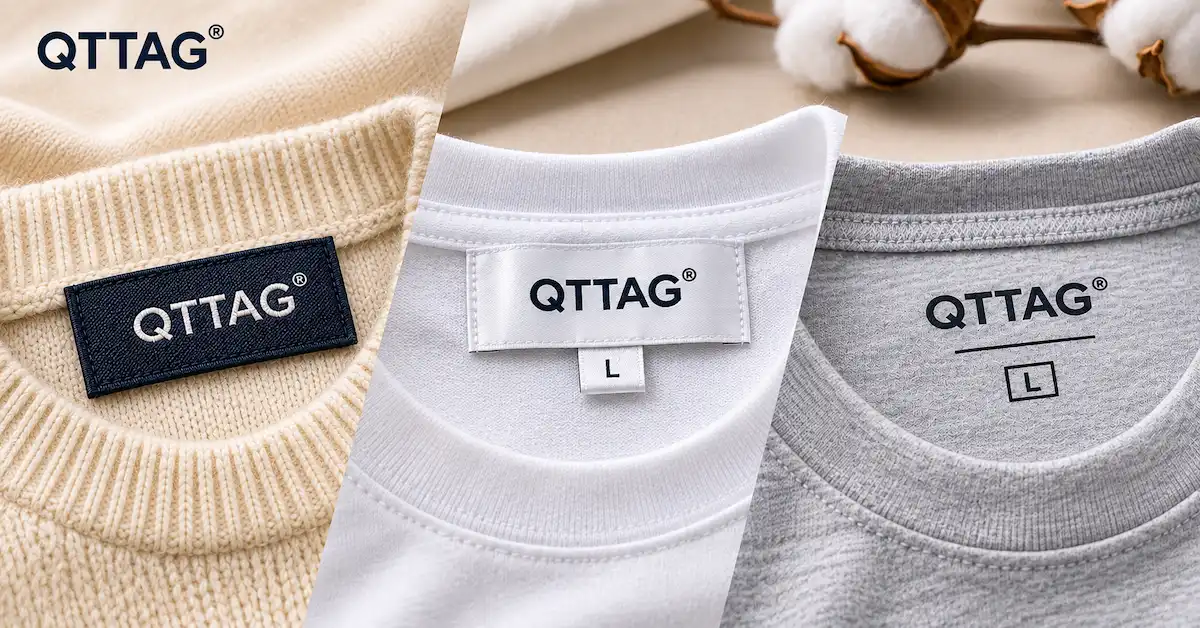
Garment labels are identification or information components attached to, sewn into or otherwise applied to clothing.
They may communicate a brand name, size, fiber composition, washing instructions or other relevant product information.
Depending on the application, a garment label may be designed primarily for branding or for communicating garment information.
Common types include:
-
Woven brand labels
-
Printed fabric labels
-
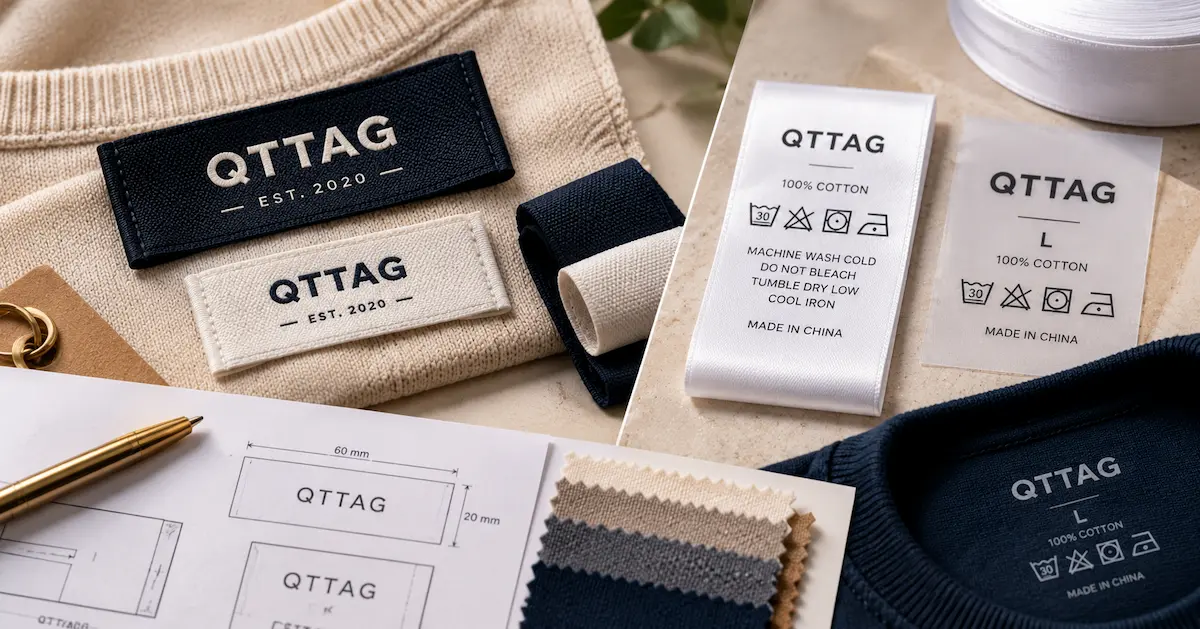
Care and composition labels
-
Size labels
-
Heat transfer labels
-
Tagless neck labels
-
Decorative garment labels
The physical construction varies according to the product.
A woven brand label and a printed care label may both be garment labels, but they serve different functions and use different production processes.
Why the Term Matters in Sourcing
Garment Labels is a broad phrase commonly used by suppliers and buyers involved in apparel manufacturing.
A buyer searching for garment labels may be looking for several different products.
This makes it useful to describe the intended label type when requesting a quotation.
What Are Clothing Labels?
Clothing labels are labels used to identify clothing brands, display product information or communicate care instructions.
In most apparel sourcing contexts, the term has essentially the same broad meaning as garment labels.
Clothing labels may include:
-
Woven clothing labels
-
Printed clothing labels
-
Clothing care labels
-
Size labels
-
Heat transfer branding
-
Custom fabric labels
A supplier may prefer one term in its product catalog without offering a fundamentally different category of products.
Are Clothing Labels and Garment Labels Interchangeable?
Often, yes.
For example, a buyer requesting custom woven clothing labels and another buyer requesting custom woven garment labels may be describing the same product.
The supplier still needs to confirm the actual specifications.
These include the finished dimensions, yarn or fabric material, artwork, fold type, attachment and quantity.
The words "garment" and "clothing" do not, by themselves, determine the manufacturing method or quality of a label.
Garment Labels vs Clothing Labels: Key Differences
The main distinction is often how the terms are used in a particular business context rather than a universally recognized technical difference.
| Comparison | Garment Labels | Clothing Labels |
|---|---|---|
| General meaning | Labels used on garments | Labels used on clothing |
| Typical products | Woven, printed, care and size labels | Woven, printed, care and size labels |
| Brand identification | Yes | Yes |
| Care information | Yes | Yes |
| Materials | Textile, printed and suitable transfer constructions | Similar material options |
| Attachment methods | Sewing, heat transfer or other compatible methods | Similar attachment options |
| Typical buyers | Apparel manufacturers and brands | Clothing brands and manufacturers |
| Standardized technical distinction | No universal distinction | No universal distinction |
What Buyers Should Focus On Instead
Rather than choosing a supplier based on terminology, consider:
-
What information must the label communicate?
-
Where will the label be placed?
-
What material is suitable for the garment?
-
Which manufacturing method is required?
-
How should the label be attached?
-
What durability or regulatory requirements apply?
These questions are more useful than assuming the two terms refer to different product standards.
The Main Types of Garment Labels
The apparel industry uses several label constructions.
Each type serves a particular design or information purpose.
Woven Garment Labels
Woven labels reproduce a logo or design using interlaced yarns.
They are commonly considered for brand identification where textile texture is part of the desired appearance.
Printed Fabric Labels
Printed labels apply artwork or information to a suitable label material.
They may be used for branding or detailed garment information.
Care Labels
Care labels communicate garment-care information and may also include fiber composition or other required details.
Their content must be accurate and appropriate for the destination market.
Size Labels
Size labels identify garment sizes according to the brand's approved sizing system.
Heat Transfer Labels
Heat transfer branding applies suitable designs directly to a garment fabric using a compatible process.
Tagless Neck Labels
Tagless neck labels are a form of garment identification commonly considered when a sewn brand label at the neckline is not preferred.
Their application and durability must be evaluated on the intended fabric.
| Label Type | Primary Purpose | Main Purchasing Consideration |
|---|---|---|
| Woven label | Brand identity | Logo detail, yarn and folds |
| Printed brand label | Brand identity | Fabric, printing and finish |
| Care label | Garment information | Accuracy, readability and durability |
| Size label | Size identification | Correct sizing and attachment |
| Heat transfer label | Direct garment branding | Fabric compatibility and application |
| Tagless neck label | Low-profile neck identification | Feel, placement and wash performance |
Woven Labels vs Printed Labels: Which Should Brands Choose?
Woven and printed labels are manufactured using different processes.
The appropriate choice depends on the artwork, garment application and intended appearance.
Woven Labels
Woven labels use yarn construction to form letters, symbols and other branding details.
They can create a distinctive textile appearance.
However, very fine artwork may require adjustments to ensure clear reproduction.
Printed Labels
Printed labels use a suitable printing method to reproduce information or artwork on a label substrate.
They may be considered when a design requires a particular printed appearance or contains substantial text.
Comparing the Two
| Feature | Woven Labels | Printed Labels |
|---|---|---|
| Artwork production | Interlaced yarns | Printing on label material |
| Surface appearance | Textile weave | Printed surface |
| Fine text | Depends on weave resolution | Depends on printing resolution |
| Colors | Available yarn colors | Compatible inks and materials |
| Construction | Cut, folded or sewn | Cut, folded or sewn |
| Care information | Possible in suitable designs | Common application |
| Main selection factor | Texture and woven identity | Printing and information requirements |
How to Decide
If a brand prioritizes a woven textile identity, physical woven samples are useful.
If the label needs detailed care information, a suitable printed construction may be more practical.
The final decision should follow the garment and approved sample rather than a general assumption about which construction is more premium.
Choosing the Right Label Material
Garment labels can use different yarns, fabrics and transfer constructions.
The selected material influences appearance, flexibility, comfort and manufacturing compatibility.
Polyester-Based Labels
Polyester materials are used in many woven and printed label constructions.
The actual texture and performance depend on the selected fabric, yarn and finishing process.
Satin-Style Labels
Satin-style constructions may be considered when a smooth surface appearance is desired.
However, actual comfort and durability must be evaluated on the finished product.
Cotton Labels
Cotton-based label materials may provide a different textile appearance.
Their suitability depends on the printing or weaving method and intended garment use.
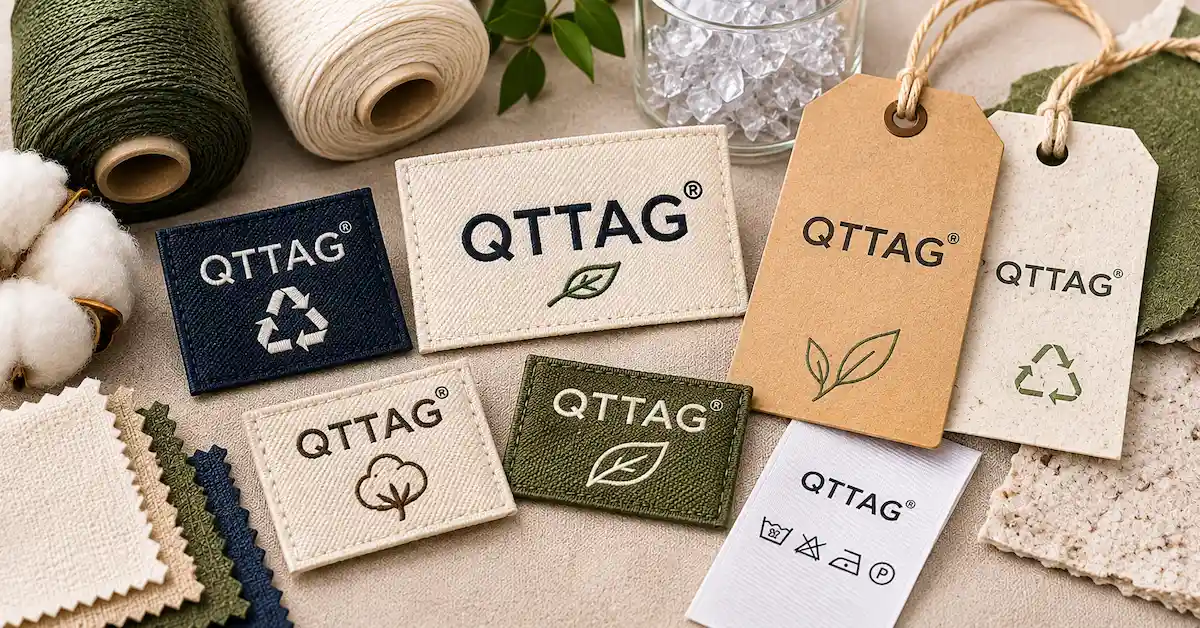
Recycled Material Options
Some projects may consider materials with documented recycled content.
Any recycled-content claim must be supported by relevant product-specific evidence.
Heat Transfer Materials
Heat transfer labels use compatible transfer systems rather than a conventional sewn label substrate.
The correct construction depends on the garment fabric and application conditions.
Material Selection Checklist
Before ordering, consider material composition, surface feel, flexibility, printing or weaving compatibility, edge quality, washing performance and garment attachment.
A material name alone is not enough to establish final product quality.
How to Choose Label Size and Placement
Label dimensions and placement should be established using the actual garment design.
A correctly manufactured label can still look unsuitable if it is too large or poorly positioned.
Neckline Labels
Neckline labels commonly provide brand and size identification.
They should be evaluated for visibility, construction and contact with the wearer.
Side Seam Labels
Side seam positions may be used for care or composition information.
The label should suit the seam construction and applicable market requirements.
Exterior Brand Labels
Some fashion collections use visible exterior labels as decorative branding elements.
Their dimensions and attachment should complement the garment.
Size-Specific Variations
A collection containing several garment sizes may use common branding but different size information.
Placement Approval
Physical garment samples help establish an appropriate location.
Buyers should also verify any product-specific labeling or placement requirements for their destination markets.
Understanding Garment Label Fold Types
Fold construction influences appearance and attachment.
Common options include:
End Fold
The ends are folded back to create a finished construction suitable for certain stitching arrangements.
Center Fold
The label is folded through the center, often allowing it to be inserted into a suitable seam.
Straight Cut
The label is finished without additional folding at the ends.
The cut edges and attachment method require evaluation.
Mitre Fold
Angled folded ends create a different presentation and stitching arrangement.
Choosing the Correct Fold
| Fold Type | Main Design Consideration |
|---|---|
| End Fold | Stitching allowance and finished width |
| Center Fold | Two-sided artwork and seam insertion |
| Straight Cut | Edge finishing and attachment |
| Mitre Fold | Fold symmetry and positioning |
Confirm the finished dimensions rather than assuming that the woven or printed artwork area is identical to the total label size.
Custom Clothing Labels for Fashion Brands
Custom clothing labels allow brands to develop specifications around their visual identity and garment requirements.
The available options depend on the selected manufacturer and production method.
Custom Logo Artwork
Provide the approved logo with suitable dimensions and proportions.
Brand Colors
Use relevant physical references when color consistency is important.
Material Selection
Choose an appropriate woven, printed or transfer construction.
Size Variations
Identify different size information or product versions clearly.
Fold and Attachment Options
Determine how the label will be attached before finalizing its design.
Custom Care Information
Where care or composition information is required, the content must be verified by the responsible product team.
Consistent Collections
Maintaining a master artwork source can help preserve the same brand identity across multiple garment styles.
Why Apparel Brands Need Both Brand Labels and Care Labels
A brand label and a care label may look similar, but their primary functions differ.
Brand Labels
A brand label identifies the clothing brand or collection.
It often prioritizes artwork, typography and material appearance.
Care Labels
A care label communicates garment-care information.
Depending on applicable requirements, related labels may also carry fiber composition, origin or business identification.
Can They Be Combined?
Some garment designs may combine different types of information within one suitable label construction.
Whether that is appropriate depends on space, readability, material and destination-market requirements.
Why Separate Labels May Be Useful
A dedicated woven label can focus on brand presentation, while a separate printed label provides sufficient space for detailed garment information.
The arrangement should be decided according to the actual product rather than a fixed rule.
Garment Labels and Textile Labeling Compliance
Clothing brands selling across different markets should understand that branding and legal labeling requirements are not identical.
The required information depends on the garment and destination market.
Common topics include:
-
Fiber composition
-
Care instructions
-
Country of origin
-
Responsible business identification
-
Language requirements
-
Label placement and permanence
A removable hang tag does not automatically replace a legally required garment label.
Information Accuracy
Verify all technical and regulatory content before printing.
Market-Specific Rules
Do not assume that one label template is suitable for every country.
Product Categories
Different rules or additional requirements may apply to particular products, including certain children's garments.
Supplier Responsibilities
A label supplier can reproduce approved information, but the business responsible for the product must ensure that the content meets the applicable requirements.
How to Coordinate Labels With Hang Tags and Packaging
Branding does not stop at the garment neckline.
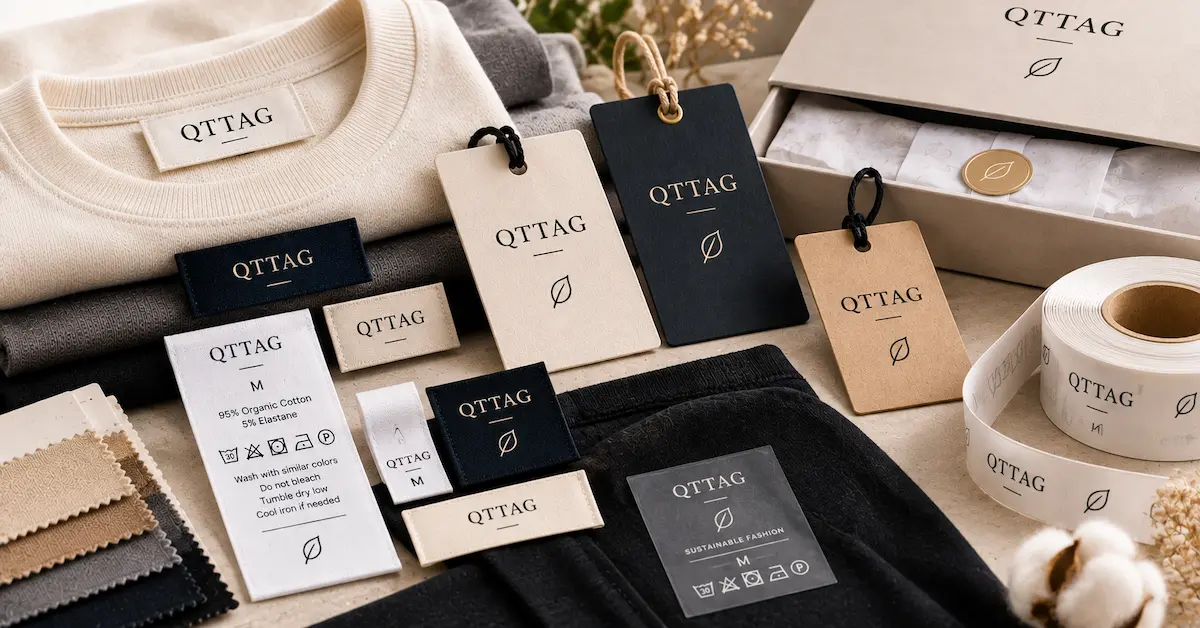
A clothing brand may use woven labels, care labels, custom hang tags, paper bags and packaging boxes across one collection.
Master Artwork
Use one approved source for the logo.
Typography
Maintain recognizable typography where appropriate.
Color References
Textile and paper materials may reproduce colors differently.
Approve physical references when necessary.
Product-Specific Constructions
Labels and packaging do not need identical materials, but they should follow a coherent design direction.
Sample Review
Evaluate the finished garment together with its hang tags and intended packaging.
A coordinated system helps reduce visual inconsistency across the collection.
Common Mistakes When Ordering Garment Labels
Using the Wrong Terminology Without a Specification
A request for garment labels alone may not tell the supplier which construction is needed.
Artwork That Is Too Detailed
Small lettering or complex elements may not reproduce clearly in the intended material.
Incorrect Dimensions
A label may not fit the garment position or seam allowance.
Ignoring Edge Finishing
Rough edges or unsuitable folds may affect appearance and comfort.
Selecting Materials Without Samples
A digital photograph cannot demonstrate every aspect of surface feel and flexibility.
Incorrect Care Information
Unverified content can create problems regardless of print quality.
Mixing Artwork Versions
Several collection variations require controlled identification.
Assuming All Materials Perform the Same
Washing, attachment and garment compatibility depend on the actual construction.
How to Approve Garment Label Samples
Physical sampling helps confirm that the selected design works as intended.
Step 1: Review Artwork
Verify logo accuracy, information, dimensions and colors.
Step 2: Confirm Material
Select the proposed yarn, fabric or transfer construction.
Step 3: Choose Finishing
Confirm cut edges, fold type and intended attachment.
Step 4: Produce a Sample
Develop a representative finished label.
Step 5: Inspect the Result
Check design reproduction, dimensions and surface appearance.
Step 6: Test Garment Application
Review the label attached to the intended fabric.
Step 7: Evaluate Performance
Where appropriate, assess washing, handling or attachment durability.
Step 8: Record Approval
Retain the approved sample and manufacturing specification.
| Approval Item | Main Check |
|---|---|
| Artwork | Correct logo and information |
| Materials | Approved construction |
| Colors | Physical appearance |
| Dimensions | Finished size |
| Printing or weaving | Detail and readability |
| Edge finishing | Cut and fold quality |
| Attachment | Garment suitability |
| Durability | Relevant test conditions |
Quality Control for Bulk Clothing Label Production
A successful sample establishes a reference, but bulk orders still need appropriate inspection.
Material Checks
Confirm the selected material and construction.
Logo Accuracy
Compare finished labels with the approved artwork.
Dimensions
Check finished width, height and relevant tolerances.
Printing or Weaving
Inspect important details and visible defects.
Cutting and Folding
Check finishing consistency.
Version Identification
Ensure the correct labels are associated with the relevant garment sizes and styles.
Packing Accuracy
Verify quantities and identification.
Repeat Orders
Retain approved specifications and review significant changes before repeating production.
What Determines the Cost of Garment Labels?
Pricing depends on the product specifications rather than on whether the buyer uses the term garment labels or clothing labels.
Factors may include:
-
Woven, printed or heat transfer construction
-
Material composition
-
Finished dimensions
-
Artwork complexity
-
Number of colors
-
Weave or print requirements
-
Edge finishing and folds
-
Order quantity
-
Different design versions
-
Sample development
-
Packing and delivery
Manufacturing Method
Woven labels and printed labels require different manufacturing processes.
Material
Material selection affects the production specification.
Quantity
MOQ and pricing vary by supplier and construction.
Design Variations
Multiple logo or size versions may affect production planning.
Complete Cost
Consider the label together with its intended attachment and any necessary garment application.
The cheapest label is not always the most suitable option for the finished clothing product.
What Should Buyers Include in a Garment Label RFQ?
A clear RFQ helps suppliers understand which product is required.
| RFQ Item | Information to Provide |
|---|---|
| Label type | Woven, printed, care or transfer |
| Brand artwork | Approved logo or design |
| Garment type | Intended application |
| Fabric | Relevant garment material |
| Label dimensions | Finished width and height |
| Colors | Approved references |
| Material | Preferred yarn or fabric |
| Finishing | Cut edge or fold construction |
| Attachment | Sewing or suitable transfer method |
| Quantity | Estimated order volume |
| Versions | Sizes or artwork variations |
| Information | Approved care or composition text |
| Performance | Washing and durability requirements |
| Sampling | Physical sample approval |
| Delivery | Destination and requested schedule |
If a buyer is uncertain about the best label type, providing the intended garment, artwork and information requirements gives the supplier a useful starting point.
Frequently Asked Questions About Garment Labels and Clothing Labels
Are garment labels and clothing labels the same?
In most apparel sourcing contexts, the terms are used interchangeably. Both can describe woven labels, printed labels, care labels and other clothing identification components.
What is the difference between woven garment labels and printed clothing labels?
Woven labels form artwork using interlaced yarns, while printed labels reproduce artwork on a suitable material using a printing process.
What type of labels do clothing brands need?
The answer depends on branding, garment information and applicable market requirements. Common options include woven brand labels, care labels, size labels and heat transfer labels.
Are custom clothing labels suitable for small fashion brands?
They can be developed for emerging brands, subject to the supplier's actual material, manufacturing and minimum-order requirements.
What materials are used for garment labels?
Different constructions may use polyester, cotton or other suitable textile materials. Heat transfer labels use compatible transfer systems.
Which label is best for a premium clothing brand?
The right label depends on the desired appearance, garment construction, artwork and intended use. Physical samples should guide the decision.
Can garment labels include care instructions?
Yes, suitable labels may carry approved care information. Readability, durability and applicable destination-market requirements must be considered.
How do I choose the correct garment label size?
Review the intended placement, artwork and seam or folding requirements. Approve a physical sample on the garment where possible.
Do garment labels need to be permanent?
Some required information may be subject to attachment or permanence rules. The actual requirements depend on the destination market and product.
What is the minimum order quantity for custom garment labels?
MOQ varies by supplier, material and construction. Request a quotation based on the complete specification.
Create Custom Garment Labels With QTTAG
Garment labels and clothing labels generally describe the same broad family of apparel branding and information products.
For clothing brands, the meaningful decisions concern the label's intended purpose, material, artwork, finished dimensions and attachment.
QTTAG supports custom garment branding projects, including woven labels, printed care labels, heat transfer labels and coordinated apparel branding products.
When developing a new collection, prepare the approved logo, garment requirements, intended label dimensions, material preferences and estimated quantities.
These details provide a starting point for selecting suitable label constructions and discussing physical sample development.
Ready to Create Custom Garment Labels for Your Clothing Brand?
Share your logo artwork, garment specifications, preferred label materials, dimensions, fold types and estimated order quantity with QTTAG.
Our team can discuss suitable garment label customization and sampling options for your apparel collection.
Request a Quote
Author
Founder at QTTAG
Jason Qiao is the founder of QTTAG, focusing on garment branding and packaging solutions. With years of experience in the apparel industry, he shares practical insights on custom labels, hang tags and sustainable packaging to help global brands grow.
Written By
Jason Qiao