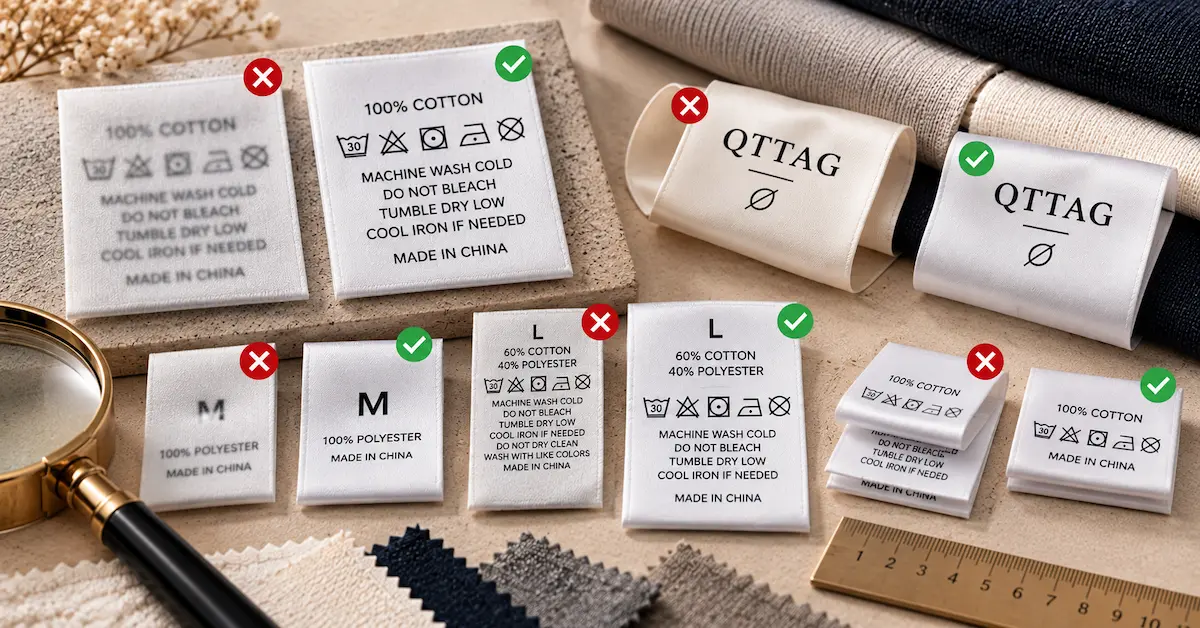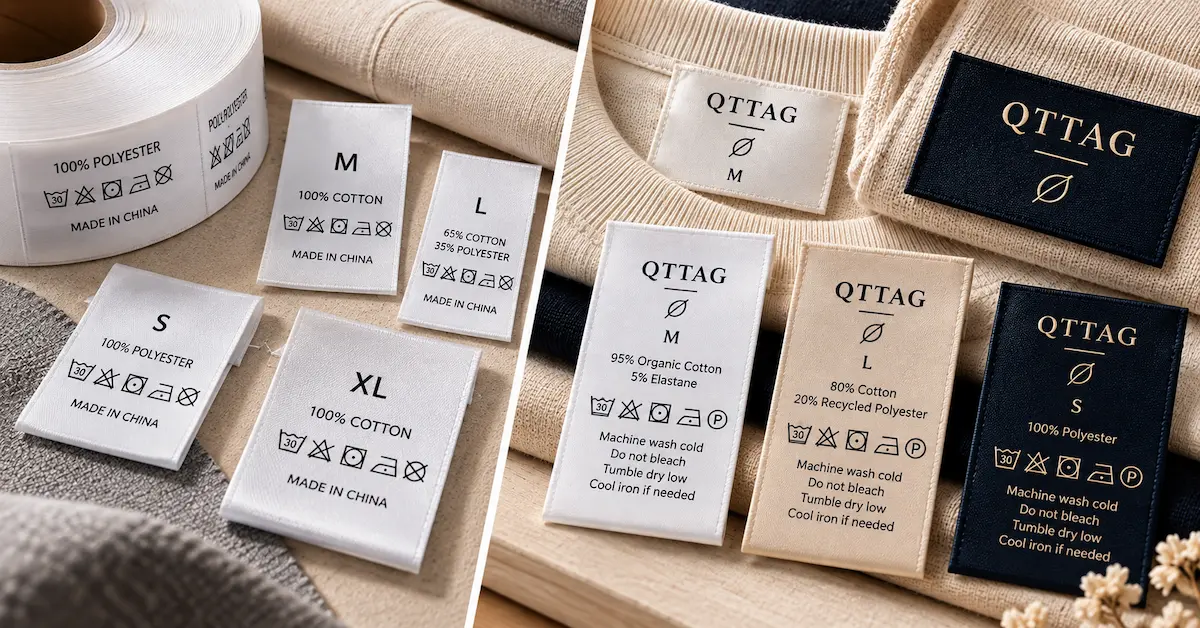
Printed Labels Cost Guide: What Changes Price, MOQ and Lead Time
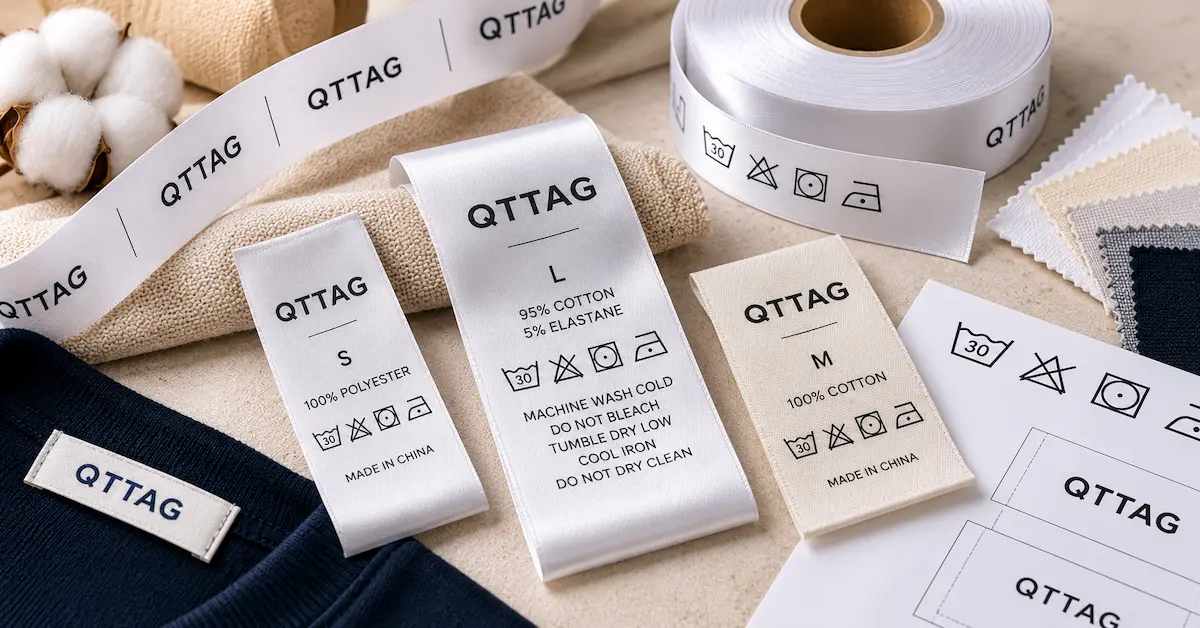
A clothing brand needs printed care labels for a new collection. The first supplier offers a price for 1,000 labels. The second sends a higher quotation, even though both have received the same artwork.
The difference may have little to do with printing quality.
One supplier might be quoting black text on white satin. The other may have included a different substrate, several artwork versions, cutting and folding. Sample approval and freight may also be handled differently.
The cost of printed labels depends on the material, printing process, label dimensions, artwork, number of versions, finishing and order quantity. MOQ and lead time depend on how these requirements fit the supplier's production system.
The difficulty for buyers is that two quotations don't always describe the same finished product.
Before comparing prices, it helps to understand how a printed clothing label is specified and what the supplier has included.
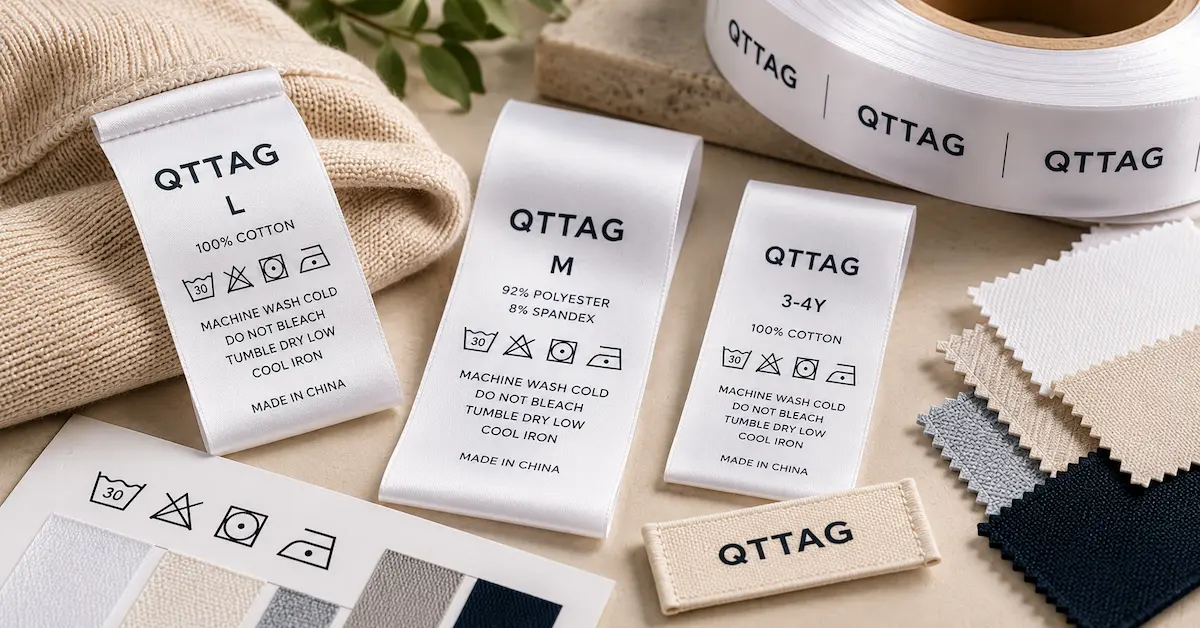
What Makes One Printed Label More Expensive Than Another?
Printed labels are not all made using the same materials or printing methods.
A simple care label carrying black text may have different production requirements from a multicolor brand label printed on a textured fabric.
Even two care labels can vary considerably.
One may contain a few lines of text. Another could include fiber composition, washing instructions, several languages and different information for multiple garment styles.
For the first label, the printing layout may be relatively straightforward.
For the second, the buyer must consider whether all the text will remain readable within the available dimensions.
Material Selection
Common printed clothing label options include satin-style materials, polyester substrates and certain cotton-based fabrics.
The surface influences how the printing looks and feels.
A smooth substrate may be suitable for relatively small text, depending on the printing system. Textured materials need to be evaluated for the same purpose.
Cotton is not automatically cheaper or more expensive than satin.
The actual price depends on material availability, construction and the supplier's production method.
Ask for representative printed samples rather than selecting solely from a material description.
Printing Method
Thermal transfer, screen printing and other compatible processes can be used for different textile labeling applications.
The chosen process may influence equipment preparation, available colors, artwork limitations and production quantities.
A supplier specializing in black text on white care labels may price that product differently from a full-color custom brand label.
This is why the RFQ should state the expected printing appearance and information requirements.
Label Dimensions and Finishing
Finished dimensions influence the material specification and how much information can fit on the label.
Cutting and folding matter too.
A label supplied as a continuous roll may require different handling from individually cut and center-folded labels.
The garment manufacturer might need the labels ready for sewing.
If the quotation doesn't include that finishing, someone will need to complete the work later.
| Specification | What Can Change the Cost |
|---|---|
| Substrate | Material composition and surface |
| Printing | Process, colors and artwork |
| Dimensions | Finished width and length |
| Information | Text density and layout |
| Variations | Different sizes, fibers or languages |
| Finishing | Cutting, folding and delivery format |
| Quantity | Volume by individual version |
| Development | Proofs, sampling and revisions |
A useful comparison begins after these details are agreed.
Satin, Cotton or Polyester: Does Material Change the Quote?
Imagine a brand ordering small care labels for lightweight shirts.
The buyer wants the label to be flexible, readable and suitable for the garment's intended care conditions.
Several materials might meet those requirements. They won't necessarily produce identical results.
Satin-style labels can provide a relatively smooth surface. Cotton-based materials have a different textile character. Polyester substrates are widely used in garment labeling and can be offered in different finishes.
None should be chosen from the material name alone.
The finished label needs to be evaluated for text clarity, thickness, folding and comfort.
For a care label, durability also matters. The information may need to remain legible after repeated garment care.
The correct test depends on the product and its intended use.
What About Recycled Materials?
A clothing brand may ask whether recycled-content substrates are available.
That introduces another purchasing requirement: verification of the material claim.
A supplier's general description of recycled content is not necessarily evidence for the specific finished label.
If the brand plans to make an environmental claim, request appropriate documentation and confirm exactly which component it covers.
Material sourcing requirements can affect available options, but they should not be represented as guaranteed cost increases without an actual quotation.
Printed Care Label MOQ: One Design or Multiple Versions?
MOQ is one of the easiest parts of a label quotation to misunderstand.
Consider a private-label clothing collection with 1,000 garments.
The brand needs different care labels for T-shirts, trousers and jackets. The logo may be the same, but the fiber compositions and care instructions are different.
Can the buyer order all the labels under one MOQ?
That depends on the supplier.
Some printed-label services allow multiple variations within a defined ordering arrangement.
Others calculate minimums separately for each unique design.
For example, LABELPARTNERS publicly describes a split-label ordering option for multiple variants. General Label lists minimum quantities per identical selection.
These are examples of different supplier policies, not rules applying to all manufacturers.
Why Versions Matter
Printed care labels can change with:
-
Fiber composition
-
Garment size
-
Style or SKU
-
Destination market
-
Required language
-
Care instructions
-
Manufacturer or responsible business information
The supplier needs to know which information changes and how many labels are required for each version.
A quotation for 1,000 identical labels may not apply to 10 different designs of 100 pieces each.
A Practical Ordering Example
A clothing brand wants to order the following quantities:
| Label Version | Quantity | Information Difference |
|---|---|---|
| T-shirt care label | 400 | T-shirt composition and care |
| Trouser care label | 300 | Trouser composition and care |
| Jacket care label | 300 | Jacket composition and care |
| Total | 1,000 | Three artwork versions |
The total purchasing volume is 1,000 units, but the supplier must confirm whether it can treat this as one production arrangement.
Don't assume the quantities can be combined.
Ask for the MOQ and unit price by version.
That one clarification can prevent misunderstandings before sampling begins.
Why Setup Fees and Artwork Changes Matter
A quoted unit price may not include every development expense.
Depending on the supplier, charges may apply for artwork preparation, proofing, sampling or production setup.
Other manufacturers include some of those services in their standard quotation.
There isn't one industry-wide charging method.
For example, FWP US publicly describes care-label printing services with an additional setup fee in certain circumstances.
That illustrates why buyers should ask what the quotation includes.
Artwork Changes After Approval
A label may require revisions if the garment composition changes or the brand discovers incorrect information.
Those revisions should be distinguished from ordinary printing defects.
The supplier may have produced the approved artwork accurately, while the information supplied by the clothing brand was wrong.
Correcting the content could require another production file or a separate run.
That's a different cost from correcting a manufacturing error.
Why Final Artwork Approval Matters
Before releasing the printed labels for production, confirm the text, symbols, language and finished layout.
Where several designs are involved, use a distinct reference for each version.
A file name such as care-label-final.pdf is not particularly helpful if several different files are all called "final."
A clear SKU or version reference makes it easier to match the correct labels to the correct garments.
How Is Printed Label Lead Time Calculated?
Printing itself is only one part of the order.
Before production starts, the supplier may need to review artwork, confirm the material, prepare a proof or produce a sample.
The buyer then approves the result.
If the artwork changes, the schedule may change too.
What Does the Quoted Lead Time Include?
This is worth asking directly.
Some suppliers quote the production period after artwork approval.
Others may quote a longer period that includes selected preparation or delivery services.
The wording matters.
A quotation of "10 working days" is incomplete unless the buyer knows when those days start and which services are included.
The Main Stages
| Stage | What Happens |
|---|---|
| Specification review | Material, dimensions and printing are confirmed |
| Artwork preparation | Text, symbols and design files are checked |
| Proof approval | Buyer approves the layout |
| Physical sampling | Sample is evaluated where required |
| Production | Labels are printed |
| Finishing | Labels are cut, folded or prepared for delivery |
| Quality checks | Information and finished construction are inspected |
| Packing | Different versions are identified |
| Shipment | Order is dispatched |
A repeat order using unchanged artwork and materials may require fewer development steps.
That doesn't automatically guarantee a shorter delivery time.
Production scheduling, material availability and shipping arrangements still need to be confirmed.
Production Time Is Not Delivery Time
If the garment factory needs labels before its sewing schedule begins, dispatch date alone is insufficient.
The buyer should establish the expected arrival date at the garment factory.
For international orders, freight arrangements and applicable import procedures may add time beyond manufacturing.
A realistic plan separates approval, production, shipping and receipt.
Printed Care Labels: Why Information Accuracy Affects Cost
For ordinary branding labels, the main concern may be whether the logo looks right.
Printed care labels are different. Their information needs to correspond to the actual garment.
This matters because a printing supplier can reproduce incorrect information perfectly.
For products covered by U.S. textile labeling rules, the Federal Trade Commission requires applicable disclosures, including fiber content, country of origin and responsible business identification.
The FTC's Care Labeling Rule guidance also explains the requirements for supported care instructions on covered apparel.
These are different responsibilities from merely printing a label.
Why Buyers Should Verify Information First
Suppose a brand changes the fabric composition during product development.
The old care-label artwork may no longer be accurate.
If labels have already been printed, they may need to be corrected or replaced.
That creates additional purchasing work and can affect the garment production schedule.
The better approach is to approve the garment's technical information before releasing the final label artwork.
What About Kidswear Labels?
Children's clothing can involve additional product and market-specific requirements.
A printed label should use the correct approved garment information, but its existence alone does not establish that the clothing meets every applicable children's product requirement.
For kidswear sourcing, check the intended market, garment category and relevant labeling obligations before approving production.
Don't ask the label supplier to invent fiber declarations, washing instructions or regulatory claims.
The buyer or other responsible party should provide verified content.
Is Physical Sampling Worth the Extra Time?
A digital proof is useful for checking text, artwork and layout.
It cannot fully show how the selected substrate feels, how the printing looks on the material or how the finished label behaves after cutting and folding.
For a new label construction, a representative physical sample can answer those questions.
What Should Be Checked?
Begin with the smallest text and laundry symbols.
Inspect the printed result at its actual finished dimensions.
A label that looks readable in an enlarged PDF may be difficult to read on a narrow textile strip.
Then review the material, cut edges, fold position and intended garment attachment.
If the label needs to withstand repeated laundering, evaluate its performance under relevant conditions.
Keep the approved sample with the final artwork and product specification.
This reference becomes particularly useful for repeat orders.
Production Accuracy Is Not the Same as Content Accuracy
A care label can pass visual inspection but still contain incorrect garment information.
Buyers should therefore approve both the content and the physical sample.
Skipping either step can create problems that are more expensive to correct after bulk manufacturing.
How Can Apparel Brands Reduce Printed Label Costs?
Reducing printed-label costs often begins with removing unnecessary complexity.
For example, a brand may be able to use one approved label material across several compatible garments.
That doesn't mean the information should be identical.
A care label for a cotton shirt and one for a polyester jacket may require different content even when their size and printing style match.
Useful Cost-Control Decisions
Select an appropriate label size. Leave enough room for readable text without adding unnecessary material.
Keep artwork versions organized. Clear references help prevent incorrect production and packing.
Confirm whether quantities can be combined. MOQ policies differ among manufacturers.
Avoid unnecessary changes after sample approval. Late revisions can affect production arrangements.
Compare complete finished labels. Include cutting, folding, packing and relevant setup charges.
Plan orders around garment production. Confirm when the labels must arrive rather than relying only on an estimated manufacturing period.
These decisions won't produce the same savings for every project.
Their value depends on the actual label specification and supplier quotation.
What Should You Send to a Printed Label Manufacturer?
A clear RFQ can help the supplier calculate the order more accurately.
| RFQ Information | What to Provide |
|---|---|
| Label type | Printed brand label, care label or size label |
| Garment | Intended clothing application |
| Material | Satin, polyester, cotton or reference sample |
| Artwork | Final approved design |
| Label dimensions | Finished width and length |
| Printing | Color requirements and text |
| Care information | Verified instructions and symbols |
| Fold or cut | Required finishing |
| Quantity | Total and quantity per artwork version |
| Versions | Different fiber compositions, sizes or languages |
| Samples | Proof and physical approval requirements |
| Durability | Applicable laundering and readability needs |
| Delivery | Destination and required date |
If the material or printing process hasn't been selected, provide the actual garment requirements.
The supplier can then discuss available constructions.
Request the MOQ, quotation scope, sample arrangements and production schedule for the proposed product.
That is more useful than asking only for the lowest possible unit price.
Frequently Asked Questions About Printed Labels Cost
How much do custom printed clothing labels cost?
Prices depend on material, printing method, dimensions, artwork, finishing, quantity and supplier-specific commercial terms. A complete quotation is needed for the finished product.
Are satin printed labels cheaper than cotton labels?
Not necessarily. Pricing depends on the actual substrate, printing process, order quantity and finishing requirements. Compare equivalent specifications.
What is the MOQ for custom printed care labels?
MOQ varies by supplier and design. Some manufacturers allow multiple versions within particular ordering arrangements, while others set minimums per identical design.
Can different care-label designs share one MOQ?
Sometimes. The supplier needs to confirm how design variations are handled and whether their quantities can be combined.
Do suppliers charge setup fees for printed labels?
Some charge separately for artwork preparation or setup, while others include these services. Check the actual quotation.
How long does printed care-label production take?
The schedule depends on artwork approval, material availability, sampling, printing, finishing and shipping. Confirm when the quoted lead time starts.
Should I approve a physical printed-label sample?
For new constructions or significant changes, physical sampling is strongly recommended. It helps verify material, text clarity, dimensions, folding and garment suitability.
Can I order the same care label for multiple garment styles?
Only when the information and physical specification are appropriate for those garments. Different fiber compositions or care instructions may require separate versions.
Are printed labels suitable for children's clothing?
Suitable printed labels may be used for children's clothing, but their content, material, placement and other relevant requirements should be reviewed for the actual product and destination market.
What information is needed for an accurate quotation?
Provide the label type, artwork, materials, finished dimensions, printing requirements, quantity per version, finishing, sampling needs and delivery destination.
Request a Printed Label Quote From QTTAG
For a new printed-label project, begin with the garment specifications and approved information.
QTTAG supports custom apparel branding inquiries involving printed labels, care labels and related garment identification products. Material availability, MOQ, production schedules and specific printing capabilities should be confirmed for each order.
Ready to Plan Custom Printed Labels for Your Clothing Brand?
Share your approved artwork, garment specifications, preferred label materials, dimensions, printing requirements, care label information, estimated order quantity and delivery needs with QTTAG.
Our team can review your requirements and discuss available customization, sampling and quotation options.
Request a Quote
Author
Founder at QTTAG
Jason Qiao is the founder of QTTAG, focusing on garment branding and packaging solutions. With years of experience in the apparel industry, he shares practical insights on custom labels, hang tags and sustainable packaging to help global brands grow.
Written By
Jason Qiao