A Practical Guide to Printed Labels for Clothing Brands
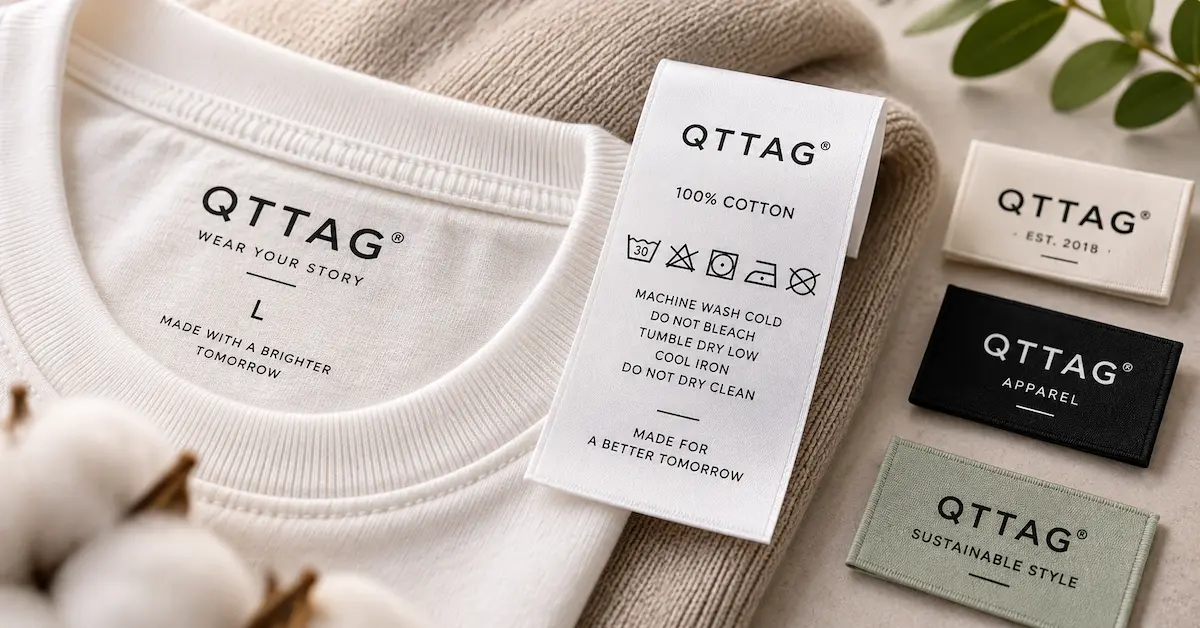
A printed clothing label has a simple job until something goes wrong.
The brand name may look sharp when the label leaves the factory, but become difficult to read after repeated washing. A care label might carry the correct information, yet the lettering is so small that customers struggle to use it. On another garment, a printed label may feel too stiff against the skin.
These problems usually come from decisions made before production: the printing method, fabric substrate, ink system, artwork size, or testing requirements.
Printed labels are widely used in apparel because they can accommodate brand graphics, small text, care instructions, and detailed product information. They offer design possibilities that differ from traditional woven labels, but their performance depends on the complete construction.
When choosing printed labels for clothing, buyers should focus on four factors: print clarity, fabric compatibility, durability under expected care conditions, and accurate information. The right combination of substrate, printing process, finishing, and quality control matters more than selecting a process based on price alone.
This guide explains how apparel brands can evaluate printed labels, identify common printing problems, and prepare specifications that manufacturers can use.
What Are Printed Labels for Clothing?
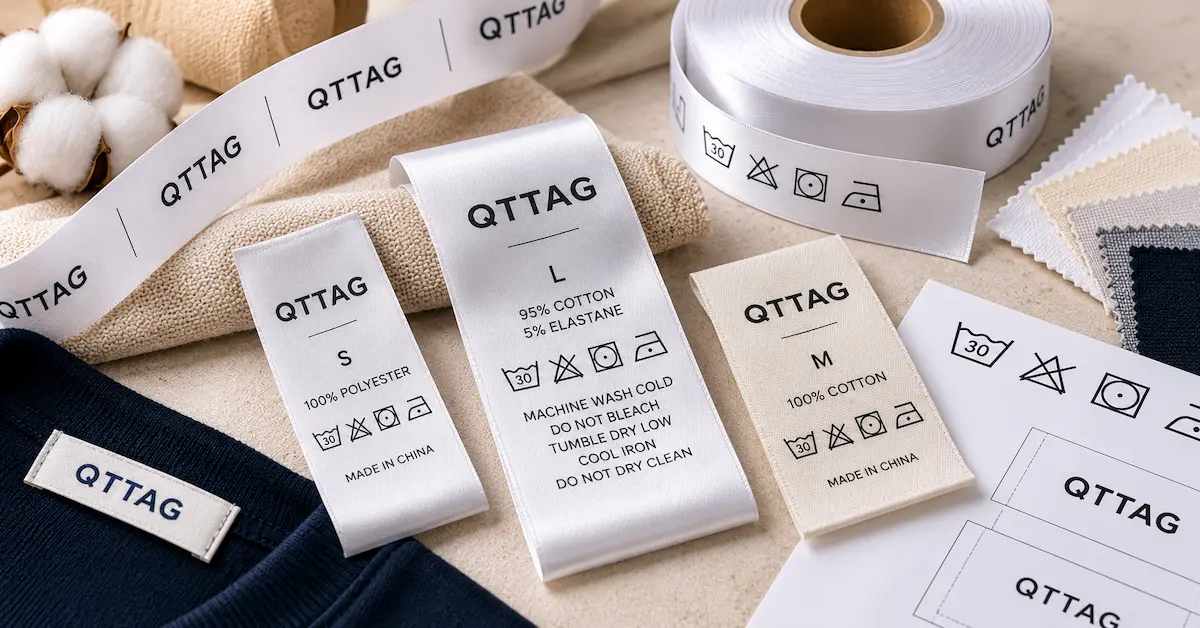
Printed labels are identification or information labels produced by applying ink or another suitable printing medium to a label substrate.
In clothing manufacturing, the substrate is often a textile material selected for its printability, texture, strength, and suitability for garment attachment.
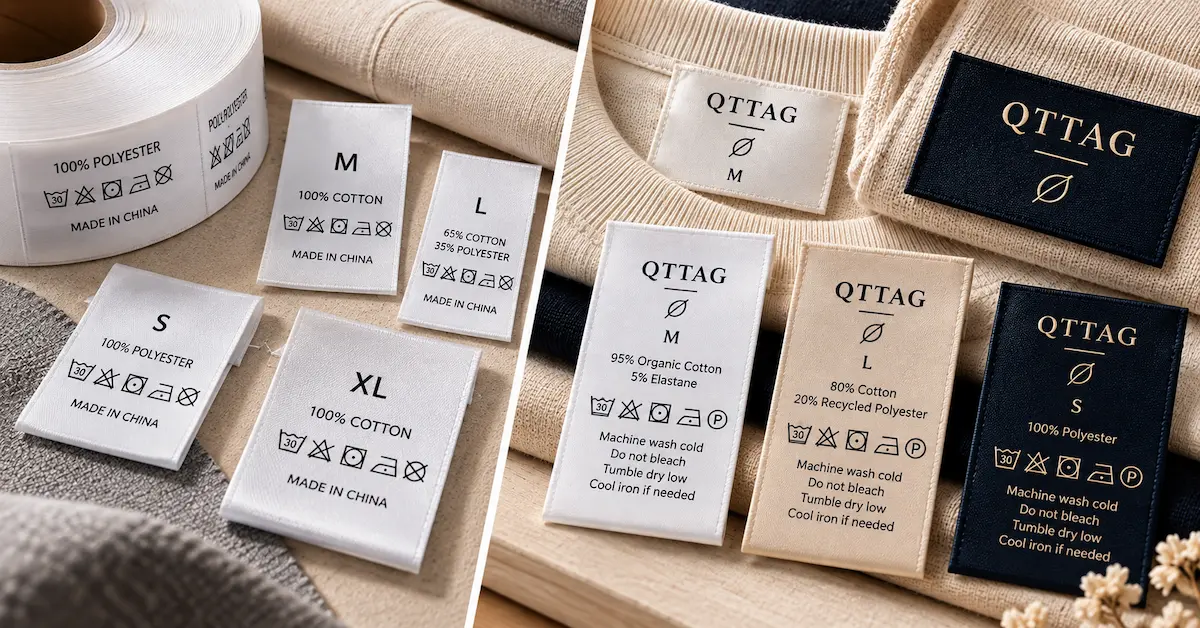
Printed clothing labels may display:
-
Brand names and logos
-
Fabric composition
-
Washing and care instructions
-
Garment sizes
-
Country-of-origin information
-
Product identification codes
-
Batch or other tracking information
-
Decorative artwork
Unlike woven labels, in which the design is formed through yarn interlacing, printed labels use a printing process to reproduce the artwork on the substrate.
This distinction becomes especially useful when a label needs to display detailed instructions or relatively small text.
Where Are Printed Labels Used?
Printed labels are commonly considered for T-shirts, underwear, knitwear, uniforms, workwear, children's clothing, sportswear, and textile accessories.
The design should reflect the location and purpose of the label.
A printed brand label inside a jacket may prioritize appearance. A care label attached inside a side seam must prioritize accurate, readable information and suitable durability.
Those are different technical requirements, even when both products are called printed labels.
Printed Labels vs Woven Labels: Understanding the Practical Difference
Clothing brands often compare these two methods because both can be used for sewn-in identification.
Neither method is universally superior.
A woven label provides an appearance formed by textile yarns. A printed label can reproduce graphics or information according to the capabilities of its printing system.
The correct choice depends on what the label needs to communicate.
Printed vs Woven Label Comparison
| Feature | Printed Labels | Woven Labels |
|---|---|---|
| Artwork Method | Applied through printing | Formed through weaving |
| Small Text | Often suitable with an appropriate print process | Limited by woven resolution and size |
| Surface Appearance | Depends on ink and substrate | Characteristic woven texture |
| Detailed Graphics | Depends on printing resolution and ink system | Depends on woven construction |
| Colors | Depends on printing process | Depends on yarn colors |
| Durability | Must be assessed for substrate and print | Must be assessed for construction and finish |
| Common Use | Care instructions, branding, product information | Main brand labels, decorative branding |
A brand might use a woven main label to reinforce its identity and a printed information label to communicate care instructions.
There is no need to force every type of garment information into one label construction.
Which Printing Methods Are Used for Clothing Labels?
Printing methods influence image quality, durability, production efficiency, and the types of artwork that can be reproduced.
The available process depends on the label manufacturer's equipment and product range.
Screen Printing
Screen printing transfers ink through a prepared screen onto a compatible substrate.
It can be useful for specific colors and graphic designs.
The suitability of this method depends on ink selection, fabric construction, artwork detail, and production requirements.
For designs containing extremely fine text, the printer should confirm the achievable resolution.
Flexographic Printing
Flexographic printing uses a flexible printing plate to transfer ink onto a moving substrate.
Depending on the equipment and material, it may be used in continuous printing applications.
The process must be matched to the substrate and artwork requirements.
Buyers should confirm that the manufacturer actually offers the method for the proposed textile label, rather than assuming every label printer has the same equipment.
Digital Printing
Digital printing transfers artwork through a suitable digital printing system.
It may be useful for particular types of multicolor designs or variable artwork.
However, digital printing is not one single technology. Different systems can use different inks and application methods.
Print durability and substrate compatibility need to be evaluated for the proposed process.
Thermal Transfer Printing
Thermal transfer printing can use a coated ribbon and a suitable printhead to transfer information onto compatible media.
It is often relevant to certain identification and variable-data applications.
The result depends on the ribbon, substrate, printing conditions, and expected environment.
This should not be confused with heat transfer labels, in which graphics are transferred onto a garment using heat and pressure.
The two terms describe different applications.
Printing Method Comparison
| Method | Potential Strength | Important Buyer Check |
|---|---|---|
| Screen Printing | Defined color graphics | Fine text, ink compatibility |
| Flexographic Printing | Continuous printing applications | Equipment, substrate and plate requirements |
| Digital Printing | Artwork flexibility | Resolution, ink system and wash performance |
| Thermal Transfer Printing | Certain information and variable-data labels | Ribbon and substrate compatibility |
No method should be selected only because it is described as newer or more advanced.
A physical sample and relevant performance testing provide a stronger basis for comparison.
How to Choose Materials for Printed Clothing Labels
Printing quality depends partly on the material underneath the ink.
Two fabrics may accept the same artwork but produce different results.
Surface texture, absorbency, coating, dimensional stability, and finishing can all affect the printed image.
Satin-Based Label Materials
Satin-based materials may provide a relatively smooth, lustrous surface.
They are frequently considered for sewn-in labels where appearance and readability matter.
However, the physical feel depends on fiber composition, fabric construction, and finishing.
A smooth visual surface does not automatically guarantee softness after attachment.
Polyester Fabric Substrates
Polyester-based materials are used in various textile-label constructions.
Their suitability depends on the print system, fabric structure, treatment, and intended care conditions.
Do not assume that every polyester label provides the same printing performance.
Cotton and Other Textile Substrates
Cotton or blended materials may be considered for certain printed label applications.
Their surface characteristics can affect how artwork appears.
Dimensional stability, ink performance, edge finishing, and laundering behavior should be assessed.
Material Selection Checklist
| Material Property | Why It Matters |
|---|---|
| Surface Smoothness | Influences text definition |
| Fabric Thickness | Affects comfort and handling |
| Print Compatibility | Determines ink or transfer performance |
| Flexibility | Affects garment movement |
| Dimensional Stability | Helps maintain finished dimensions |
| Edge Behavior | Affects fraying and comfort |
| Care Compatibility | Influences expected performance |
A suitable printed label material should be selected for the garment and the required information, not merely for how it looks in a catalog.
Why Text Clarity Is Critical for Printed Care Labels
A printed care label may contain several lines of information in a relatively small area.
This makes text clarity a major quality concern.
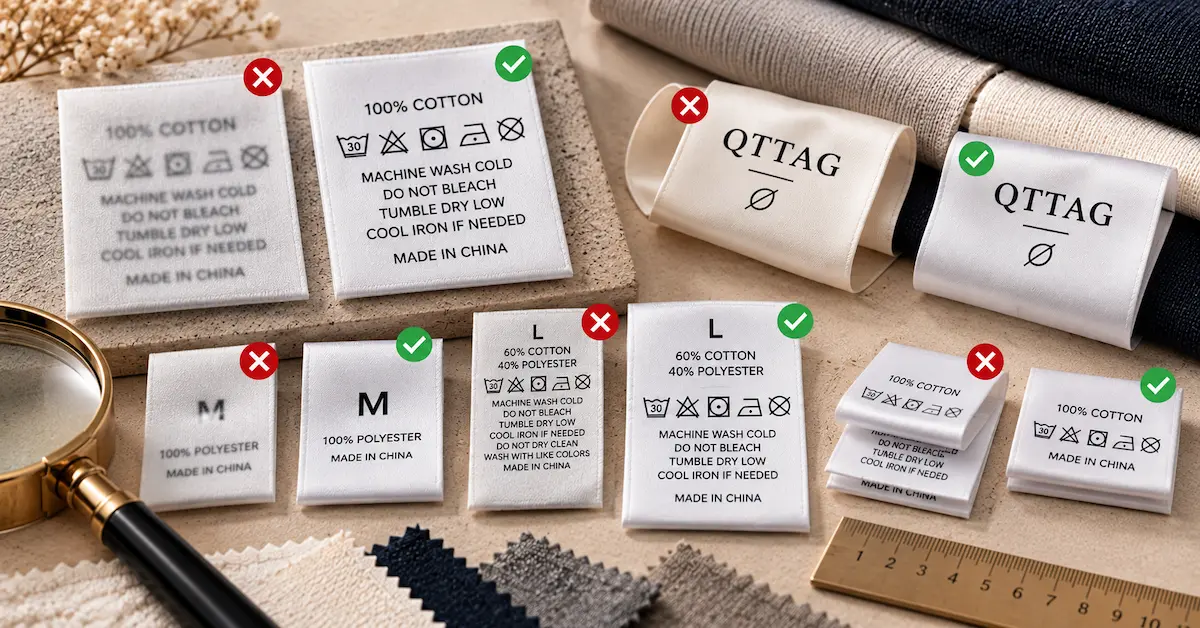
Text can become difficult to read because of low printing resolution, unsuitable font sizes, poor contrast, ink spreading, or distortion in the fabric.
Choose Readable Lettering
The smallest possible lettering is not necessarily the best option.
Buyers should review the complete text at its actual printed size.
If the information is difficult to read, consider increasing the label dimensions, simplifying the layout, or reorganizing the content.
Check Line Spacing
Closely spaced lines can create a crowded appearance.
Fabric movement or slight printing variations may make the text even harder to distinguish.
Allow enough space for the information to remain clear.
Use Effective Contrast
Dark printing on a light material is a common option.
Other color combinations can also work when the contrast is sufficient.
Low-contrast decorative text may be appropriate for some branding designs, but it can be unsuitable for important care information.
Readability Checklist
| Item | Inspection Question |
|---|---|
| Font Size | Can the text be read at actual size? |
| Letter Definition | Are characters distinct? |
| Line Spacing | Are adjacent lines clearly separated? |
| Contrast | Is the printing distinguishable from the background? |
| Symbols | Are symbols recognizable? |
| Ink Coverage | Are there gaps or unintended marks? |
| Label Dimensions | Does the information fit without crowding? |
Print readability should be checked on actual samples rather than only on the artwork file.
Understanding Washing and Care Information Requirements
Printed labels are frequently used for care and fiber-information labels, but accurate printing alone does not ensure legal compliance.
The brand must confirm that the content meets the requirements applicable to its products and intended sales markets.
For example, U.S. textile products may be subject to Federal Trade Commission requirements addressing fiber content, origin, responsible business identification, and care instructions.
European Union rules include requirements concerning textile fiber composition labeling.
The applicable obligations are not identical across markets or product categories.
Common Information Fields
| Information | Buyer Responsibility |
|---|---|
| Fiber Composition | Verify against actual product materials |
| Care Instructions | Confirm appropriate garment-care guidance |
| Country of Origin | Verify applicable origin determination |
| Responsible Business Information | Confirm market-specific obligations |
| Garment Size | Match the intended product |
| Product Code | Verify identification accuracy |
Care symbols should not be selected based purely on visual preference.
For example, a washing symbol may communicate a specific permitted care process. Using an incorrect symbol can mislead customers.
Official guidance should be consulted for the relevant market.
Important Distinction: Printing vs Compliance
A label manufacturer may reproduce text exactly as provided.
That does not automatically mean the supplied wording is correct or legally complete.
Before approving production, the clothing brand or responsible compliance team should review the information.
The printer should work from a clearly approved final file.
How to Evaluate Printed Label Wash Durability
Printed labels are often exposed to repeated laundering.
A label that initially looks sharp may lose contrast or readability over time if the printing system is unsuitable for the expected conditions.
Potential problems include:
-
Ink fading
-
Abrasion-related wear
-
Reduced text clarity
-
Ink cracking or separation
-
Dimensional changes
-
Edge deterioration
-
Damage around the attachment area
The actual outcome depends on the combination of ink, substrate, printing process, finishing, and garment-care conditions.
Test Under Relevant Conditions
A meaningful test should represent the intended garment-care requirements.
For example, a label used on frequently washed workwear may require different evaluation conditions from one used on a garment intended for more limited laundering.
Buyers should agree on relevant test methods and acceptance criteria with the supplier.
What to Check After Washing
| Inspection Item | What to Look For |
|---|---|
| Text Clarity | Is the information still readable? |
| Print Appearance | Has the ink faded or changed? |
| Surface Condition | Are there cracks or worn areas? |
| Fabric Dimensions | Has the label distorted? |
| Edge Finish | Is fraying visible? |
| Attachment | Is the label securely attached? |
Tests should be documented when performance is an important requirement.
Avoid broad claims such as "permanently washable" or "guaranteed fade-proof" unless a specific supporting test and scope are available.
Common Printed Label Defects and Their Possible Causes
Understanding defects helps buyers provide useful feedback instead of simply requesting a better sample.
Problem 1: Blurred Small Text
Possible factors include artwork resolution, printhead or screen limitations, ink spreading, and substrate texture.
Review the artwork and process before making the text smaller to fit.
Problem 2: Uneven Ink Coverage
Some printed areas may appear lighter or contain gaps.
Possible reasons depend on the print method and may involve substrate variation, process settings, or ink transfer.
The supplier should inspect the actual production conditions.
Problem 3: Ink Fades After Washing
Potential causes include unsuitable ink or substrate combinations, inappropriate curing or finishing, or care conditions beyond the validated performance.
Testing should help identify the problem.
Problem 4: Printed Label Feels Too Stiff
The substrate, coating, ink deposit, folded construction, or attachment method may contribute.
Replacing the fabric alone may not address every cause.
Problem 5: Label Edges Fray
The cutting or edge-finishing method may not be appropriate for the selected material.
Evaluate an alternative finish and compare the physical samples.
Troubleshooting Reference
| Defect | Possible Factors | Recommended Check |
|---|---|---|
| Blurred Text | Resolution, ink spreading, substrate texture | Review artwork and sample |
| Weak Ink Coverage | Ink transfer or surface variation | Inspect print consistency |
| Fading | Ink/substrate and care compatibility | Conduct relevant wash tests |
| Stiffness | Material, ink layer or folding | Test garment comfort |
| Fraying | Cutting or substrate behavior | Review edge finishing |
| Wrong Information | Artwork revision or data error | Verify approved master file |
These are possible diagnostic factors, not confirmed causes for a particular production defect.
Printed Labels for Children's Clothing: What Should Buyers Check?
Children's clothing can create additional considerations around comfort, safety, and market-specific regulatory requirements.
A label may contact the skin frequently or be positioned in a seam where the wearer notices it.
This makes material selection and attachment important.
Comfort and Placement
Consider whether the label creates unnecessary stiffness, bulk, or irritation.
Examine the complete sewn assembly, including edge treatment.
Clear Information
Care and identification information should be readable and appropriate for the product.
Any mandatory content must be reviewed against applicable requirements.
Safety and Compliance
Rules can vary by product type, age group, and destination market.
Do not assume a general printed label specification automatically satisfies every children's product requirement.
Testing
Where required by the product or market, arrange appropriate testing and maintain the relevant documentation.
Claims about safety, certification, or compliance should be supported by actual evidence.
How to Approve Printed Label Samples Before Bulk Production
Sampling helps buyers verify that the artwork, material, printing and finishing work together.
A digital proof confirms the intended layout, but not the actual physical print result.
Sample Approval Checklist
| Check | Approval Question |
|---|---|
| Artwork | Does it match the approved file? |
| Text | Is all information accurate? |
| Print Clarity | Can small characters be read? |
| Color | Does it match the agreed reference? |
| Substrate | Is the material appropriate? |
| Dimensions | Does the label meet the specification? |
| Edge Finish | Is cutting and finishing acceptable? |
| Comfort | Is it suitable for its garment position? |
| Washing | Does it meet agreed performance criteria? |
| Revision | Is the sample the current approved version? |
Review the sample under representative conditions.
Where relevant, inspect it after attachment to the finished garment.
Record the Approval
The approval record should reference the artwork version, material, printing process, dimensions, and any agreed testing requirements.
This reduces the risk of a later order using an outdated specification.
What Affects the Cost of Custom Printed Labels?
Printed label prices depend on the full specification and manufacturing process.
Factors may include:
-
Printing method
-
Substrate material
-
Label dimensions
-
Number of artwork colors
-
Artwork detail
-
Print setup
-
Order quantity
-
Different design versions
-
Cutting and folding
-
Testing requirements
-
Sorting and packing
A quotation should identify what is included.
For example, a label requiring several different care-information versions may involve more preparation than one repeated design.
The same applies to projects with multiple garment sizes or destination-market label variations.
Comparing Quotes
Use the same technical specification when requesting prices from different suppliers.
Ask whether the quotation includes sample development, printing, finishing, inspection, packing, and shipping.
A low unit price may not represent the most suitable option if the printing cannot meet the required durability or legibility.
What to Include in a Printed Label RFQ
A clear RFQ helps the supplier recommend a suitable printing process and substrate.
Printed Label RFQ Checklist
| Item | Information to Provide |
|---|---|
| Product Type | Printed brand label or care label |
| Garment Application | T-shirt, knitwear, uniform, etc. |
| Artwork | Approved design and information |
| Dimensions | Finished label size |
| Substrate Preference | Requested textile material |
| Printing Requirements | Colors, text and graphic details |
| Smallest Text | Important readability requirements |
| Quantity | Pieces per artwork version |
| Variations | Sizes, care versions or markets |
| Performance | Relevant wash or abrasion requirements |
| Finishing | Cutting, folding and edge treatment |
| Approval | Sample and testing requirements |
| Packing | Separation by style or SKU |
| Delivery | Receiving destination and schedule |
If the project involves care labels, provide the approved text and any required symbols.
Do not expect the label supplier to guess the correct care instructions from a photograph of the garment.
The accuracy of the content should be established before final artwork approval.
Frequently Asked Questions About Printed Labels
What are printed clothing labels?
Printed clothing labels are labels that display branding or product information through printing on a suitable substrate, commonly a textile material.
What is the difference between printed and woven labels?
Printed labels reproduce graphics using a printing process. Woven labels create the design through yarn interlacing. Each method has different visual and technical characteristics.
Are printed labels suitable for small text?
They can be, depending on the printing process, material, font size and artwork. Readability should be confirmed with physical samples.
Can printed labels be used as care labels?
Yes. Printed textile labels are commonly considered for displaying garment-care instructions and other product information.
Do printed labels fade after washing?
Performance depends on the ink system, substrate, production method and laundering conditions. Relevant testing is recommended.
Are satin printed labels comfortable?
They may be suitable for certain skin-contact applications, but comfort depends on the complete material, edge finishing and attachment method.
Can printed labels be customized with a brand logo?
Yes. Custom printing can reproduce brand-provided artwork within the capabilities of the selected process.
What is the difference between thermal transfer and heat transfer labels?
Thermal transfer printing may use a ribbon to print information onto suitable media. Heat transfer labels are applied to garment fabric using heat and pressure. The processes are not interchangeable.
Are printed labels suitable for children's clothing?
They may be suitable when their construction, attachment and information meet the product's needs and applicable safety or labeling requirements.
What should I check before ordering printed labels in bulk?
Check artwork accuracy, text clarity, material, dimensions, printing performance, edge finishing, relevant tests and approved sample references.
Can printed care labels include multiple languages?
Yes, when the label size, printing method and information layout permit it. Confirm the language and labeling requirements of the intended market.
What information should I send for a printed label quotation?
Provide artwork, approved text, dimensions, fabric preferences, quantities, care requirements, finishing instructions and delivery details.
Develop Printed Clothing Labels with QTTAG
A successful printed label starts with accurate information and a manufacturing process suited to the garment.
For branding labels, evaluate logo clarity, colors, material and comfort.
For care labels, give particular attention to approved information, legibility and performance under the garment's expected care conditions.
Before placing a bulk order, review physical samples and agree on the specifications that production must follow.
QTTAG supports custom printed labels, care labels, woven labels, heat transfer labels and coordinated apparel branding products.
If your clothing collection requires printed brand or information labels, prepare the artwork, label dimensions, fabric preferences and estimated quantity for review.
Ready to Create Custom Printed Labels for Your Clothing Brand?
Share your artwork, label information, materials, dimensions and estimated quantities with QTTAG. Our team can discuss suitable printing methods, customization options and sample development.
Request a Quote → Create Your Custom Sample
Author
Founder at QTTAG
Jason Qiao is the founder of QTTAG, focusing on garment branding and packaging solutions. With years of experience in the apparel industry, he shares practical insights on custom labels, hang tags and sustainable packaging to help global brands grow.
Written By
Jason Qiao