Woven Labels Cost Guide: What Changes Price, MOQ and Lead Time
Two woven label manufacturers receive the same logo from a clothing brand. One recommends a standard weave and sends a relatively low quotation. The other proposes a finer construction, asks for artwork adjustments and quotes a higher price.
Both suppliers are looking at the same design. Why aren't their offers similar?
The answer may lie in the yarns, weave density, finished dimensions or cutting requirements. Even the number of label versions can change how an order is priced.
Woven labels cost depends on the finished size, yarn and weave construction, number of colors, artwork detail, cutting, folding and order quantity. MOQ and lead time depend on how the manufacturer organizes production, samples and individual design versions.
A low unit price is useful only when the specification matches what the garment factory needs.
Before comparing quotations, it helps to understand which details influence the actual manufacturing work.
Why the Same Woven Label Design Can Receive Different Quotes
A woven label isn't simply a logo printed onto fabric.
Its artwork is formed by interlacing yarns. The selected weave and yarns determine how letters, shapes and colors appear in the finished label.
That makes the production specification important.
A small wordmark with relatively bold lettering may be straightforward to reproduce using one suitable construction. A design with thin serif lettering, closely spaced characters and several colors may need more careful development.
The second design isn't automatically impossible or more expensive. The supplier needs to assess the intended dimensions and available weaving methods.
Consider the difference between requesting a label described as "navy and white, 50 mm wide" and supplying a complete woven-label specification.
The first gives the manufacturer a general direction.
The second confirms the weave, finished height, yarn colors, cut edges and fold requirements. It also establishes whether the supplied quotation includes individual finished labels or an unfinished woven strip.
Those aren't minor purchasing details.
If one supplier quotes cut-and-folded labels and another quotes woven tape, the unit prices describe different deliverables.
What Should Buyers Compare?
| Quotation Detail | Why It Affects the Offer |
|---|---|
| Finished width and height | Determines material and production requirements |
| Weave construction | Influences yarn selection and design reproduction |
| Yarn colors | May affect material selection and production preparation |
| Artwork detail | Can affect weaving feasibility and development |
| Cutting method | Determines edge and finishing operations |
| Fold type | Changes the finished construction |
| Design versions | May require separate production arrangements |
| Quantity | Influences the production economics |
| Sampling | Adds approval steps where required |
The table is more useful than comparing a price per piece without knowing what's included.
Does Damask, Satin or Taffeta Change the Price?
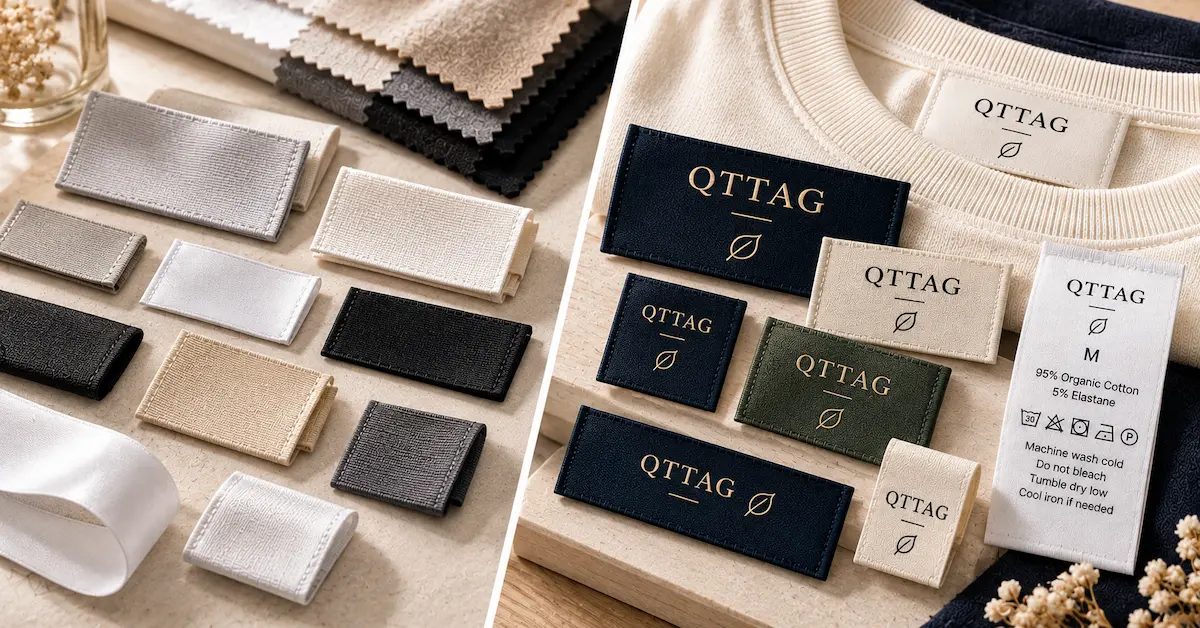
Buyers often see damask, satin and taffeta in woven-label catalogs.
These terms refer to different textile constructions or finishes offered by manufacturers. They can influence the label's texture, appearance and suitability for particular artwork.
They shouldn't be treated as a fixed price ranking.
Damask Woven Labels
Damask constructions are often considered for logos requiring relatively fine woven detail.
A buyer developing a compact neck label with thin lettering may want to compare damask samples with other available constructions.
The important question is whether the required logo detail remains clear at the finished dimensions.
Choosing a finer construction may affect manufacturing requirements, but the actual price depends on the supplier's specifications and production process.
Satin Woven Labels
Satin-style woven constructions can provide a different surface appearance, often associated with a smoother or more lustrous finish.
The result depends on the yarn and weave.
For a garment label positioned close to the skin, review the finished construction rather than assuming that a material name guarantees comfort.
Taffeta Labels
Taffeta-style woven labels may be considered when their texture and construction suit the intended design.
Some suppliers position these as practical alternatives for particular applications.
But a taffeta label is not automatically the least expensive option in every project.
What About High-Density Woven Labels?
High-density construction can be relevant when a logo contains fine elements.
It may involve different weaving specifications from a more straightforward design.
There is no universal rule that a label must use the highest possible density to be considered good quality.
A brand with bold lettering may not benefit from adding complexity that doesn't improve the visible result.
Approve the weave based on the logo and garment, then compare prices for that approved construction.
Why Logo Detail and Yarn Colors Matter
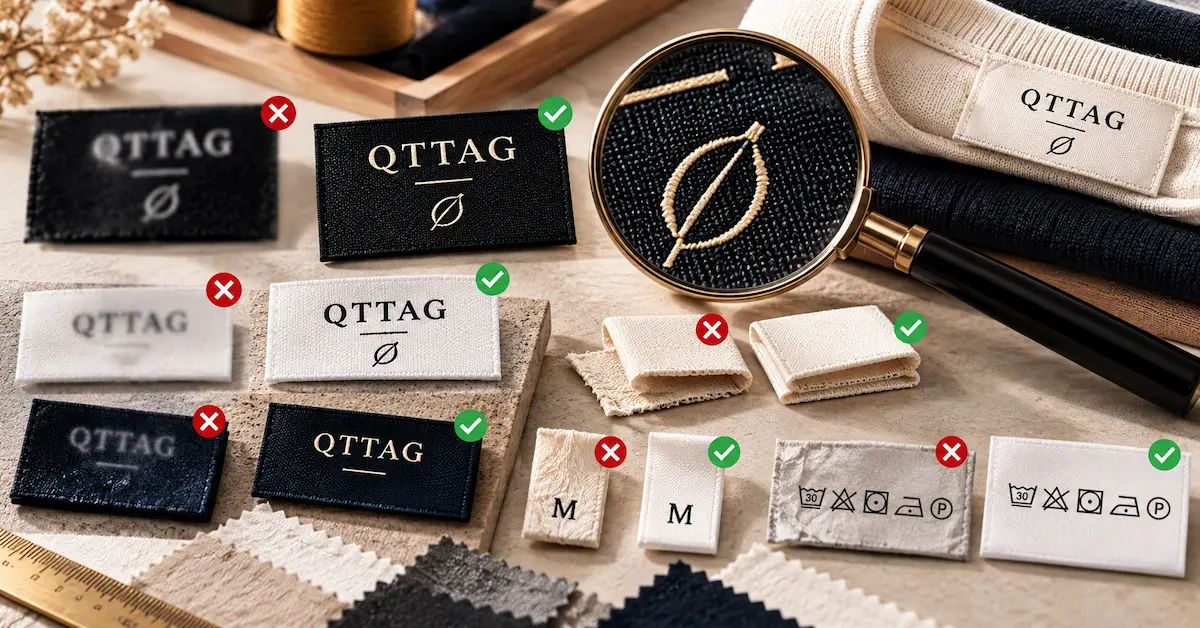
A digital logo can contain details that are difficult to reproduce at a small woven size.
The problem often appears in the lettering.
A narrow gap inside a letter may close visually. Two nearby lines may become difficult to distinguish. A delicate symbol could lose definition after being translated into yarns.
This is why artwork review should happen before the order is priced as a finished product.
The supplier may recommend increasing the label size, adjusting the weave or modifying the production artwork.
Any change to the brand design needs approval.
More Colors Don't Always Mean a Simple Price Formula
The number of yarn colors can influence the manufacturing specification.
However, adding one color doesn't necessarily produce a predictable percentage increase in cost.
Available yarns, the selected weave and production arrangements all matter.
It's also worth distinguishing a digital color reference from a physical yarn sample.
A logo designed with precise screen colors may need to be matched to available yarn shades.
For a collection where brand consistency is important, ask the manufacturer how color approval works and whether physical references are available.
If the approved yarn colors change between orders, the original sample may no longer be a sufficient production reference.
Cutting and Folding: The Costs Buyers Sometimes Miss
Imagine a clothing brand ordering woven neck labels for T-shirts.
The artwork shows the final visible size. But the labels will be folded before being sewn into the neckline.
That changes the specification.
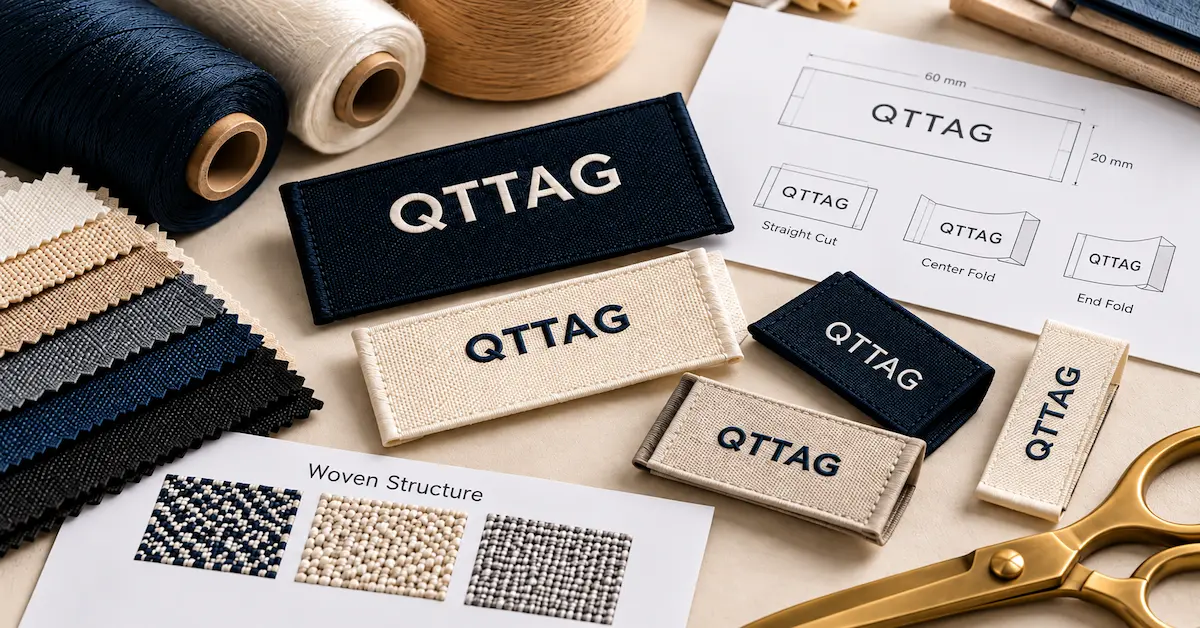
A center-fold label needs sufficient material for its finished construction, with the artwork arranged correctly around the fold.
End-fold labels have different finishing requirements.
Straight-cut labels may not require the same folding work, but their edge construction still needs to be appropriate.
Other options, including mitre or specialty folds, may involve additional operations.
Finished Size vs. Flat Size
A manufacturer needs to know whether the dimensions provided refer to the artwork, the unfolded woven piece or the finished folded label.
Confusing these measurements can affect both the quotation and the completed product.
The same applies to cutting.
Heat cutting, suitable mechanical cutting and other finishing methods may require different processes depending on the yarn and label construction.
Before approving a price, request confirmation of the finished dimensions, fold type, edge finish and delivery format.
If the garment factory expects individual labels ready for sewing, the supplier's quotation should clearly describe that product.
How Does MOQ Work for Custom Woven Labels?
MOQ is often described as a single number, but the meaning can change from one supplier to another.
A manufacturer may define the minimum per artwork, colorway or production arrangement.
This becomes important when a clothing brand needs several versions of the same logo.
One Logo, Several Garment Sizes
Suppose a collection uses the same woven wordmark across multiple garment sizes.
If the woven labels are identical and separate size labels are used, the brand may be able to order one common woven design.
But if the size information is woven directly into each neck label, the manufacturer needs to assess the different versions.
Whether those quantities can be combined toward one MOQ depends on the production arrangement.
Buyers shouldn't assume that every version automatically counts toward the same minimum.
Different Logo Colors
A brand may need a dark logo for light garments and a light logo for dark garments.
These can involve different yarn combinations.
The supplier should confirm whether the colorways are quoted separately.
How Small Can a Woven Label Order Be?
There is no universal minimum for the industry.
Published supplier terms differ substantially. Some manufacturers offer small-batch orders, while others set higher minimums for particular woven constructions.
That variation reflects different business and production arrangements; it doesn't establish the quality of the finished labels.
When requesting a quotation, ask how the minimum is calculated for the specific artwork and construction.
It can also help to request prices at more than one quantity, provided those quantities represent realistic purchasing options.
A smaller order may suit a new clothing brand even when the unit price is higher.
Buying large quantities of labels that may never be used isn't necessarily a saving.
What Determines Woven Label Production Lead Time?
Lead time begins earlier than the weaving process itself.
A new design may require artwork review, yarn confirmation and physical sampling before the bulk order is approved.
If the initial woven sample doesn't reproduce the logo clearly, the supplier may need to adjust the design or construction.
The buyer then reviews the revised sample.
These approvals take time even before bulk weaving starts.
A Typical Woven Label Order Sequence
| Stage | What Happens |
|---|---|
| Artwork review | Supplier checks the logo and dimensions |
| Construction selection | Weave, yarn colors and folds are confirmed |
| Digital proof | Artwork and layout are reviewed |
| Physical sample | Woven construction is evaluated where required |
| Sample approval | Buyer authorizes the reference |
| Production scheduling | Supplier allocates the manufacturing work |
| Bulk weaving | Approved labels are manufactured |
| Finishing | Cutting and folding are completed |
| Inspection and packing | Labels are checked and identified |
| Shipment | Finished order is dispatched |
Not every order requires every stage.
A repeat order with unchanged artwork, materials and specifications may involve fewer development steps.
However, production scheduling and material availability still matter.
When Does the Lead Time Start?
This should be agreed before ordering.
Some suppliers quote production time from artwork approval. Others may begin after physical sample approval or after specified commercial conditions have been met.
If a supplier quotes two weeks, ask whether that includes sample development, cutting, folding and shipping.
A production-completion estimate is not necessarily a delivery date.
The clothing factory may need the labels before sewing begins. In that situation, the important deadline is when usable labels arrive, not when they leave the weaving facility.
How Do You Compare the Real Cost of a Woven Label Order?
The unit price is only part of the buying decision.
A new woven design may involve artwork preparation or sampling charges. The order may also require specialty folding, separate packing by design or additional freight.
Ask whether those items are included.
For a complete comparison, use:
Total purchasing cost = label production + applicable development and sampling charges + finishing and packing + freight.
If additional label preparation or garment sewing is charged separately, consider those costs when budgeting for the finished garment.
A supplier offering a lower unit price may still be a reasonable choice. The point is to compare the same deliverables.
Compare Finished Labels, Not Just Quotations
A useful supplier comparison should examine the accepted physical sample.
Check the logo detail, yarn colors, dimensions and finished edges.
Look at the label after folding.
Then consider how it will be attached to the garment.
A label that looks attractive as a loose sample may not work as expected inside a neckline or seam.
Where relevant, agree on laundering, comfort or attachment requirements before approving bulk production.
That gives the buyer a better basis for comparing value than price alone.
How Can Apparel Brands Reduce Woven Label Costs?
Reducing cost doesn't always mean choosing a cheaper yarn or less detailed weave.
Sometimes it means removing requirements that aren't necessary for the finished garment.
For example, a bold logo may reproduce well using a straightforward woven construction. There may be no practical benefit in specifying a more complex option.
Similarly, a brand can review whether every garment style needs a different woven label or whether the same approved brand label can be used across compatible products.
Those decisions should be made during product development, not after the purchase order has been released.
A stable artwork file also helps.
Late changes to logo dimensions, yarn colors or folds may require renewed approval or production preparation.
For repeat orders, keep the approved sample and production specification together.
That makes it easier to identify which details should remain unchanged.
The goal is to reduce unnecessary development and manufacturing work while preserving the required branding result.
What Should You Send to a Woven Label Manufacturer?
A clear quotation request doesn't need to be complicated.
It should explain what the finished label needs to look like and how it will be used.
| RFQ Information | What to Provide |
|---|---|
| Logo artwork | Approved vector file or suitable reference |
| Garment type | T-shirt, knitwear, jacket or other |
| Finished dimensions | Width and height |
| Weave preference | Damask, satin, taffeta or reference sample |
| Yarn colors | Approved color references |
| Artwork variations | Different logos, sizes or colorways |
| Fold type | Center fold, end fold, straight cut or other |
| Edge finishing | Required finished edge |
| Quantity | Total and quantity per version |
| Sampling | Physical sample and approval requirements |
| Quality | Relevant appearance and performance criteria |
| Delivery | Destination and required date |
If the weave hasn't been chosen, provide the artwork and a representative garment.
The manufacturer can then discuss feasible constructions.
Ask for the MOQ, sample arrangements, quotation scope and production timeline for the proposed option.
Those answers are more useful than an isolated price per label.
Frequently Asked Questions About Woven Labels Cost
How much do custom woven labels cost?
There is no fixed industry price. Cost depends on dimensions, yarns, weave construction, artwork, colors, folding, quantity and supplier-specific terms.
Are damask woven labels more expensive than taffeta labels?
They may be, depending on the actual construction and manufacturer. The material name alone doesn't determine the price. Compare quotations for approved specifications.
Does higher weaving density increase the price?
It can influence production requirements, particularly for detailed artwork. The cost effect depends on the loom, yarn, dimensions and supplier's manufacturing process.
What is the MOQ for custom woven labels?
MOQ varies by manufacturer and design. Ask whether it applies per artwork, colorway, quantity tier or production run.
Can different woven label sizes share one MOQ?
Possibly, depending on the production method and supplier's terms. Different woven artwork versions may require separate arrangements.
How long does woven label production take?
The schedule depends on artwork preparation, yarn availability, sampling, approval, production, finishing and delivery. Confirm which stages are included in the quoted lead time.
Is a physical sample necessary before bulk production?
For new designs and significant construction changes, a physical sample is strongly recommended. It helps confirm artwork, yarn colors, finished dimensions, folding and garment suitability.
How can I get an accurate woven label quotation?
Provide the approved logo, finished size, weave preference, yarn colors, fold type, quantity by version, sampling requirements and delivery destination.
Request a Custom Woven Label Quote From QTTAG
If you are preparing woven labels for a new clothing collection, begin with the approved logo and intended garment application.
QTTAG supports custom garment branding projects, including woven labels and related apparel identification products. Specific yarn options, MOQ, sample arrangements and production schedules should be confirmed for each order.
Ready to Plan Custom Woven Labels for Your Clothing Brand?
Share your logo artwork, garment specifications, preferred yarn colors, woven label dimensions, fold requirements, estimated order quantity and delivery needs with QTTAG.
Our team can review your requirements and discuss available customization, sampling and quotation options.
Request a Quote
Author
Founder at QTTAG
Jason Qiao is the founder of QTTAG, focusing on garment branding and packaging solutions. With years of experience in the apparel industry, he shares practical insights on custom labels, hang tags and sustainable packaging to help global brands grow.
Written By
Jason Qiao