Woven Labels Explained: Materials, Design and Production Tips
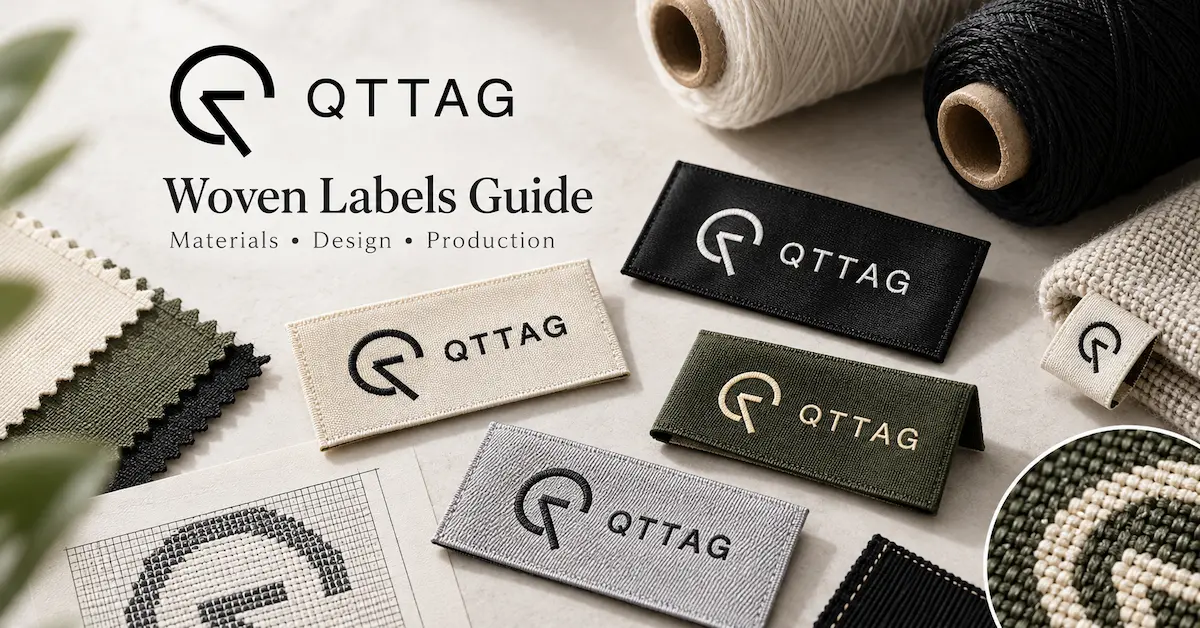
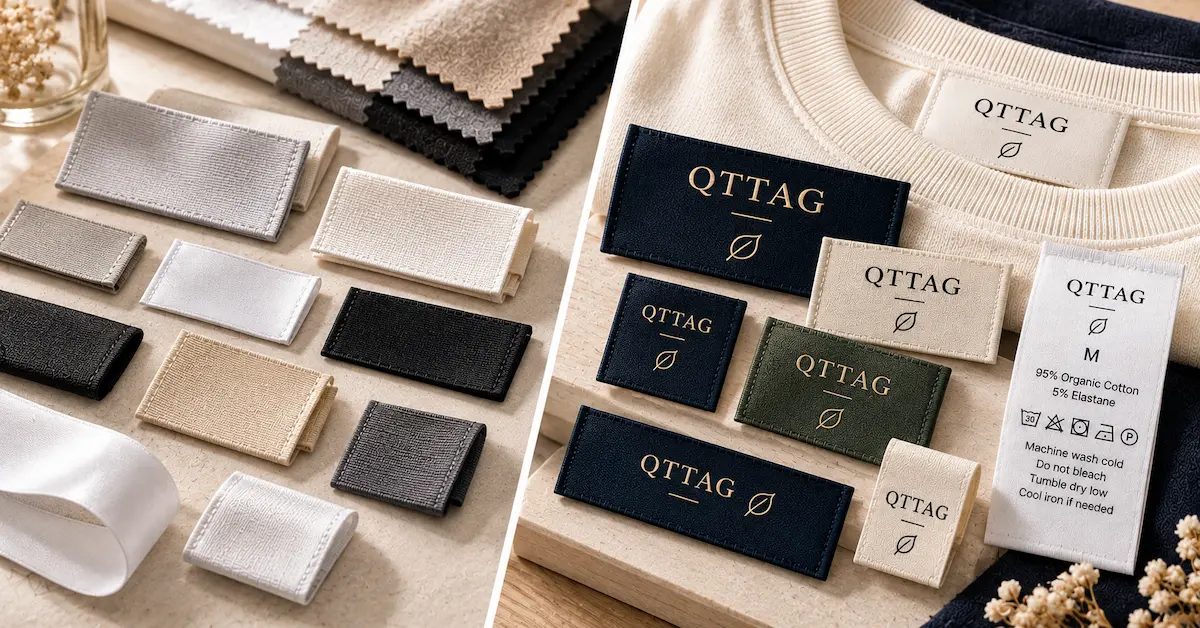
A woven label can make a clothing brand feel established, even when the label itself is only a few centimeters wide. The fabric texture, lettering and edge finish all contribute to how customers experience a garment.
But getting those details right takes more than uploading a logo and choosing a color.
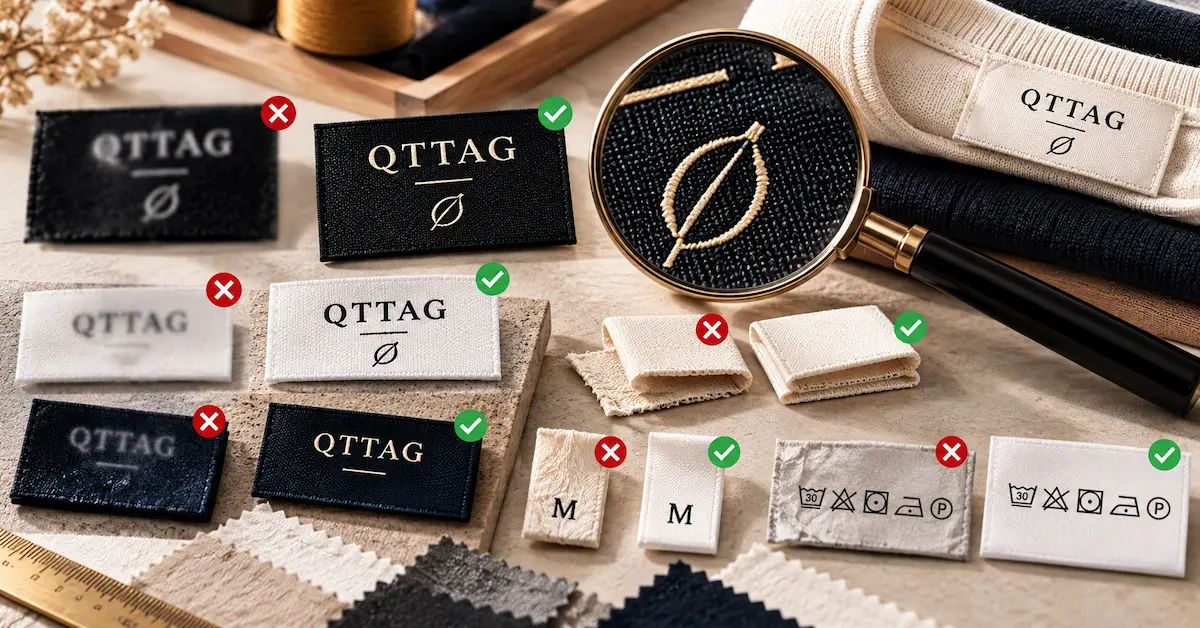
A fine line that looks perfect on a computer screen may disappear in a woven sample. Two labels made with different yarns can have noticeably different textures. Even when the artwork is identical, the weave structure and finishing process can change the result.
For clothing brands and apparel manufacturers, understanding how woven labels are made helps prevent design problems before bulk production.
Woven labels are textile labels in which logos, lettering and graphics are created by interlacing yarns rather than printing the entire design onto a finished fabric surface. Their quality depends on yarn selection, weave construction, design complexity, dimensional control and finishing.
This guide explains the materials, technical design considerations and production decisions that matter when developing custom woven labels.
What Are Woven Labels and How Do They Work?
Woven labels are small textile components used to display a brand name, logo, size or decorative design.
The artwork is formed during weaving, using yarns that create the background and visible design elements.
This gives woven labels a characteristic textile appearance.
Unlike a printed fabric label, where artwork is applied to a substrate, a woven label incorporates the design into the woven construction.
The difference becomes easier to see when looking closely at the surface.
On a woven label, individual yarns contribute to the lettering and shapes. The visual result depends on how those yarns are arranged.
Basic Components of a Woven Label
| Component | Function | Why It Matters |
|---|---|---|
| Warp Yarns | Run lengthwise through the woven structure | Influence construction and stability |
| Weft Yarns | Interlace with warp yarns | Help form the background and design |
| Yarn Material | Provides physical properties | Affects feel, sheen and performance |
| Weave Construction | Controls yarn arrangement | Influences texture and graphic detail |
| Design Pattern | Guides artwork reproduction | Determines logo layout |
| Edge Finish | Finishes the cut or woven edges | Influences appearance and comfort |
The interaction between these elements determines what the finished label looks and feels like.
That is why two suppliers may produce different samples from the same artwork file.
Woven Label Materials: What Should Buyers Know?
When buyers ask about woven label materials, the conversation often begins with yarn selection.
Polyester is widely used in apparel labeling, but material availability and construction vary between manufacturers.
Other fibers or blends may be possible depending on the application and manufacturing setup.
The important point is that a yarn name alone does not define the finished label.
Polyester Yarn
Polyester yarn is common in woven-label production because it can be used in a wide range of textile constructions.
Its suitability depends on yarn characteristics, weave structure, dyeing and finishing.
Buyers should evaluate the actual sample rather than assuming all polyester labels have the same hand feel or durability.
Cotton and Other Fibers
Cotton and specialty yarns may be considered for certain label designs.
However, a natural fiber is not automatically more sustainable, more comfortable or more durable in every application.
The finished product depends on fiber sourcing, processing, construction and intended use.
Environmental claims should be supported by appropriate documentation.
How Yarn Characteristics Affect the Result
A yarn's thickness, surface appearance, flexibility and color influence the woven design.
For example, a relatively bulky yarn can make very small lettering more difficult to reproduce.
A different yarn construction may allow a different level of detail, but it can also affect texture and cost.
Material Questions for Suppliers
Before choosing a material, ask:
-
What yarn composition is proposed?
-
How will the label feel against the garment?
-
Is the material suitable for the intended washing conditions?
-
What color options are available?
-
Can a physical yarn or label sample be provided?
-
Are there any relevant testing or documentation requirements?
These questions are more useful than selecting material based only on a catalog description.
Damask, Satin and Taffeta: Understanding the Differences
The terms damask, satin and taffeta are often used in woven-label discussions.
However, terminology and available constructions can vary between suppliers.
A buyer should confirm the exact weave, material and sample specifications rather than relying on product names alone.
Damask Woven Labels
Damask-style woven labels are commonly selected when brands want comparatively refined design reproduction.
Depending on the weaving setup, they may be suitable for logos containing relatively small details.
The achievable resolution still depends on artwork size, yarn properties and loom capabilities.
A label described as damask is not guaranteed to reproduce every fine line perfectly.
Satin Woven Labels
Satin describes a weave structure associated with a smoother, often more lustrous surface.
Satin constructions may suit brands looking for a distinctive smooth appearance.
The finish, yarn composition and construction determine the actual feel.
It is important to distinguish satin as a weave from the fiber used to manufacture it.
Taffeta Labels
Taffeta-type woven labels can offer a different surface texture and structure.
Their appearance and stiffness depend on the actual manufacturing specification.
They may be considered for applications where a structured textile finish is acceptable.
Woven Label Construction Comparison
| Construction | General Appearance | Potential Advantage | Buyer Consideration |
|---|---|---|---|
| Damask-style | Refined woven graphic surface | Suitable for certain detailed designs | Actual detail resolution |
| Satin | Smooth, often lustrous appearance | Distinctive surface finish | Feel, contrast and construction |
| Taffeta-type | More structured textile texture | Suitable for selected branding applications | Stiffness and graphic clarity |
| High-density Construction | Greater yarn or pattern density where supported | Potentially finer reproduction | Loom capability, yarn and artwork |
These descriptions are general guidance, not guaranteed performance specifications.
A manufacturer should provide physical samples for comparison.
What Does Woven Label Density Mean?
Density is often mentioned when discussing label quality.
In simple terms, woven density relates to how closely yarns or woven elements are arranged within the construction.
However, buyers should be careful with marketing terms such as "high density."
Higher density does not automatically mean that every design will look sharper or that the label will be softer.
The result depends on the weaving equipment, yarn size, weave structure and design.
Why Density Matters for Logo Detail
A woven design is built from physical yarn arrangements.
This places limits on how precisely curved lines, small letters and narrow gaps can be reproduced.
A complex logo may need more available woven detail than a simple geometric symbol.
Increasing label dimensions can sometimes improve reproduction more effectively than changing the construction alone.
Ask for a Physical Comparison
If the supplier offers different densities, request samples of the same artwork at the same dimensions.
Compare:
-
Letter readability.
-
Curve and diagonal-line definition.
-
Surface texture.
-
Color separation.
-
Edge finish.
-
Overall hand feel.
A direct physical comparison provides more useful information than relying only on density descriptions.
Why Some Logos Are Difficult to Weave
A digital logo consists of shapes and colors that can be displayed with extremely fine detail.
A woven label must reproduce those elements using yarns.
The two systems do not have identical capabilities.
This is especially noticeable with delicate lettering, thin lines and complicated illustrations.
Small Text
A short brand name in a simple typeface may remain readable at a relatively small size.
A longer name using narrow, decorative lettering can be more difficult.
The result depends on dimensions and production capability.
Thin Lines
Very narrow strokes may lose definition or appear inconsistent.
Increasing line thickness or enlarging the label may improve clarity.
Gradients and Photographic Details
Smooth digital gradients are not reproduced in the same way as printed color transitions.
Certain effects may be approximated through yarn selection and woven patterning, but detailed photographic artwork is often better suited to an alternative production method.
Closely Spaced Elements
Letters and symbols positioned too close together may visually merge.
Small adjustments to spacing can improve legibility without changing the overall brand identity.
Artwork Feasibility Checklist
| Artwork Feature | Possible Difficulty | Potential Adjustment |
|---|---|---|
| Very Small Letters | Reduced readability | Increase size or simplify |
| Thin Lines | Loss of definition | Adjust line weight |
| Complex Curves | Stepped or uneven appearance | Review dimensions and construction |
| Closely Spaced Text | Elements may merge | Increase spacing |
| Gradients | Limited continuous color transition | Simplify or use another method |
| Multiple Fine Details | Insufficient reproduction space | Enlarge design or revise layout |
Any design modification should be approved by the brand owner.
A label manufacturer should not independently redraw a brand logo without authorization.
How to Prepare Artwork for Woven Label Production
Good artwork preparation can reduce unnecessary sample revisions.
The goal is to provide the manufacturer with clear information about the intended design and its physical dimensions.
Start with Vector Artwork
Vector artwork is often useful because it preserves geometric information when designs are resized.
Depending on supplier requirements, suitable formats may include AI, EPS, SVG or vector PDF.
A high-resolution image can be included as a visual reference.
However, an image file may not provide everything needed for accurate production preparation.
Define the Finished Dimensions
State the intended label width and height.
If the label will be folded, distinguish the visible dimensions from the dimensions required before folding.
This information affects artwork placement.
Provide Color References
Specify approved brand colors where possible.
A screen color alone may not correspond exactly to an available yarn.
The supplier should explain practical matching options.
Separate Artwork Approval from Construction Approval
A logo file may be approved by the marketing department, but the physical label still needs technical approval.
The final sample should be evaluated for construction, dimensions, comfort and appearance.
These are separate decisions.
How Color Selection Affects Woven Labels
Color is an important part of brand recognition.
For woven labels, colors are created using selected yarns and their arrangement.
That introduces different considerations from digital printing.
Available Yarn Colors
A supplier may use an existing yarn color range or evaluate project-specific color requirements.
Available options depend on production capabilities and materials.
Physical Color Matching
Woven texture affects how light interacts with a label.
The same nominal color can appear different when produced with different yarns or weave constructions.
For critical brand colors, physical sample approval is recommended.
Contrast and Readability
A label with low contrast between the logo and background can be difficult to read.
Some designs deliberately use subtle contrast, but the result should still meet the brand's visual objectives.
Color Planning Checklist
Before approving production, confirm:
-
Approved color references.
-
Yarn color selection.
-
Logo and background contrast.
-
Appearance under suitable lighting.
-
Consistency between label versions.
-
Any acceptable variation agreed with the supplier.
Do not assume a digital mockup represents the exact final woven color.
How Are Custom Woven Labels Manufactured?
The exact workflow depends on the factory's equipment, label construction and finishing requirements.
A typical project can be divided into several stages.
Stage 1: Artwork and Technical Review
The manufacturer checks the logo, physical dimensions, colors and design complexity.
The goal is to determine whether the artwork can be reproduced using the proposed method.
Stage 2: Weaving Pattern Preparation
The approved artwork is translated into manufacturing instructions appropriate for the weaving equipment.
The supplier may recommend adjustments if important details are too small.
Stage 3: Yarn and Color Preparation
Suitable yarns are selected according to the approved design and material requirements.
Color references are confirmed.
Stage 4: Weaving
The label design is created through the controlled interlacing of yarns.
Depending on the equipment, multiple labels may be produced within a continuous woven arrangement.
The exact machine setup varies.
Stage 5: Cutting and Finishing
Labels are separated and finished according to the required dimensions and construction.
Possible operations include cutting, folding and suitable edge finishing.
Stage 6: Inspection
Finished labels are checked against approved specifications.
Relevant inspection points may include dimensions, logo appearance, colors, edge quality and visible defects.
Stage 7: Packing
Labels are counted, identified and packed according to order requirements.
Where an order contains several sizes or designs, clear separation helps reduce mixing.
Production Workflow Reference
| Stage | Main Activity | Buyer Approval or Check |
|---|---|---|
| Artwork Review | Evaluate logo feasibility | Confirm artwork |
| Pattern Preparation | Prepare weaving instructions | Review proposed reproduction |
| Material Preparation | Select yarns and colors | Confirm materials and references |
| Weaving | Produce woven label material | Check sample appearance |
| Finishing | Cut and fold labels | Verify dimensions and edges |
| Inspection | Compare against approved specification | Confirm acceptance criteria |
| Packing | Count and separate label versions | Verify quantities and identification |
This is a general process illustration. Actual QTTAG equipment and workflow details should be confirmed before publishing factory-specific claims.
Cutting and Folding: Finishing the Woven Label
A woven label is not necessarily ready for garment attachment immediately after weaving.
The finishing process affects how the label looks, feels and attaches to clothing.
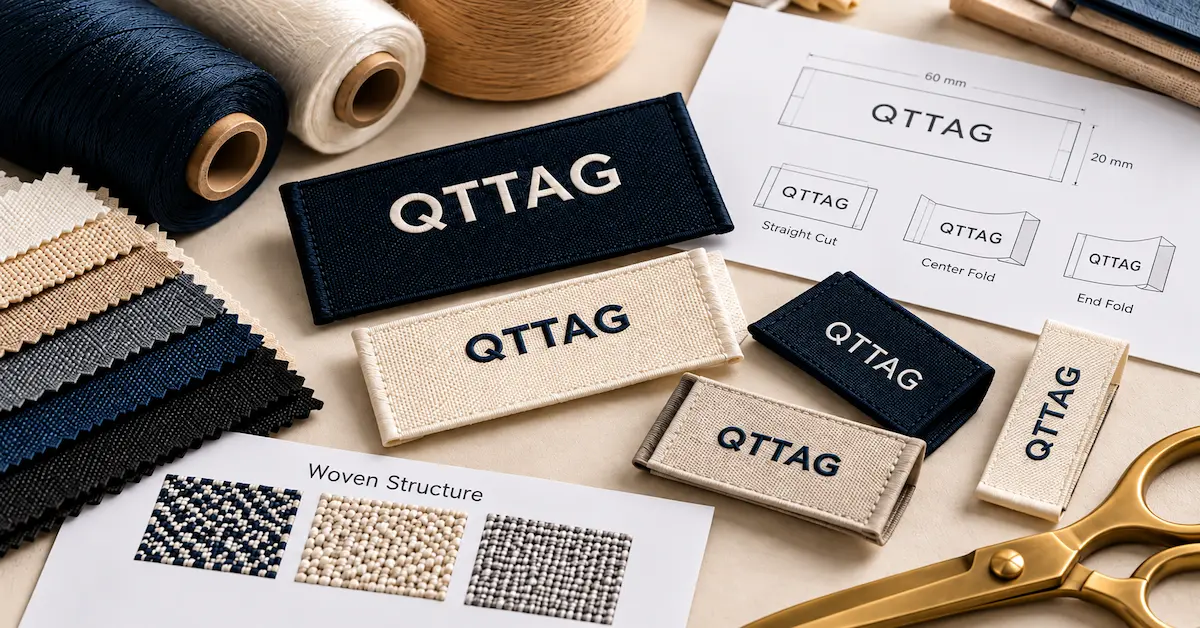
Straight Cut
A straight cut label has no additional fold.
The edge treatment and attachment method should suit the material and application.
Center Fold
Center fold labels are folded in half.
They are often attached where the open ends can be captured within a garment seam.
End Fold
End fold labels have their ends folded inward.
This can provide a clean presentation for selected sewn applications.
Mitre Fold
Mitre fold labels use angled folds that may suit certain specialized applications.
Edge Quality
Cut edges should be evaluated for fraying, roughness and dimensional consistency.
Where heat or ultrasonic methods are used, the material must be compatible with the process.
An edge that is visually clean may still feel too firm for a neckline.
That is why the finished sample should be checked on the intended garment.
How to Inspect Woven Label Quality
Quality evaluation should begin with an agreed specification.
A buyer cannot assess whether a label is acceptable without knowing what was approved.
The inspection should consider both appearance and construction.
Logo Accuracy
Compare the finished label with the approved artwork.
Check spelling, proportions, lettering and important graphic details.
Dimensions
Measure the label according to the agreed finished-size definition.
For folded labels, verify the correct visible dimensions and fold construction.
Color Consistency
Compare the sample with the approved physical color reference, where available.
Weaving Defects
Look for defects such as missing or irregular yarn elements, unintended marks and visible inconsistencies.
Acceptance criteria should be agreed upon for the product.
Edge and Fold Finish
Check whether cutting and folding are consistent and suitable for the application.
Garment Compatibility
If the label will contact skin or be attached to a lightweight garment, evaluate comfort and behavior after attachment.
Woven Label Quality Inspection Checklist
| Inspection Item | What to Check | Decision |
|---|---|---|
| Logo | Shape, spelling and proportions | Pass / Revise |
| Text | Readability at finished size | Pass / Revise |
| Color | Comparison with approved reference | Pass / Revise |
| Dimensions | Correct finished measurements | Pass / Revise |
| Surface | Visible weaving defects | Pass / Revise |
| Edges | Clean and suitable finishing | Pass / Revise |
| Fold | Correct construction | Pass / Revise |
| Attachment | Compatibility with intended garment | Pass / Revise |
| Performance | Relevant agreed tests | Pass / Revise |
The supplier and buyer should determine which tests and tolerances are appropriate for the order.
What Affects the Cost of Woven Labels?
Woven label costs depend on the complete manufacturing specification.
A simple logo and a complex multicolor design may require different production preparation even when the labels are the same size.
Relevant cost factors include:
-
Label dimensions.
-
Yarn material and construction.
-
Weave type and density.
-
Artwork complexity.
-
Number of colors.
-
Finishing and folding.
-
Order quantity.
-
Number of design variations.
-
Inspection and packing requirements.
Why Artwork Complexity Matters
A design that is difficult to reproduce may require additional technical preparation or sample development.
Changing the label dimensions or simplifying a small element can sometimes improve production feasibility.
However, the supplier should evaluate the actual design before making cost recommendations.
Why Order Quantity Matters
Manufacturing setup and processing costs are distributed across the order.
Smaller quantities may therefore have different unit economics from larger orders.
No single minimum order quantity applies universally across all woven-label constructions.
Request a quotation based on actual specifications.
Woven Label RFQ: What Should Buyers Prepare?
A clear Request for Quotation helps a manufacturer evaluate the work accurately.
It also makes quotations from different suppliers easier to compare.
Recommended Woven Label RFQ Details
| Information | Required Detail |
|---|---|
| Artwork | Approved logo or design |
| Label Size | Finished dimensions |
| Material | Requested yarn or woven construction |
| Colors | Approved references |
| Weave Preference | Damask, satin or another proposed construction |
| Fold Type | Straight cut, center fold, end fold, etc. |
| Garment Application | Neckline, hem, jacket, bag or other |
| Quantity | Estimated pieces per design |
| Variations | Different sizes, colors or versions |
| Testing | Relevant durability or performance requirements |
| Packaging | Bulk packing or separation by variation |
| Destination | Delivery country |
| Schedule | Requested sampling and delivery timeline |
If you do not know which weave construction is appropriate, provide the garment type and a reference sample.
A useful supplier should be able to discuss the trade-offs before finalizing production.
Frequently Asked Questions About Woven Labels
What are woven labels made of?
Woven labels are made using interlaced yarns. Polyester is a common material, while other fibers and constructions may be available depending on the manufacturer and application.
What is the difference between woven and printed labels?
Woven labels create artwork through the woven yarn structure. Printed labels apply ink or another suitable printing medium to a substrate. The methods offer different visual and technical characteristics.
What are damask woven labels?
Damask-style woven labels use particular woven constructions that are often selected for detailed textile branding. Actual detail and texture depend on the manufacturer's specifications.
Are high-density woven labels always better?
No. Higher density may help certain designs, but performance and visual quality also depend on yarns, loom setup, artwork and finishing.
Can woven labels reproduce small text?
Yes, within the limits of the construction and physical dimensions. Very small lettering may need adjustments to remain legible.
Can woven labels reproduce gradients?
Traditional woven designs do not reproduce continuous gradients like photographic printing. Some effects may be approximated using different yarn colors and patterns.
What fold types are available for woven labels?
Common options include center fold, end fold, straight cut and mitre fold. Suitability depends on the material and intended attachment.
Are woven labels suitable for necklines?
They can be, provided the material, edge finish and attachment are appropriate for skin-contact comfort.
How do I check woven label quality?
Review the approved artwork, logo clarity, dimensions, colors, weaving consistency, finishing and relevant performance requirements.
What information is needed for a woven label quotation?
Provide your artwork, dimensions, material preferences, colors, fold type, quantity, garment application and delivery requirements.
Develop Custom Woven Labels with QTTAG
A successful woven label begins with realistic design requirements.
Before approving an order, check whether the artwork can be reproduced at the intended size. Confirm the yarn, weave construction, colors and finishing method.
Physical sampling is particularly useful when the logo contains small details or the label needs to meet specific comfort requirements.
QTTAG supports custom woven labels and other apparel branding products, including care labels, heat transfer labels, hang tags and packaging solutions.
If you are developing labels for a new collection, prepare your artwork, garment application, intended dimensions, color references and estimated quantities.
The team can review your project requirements and discuss appropriate development and sampling options.
Ready to Develop Custom Woven Labels for Your Brand?
Share your artwork, label dimensions, preferred weave, colors and estimated quantities with QTTAG. Our team can discuss suitable materials, design adjustments and sampling options.
Request a Quote → Create Your Custom Sample
Author
Founder at QTTAG
Jason Qiao is the founder of QTTAG, focusing on garment branding and packaging solutions. With years of experience in the apparel industry, he shares practical insights on custom labels, hang tags and sustainable packaging to help global brands grow.
Written By
Jason Qiao