Woven Labels vs Custom Woven Labels: Key Differences for Apparel Brands
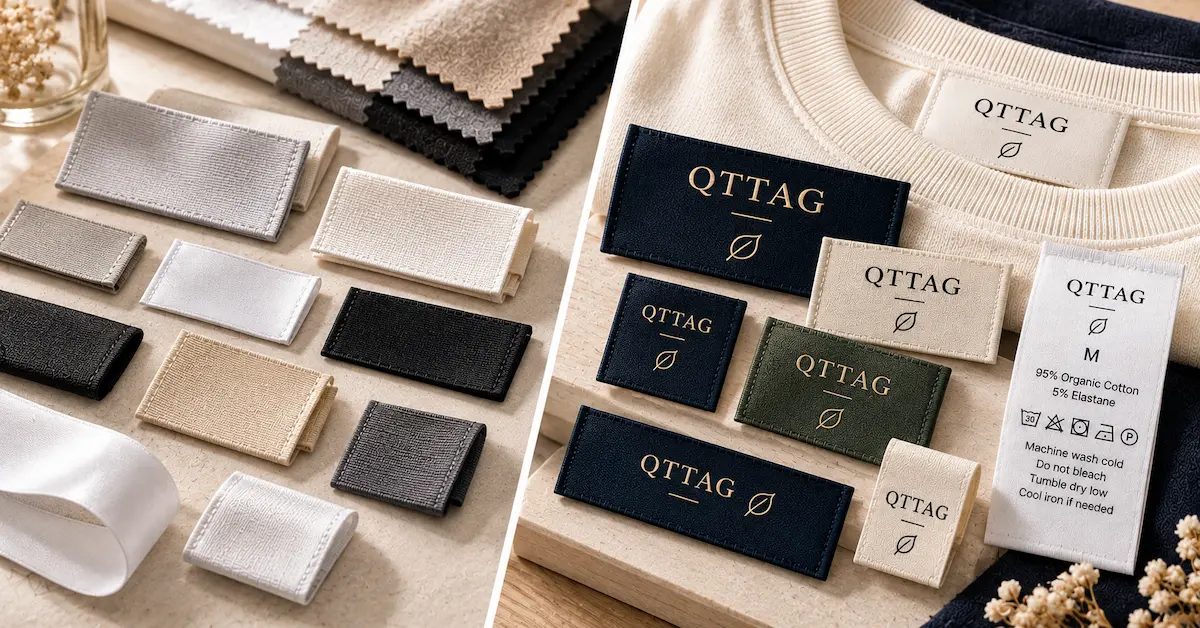
Woven labels are among the most recognizable branding details on clothing. From the neckline of a premium T-shirt to the inside of a tailored jacket, they communicate brand identity through yarn colors, woven textures and carefully reproduced logos.
When sourcing labels, apparel buyers often encounter the terms woven labels and custom woven labels. The wording can make these products sound like two separate manufacturing categories, but the distinction is more straightforward.
Custom woven labels are woven labels manufactured to meet a buyer's specific artwork, dimensions, colors, construction and finishing requirements. The term woven labels describes the broader product category, which can include both standardized designs and fully customized products.
Neither term guarantees a particular material grade, weaving density or quality level. Those characteristics depend on the actual manufacturing specification.
For clothing brands, the important decision is determining how much customization the collection requires and whether the selected woven construction can reproduce the approved artwork consistently.
This guide compares woven labels and custom woven labels, explains the principal materials and finishing options, and provides practical recommendations for sample approval and bulk sourcing.
What Are Woven Labels?
Woven labels are textile labels manufactured by interlacing yarns to create a design, logo, lettering or other identification details.
Unlike printed labels, where ink or another marking material is applied to a substrate, the visible design of a woven label is formed through the yarn structure.
Woven labels may be used for:
-
Brand identification
-
Clothing collection names
-
Size information
-
Decorative garment branding
-
Product-line identification
-
Selected textile information
Their construction can vary according to yarn selection, weave structure, design complexity, finished dimensions and edge finishing.
Why Fashion Brands Use Woven Labels
Woven labels provide a textile-based branding element that can be integrated into the garment.
Their appearance may complement the materials and overall visual direction of the clothing collection.
For example, a restrained woven wordmark may suit premium knitwear, while a bold contrasting woven logo may suit casual outerwear.
The preferred design depends on the brand rather than a universal ranking of label styles.
Are All Woven Labels Customized?
Not necessarily.
A supplier may offer standard label formats, generic designs or commonly used dimensions.
Other projects require new artwork and detailed manufacturing specifications.
Both can use woven construction.
The amount of customization is a separate consideration from the weaving method.
What Are Custom Woven Labels?
Custom woven labels are textile labels developed according to specifications provided or approved by the buyer.
A clothing brand may customize:
-
Logo or brand name
-
Typography
-
Yarn colors
-
Finished dimensions
-
Weave construction
-
Artwork placement
-
Label shape
-
Fold type
-
Edge finishing
-
Sewing allowance
-
Design variations
Custom manufacturing can help a brand reproduce its intended identity more closely.
However, the supplier must still evaluate whether the design is feasible using the proposed construction.
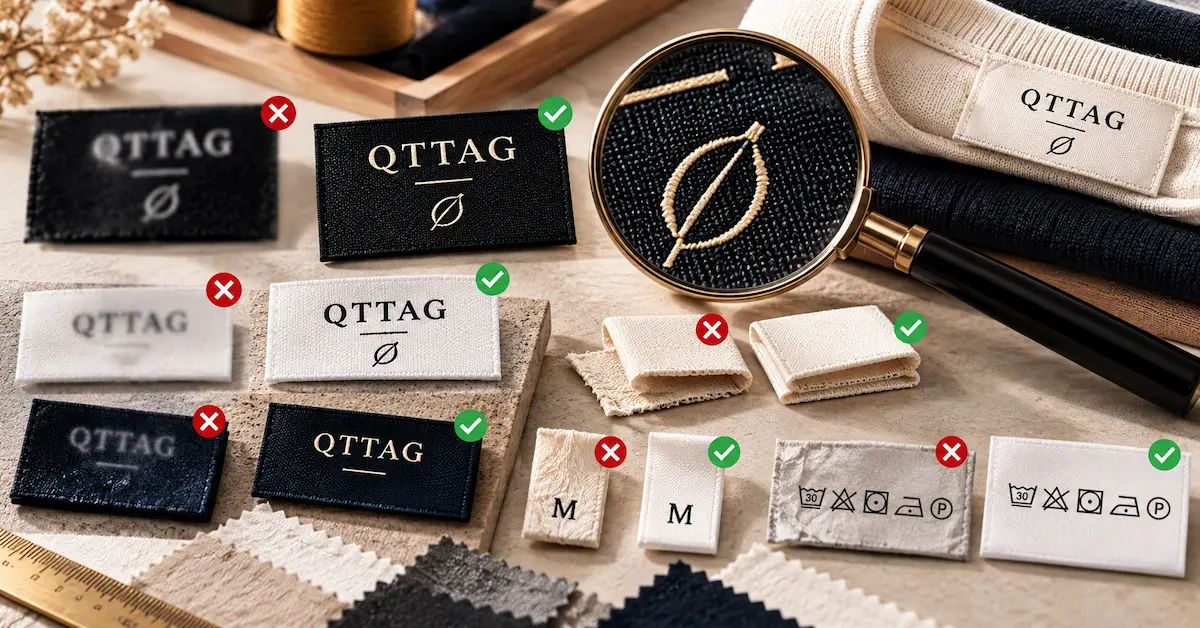
A Custom Logo Does Not Guarantee Unlimited Detail
Artwork designed for digital screens can contain lines and lettering that are too fine for certain woven specifications.
Small details may require a revised size, increased spacing or another suitable weave construction.
All proposed artwork changes should be approved before sampling.
What Makes a Woven Label Truly Custom?
The important distinction is whether the final specifications are created or adapted for the buyer.
A customized label may use a familiar rectangular format while incorporating a unique logo, yarn selection and finishing method.
It does not need an unusual shape or a complex construction to qualify as a custom product.
Woven Labels vs Custom Woven Labels: Main Differences
The table below compares commonly available standardized options with buyer-specific custom production.
| Feature | Standardized Woven Label Options | Custom Woven Labels |
|---|---|---|
| Product category | Woven textile label | Woven textile label |
| Artwork | Existing or limited options | Buyer-approved logo and artwork |
| Dimensions | Available standard sizes | Buyer-defined within manufacturing limits |
| Yarn colors | Available combinations | Selected colors from feasible yarn options |
| Typography | Existing designs or limited changes | Artwork-specific typography |
| Weave | Available constructions | Construction selected for the design |
| Fold type | Available formats | Selected according to garment requirements |
| Edge finishing | Supplier's standard options | Approved finish where feasible |
| Sampling | Depends on product and supplier | Often important for new artwork |
| MOQ | Supplier-specific | Supplier- and design-specific |
| Main benefit | Straightforward selection | Closer alignment with brand requirements |
Which Option Is Better?
Neither option is universally better.
A standardized woven label can be appropriate when the available size, appearance and information meet the buyer's needs.
Custom woven labels are generally more relevant when the brand needs a specific identity or construction that cannot be satisfied by an existing option.
The decision should be based on the approved garment and the intended branding requirements.
How Woven Label Construction Affects Appearance
The weave construction influences the visible texture and the way a logo is reproduced.
Different structures may offer different combinations of detail, surface appearance and manufacturing characteristics.
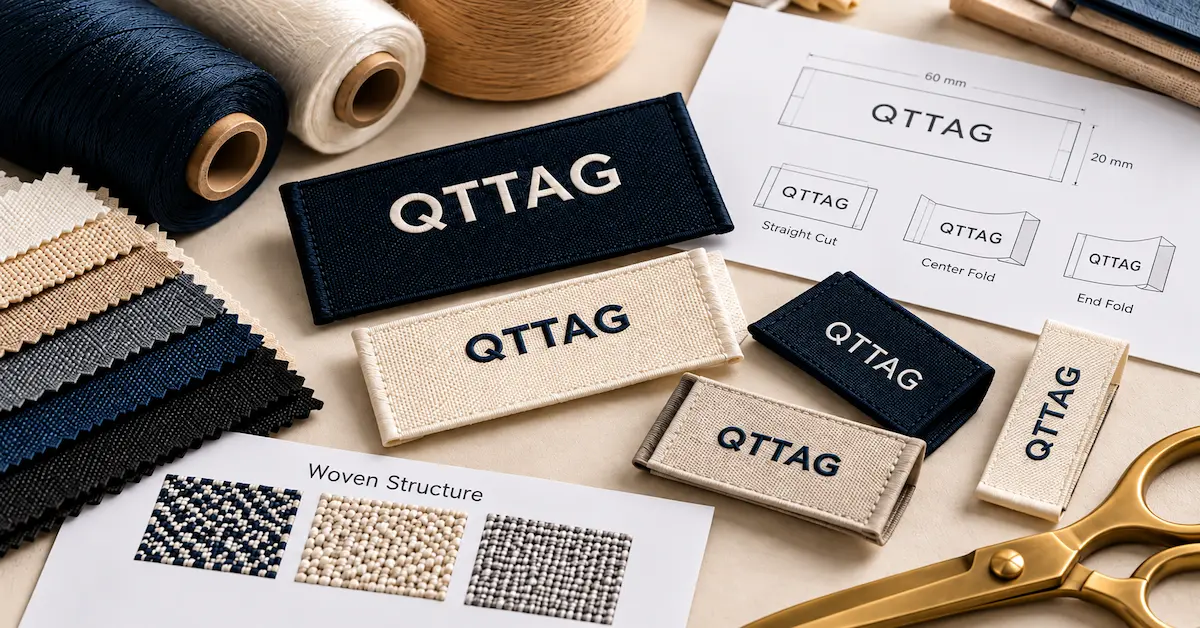
Damask Woven Labels
Damask woven labels are commonly considered for designs requiring relatively refined woven artwork.
They may be suitable for detailed lettering and selected graphic elements, depending on yarn and production specifications.
A damask construction should not automatically be assumed to reproduce every small design accurately.
Physical sampling remains important.
Satin Woven Labels
Satin woven labels may provide a different surface appearance or texture.
The actual result depends on the selected weave and manufacturing construction.
Buyers should examine physical samples rather than make a decision based on material names alone.
Taffeta Labels
Taffeta-style woven labels may be offered as part of a supplier's product range.
Their appearance, flexibility and suitability depend on the actual specification.
The buyer should confirm the construction and intended use.
High-Density Woven Labels
High-density woven labels are often discussed when a design requires relatively fine detail.
However, "high density" is not a universal guarantee of a specific logo resolution.
A buyer should request clear manufacturing specifications and representative samples.
Construction Comparison
| Woven Label Option | Design Consideration | Approval Focus |
|---|---|---|
| Damask | Refined textile artwork | Logo clarity and weave detail |
| Satin-style | Surface appearance | Texture and material feel |
| Taffeta-style | Suitable woven construction | Flexibility and finished appearance |
| High-density weave | Fine graphic reproduction | Small text and detailed artwork |
The best construction is one that meets the agreed visual and garment requirements.
What Materials Are Used for Woven Labels?
Yarn material influences woven texture, color, flexibility and production performance.
Polyester yarns are widely used in commercial woven label manufacturing, while other fiber options may be available depending on the supplier.
Polyester Yarns
Polyester-based constructions may offer a range of yarn colors and woven finishes.
The actual properties depend on the specific yarn, weave and treatment.
Cotton and Other Yarns
Selected alternative yarn materials may be considered for certain designs.
Buyers should confirm manufacturing compatibility and the actual material composition.
Recycled Polyester
Some projects may explore yarns containing documented recycled content.
Any recycled-content claim must be supported by relevant evidence for the specific product.
Material Selection Checklist
Buyers should compare yarn composition, texture, color, flexibility, artwork reproduction and suitability for the garment.
A particular fiber name does not automatically establish better comfort, durability or environmental performance.
How Custom Woven Labels Improve Brand Identity
For clothing brands, one of the main reasons to choose custom woven labels is the ability to control how the logo appears.
Accurate Logo Proportions
The production artwork should preserve the recognizable features of the approved logo.
Coordinated Brand Colors
Yarn colors can be selected to support the intended visual direction.
However, woven yarn and printed paper may not reproduce a digital color reference identically.
Consistent Typography
Letter spacing, line thickness and positioning should be evaluated at the finished label size.
Multiple Garment Styles
A brand may use a consistent design across T-shirts, knitwear, outerwear and other products.
The physical dimensions or folds may need to change for different garments.
Coordinated Branding Accessories
Woven labels can share artwork references with custom hang tags, care labels and apparel packaging.
The goal is a recognizable identity rather than identical manufacturing materials.
Woven Label Design: How to Prepare the Artwork
A successful woven label begins with production-ready artwork.
The design should be evaluated according to the intended size and weave construction.
Use Approved Logo Files
Vector artwork can provide clear shapes and proportions.
The supplier should confirm its preferred file format.
Review Small Lettering
Tiny text and narrow strokes may require adjustment.
Ask for an artwork feasibility review before manufacturing.
Define the Finished Dimensions
Include width, height and relevant fold or sewing allowances.
Confirm Yarn Colors
Use available physical yarn references when possible.
Specify Artwork Orientation
For folded designs, confirm which parts of the artwork remain visible after folding and attachment.
Approve Any Revisions
The manufacturer should not independently change a logo without approval.
Artwork Preparation Checklist
| Requirement | What to Confirm |
|---|---|
| Logo | Approved version |
| Typography | Readable at finished dimensions |
| Colors | Suitable yarn references |
| Dimensions | Final width and height |
| Weave | Proposed manufacturing construction |
| Fold | Correct artwork positioning |
| Sewing | Allowance and attachment location |
| Versions | Correct artwork for each garment |
What Fold Types Are Available for Woven Labels?
Folding influences both appearance and attachment.
Different fold constructions are suitable for different garment applications.
End Fold Labels
The ends are folded backward to create a finished format.
They may be considered where the label is stitched across its ends.
Center Fold Labels
A center fold creates two sides and is commonly considered for suitable seam insertion.
The artwork should be positioned according to the intended visible area.
Straight Cut Labels
Straight cut labels use an unfolded construction.
Edge quality and attachment requirements must be evaluated.
Mitre Fold Labels
Mitre folds create angled end sections.
They may be considered where a particular presentation or sewing method is desired.
Fold Type Comparison
| Fold Type | Main Feature | Important Check |
|---|---|---|
| End fold | Folded ends | Sewing allowance and symmetry |
| Center fold | Folded through the middle | Visible artwork and seam placement |
| Straight cut | Unfolded edge construction | Edge finish |
| Mitre fold | Angled folded ends | Shape and alignment |
The finished label size should always be specified separately from the artwork area when folding affects the dimensions.
Choosing Woven Labels for Different Garments
The intended garment influences the label size, thickness, fold and attachment.
T-Shirts
T-shirts may require compact neckline branding that complements lightweight fabric.
Knitwear
Label construction should be evaluated for comfort, flexibility and the garment's knitting structure.
Jackets and Outerwear
These garments may accommodate larger woven brand labels or different placement options.
Sportswear
Garment movement, fabric properties and intended use should be considered.
Children's Clothing
Applicable labeling and safety requirements may influence the appropriate material and attachment.
Premium Fashion Collections
Material appearance, artwork definition and brand consistency may be particularly important.
Sample on the Actual Garment
A loose woven label may look appropriate but behave differently after sewing.
Where practical, evaluate a representative finished garment before bulk approval.
Custom Woven Labels vs Printed Clothing Labels
Woven labels and printed labels are manufactured differently.
A woven label forms its artwork using yarns, whereas a printed label applies artwork or information using a printing process.
| Feature | Woven Labels | Printed Labels |
|---|---|---|
| Artwork | Interlaced yarn design | Printed graphic or text |
| Surface | Woven textile texture | Printed material surface |
| Fine information | Depends on weave capability | Depends on printing capability |
| Typical branding | Woven logo and identification | Printed logo or detailed information |
| Material options | Suitable woven yarns | Suitable printable substrates |
| Attachment | Sewing or compatible construction | Sewing or compatible construction |
| Main buying decision | Textile look and woven details | Printing and information requirements |
A fashion brand may use both.
For example, a woven label can identify the brand while a separate printed care label carries garment information.
The choice should reflect the function of each label.
Are Custom Woven Labels More Expensive?
Custom woven label pricing depends on the actual manufacturing specification.
A customized logo may require new artwork preparation, sampling or production setup.
However, the final unit price cannot be determined simply by the word "custom."
Important factors may include:
-
Label dimensions
-
Yarn composition
-
Weave construction
-
Number of colors
-
Logo detail
-
Cutting and folding
-
Order quantity
-
Design variations
-
Sampling requirements
-
Packing and delivery
Design Complexity
Fine artwork may require additional production preparation.
Quantity
MOQ and production pricing vary by supplier and construction.
Material Selection
Different yarns and weave specifications may have different costs.
Fold and Finishing
Additional manufacturing steps may influence the quotation.
Complete Cost Comparison
Compare labels using equivalent dimensions, materials and finishing requirements.
A cheaper option is not necessarily the better choice if it fails to meet the brand's intended design.
How to Approve a Custom Woven Label Sample
Physical sampling is important because woven appearance cannot be judged completely from digital artwork.
Step 1: Confirm the Artwork
Review the logo, typography, colors and dimensions.
Step 2: Select Yarn and Weave
Compare suitable materials and constructions.
Step 3: Specify the Fold and Finish
Confirm cutting, folding and intended attachment.
Step 4: Produce a Physical Sample
The sample should represent the final proposed construction.
Step 5: Inspect Logo Reproduction
Check the smallest letters, lines and graphical details.
Step 6: Review the Garment Application
Attach the sample to the intended garment where practical.
Step 7: Evaluate Relevant Performance
Review material feel, attachment and suitable laundering requirements.
Step 8: Record Approval
Retain the physical sample and production specifications.
Sample Approval Checklist
| Inspection Item | What Buyers Should Check |
|---|---|
| Logo | Clarity and correct proportions |
| Yarn | Approved material and appearance |
| Colors | Physical yarn references |
| Dimensions | Finished width and height |
| Weave | Texture and detail |
| Edges | Cutting quality |
| Fold | Accuracy and symmetry |
| Attachment | Intended garment application |
| Performance | Agreed test requirements |
Common Mistakes When Ordering Woven Labels
Several sourcing mistakes can be avoided with clearer specifications.
Using Artwork That Is Too Detailed
Small features may not reproduce clearly in the selected weave.
Choosing Material From Photographs Alone
Surface texture and flexibility are difficult to evaluate digitally.
Ignoring Folding Allowances
The visible artwork may not fit the intended finished dimensions.
Selecting the Wrong Label Size
A label may appear disproportionate on the garment.
Assuming High-Density Weaving Solves Every Problem
Even a refined weave has manufacturing limitations.
Skipping Physical Samples
A digital preview cannot demonstrate the complete finished product.
Mixing Artwork Versions
Different collection styles may require controlled label variations.
Ignoring Garment Compatibility
The label must work with the intended fabric and attachment method.
Quality Control for Bulk Woven Label Production
After sample approval, production should follow the agreed specifications.
Material Consistency
Confirm the correct yarn and proposed construction.
Logo Accuracy
Compare woven details with the approved reference.
Color Consistency
Inspect the physical appearance under appropriate conditions.
Dimensions
Measure the finished labels using agreed tolerances.
Weave Quality
Check for visible defects or unacceptable irregularities.
Cutting and Folding
Inspect edge finishing and fold position.
Order Identification
Separate different artwork, color or size versions where necessary.
Packing
Confirm quantities and labeling before shipment.
A good quality-control process should identify issues during production rather than rely only on the final finished batch.
How to Choose a Custom Woven Label Manufacturer
Apparel brands should evaluate suppliers based on their actual ability to manufacture the required label.
Review Available Weave Constructions
Ask which woven structures are available for the intended design.
Check Yarn and Color Options
Confirm relevant materials and physical color references.
Evaluate Artwork Preparation
The supplier should identify potential logo-resolution problems before production.
Request Physical Samples
Examine representative materials and finished constructions.
Understand MOQ
Minimum order quantities depend on the specific product and supplier.
Review Quality-Control Practices
Ask how logo clarity, color, dimensions and finishing are checked.
Confirm Repeat-Order Procedures
Approved materials and artwork should remain identifiable for future production.
Compare Equivalent Quotations
Ensure competing offers use comparable specifications.
What Should Buyers Include in a Woven Label RFQ?
A detailed RFQ helps suppliers provide more useful recommendations and quotations.
| RFQ Information | What to Provide |
|---|---|
| Brand artwork | Approved logo file |
| Garment type | Intended clothing application |
| Label dimensions | Finished width and height |
| Yarn material | Preferred composition |
| Weave construction | Preferred type or visual reference |
| Colors | Approved references |
| Fold type | End fold, center fold or other |
| Cutting | Required edge finish |
| Attachment | Intended sewing location |
| Quantity | Estimated order volume |
| Variations | Different designs, colors or sizes |
| Sampling | Physical sample approval |
| Performance | Relevant washing or durability needs |
| Delivery | Destination and schedule |
If the exact weave construction has not been selected, buyers can provide a representative garment, design artwork and desired appearance.
The supplier can then discuss suitable options.
Frequently Asked Questions About Woven Labels
What is the difference between woven labels and custom woven labels?
Woven labels are a broad category of textile labels manufactured with interlaced yarns. Custom woven labels are produced according to a buyer's specific artwork, dimensions, colors and finishing requirements.
Are custom woven labels better than standard woven labels?
Not automatically. The better option depends on whether the available construction meets the brand's design and garment requirements.
What materials are used in woven labels?
Woven labels commonly use suitable textile yarns, including polyester-based options. Other materials may be available depending on the manufacturing specification.
What are damask woven labels?
Damask woven labels use a woven construction that may suit relatively detailed textile branding. Actual logo reproduction depends on the selected yarn, design and weave.
Are high-density woven labels suitable for small logos?
Some high-density constructions can support finer artwork, but very small lettering still requires technical review and physical sample approval.
What fold types are available for woven labels?
Common options include end folds, center folds, straight cuts and mitre folds, depending on the intended garment application.
Can a woven label reproduce an exact logo color?
Yarn colors can be selected to support brand references, but exact appearance depends on available yarns and woven construction. Physical samples should guide approval.
Are woven labels comfortable against the skin?
Comfort depends on material, thickness, edge finishing, placement and attachment. The complete garment application should be evaluated.
What is the minimum order quantity for custom woven labels?
MOQ varies by supplier, dimensions, yarns, weave and other specifications. Request a quotation using the actual design.
How do I choose between woven and printed labels?
Choose according to the required artwork, garment function, surface appearance and information. Physical samples are useful for comparing the two.
Develop Custom Woven Labels With QTTAG
Woven labels and custom woven labels belong to the same product family. The meaningful difference is the level of customization required by the apparel brand.
A successful woven label project combines approved artwork, suitable yarns, appropriate weave construction, accurate dimensions and consistent finishing.
QTTAG supports custom garment branding projects, including woven labels, printed care labels, heat transfer labels and coordinated apparel identification products.
When developing a new clothing collection, share the approved logo, desired label dimensions, color references, garment type, fold requirements and estimated quantity.
These details provide a starting point for reviewing available woven constructions and physical sampling.
Ready to Create Custom Woven Labels for Your Clothing Brand?
Share your logo artwork, garment specifications, preferred yarn colors, woven label dimensions, fold requirements and estimated order quantity with QTTAG.
Our team can discuss suitable woven label customization and sampling options for your apparel collection.
Request a Quote
Author
Founder at QTTAG
Jason Qiao is the founder of QTTAG, focusing on garment branding and packaging solutions. With years of experience in the apparel industry, he shares practical insights on custom labels, hang tags and sustainable packaging to help global brands grow.
Written By
Jason Qiao