A Practical Guide to Care Labels for Clothing Brands
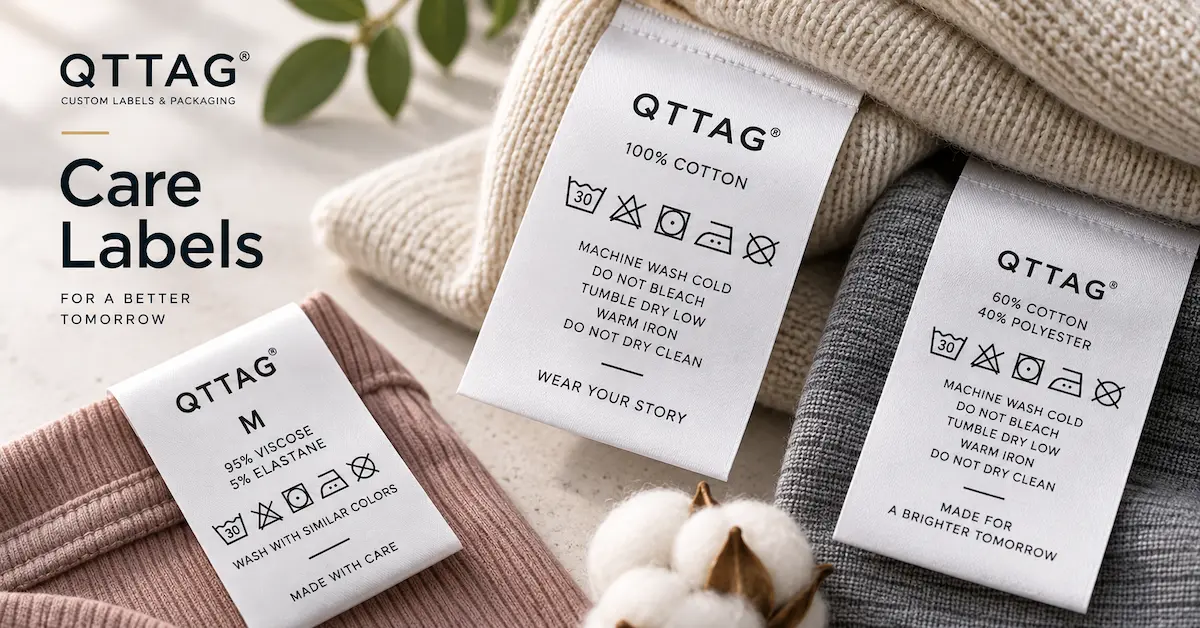
A customer washes a new sweater according to its care label. The garment shrinks. The customer complains, and the clothing brand discovers that the instructions were copied from another style using a different fabric.
The label itself was printed correctly. The information was wrong.
This example shows why care labels deserve more attention during apparel development. They are not simply pieces of fabric carrying washing symbols. They communicate instructions that consumers rely on, while certain markets also impose specific textile labeling requirements.
For clothing brands, the challenge is making sure the information is accurate before it reaches the printing stage.
Care labels should be developed using verified garment specifications, supported care instructions, applicable market requirements, and an approved final layout. The wording and symbols must describe the actual product, remain readable, and be reviewed whenever the garment's materials or construction change.
This guide explains how to plan clothing care labels, understand common care symbols, distinguish labeling obligations across markets, and avoid mistakes before bulk production.
What Are Care Labels for Clothing?
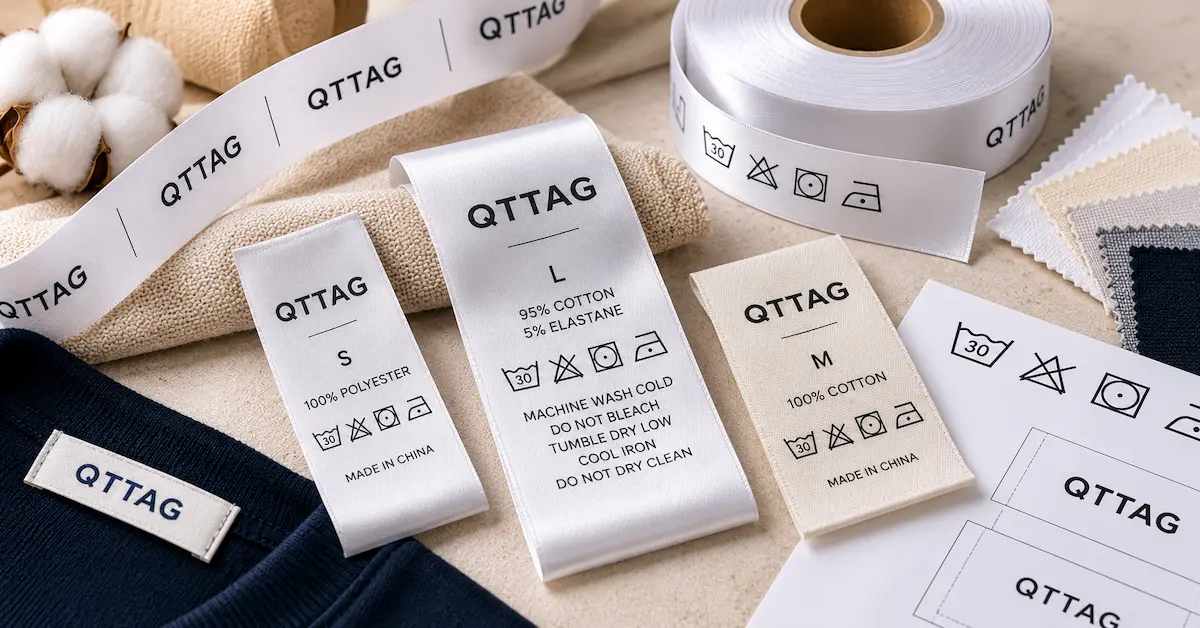
Care labels are labels or markings that communicate information about how a garment should be maintained.
They may use written instructions, standardized graphic symbols, or both, depending on the product and destination market.
Common subjects include:
-
Washing methods
-
Washing temperatures
-
Bleaching
-
Drying
-
Ironing
-
Professional textile care
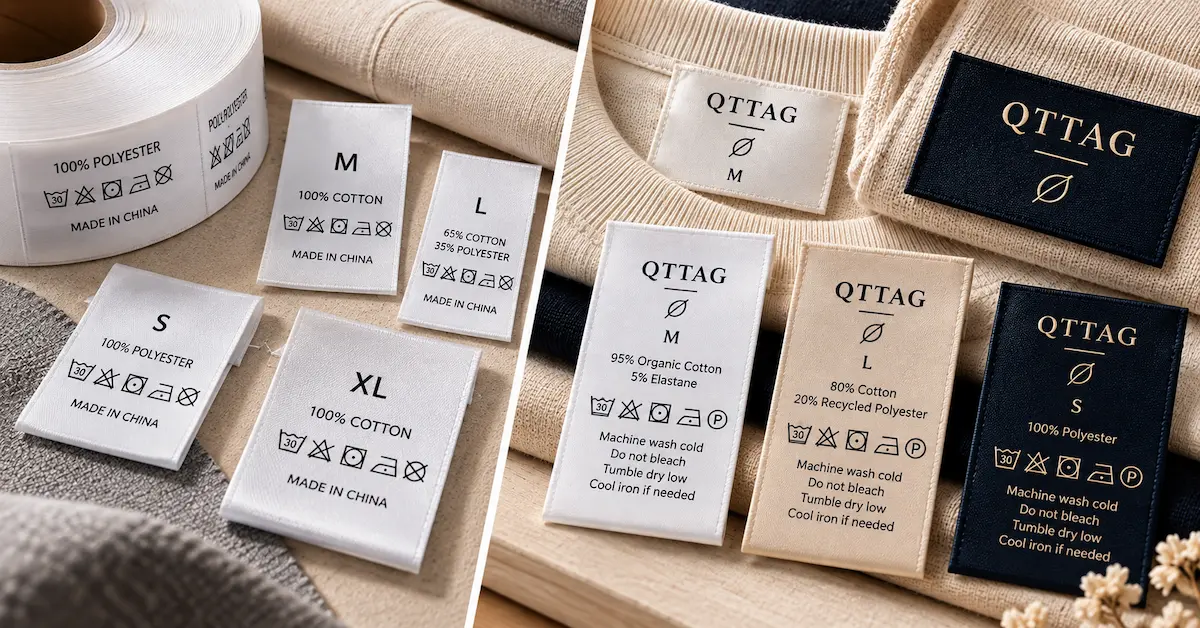
A care label may also carry information such as fiber composition, country of origin, responsible business identification, size, or product codes.
However, these disclosures are not all governed by the same laws.
For example, in the United States, the Care Labeling Rule addresses care instructions, while other textile labeling provisions address fiber content, origin, and business identification.
For international brands, it is useful to treat care information and other legally required textile information as related but distinct responsibilities.
Care Labels vs Brand Labels
| Feature | Care Labels | Brand Labels |
|---|---|---|
| Main Purpose | Explain garment care | Identify the brand |
| Typical Information | Washing, drying and ironing | Brand name and logo |
| Buyer Priority | Accuracy, readability and durability | Visual identity and appearance |
| Regulatory Relevance | Depends on applicable care-labeling rules | May coexist with other mandatory disclosures |
| Production Review | Content and technical approval | Artwork and branding approval |
A garment may combine several functions on one physical label, provided that the resulting label meets the relevant requirements.
Why Accurate Care Instructions Matter
The quality of a care label begins with the garment, not the label printer.
A manufacturer can reproduce the supplied wording perfectly, but that does not establish whether the instructions are appropriate for the product.
Care recommendations should account for the garment's materials and construction.
A shirt might contain a cotton-rich outer fabric, polyester sewing thread, decorative printing, and other components.
The care method should be suitable for the garment as a whole, not merely one individual material.
What Can Go Wrong?
Incorrect care information may lead to:
-
Shrinkage or dimensional changes
-
Color bleeding or fading
-
Damage to prints or decorations
-
Distortion of garment components
-
Customer complaints
-
Returns or product disputes
-
Compliance concerns
These risks should be assessed before care information is approved.
The Garment Is the Reference
Suppose a clothing brand changes a fabric specification during development.
The new material may have different care requirements.
Even when the design looks the same, the original care-label instructions should be reviewed again.
Do not assume that previously approved information remains correct after a material or construction change.
Understanding the Five Main Laundry Care Symbol Groups
Care symbols help communicate garment maintenance information in a compact visual format.
The widely recognized GINETEX system is associated with five principal care categories.
These are washing, bleaching, drying, ironing, and professional textile care.
The actual symbols and their variations carry specific meanings.
Washing
The washing symbol is commonly represented by a wash tub.
Its variations may communicate permitted washing conditions, temperature limits, or the required washing process.
A brand should choose the instruction supported by the garment's care requirements.
Bleaching
The bleaching category is generally represented by a triangle.
Different variations communicate whether bleaching is permitted or restricted.
Selecting a symbol without checking the actual garment can create misleading instructions.
Drying
A square is used within the care-symbol system for drying information.
Additional markings distinguish different drying methods and conditions.
Ironing
The iron symbol communicates ironing conditions or restrictions.
Its variations should reflect what the garment can tolerate.
Professional Textile Care
A circle is used for professional textile-care processes.
Its markings identify relevant professional cleaning requirements or restrictions.
Care Symbol Reference
| Care Category | General Symbol Shape | What Buyers Must Confirm |
|---|---|---|
| Washing | Wash tub | Method and permitted conditions |
| Bleaching | Triangle | Whether and how bleaching is allowed |
| Drying | Square | Appropriate drying method |
| Ironing | Iron | Permitted ironing conditions |
| Professional Care | Circle | Appropriate professional cleaning process |
This table explains symbol categories; it does not replace the official definitions of individual symbols.
Important: The GINETEX care symbols are protected trademarks in many countries. Commercial use may require an appropriate license. Brands and label manufacturers should verify symbol usage rights before reproducing them.
Are Care Symbols the Same Worldwide?
No. International textile-care communication involves different legal systems, standards, and industry practices.
A brand selling clothing across multiple markets should not assume that one symbol set automatically satisfies every market.
International Care Symbol Systems
ISO 3758 is an international standard concerning the use of graphic symbols for textile care labeling.
GINETEX is closely associated with the widely recognized care-symbol system.
Other markets may apply different requirements or industry conventions.
A clothing brand should establish which rules and accepted symbol systems apply to its intended destinations.
Questions to Ask Before Selecting Symbols
-
In which countries will the garments be sold?
-
Are written care instructions required?
-
Are symbols accepted or required?
-
Does the selected symbol system require authorization?
-
Who will verify the final care information?
-
Does the label need additional languages?
-
Are there product-specific exceptions?
These questions should be resolved before production artwork is released.
The goal is not to put every available symbol on the label.
It is to communicate supported and appropriate instructions for the finished garment.
Care Label Requirements in the United States
The United States has specific federal requirements relevant to many textile products.
The Federal Trade Commission administers the Care Labeling Rule, codified in 16 CFR Part 423.
For covered textile wearing apparel, manufacturers and importers generally must provide appropriate regular-care instructions, subject to the rule's scope and exemptions.
What Must Care Instructions Communicate?
The applicable instructions need to describe regular-care procedures and appropriate warnings.
The requirements vary according to the product and care method.
The instructions must have a reasonable basis.
A clothing brand should not invent washing temperatures or maintenance claims simply because they appear common in its product category.
Permanence and Accessibility
For covered garments, the rule generally requires care information to be provided through an appropriate label that remains available to the consumer, subject to specified exceptions.
The precise requirements should be checked against the rule.
Other U.S. Textile Labeling Information
Many covered textile and wool products are also subject to requirements involving:
-
Fiber content
-
Country of origin
-
Manufacturer or other responsible business identification
These requirements arise under textile and wool labeling provisions separate from the care instructions themselves.
Practical U.S. Label Review
| Label Information | Main Review Question |
|---|---|
| Care Instructions | Are they supported and appropriate for the finished garment? |
| Fiber Content | Does the disclosure match the actual product? |
| Country of Origin | Has origin been determined correctly? |
| Business Identification | Is the responsible business identified as required? |
| Legibility | Can the information be read? |
| Attachment | Does the labeling arrangement meet applicable requirements? |
For exact wording, exemptions, and placement rules, refer to the applicable FTC regulations and official guidance.
Textile Labeling Requirements in the European Union
The European Union regulates textile fiber names and composition labeling through Regulation (EU) No 1007/2011.
The regulation addresses how fiber composition is identified for covered textile products.
It also includes requirements concerning the legibility, accessibility, and language of applicable fiber-composition information.
What Regulation 1007/2011 Covers
Its primary focus is textile fiber names and the labeling or marking of fiber composition.
Specific rules apply to different product types and textile constructions.
What It Does Not Cover
An important distinction is that Regulation 1007/2011 does not itself harmonize washing and care instructions, garment sizing, or country-of-origin labeling across the EU.
These topics should not automatically be treated as requirements established by this particular regulation.
Separate national rules, other applicable legislation, commercial practices, or relevant standards may need to be considered.
European Market Review
| Topic | Main Consideration |
|---|---|
| Fiber Composition | Apply relevant EU textile fiber labeling rules |
| Language | Check requirements for the destination Member State |
| Care Instructions | Review applicable national rules and other requirements |
| Care Symbols | Check applicable system and usage rights |
| Product Claims | Ensure information is accurate and supported |
| Other Information | Review other applicable product-specific requirements |
Clothing brands selling across several European markets should have their proposed label content reviewed for each relevant destination.
United States vs European Union: What Is Different?
Both markets place importance on accurate textile information, but their regulatory structures differ.
A single generic label template may not be enough for every product.
U.S. and EU Labeling Comparison
| Topic | United States | European Union |
|---|---|---|
| Care Instructions | FTC Care Labeling Rule applies to covered products | No single EU-wide care-labeling requirement established by Regulation 1007/2011 |
| Fiber Content | Relevant FTC textile and wool labeling rules | Regulation (EU) No 1007/2011 |
| Origin Information | Applicable U.S. textile origin disclosures | Not harmonized by Regulation 1007/2011; other rules may apply |
| Languages | Applicable U.S. labeling requirements | Fiber-label language rules depend on destination Member State |
| Care Symbols | Must follow applicable rule and permitted presentation | Check relevant standards, practices and usage rights |
| Compliance Review | Product and market-specific | Product and destination-specific |
This is a high-level comparison, not an exhaustive legal checklist.
The legal requirements depend on the product, market, and current rules.
Buyers should confirm final compliance requirements with qualified professionals or responsible compliance teams.
How to Verify Fiber Content Before Printing
Fiber-content mistakes can occur when labels are copied between similar garments.
Two products may use the same design and appearance but have different material compositions.
For example, a clothing collection might include:
-
A cotton T-shirt
-
A cotton-polyester blend T-shirt
-
A polyester performance T-shirt
Even if all three use the same brand logo, their fiber-content information may differ.
Use the Final Approved Material Specification
The source of truth should be the verified technical specification for the actual garment.
A supplier's preliminary fabric quotation may not represent the final approved material.
Similarly, a fabric composition listed in an old tech pack may no longer be accurate after development changes.
Check Multi-Component Garments
A garment may contain several textile components with different fiber compositions.
The applicable rules may require different ways of presenting that information.
Do not assume one general fiber statement correctly describes every component.
Fiber Content Verification Checklist
| Check | Responsible Source |
|---|---|
| Actual Material Composition | Approved material specification |
| Main Fabric | Verified garment BOM or supporting documentation |
| Secondary Textile Components | Relevant material records |
| Applicable Labeling Rules | Responsible compliance reviewer |
| Final Wording | Approved label master |
| Final Artwork | Controlled production file |
The label manufacturer should receive approved wording rather than being expected to determine the garment composition independently.
Care Labels for Cotton, Polyester and Blended Fabrics
Different fibers have different properties, but fiber content alone does not establish the correct care instruction.
Fabric finishing, dyeing, decorative elements, seams and garment construction can change care performance.
Cotton Garments
Cotton fabrics can behave differently depending on construction and finishing.
Some products may experience shrinkage under particular washing or drying conditions.
The appropriate care instructions should be determined for the finished garment.
Polyester Garments
Polyester products can differ in construction, finishes and heat sensitivity.
The presence of polyester does not justify assigning one universal ironing or drying instruction.
Cotton-Polyester Blends
Blended fabrics combine fibers, but their final care requirements depend on the material and garment as a whole.
Do not simply choose care instructions based on the fiber present in the largest proportion.
Knitwear and Delicate Constructions
Fabric structure can be as important as fiber content.
A loosely knitted garment may require different handling from a firmly woven textile made from similar fibers.
Why Testing Matters
Where appropriate, care recommendations may be supported by:
-
Garment or material test results
-
Reliable technical literature
-
Relevant production experience
-
Other acceptable evidence under applicable rules
The testing method should correspond to the garment's intended care instructions.
A generic material assumption is not a substitute for an appropriate basis.
Designing Care Labels That Remain Readable
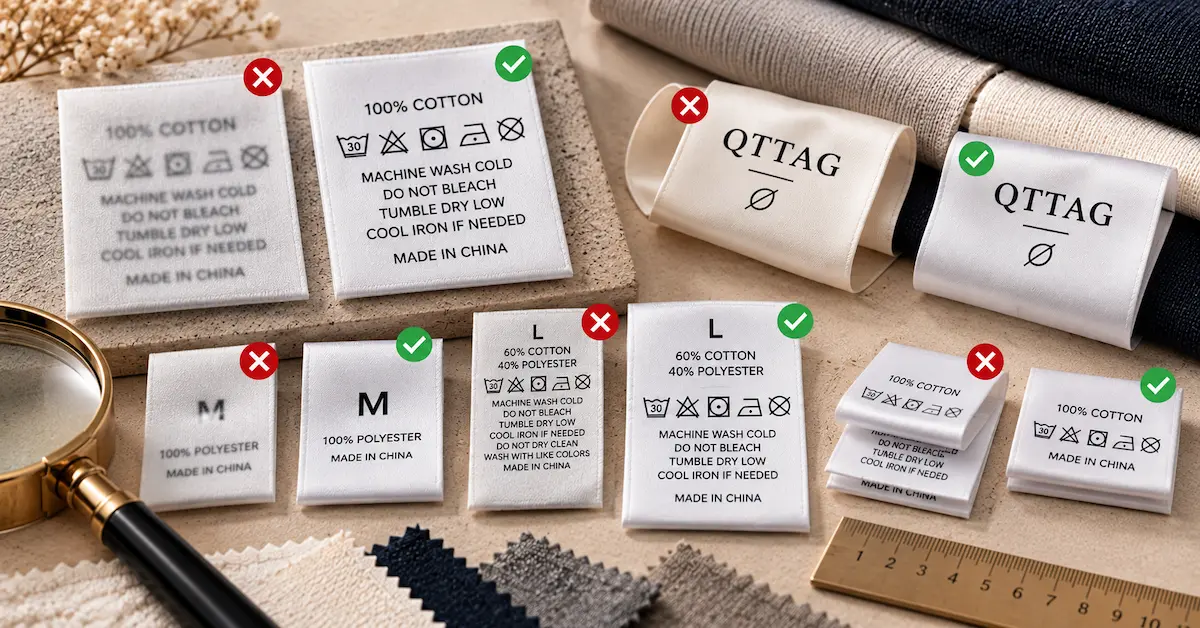
A legally reviewed care-label design can still create problems if customers cannot read it.
Care labels often contain substantial information in limited space.
Shrinking the text is not always an acceptable solution.
Establish Information Hierarchy
Group related information logically.
For example, fiber content should be clear and care instructions should be easy to locate.
Do not let decorative branding distract from important disclosures.
Check the Actual Size
Review the printed label at its finished dimensions.
A design shown at four times its actual size may appear much clearer than it will on the garment.
Consider Folding and Sewing
Some label areas may be concealed by folds or seams.
The usable printing area should account for the finished construction.
Readability Checklist
| Review Item | What to Confirm |
|---|---|
| Text Size | Important information is readable |
| Contrast | Text stands out from the substrate |
| Symbol Clarity | Selected symbols remain recognizable |
| Margins | No important content is cut off |
| Folding | Required information remains accessible |
| Surface | Printing remains clear on the actual material |
| Durability | Legibility meets applicable requirements |
Printed information should be checked after representative finishing, not only on the original artwork.
How to Prevent Common Care Label Errors
Most care-label problems can be grouped into content, design, and production errors.
Error 1: Using Care Instructions from Another Garment
A similar-looking garment may have different materials or finishes.
Prevention: Link care instructions to the approved garment specification.
Error 2: Using Incorrect Fiber Content
The material may have changed during development.
Prevention: Verify composition against the current product records.
Error 3: Selecting Unsupported Care Symbols
A care symbol may communicate conditions that have not been validated.
Prevention: Use reviewed instructions and applicable symbol guidance.
Error 4: Omitting a Required Language
The label may be intended for more than one destination.
Prevention: Complete a market-by-market language review.
Error 5: Making Text Too Small
The designer may reduce the font to fit more content.
Prevention: Reconsider the layout or label size instead of sacrificing readability.
Error 6: Using an Outdated Artwork File
The garment's care requirements may have been revised, but the printer receives an earlier version.
Prevention: Use controlled artwork revisions and an authorized production release.
Error Prevention Matrix
| Error | Possible Consequence | Preventive Control |
|---|---|---|
| Wrong Care Instructions | Garment damage or misleading guidance | Technical content approval |
| Incorrect Fiber Content | Mislabeling | Verified composition records |
| Wrong Language | Market compliance issues | Destination review |
| Unreadable Text | Poor usability or noncompliance | Actual-size proof check |
| Wrong Symbols | Misleading instructions or IP concerns | Symbol and license verification |
| Outdated Artwork | Incorrect production | Revision control |
These controls should be completed before approving bulk printing.
Who Should Approve Care Label Information?
Care labels frequently require input from more than one department.
The supplier can manufacture the physical label, but the underlying garment data must be verified by the appropriate responsible party.
Suggested Approval Responsibilities
| Role | Main Responsibility |
|---|---|
| Product Development | Confirm garment materials and construction |
| Technical Team | Establish supported garment-care requirements |
| Compliance Team | Check relevant market obligations |
| Design Team | Prepare clear layout using approved information |
| Purchasing Team | Ensure correct label version and order details |
| Label Manufacturer | Produce labels against agreed specifications |
| Quality Team | Inspect output against approved requirements |
These responsibilities are an illustrative workflow.
The organization may assign them differently, especially in smaller brands.
What matters is that each critical decision has a clear owner.
Do Not Confuse Artwork Approval with Compliance Approval
A designer may confirm that a label looks attractive.
That does not establish that its care instructions are correct.
Similarly, a printer may confirm that the symbols are clear.
That does not establish that the brand has the right to use a protected symbol system or that the instructions are supported.
Content approval and print approval should be treated separately.
Care Label Compliance Checklist Before Bulk Production
A structured checklist makes the final review easier to repeat.
Final Care Label Checklist
| Checkpoint | Approval Requirement |
|---|---|
| Garment Identification | Correct style and product version |
| Material Information | Matches verified specifications |
| Care Instructions | Supported by appropriate evidence |
| Destination Market | Requirements reviewed |
| Fiber Disclosure | Applicable information included |
| Origin and Business Details | Reviewed where required |
| Language | Suitable for intended destination |
| Symbols | Correct meaning and usage authorization |
| Print Readability | Checked at actual size |
| Label Construction | Appropriate for garment and rules |
| Artwork Revision | Latest approved version |
| Physical Sample | Reviewed when required |
| Bulk Production Release | Authorized approval documented |
A label should not be released for production when critical information remains unverified.
If the garment specification changes, review whether the care label needs updating before the next order.
What to Include in a Care Label RFQ
A care-label quotation should cover the physical label requirements as well as the information and versions to be printed.
Care Label RFQ Template
| RFQ Field | Information to Provide |
|---|---|
| Garment Type | T-shirt, jacket, knitwear, etc. |
| Approved Label Text | Final content |
| Care Symbols | Approved symbols and usage rights |
| Fiber Information | Verified composition |
| Languages | Approved language versions |
| Finished Dimensions | Required width and height |
| Material Preference | Suitable label substrate |
| Printing | Print colors and readability requirements |
| Fold Type | Required construction |
| Attachment Position | Garment location |
| Quantity | Pieces per version |
| Variations | Product styles, markets or sizes |
| Quality Requirements | Relevant inspection and performance criteria |
| Delivery | Destination and requested schedule |
If multiple garment styles require different care information, provide a version breakdown.
Confirm the exact scope of the supplier's services before accepting a quotation.
Frequently Asked Questions About Clothing Care Labels
What is a care label in clothing?
A care label is a label or marking that provides instructions for maintaining a garment. It may explain washing, drying, ironing, bleaching, and professional cleaning requirements.
Are care labels required on clothing?
Requirements depend on the product and sales market. The United States has specific FTC care-labeling rules for covered garments. Other markets may use different legal frameworks.
What information should a clothing care label include?
Appropriate care instructions are central to a care label. Fiber composition, origin, and business identification may also be required under separate applicable textile labeling rules.
What do the five main laundry symbols represent?
They represent washing, bleaching, drying, ironing, and professional textile care. Their detailed markings communicate particular care conditions.
Can I use care symbols instead of written instructions?
That depends on the destination market, applicable rules, and symbol system. Do not assume symbol-only labeling is accepted everywhere.
Does ISO 3758 make care labeling mandatory worldwide?
No. ISO 3758 establishes a standardized approach to care symbols, but the legal obligation to provide care information depends on relevant market laws.
Do care symbols require a license?
Some widely used care symbols are protected trademarks, including the GINETEX system in many countries. Commercial users should verify the applicable licensing requirements.
Are EU clothing care-label requirements the same as U.S. requirements?
No. The U.S. FTC Care Labeling Rule addresses regular-care instructions for covered products. EU Regulation 1007/2011 primarily concerns textile fiber composition and does not establish an equivalent EU-wide care-labeling framework.
Can I use the same care label for different garments?
Only when the information is accurate and suitable for all relevant garments and markets. Different materials, finishes, or production details may require different label versions.
Should care labels be washable?
Care-label construction and legibility must suit the garment's use and any applicable durability requirements. The selected material and print should be evaluated under relevant conditions.
What is the difference between a care label and a wash care label?
The terms are often used interchangeably. A wash care label commonly refers to a garment label providing washing and other maintenance instructions.
Can QTTAG produce custom care labels?
QTTAG offers custom care-label solutions. Buyers should provide approved information, artwork, dimensions, material preferences, quantities, and any relevant compliance requirements for project review.
Develop Accurate Custom Care Labels with QTTAG
A care label should be approved as carefully as the garment it belongs to.
Start with the final fabric specification and confirmed garment construction. Establish appropriate care instructions using reliable evidence.
Then identify the intended sales markets and review the applicable labeling obligations.
Once the content is approved, prepare a readable physical layout and confirm the label material, dimensions, attachment, and production version.
QTTAG supports custom care labels, printed clothing labels, woven labels, and coordinated apparel branding products.
If you are developing care labels for a new clothing collection, prepare the verified label text, destination markets, garment specifications, and estimated quantities.
Our team can discuss suitable materials, label construction, customization, and sampling options.
Ready to Create Custom Care Labels for Your Clothing Brand?
Share your approved care instructions, fiber information, artwork, label dimensions and estimated quantities with QTTAG. Our team can discuss suitable materials, customization and sampling options.
Request a Quote → Create Your Custom Sample
Author
Founder at QTTAG
Jason Qiao is the founder of QTTAG, focusing on garment branding and packaging solutions. With years of experience in the apparel industry, he shares practical insights on custom labels, hang tags and sustainable packaging to help global brands grow.
Written By
Jason Qiao