How to Choose Custom Clothing Labels for Modern Apparel Brands
Custom clothing labels are more than small pieces of branding sewn into garments. They connect a brand's visual identity with the practical requirements of clothing production.
A label that looks perfect on a design screen may not reproduce correctly when woven into fabric. Small lettering can lose definition, folded edges can affect the finished dimensions, and the wrong material may feel uncomfortable against the skin.
For apparel brands, the real challenge is turning approved artwork into a label that can be manufactured consistently.
To order custom clothing labels successfully, start with the garment application, prepare production-ready artwork, choose a suitable material and construction, confirm the finished dimensions, and approve a physical sample before bulk manufacturing. Every decision should be documented in a specification that the manufacturer can follow.
This guide explains the customization process from the buyer's perspective, including the information to prepare, the production choices to compare, and the checks that help reduce avoidable errors.
What Are Custom Clothing Labels?
Custom clothing labels are garment identification components manufactured according to a brand's specific design and technical requirements.
Unlike generic labels, they can be developed with custom logos, colors, dimensions, materials, folds, and finishing methods.
Common applications include:
-
Fashion brand labels inside T-shirts and jackets
-
Private-label clothing identification
-
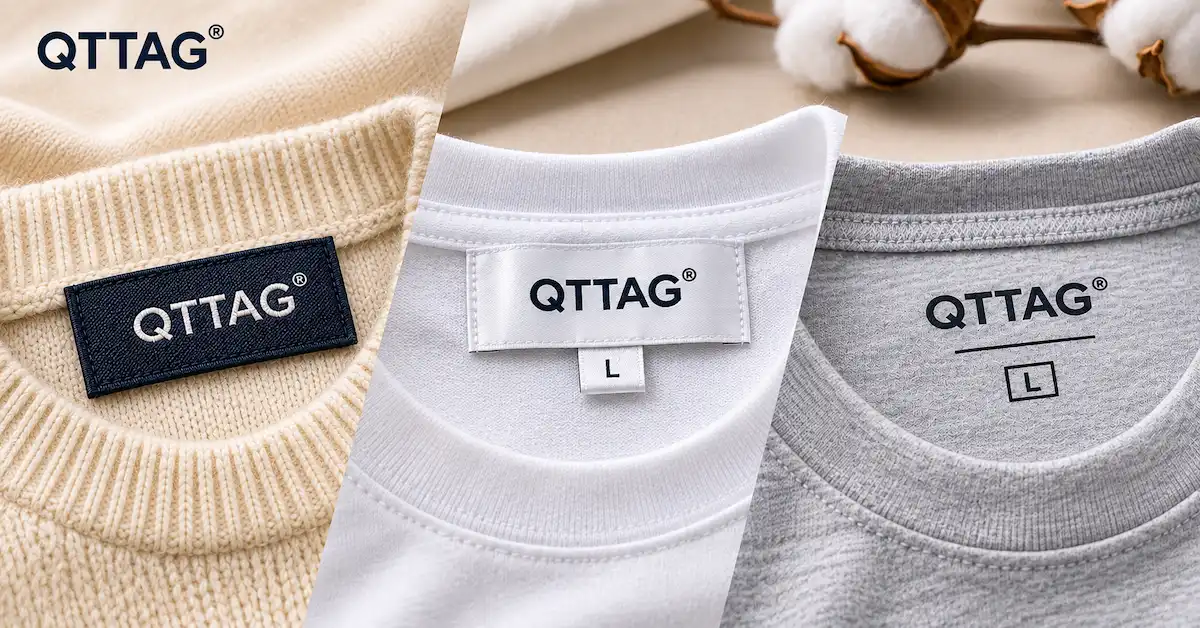
Custom woven neck labels
-
Size labels for apparel collections
-
Printed fabric labels
-
Decorative labels on sleeves and hems
-
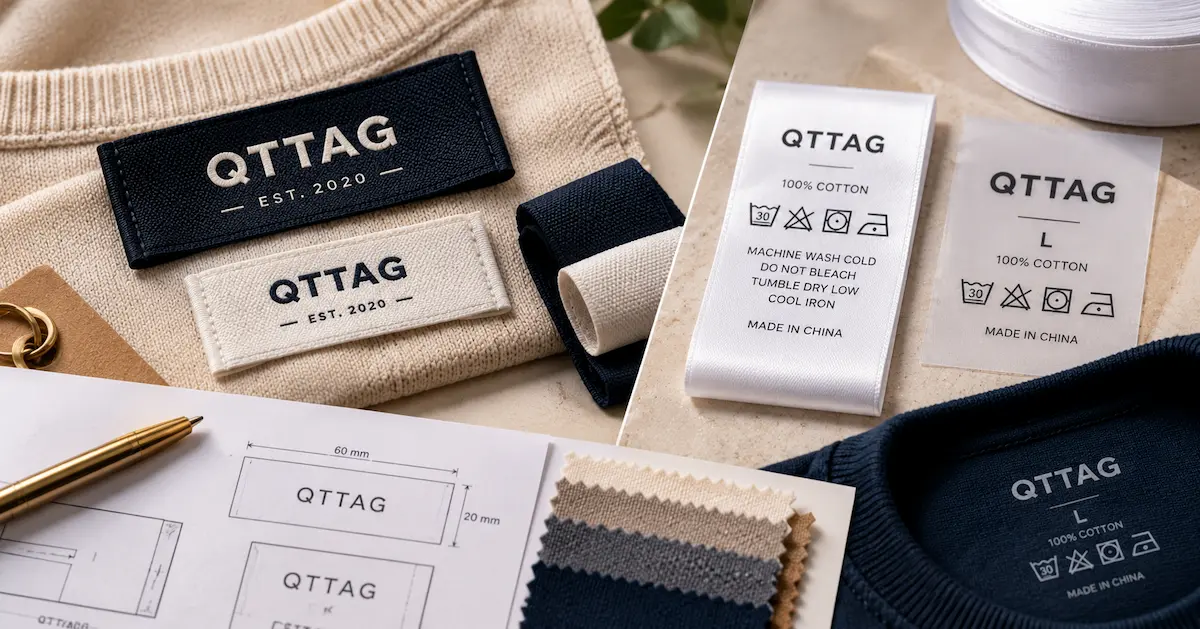
Custom care and information labels
A custom clothing label should perform two jobs well: represent the brand accurately and remain suitable for its intended garment application.
The design is only one part of the process. The material, construction, attachment method, and durability also matter.
Custom vs Standard Clothing Labels
| Feature | Standard Label | Custom Clothing Label |
|---|---|---|
| Branding | Generic or predefined | Brand-specific artwork |
| Dimensions | Standard options | Custom dimensions within production limits |
| Colors | Limited selection | Defined brand colors |
| Materials | Preselected | Selected according to design and application |
| Fold Types | Standard construction | Application-specific fold options |
| Artwork | Limited customization | Custom logo, lettering and graphics |
| Development | May require little design work | Requires artwork and specification approval |
Custom development gives buyers more control, but it also requires clearer communication with the supplier.
Define Your Clothing Brand's Label Requirements
Before choosing materials or requesting prices, establish what the label needs to accomplish.
Different clothing categories require different labeling solutions.
For example, a custom label for a cotton T-shirt may need to be small, flexible, and comfortable.
A label for a denim jacket may be more visible and incorporate a stronger woven texture.
A premium knitwear brand might prefer restrained lettering and a soft finish.
Identify the Garment Application
Start by answering these questions:
-
What type of garment will use the label?
-
Where will the label be attached?
-
Will the label contact the wearer's skin?
-
Is the label mainly decorative or informational?
-
Will it need to withstand repeated laundering?
-
What is the preferred finished size?
-
Which brand colors must be reproduced?
-
How many variations are required?
These details help the manufacturer evaluate the project before sampling.
Example: Custom Label Requirements by Product
| Clothing Product | Common Label Requirement | Main Consideration |
|---|---|---|
| Cotton T-shirt | Small custom neck label | Comfort and clarity |
| Hoodie | Woven brand and size labels | Durability and attachment |
| Denim Jacket | Decorative woven label | Texture and visual impact |
| Premium Knitwear | Soft woven or suitable printed label | Hand feel and finish |
| Activewear | Low-profile label or compatible heat transfer | Flexibility and wash performance |
| Fashion Accessories | Small woven or printed branding label | Dimensions and attachment method |
There is no universal label construction suitable for every garment.
The correct specifications should follow the garment's actual use.
Prepare Production-Ready Logo Artwork
Artwork preparation is one of the most important steps in custom clothing label development.
A digital logo can contain features that are difficult to reproduce at small physical dimensions.
Thin lettering, tiny gaps, detailed illustrations, and subtle color gradients may behave differently depending on the manufacturing process.
Use Clear Artwork Files
Vector files are generally useful because their dimensions can be adjusted without the same loss of detail associated with low-resolution raster images.
Common production file formats include:
-
AI
-
EPS
-
PDF with vector artwork
-
SVG, when supported by the supplier
A high-resolution PNG may be useful as a visual reference, but it may not contain the information needed for final production.
Confirm the supplier's preferred file requirements.
Check Small Details
Before submitting the artwork, inspect:
-
Letter spacing
-
Thin lines
-
Small symbols
-
Logo proportions
-
Background colors
-
Minimum readable text size
-
Color separation requirements
A manufacturer may recommend simplifying certain elements to improve reproduction.
The goal is not to change the brand identity. It is to make the approved design suitable for the selected production method.
Protect Your Logo Proportions
Do not stretch a logo to fill a label.
If the label dimensions do not match the artwork proportions, adjust the surrounding space or reconsider the label size.
This is particularly important for brands using a separate logo symbol and wordmark.
For QTTAG-style branding systems, maintaining consistent symbol geometry and wordmark spacing across woven labels, hang tags, and packaging is part of a coordinated presentation.
Choose the Right Material for Custom Clothing Labels
Material selection affects texture, appearance, flexibility, and durability.
A material should be chosen according to the garment's intended use rather than visual appearance alone.
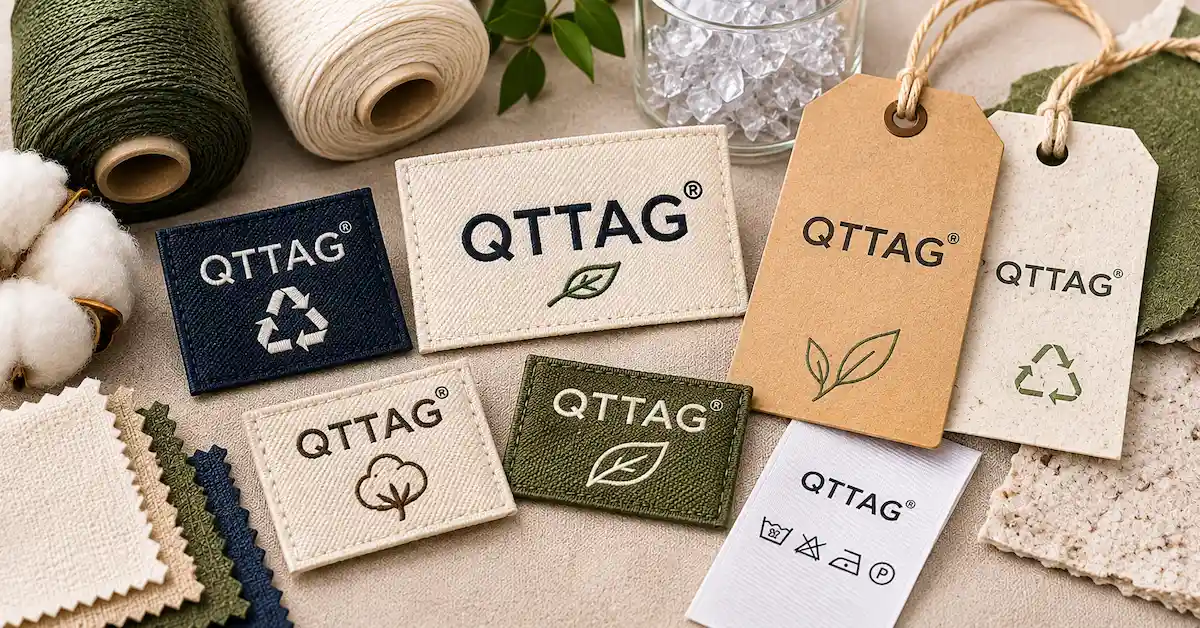
Custom Woven Labels
Woven labels use yarns to form the design.
They are frequently considered for brand identification where a textile appearance is desirable.
The result depends on weaving construction, yarn properties, density, and artwork complexity.
Printed Fabric Labels
Printed labels apply information or graphics to a fabric substrate.
They can be useful for detailed logos, smaller lettering, and certain information-label applications.
Printing performance depends on the substrate, ink, method, and finishing process.
Satin and Other Fabric Options
Satin-type materials may provide a smooth, lustrous appearance.
Other woven substrates offer different levels of texture, stiffness, and visual character.
Material descriptions alone cannot fully communicate hand feel.
Request physical samples when comfort, thickness, or texture is important.
Material Selection Checklist
| Selection Factor | What to Check |
|---|---|
| Appearance | Color, sheen and surface texture |
| Comfort | Softness and edge feel |
| Artwork Detail | Legibility at finished size |
| Durability | Relevant laundering and abrasion performance |
| Garment Compatibility | Fabric weight and attachment method |
| Manufacturing | Available production processes |
| Cost | Material, complexity and order quantity |
A good material choice should satisfy the design requirements without creating unnecessary problems during garment production.
How to Choose Custom Label Sizes
Label size should be established before final artwork approval.
The finished dimensions determine how much information can be displayed and how the label will appear once attached.
A larger label may offer more space for detailed branding, but it can also create unnecessary bulk.
A smaller label may be discreet, but lettering can become difficult to reproduce or read.
Finished Size vs Production Size
One of the most common sources of confusion is the difference between a label's visible dimensions and the dimensions required before folding or attachment.
For example, a center fold label may have a visible area that represents only part of the full manufactured piece.
The specification should state whether each measurement describes:
-
The full label before folding
-
The finished visible width
-
The finished visible height
-
The fold allowance
-
The area captured in the garment seam
Providing only one pair of dimensions may not be sufficient.
Test the Actual Size
Print or produce the design at its intended scale.
Place it on the garment and check whether the brand name is readable and the label proportions look balanced.
What looks appropriately sized on a computer screen may feel too large or too small on finished clothing.
Understanding Custom Label Folding Options
The fold construction influences both appearance and attachment.
Several common options are available.
Center Fold Labels
Center fold labels are folded in half and commonly attached with the open ends captured in a seam.
They are useful for many neck and side-seam applications.
End Fold Labels
End fold labels have folded ends that can be secured to the garment.
They can provide a clean presentation when the construction is appropriate for the intended attachment.
Straight Cut Labels
Straight cut labels are supplied without additional folds.
Their edges must be suitable for the selected finishing and attachment process.
Mitre Fold Labels
Mitre folds create angled ends and may be selected for certain hanging or specialty label applications.
Choosing a Fold Type
| Fold Type | Typical Application | Buyer Check |
|---|---|---|
| Center Fold | Neck or seam branding | Visible dimensions and seam allowance |
| End Fold | Flat attached labels | Folded ends and sewing position |
| Straight Cut | Flat label applications | Edge treatment and attachment |
| Mitre Fold | Specialty sewn or hanging labels | Fold geometry and clearance |
The final choice should be confirmed with the garment manufacturer or sewing team.
A label that is manufactured correctly but specified with an unsuitable fold may still be difficult to attach.
How to Select Custom Label Colors
Color consistency is important when labels form part of a wider branding system.
The challenge is that color can appear different across digital displays, printed paper, woven yarns, and packaging materials.
Provide Color References
Instead of relying only on screenshots, provide recognized color references or approved physical samples where possible.
Color matching may involve constraints related to available yarns, inks, and materials.
A manufacturer should explain when an exact visual match cannot be guaranteed across different processes.
Compare Samples Under Suitable Lighting
Review label samples using consistent lighting conditions.
A color that appears correct under warm indoor lighting may look different in daylight.
When several products need matching brand colors, establish a shared approval reference.
Coordinate Across Products
For collections requiring woven labels, printed care labels, hang tags, and packaging, consider approving colors together.
This reduces the risk of the same brand color appearing noticeably different across components.
Understand the Custom Clothing Label Manufacturing Process
The production process varies according to the selected label type.
For a typical woven label project, development may involve the following stages.
Step 1: Artwork Review
The manufacturer reviews the supplied logo, dimensions, colors, and required construction.
Unclear details should be resolved before the design moves forward.
Step 2: Material and Construction Selection
The supplier confirms a suitable material, weaving approach, fold type, and finishing method.
Step 3: Sample Development
An initial sample is produced for evaluation.
The buyer checks the physical result against the approved design brief.
Step 4: Sample Revision and Approval
If necessary, the artwork, dimensions, colors, or construction are adjusted.
Changes should be recorded so the final approved version is clear.
Step 5: Bulk Manufacturing
Production begins according to the approved specifications and commercial terms.
Step 6: Finishing and Inspection
Labels may be cut, folded, finished, sorted, and inspected according to the project requirements.
Step 7: Packing and Delivery
Finished labels are packed according to the agreed quantity, variation, and shipping instructions.
Important: Not every custom label uses the same equipment or production stages. Printed labels, woven labels, and heat transfer labels require different technical processes.
The supplier should confirm the actual workflow for the selected product.
Why Custom Clothing Label Sampling Matters
Sampling helps bridge the gap between digital design and physical manufacturing.
A sample may reveal problems that were not obvious during artwork preparation.
These can include:
-
Small lettering that is difficult to read
-
Colors that differ from expectations
-
Incorrect finished dimensions
-
Rough or unsuitable edges
-
An inappropriate folding method
-
Excessive thickness
-
Poor positioning on the garment
What Should Buyers Check?
A practical sample approval checklist should include:
| Inspection Item | Approval Question |
|---|---|
| Logo | Does the artwork match the approved design? |
| Size | Are the finished dimensions correct? |
| Colors | Do the colors meet the agreed reference? |
| Material | Is the texture suitable for the garment? |
| Fold | Is the construction appropriate for attachment? |
| Edges | Are the edges clean and comfortable? |
| Text | Is all important lettering readable? |
| Attachment | Does the label work on the intended garment? |
| Durability | Does the sample meet relevant testing requirements? |
The approved sample should be retained as a manufacturing reference.
When changes are made after approval, confirm whether another sample is necessary.
What Determines Custom Clothing Label MOQ?
Minimum order quantity, or MOQ, is a common consideration for fashion startups and private-label businesses.
However, no single MOQ applies to all custom clothing labels.
It may depend on:
-
Manufacturing method
-
Material
-
Artwork complexity
-
Label size
-
Number of colors
-
Number of design variations
-
Production setup requirements
-
Order packaging requirements
A project involving one design in a single size may have different production requirements from a collection containing multiple logos, colors, and label dimensions.
How Can Small Brands Plan an Order?
Small brands should prepare estimated quantities for each label variation.
For example, an apparel collection may use the same main brand label across several garment sizes but require separate size labels.
This is different from ordering a unique main brand label for every size.
The supplier can then evaluate the most practical production arrangement.
Ask for a project-specific MOQ instead of relying on generic figures found online.
How to Estimate Custom Label Production Costs
Custom clothing label pricing reflects the full manufacturing specification.
Two labels with the same external dimensions may have different costs because of their construction, artwork, materials, or finishing requirements.
Common Cost Factors
| Factor | Why It Affects Cost |
|---|---|
| Material | Different yarns and fabrics have different costs |
| Label Dimensions | Changes material consumption and processing |
| Artwork Complexity | May require more detailed production preparation |
| Colors | Can affect materials and manufacturing setup |
| Fold Type | Influences finishing and handling |
| Quantity | Changes production setup cost allocation |
| Variations | Multiple designs may require separate preparation |
| Packing | SKU sorting or individual packing adds handling |
| Testing | Additional tests may add project requirements |
Request Comparable Quotations
When evaluating suppliers, use the same specifications for every quotation.
Confirm whether the quoted price includes:
-
Sample development
-
Bulk production
-
Cutting and folding
-
Inspection
-
Sorting and packing
-
Shipping, where applicable
A lower quoted unit price may not represent the lowest overall cost if important services are excluded.
How to Evaluate an OEM/ODM Clothing Label Supplier
Choosing a suitable supplier requires more than comparing sample photographs.
The manufacturer should be able to explain how the proposed design will be produced and what information is needed before accepting the order.
Evaluate Technical Communication
Can the supplier explain the implications of small text, material choice, fold type, and finished dimensions?
A useful technical discussion should help prevent avoidable artwork and construction problems.
Review Sampling Procedures
Ask how the sample will be produced, how revisions are handled, and what constitutes final approval.
Clarify Production Variations
If your collection includes different sizes or colors, confirm how each label version will be identified.
Discuss Quality Requirements
Specify the defects that matter, the required measurements, and the inspection criteria.
Confirm Delivery Conditions
Separate sampling time, production time, and shipping time when discussing schedules.
The actual lead time should be confirmed against the approved project.
Consider Coordinated Branding
Some brands prefer to develop woven labels, size labels, care labels, hang tags, and packaging together.
A coordinated project can simplify artwork management and visual consistency, provided the supplier can support the required specifications.
Frequently Asked Questions About Custom Clothing Labels
Can I customize clothing labels with my own logo?
Yes. Custom clothing labels can be developed using brand-provided artwork. The final reproduction depends on the material, manufacturing method, and label dimensions.
What information should I provide to a clothing label manufacturer?
Provide your logo, garment application, desired dimensions, colors, material preferences, fold type, estimated quantity, and any relevant testing or delivery requirements.
Are custom woven labels suitable for luxury clothing?
They can be suitable when their texture, artwork reproduction, and finish match the garment's design requirements. Premium positioning alone does not determine the correct label material.
What is the difference between OEM and ODM clothing labels?
OEM generally refers to manufacturing according to customer-defined specifications. ODM involves additional design or development support. The exact scope should be agreed upon with the supplier.
Can small fashion brands order custom labels?
Yes, subject to the supplier's available manufacturing methods and minimum order requirements. Sharing complete specifications helps the supplier recommend practical options.
What fold types are available for custom labels?
Common choices include center fold, end fold, straight cut, and mitre fold constructions. Availability depends on the selected material and manufacturing process.
How can I ensure my logo is reproduced accurately?
Supply clear artwork, maintain the correct proportions, confirm the final dimensions, and approve a physical sample before bulk manufacturing.
Can I choose custom colors for clothing labels?
Yes, within the technical capabilities of the selected process. Use agreed color references and review physical samples.
How long does custom clothing label production take?
The schedule depends on artwork approval, material availability, production method, order quantity, and shipping arrangements. Request separate estimates for sampling and bulk production.
What should I check before approving a sample?
Review artwork, colors, dimensions, material, fold construction, edge quality, comfort, attachment suitability, and relevant durability requirements.
Start Your Custom Clothing Label Project with QTTAG
Custom clothing label development works best when the garment application, artwork, materials, and manufacturing requirements are considered together.
Before requesting bulk production, prepare a clear specification and confirm the proposed construction with the manufacturer.
For brands developing several products, it is also useful to document shared logo proportions, color references, and labeling rules across the collection.
QTTAG supports custom garment labels, woven labels, care labels, heat transfer labels, hang tags, and coordinated apparel branding products.
Ready to Develop Your Custom Clothing Labels?
Share your artwork, label dimensions, material preferences, estimated quantities and delivery requirements with QTTAG. Our team can help you explore customization and sampling options.
Request a Quote → Create Your Custom Sample
Author
Founder at QTTAG
Jason Qiao is the founder of QTTAG, focusing on garment branding and packaging solutions. With years of experience in the apparel industry, he shares practical insights on custom labels, hang tags and sustainable packaging to help global brands grow.
Written By
Jason Qiao