A Practical Guide to Custom Printed Labels for Clothing Brands
A fashion brand is preparing its next collection. The garments are ready for production, and the design team has approved the logo. Then the purchasing manager opens the label files.
There are six clothing styles, five sizes, three fabric compositions, and different labeling requirements for two export markets.
What looked like one printed label order has become a collection of variations. A single outdated file could put the wrong information on hundreds of garments.
This is where custom printed label development needs more attention than the printing itself.
To order custom printed labels successfully, clothing brands should establish approved artwork, link each label version to the correct garment, verify all variable information, and approve representative physical samples before bulk production.
This guide focuses on the practical steps that connect design, garment data, regulatory review, manufacturing and delivery. It is written for fashion brands, private-label companies and apparel purchasing teams managing customized clothing labels.
What Are Custom Printed Labels?
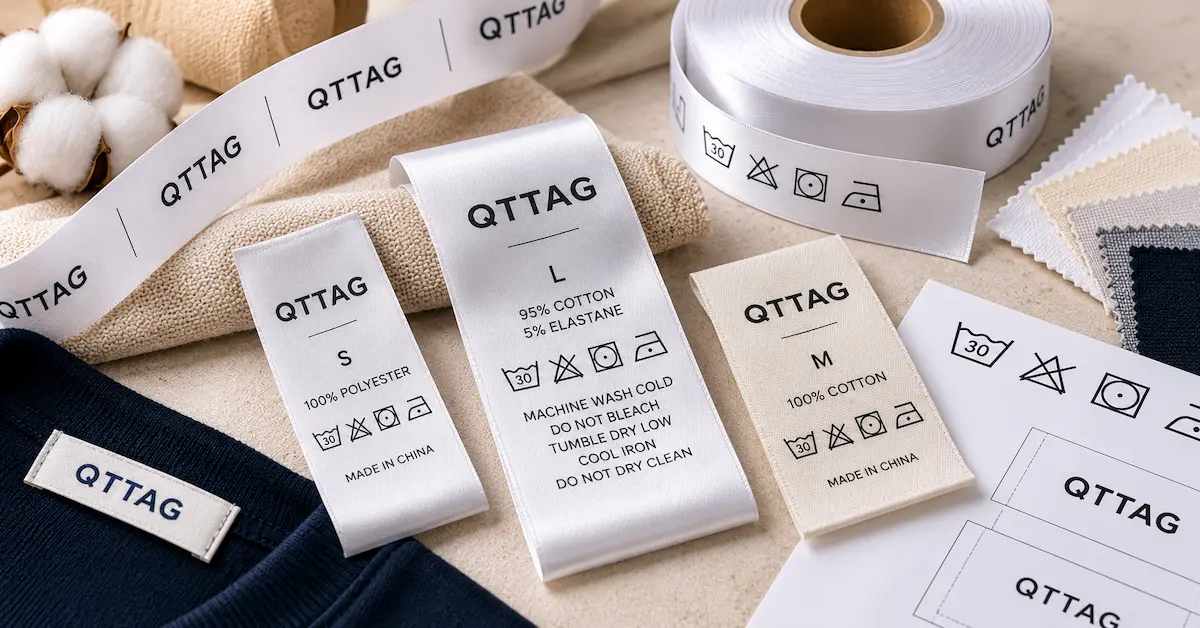
Custom printed labels are labels manufactured with brand-specific artwork, information and physical specifications.
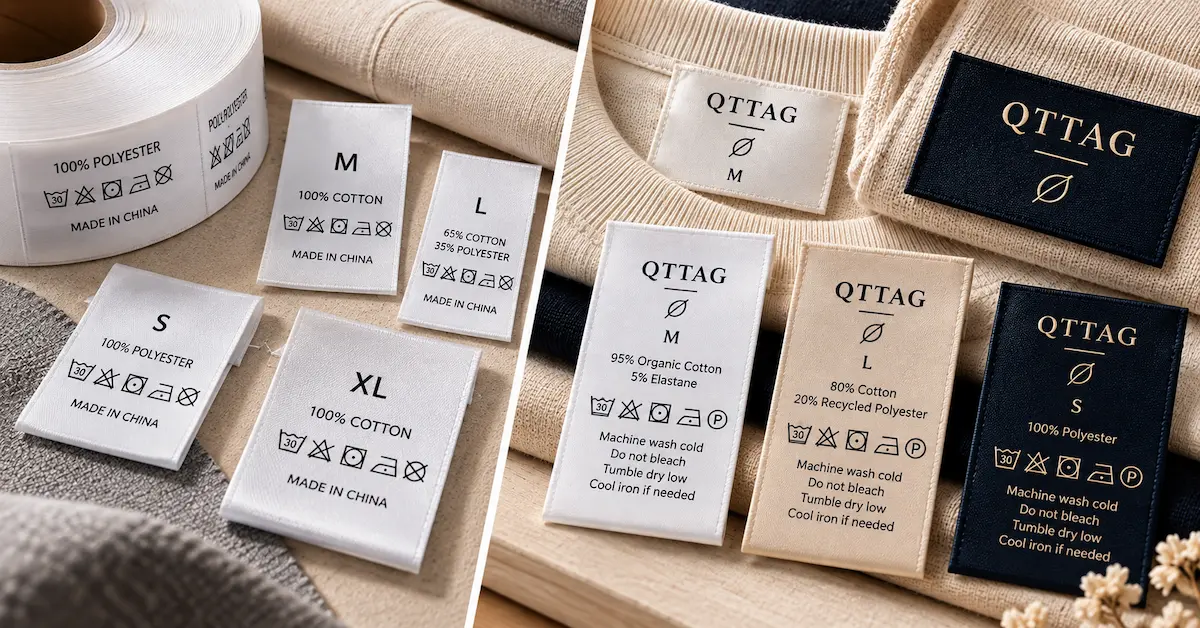
They may be used for brand identification, garment sizing, fiber composition, care instructions or other product details.
Customization can involve more than printing a logo.
Buyers may need different:
-
Brand artwork and label colors
-
Physical dimensions
-
Fabric substrates
-
Printing layouts
-
Garment size information
-
Fiber composition statements
-
Care instructions
-
Country-of-origin information
-
Languages
-
Product identification codes
Each variation introduces information that must be controlled.
For a small clothing startup, one or two approved designs may be sufficient. A larger apparel collection may require a structured approach to avoid inconsistencies across styles.
Custom Printed Labels vs Standard Printed Labels
| Factor | Standard Printed Labels | Custom Printed Labels |
|---|---|---|
| Artwork | Predefined or limited | Buyer-specific design |
| Branding | Generic or limited | Approved company identity |
| Text | Standard information | Product-specific content |
| Dimensions | Selected standard options | Project-specific dimensions |
| Languages | May be limited | Defined for target markets |
| Variations | Few predefined versions | Multiple style and SKU versions |
| Development | Limited preparation | Artwork, data and sample approval |
The exact customization options depend on the manufacturer's equipment and available materials.
Start with a Label Content Matrix
The biggest risk in a custom printed label project is not always poor print quality.
It may be incorrect information.
A label content matrix connects every approved label design to the garments that will use it.
This helps a purchasing team answer a basic question: Which information belongs on which product?
Example: Label Content Matrix
The following is an illustrative planning example, not a QTTAG customer record.
| Style Code | Garment | Size Range | Fabric Information | Label Version |
|---|---|---|---|---|
| TS-101 | Cotton T-shirt | XS–XL | Approved cotton composition | PL-101 |
| TS-102 | Blended T-shirt | XS–XL | Approved blend composition | PL-102 |
| HD-201 | Hoodie | S–XXL | Approved hoodie composition | PL-201 |
| JK-301 | Jacket | S–XL | Approved jacket composition | PL-301 |
A style code identifies the garment. A label code identifies the printed information assigned to it.
The distinction is important because two garments can look similar while requiring different information.
Avoid Using One Label for Every Style
A brand may use the same logo across all clothing products.
However, that does not mean it should use identical care or fiber-content information on every garment.
Information labels should reflect the actual product and the requirements applicable to its destination market.
Maintaining this separation makes future changes easier to track.
How to Prepare Artwork for Custom Printed Clothing Labels
Print-ready artwork must combine the approved visual design with technically accurate content.
For a brand label, the design team may focus on the logo.
For an information label, the most important elements may be readable text, approved care instructions and the correct product data.
Some labels combine both.
Prepare the Master Design
A master design establishes the elements shared by multiple label versions.
These might include:
-
Brand logo
-
Typography
-
General layout
-
Margins
-
Graphic hierarchy
-
Print colors
-
Label orientation
The master should also indicate which areas contain variable information.
Keep Variable Data Separate
Rather than manually editing an entire label for every clothing style, organize the changing information in a controlled source.
For example, the brand may maintain a spreadsheet with columns for:
Style Code | Label Code | Size | Fiber Content | Care Text | Origin | Language | Revision
The label manufacturer can review the intended production workflow based on this information.
Whether the information can be imported automatically depends on the software and equipment used.
Do not assume every supplier supports automated variable-data printing.
Artwork Preparation Checklist
| Item | Requirement |
|---|---|
| Logo | Approved brand artwork |
| Fonts | Available to the printer or properly prepared |
| Dimensions | Defined finished label size |
| Print Colors | Documented references |
| Text | Approved final wording |
| Symbols | Correct, authorized artwork |
| Data Versions | Controlled revision numbers |
| Margins | Sufficient clearance for cutting or folding |
| File Identification | Clear design and version codes |
The supplier should confirm which artwork formats it accepts.
Managing Different Garment Sizes
A clothing collection may use the same main brand label across several sizes.
Printed size information, however, must match the finished garment.
This sounds straightforward until there are hundreds of combinations.
For example, imagine a T-shirt design sold in six colors and five sizes.
That creates 30 commercial SKUs.
It does not necessarily require 30 unique printed label designs. Some versions may be shared if their information and specifications are identical.
Avoid Unnecessary Artwork Versions
The purchasing team should identify which fields actually vary.
If only the garment size changes, the brand may be able to use one approved layout with several controlled size versions.
If fabric composition also changes between colors or styles, additional label versions may be required.
Sample Size-Version Matrix
| Label Code | Size | Garment Quantity | Required Label Quantity |
|---|---|---|---|
| PL-101-XS | XS | 120 | 120 |
| PL-101-S | S | 240 | 240 |
| PL-101-M | M | 360 | 360 |
| PL-101-L | L | 200 | 200 |
| PL-101-XL | XL | 80 | 80 |
| Total | — | 1,000 | 1,000 |
This example assumes one label is required per garment, before any separately agreed allowance.
The required labels should be calculated from the approved production breakdown rather than divided equally between sizes.
Developing Multilingual Custom Printed Labels
Brands selling clothing internationally may need labels designed for more than one market.
The challenge is not simply fitting additional words into the same space.
Different markets can have different requirements concerning language, terminology, care information and legally required disclosures.
Decide Which Markets the Garment Will Enter
Before preparing translations, identify the intended destinations.
A single multilingual label may work for certain distribution plans, while another project may require separate market-specific versions.
This decision should be reviewed by the brand's compliance team.
Translation Is Not Just Graphic Design
Automatic translation can provide a starting point, but it should not replace qualified review of regulated or technical information.
Care instructions, fiber names and legal statements require particular attention.
A visually correct translation can still be inappropriate if the terminology does not meet the destination market's requirements.
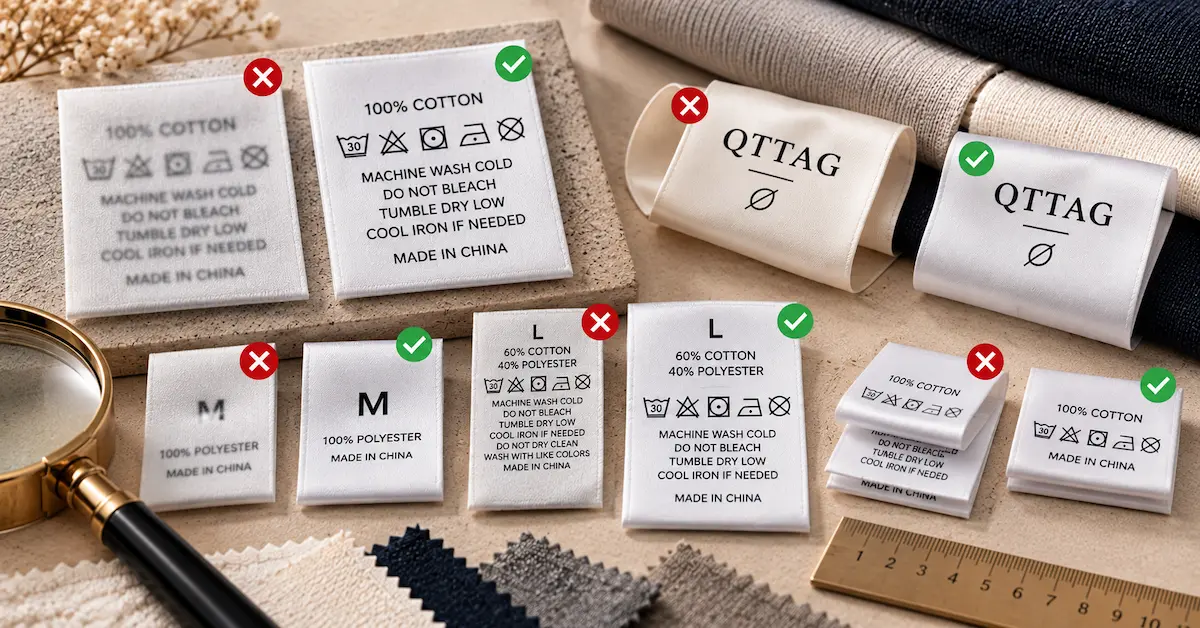
Common Multilingual Layout Problems
-
Too many languages on a small label
-
Text becoming unreadably small
-
Inconsistent technical terminology
-
Incorrect language assigned to a destination
-
Care symbols without adequate explanation
-
Missing information after layout revisions
Language-Planning Worksheet
| Planning Field | Buyer Question |
|---|---|
| Destination Market | Where will this garment be sold? |
| Required Languages | Which language obligations apply? |
| Approved Translations | Who verified the wording? |
| Label Dimensions | Is the text legible at actual size? |
| Layout Version | Which languages are included? |
| Market Allocation | Which garments receive this version? |
When a label becomes too crowded, reconsider its dimensions, layout or market allocation rather than automatically reducing the font size.
Custom Care Labels: Approve the Information Before Printing
Printed care labels often contain the information with the greatest consequence if it is wrong.
A mistake in the logo may affect visual branding. Incorrect care information may affect consumers and create compliance problems.
Fiber Composition
Fiber content should be verified against the garment's actual approved material specification.
It should not be copied from another product without checking.
Care Instructions
Care instructions should be based on appropriate garment-care information and the requirements applicable to the destination market.
A supplier should not guess the correct washing conditions from a photograph.
Country of Origin
Origin information should be determined according to the applicable rules and actual production facts.
It should not be automatically copied from the location of the label supplier.
Responsible Business Information
Certain markets and product categories require specified business-identification details.
The brand or other responsible party should approve the wording.
United States and European Union Considerations
In the United States, applicable Federal Trade Commission rules address textile labeling and garment-care information.
The European Union's Regulation (EU) No 1007/2011 concerns textile fiber names and composition labeling.
Neither framework should be treated as one universal worldwide labeling standard.
Official reference points include:
These references do not replace product-specific regulatory review.
Important: The clothing brand or responsible business should approve all required label information before instructing the manufacturer to print it.
How to Fit More Information Without Sacrificing Readability
Multilingual information and detailed care instructions can make label layouts crowded.
Simply shrinking the text is often a poor solution.
The finished label must remain readable under its expected use conditions and applicable requirements.
Establish a Clear Information Hierarchy
Consider which information must remain prominent.
The layout may include a brand name, size, fiber composition, care instructions and other details.
Organizing the content into logical groups can improve readability.
Review Both Sides When Appropriate
Some printed label constructions may allow information on both sides.
Whether this is suitable depends on the manufacturing method, attachment arrangement and applicable labeling requirements.
The buyer should confirm the usable area rather than assuming the entire substrate is available for printing.
Choose Dimensions Based on Content
The label size should reflect the approved information.
If the text cannot be read comfortably at actual size, discuss a different layout, larger label or alternative version strategy.
Printed Label Layout Review
| Problem | Possible Adjustment |
|---|---|
| Small text is hard to read | Increase text size or label space |
| Multiple languages are crowded | Reorganize content or review market versions |
| Cutting is close to printed text | Increase safe margins |
| Symbols are too small | Review scale and approved artwork |
| Fabric creases across key information | Reconsider construction or placement |
| Label feels bulky | Review material and fold arrangement |
Changes to physical dimensions or construction should be approved before production.
How to Handle Fabric Composition Changes
Consider a clothing brand developing a T-shirt collection.
The initial specification uses one fabric blend. During sampling, the brand chooses another fabric because it provides a different hand feel.
The garment design remains almost unchanged.
However, the existing fiber-content artwork may now be incorrect.
A Fabric Change Should Trigger a Label Review
When the approved material specification changes, review all dependent information.
This may include fiber composition, appropriate care instructions, marketing claims and relevant product records.
Not every material change will alter every field, but the impact should be checked.
Revision Example
| Event | Previous Record | New Record | Required Action |
|---|---|---|---|
| Fabric composition changed | Material version A | Material version B | Review label text |
| Care guidance updated | Care version 01 | Care version 02 | Approve new wording |
| Artwork revised | Label version V01 | Label version V02 | Approve updated proof |
| Bulk production pending | Earlier label file | Current approved file | Confirm release version |
This is an illustrative scenario.
It shows why label data should remain linked to the clothing product's technical specification.
How to Prevent Printing the Wrong Artwork Version
A project can have perfectly prepared artwork and still go wrong if the manufacturer uses an outdated file.
This risk increases when several employees are involved in design approval.
Create a Single Source of Truth
Store the current approved label files in a controlled location.
The purchasing team, design department and supplier should know where to find the production version.
Older files should be clearly marked as superseded.
Use Version Numbers
A simple naming convention can help.
For example:
QTTAG_CLIENT_TS101_PRINTLABEL_V03.pdf
The example identifies the customer, garment style, label type and revision.
Your own naming system may differ, but it should prevent confusion.
Separate Proof Approval from Production Release
An approved design proof confirms the intended content and layout.
A production-release decision confirms that the correct version, specifications, quantity and packing instructions are ready for manufacturing.
These steps can be recorded separately.
Version-Control Checklist
-
Correct client and brand
-
Correct garment style
-
Correct label version
-
Correct language
-
Correct fiber information
-
Correct size variation
-
Correct physical dimensions
-
Current approval date
-
Authorized reviewer
-
Matching production order
A controlled release is especially important for orders involving many versions.
Planning Sampling for Custom Printed Labels
Not every printed label project needs the same sampling procedure.
The required sample review depends on design complexity, materials, information content and intended garment use.
A brand using a new substrate may need physical testing.
Another brand reordering a previously approved design may primarily need confirmation that the current information is correct.
Three Useful Approval Stages
Content approval: Confirm the wording, symbols, languages and variable data.
Artwork approval: Confirm the layout, margins, colors and dimensions.
Physical sample approval: Confirm the printed result, substrate, finishing, attachment and applicable performance requirements.
These stages address different risks.
A physical label with beautiful printing can still contain the wrong fiber composition.
Likewise, legally correct content can be difficult to read if the physical layout is unsuitable.
Sample Approval Table
| Check | Reviewer | Result |
|---|---|---|
| Brand Artwork | Brand/design team | Approved / Revise |
| Product Information | Technical/compliance team | Approved / Revise |
| Translation | Authorized reviewer | Approved / Revise |
| Layout | Brand and production team | Approved / Revise |
| Label Material | Product development | Approved / Revise |
| Print Clarity | Quality reviewer | Approved / Revise |
| Garment Application | Garment technical team | Approved / Revise |
| Applicable Tests | Responsible technical reviewer | Approved / Revise |
The responsible roles may vary between businesses.
The key is to ensure that each approval has an identified owner.
Preparing Custom Printed Labels for Bulk Production
After sample approval, the supplier needs a clear manufacturing order.
A project containing one artwork version is relatively straightforward.
An order containing several garments, sizes, languages and information versions requires more careful coordination.
Build a Production Release List
The list should include every approved label version and its required quantity.
For example:
| Label Version | Garment Style | Market | Quantity | Status |
|---|---|---|---|---|
| PL-101-V03 | TS-101 | Market A | 1,000 | Approved |
| PL-102-V02 | TS-102 | Market A | 600 | Approved |
| PL-201-V04 | HD-201 | Market B | 800 | Approved |
These are hypothetical examples.
If two designs differ only in language, they still require clear identification.
The supplier should not need to infer market allocation from file names alone.
Confirm Packing by Version
For multiple versions, buyers may request:
-
Separate packs by design
-
Label code identification
-
Size or language identification
-
Quantity per pack
-
Order reference
-
Revision number
-
Delivery destination
Actual sorting and packing capabilities should be confirmed in the quotation.
What Affects Custom Printed Label Pricing?
Custom printed labels can have different cost structures depending on the order.
The number of label versions may matter as much as the total number of physical labels.
A single design ordered in a large quantity differs from many small variations using different artwork.
Cost Drivers to Discuss
| Cost Factor | Purchasing Consideration |
|---|---|
| Substrate | Material and finishing requirements |
| Printing Method | Setup and compatibility |
| Artwork Versions | Number of distinct production files |
| Colors | Print system and artwork requirements |
| Physical Size | Material consumption and handling |
| Order Quantity | Production setup allocation |
| Sample Development | Approval and revision requirements |
| Testing | Agreed performance verification |
| Packing | Version-specific sorting |
| Delivery | Destination and schedule |
A quotation should make these elements clear.
Do not assume that the price for a standard printed label automatically applies to a multilingual, multi-version project.
What About MOQ?
Minimum order quantities depend on the manufacturer's production method, setup requirements and order specifications.
A project-specific MOQ is more useful than a general industry number.
Buyers should provide quantities by artwork version rather than only a total order quantity.
How to Evaluate a Custom Printed Label Supplier
A suitable supplier should understand that accuracy and version control are part of custom label manufacturing.
The ability to print a sharp logo is important, but it does not resolve every procurement risk.
Ask About Artwork Management
How does the supplier identify approved production versions?
Can different designs or sizes be clearly separated?
Ask About Information Checks
Does the supplier have a procedure for comparing printed output with approved artwork?
The brand should still take responsibility for verifying the content it supplies.
Discuss Sampling
Can the buyer review a physical sample in the intended material and construction?
What is the process if revisions are required?
Confirm Manufacturing Suitability
Does the proposed printing method suit the artwork, substrate and expected care conditions?
What testing or evidence is available when performance claims are important?
Discuss Order Organization
If the collection involves several SKUs, can the labels be counted, sorted and packed according to the required version breakdown?
A professional supplier evaluation should produce clear answers to these questions, not just an attractive product catalog.
Custom Printed Label RFQ Checklist
Before requesting a quotation, collect the necessary project information in one place.
| RFQ Field | What to Provide |
|---|---|
| Product Type | Brand label, care label, size label or other |
| Approved Artwork | Current design files |
| Information Content | Approved text and symbols |
| Languages | Required language versions |
| Garment Styles | Style codes and applications |
| Dimensions | Finished label sizes |
| Material | Preferred substrate or sample |
| Printing Requirements | Colors and readability needs |
| Quantity Breakdown | Pieces per version |
| Revision Control | Approved version codes |
| Quality Requirements | Relevant inspection and tests |
| Packaging | Separation by version or SKU |
| Destination | Receiving location |
| Timeline | Target sampling and delivery dates |
If the order contains regulated information, the brand should complete the necessary content review before final production approval.
Providing this information early helps reduce avoidable revisions.
Frequently Asked Questions About Custom Printed Labels
What are custom printed labels?
Custom printed labels are brand-specific or product-specific labels manufactured using approved artwork, information, materials, dimensions and printing requirements.
Can I print my own clothing brand logo on labels?
Yes. Brand artwork can be reproduced using a suitable printing process, subject to material compatibility, design dimensions and supplier capabilities.
Can custom printed labels include care instructions?
Yes. Printed labels may include approved care information, fiber composition and other product details, where appropriate for the label's intended use.
Can one printed label design be used for several clothing styles?
It may be possible when the information, dimensions and construction are suitable for all relevant styles. Differences in product data may require separate versions.
Can custom printed labels contain multiple languages?
Yes, subject to space, readability and production capabilities. The language and content must also meet applicable market requirements.
How do I prevent incorrect care information?
Use verified garment specifications, approved care wording, controlled artwork versions and a documented production release process.
What happens when my garment fabric changes?
Review information that depends on the material, including fiber composition and care guidance. Update and reapprove the label when necessary.
Do I need separate label files for every size?
That depends on the design and manufacturing workflow. Size variations must be clearly identified, even when a shared master layout is used.
Should I approve a physical sample?
Physical samples are useful for confirming print appearance, material, dimensions, finishing and garment compatibility. Content accuracy must also be approved separately.
What affects custom printed label MOQ?
MOQ depends on the manufacturing process, setup, substrate, design variations and order requirements. Ask for a project-specific quotation.
Can printed label versions be packed separately?
This may be available depending on the supplier's packing capabilities. Specify version and quantity requirements before ordering.
What should I send QTTAG for a custom printed label quotation?
Send your artwork, approved text, label dimensions, material preferences, language and size variations, quantity breakdown and destination.
Develop Custom Printed Labels with QTTAG
A custom printed label project is successful when the finished labels match the approved design, carry accurate information, and reach the correct garment production line.
That requires more than clear printing.
The clothing brand should verify product data and approve the content. The design team should control the artwork. The purchasing team should confirm versions, quantities and delivery instructions with the supplier.
For collections containing multiple sizes, fabric compositions or languages, a well-organized label matrix can prevent unnecessary confusion.
QTTAG provides custom printed labels, care labels and coordinated apparel branding products, with customization and sampling support.
If you are planning an order, prepare the approved artwork and a breakdown of the versions your clothing collection requires.
Ready to Develop Custom Printed Labels for Your Brand?
Share your logo, approved label content, dimensions, material preferences, language versions and order quantities with QTTAG. Our team can discuss suitable customization, sampling and production options.
Request a Quote → Create Your Custom Sample
Author
Founder at QTTAG
Jason Qiao is the founder of QTTAG, focusing on garment branding and packaging solutions. With years of experience in the apparel industry, he shares practical insights on custom labels, hang tags and sustainable packaging to help global brands grow.
Written By
Jason Qiao