Fashion Startup Resources: What Apparel Brands Need to Know
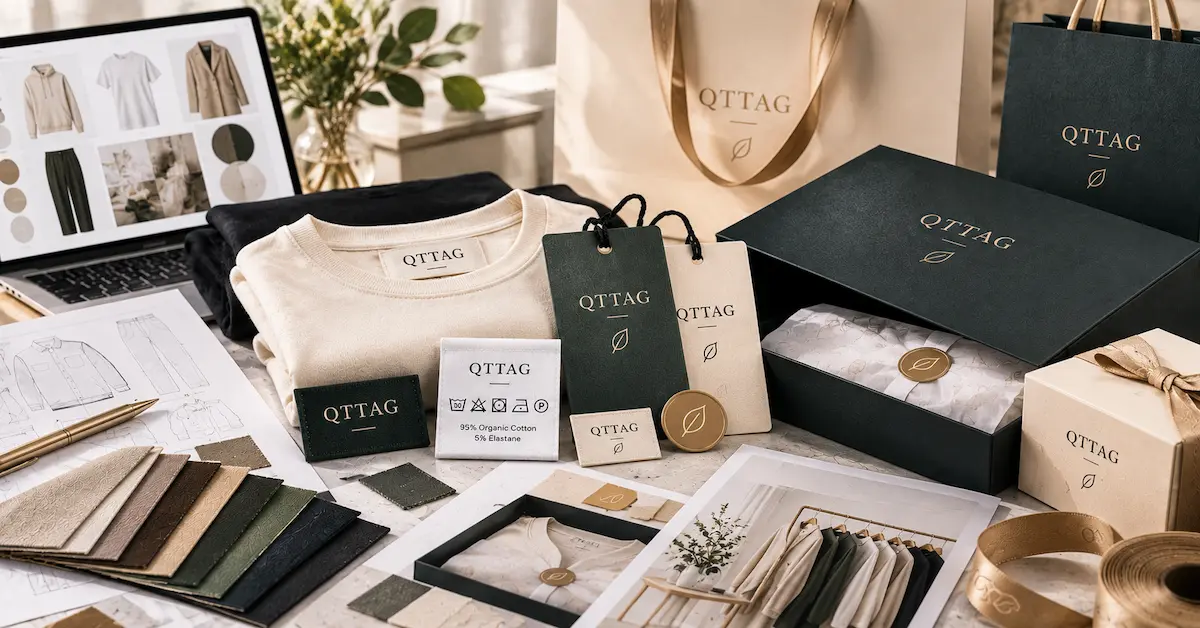
Starting a fashion brand involves more than designing clothing. New apparel businesses must make decisions about their target customers, first collection, manufacturing partners, garment labels, hang tags, packaging, product information, sampling and production budgets.
These decisions are closely connected. A brand logo influences the design of woven labels and hang tags. Garment materials affect care instructions. Packaging dimensions depend on the finished clothing, while minimum order quantities can influence which customization options are practical for an initial collection.
The most useful fashion startup resources help founders turn a clothing concept into a clear product specification, an approved sample and a manageable first production order. Before committing to bulk manufacturing, brands should establish their product requirements, identify suitable suppliers, check applicable labeling rules and understand the complete cost of bringing garments to market.
This guide explains how emerging fashion brands can organize their launch, develop a consistent branding system, prepare technical information, compare suppliers and avoid common sourcing mistakes.
What Does a Fashion Startup Need Before Launching?
A new clothing brand needs a clear product concept and a practical manufacturing plan.
A logo and collection mood board are useful starting points, but they do not provide enough information for a manufacturer to produce finished garments.
Before requesting quotations, founders should define:
-
The target customer and intended market
-
Main garment categories
-
Initial product styles
-
Fabric and construction requirements
-
Brand logo and visual identity
-
Label and packaging needs
-
Estimated order quantities
-
Target selling price
-
Intended sales channels
-
Production and launch schedule
The exact level of detail depends on whether the business is developing completely original garments or customizing existing product styles.
Start With a Focused Collection
A startup does not necessarily need many products at launch.
A small collection can be easier to manage because it reduces the number of samples, materials, artwork versions and inventory decisions.
For example, a brand focused on premium basic T-shirts might begin with a limited selection of fits, colors and sizes before expanding into additional categories.
This is a planning example, not a universal recommendation about the number of products every business should launch.
Identify What Makes the Brand Distinctive
The differentiation may come from fit, fabric, visual identity, intended use or another product characteristic.
The brand should be able to explain that difference clearly to manufacturers and potential buyers.
Build a Practical Clothing Brand Launch Plan
An organized launch plan helps founders understand which decisions must be made before production.
| Development Stage | Main Decision | Suggested Deliverable |
|---|---|---|
| Brand concept | Who is the clothing for? | Customer and positioning brief |
| Product planning | What garments will be sold? | Initial collection list |
| Technical development | How should products be made? | Product specifications |
| Supplier selection | Who can manufacture the products? | Supplier comparison |
| Brand identity | How will products be identified? | Approved logo and artwork |
| Labeling | What labels are required? | Label specification |
| Packaging | How will products be presented? | Packaging brief |
| Sampling | Do the designs work physically? | Approved samples |
| Quality review | What is acceptable? | Inspection criteria |
| Production | What will be ordered? | Confirmed purchase order |
| Launch preparation | Are products ready for sale? | Product and inventory records |
Not every task must happen sequentially.
For example, branding and product development can progress together, but final packaging dimensions should generally be verified against representative finished garments.
How to Define Your First Clothing Collection
The first collection establishes the product direction of the business.
A useful collection brief should be specific enough for sourcing teams and manufacturers to evaluate.
Choose the Product Category
Determine whether the brand will focus on T-shirts, knitwear, sportswear, outerwear, children's clothing or another category.
Different garments have different technical requirements.
Define the Intended Fit
Fit may influence fabric selection, pattern development, sizing and production.
Select Suitable Materials
Material selection should follow the product's intended appearance, comfort and use requirements.
Plan Color and Size Variations
Every additional color or size can introduce procurement and inventory considerations.
Identify Branding Locations
Decide where woven labels, printed neck labels, patches or other brand elements should appear.
Consider the Sales Channel
Garments intended for boutique retail, wholesale distribution and e-commerce may need different packaging or product identification arrangements.
A clear collection brief reduces the likelihood of major changes after sampling has begun.
Private Label Clothing vs. Custom Garment Manufacturing
Fashion startups often encounter two broad sourcing approaches: using existing product constructions with permitted customization, or developing garments to a more original specification.
These approaches are not identical.
| Factor | Private Label Using Existing Styles | Custom Garment Development |
|---|---|---|
| Starting point | Existing supplier product options | Brand-specific design requirements |
| Product development | May involve fewer structural changes | Often requires more technical development |
| Branding | Custom labels, tags and packaging may be added | Branding developed with the garment |
| Fit and construction | May follow existing specifications | May require original patterns and samples |
| Sampling | Depends on customization scope | Depends on design complexity |
| MOQ | Supplier- and product-specific | Supplier- and product-specific |
| Main consideration | Product suitability and branding flexibility | Technical control and development capacity |
When Private Label May Be Suitable
An emerging brand may consider existing garment styles when their construction, material and fit already suit the business.
The supplier must confirm which changes are permitted.
When Custom Development May Be Suitable
An original collection may require custom patterns, materials, construction methods or other technical details.
This can involve additional development and approval work.
Avoid Assuming One Method Is Always Cheaper
The cost depends on garment construction, material quantities, supplier terms and the number of required changes.
Compare actual quotations based on equivalent specifications.
How to Find and Evaluate Clothing Manufacturers
Supplier selection affects the quality and feasibility of a clothing startup's first collection.
The most suitable manufacturer is one whose capabilities match the actual product requirements.
Confirm Product Experience
A manufacturer specializing in one garment category may not be the best match for an unrelated product.
Ask whether the supplier can produce the required materials, construction and finishing.
Review Manufacturing Requirements
Provide a product specification rather than only reference images.
This helps suppliers evaluate feasibility.
Discuss Minimum Order Quantities
MOQ should be confirmed for the exact garment, material and customization requirements.
Ask About Sampling
Understand the sample-development process, revision arrangements and approval responsibilities.
Review Quality Control
Ask how materials, garment dimensions, sewing, branding and finished products are inspected.
Clarify Production Responsibilities
Some brands source garments, labels and packaging from different suppliers.
Others use manufacturing partners that coordinate several components.
Establish who will manage each part of the project.
Compare Complete Quotations
Check the quotation scope, exclusions, shipping terms and relevant commercial conditions.
An attractive unit price is not enough to evaluate the complete purchasing arrangement.
Why Brand Identity Should Be Defined Before Ordering Labels
Clothing labels reproduce the brand's identity in physical form.
If the logo, typography or colors are still changing, label development may need to be repeated.
Establish an Approved Logo
Use a consistent master artwork file.
Define the Visual System
Confirm the relevant colors, typefaces and proportions.
Consider Different Materials
A logo may appear on woven textile, printed satin, paper tags and packaging boxes.
These materials reproduce artwork differently.
Prepare Production Versions
The supplier may require artwork adapted to the selected manufacturing process.
Any adjustments should preserve the intended brand identity and receive approval.
Maintain Version Control
A final approved file should be clearly identified.
This reduces the risk of producing labels from an outdated logo.
What Clothing Labels Does a Fashion Startup Need?
The answer depends on the garment, branding requirements and destination market.
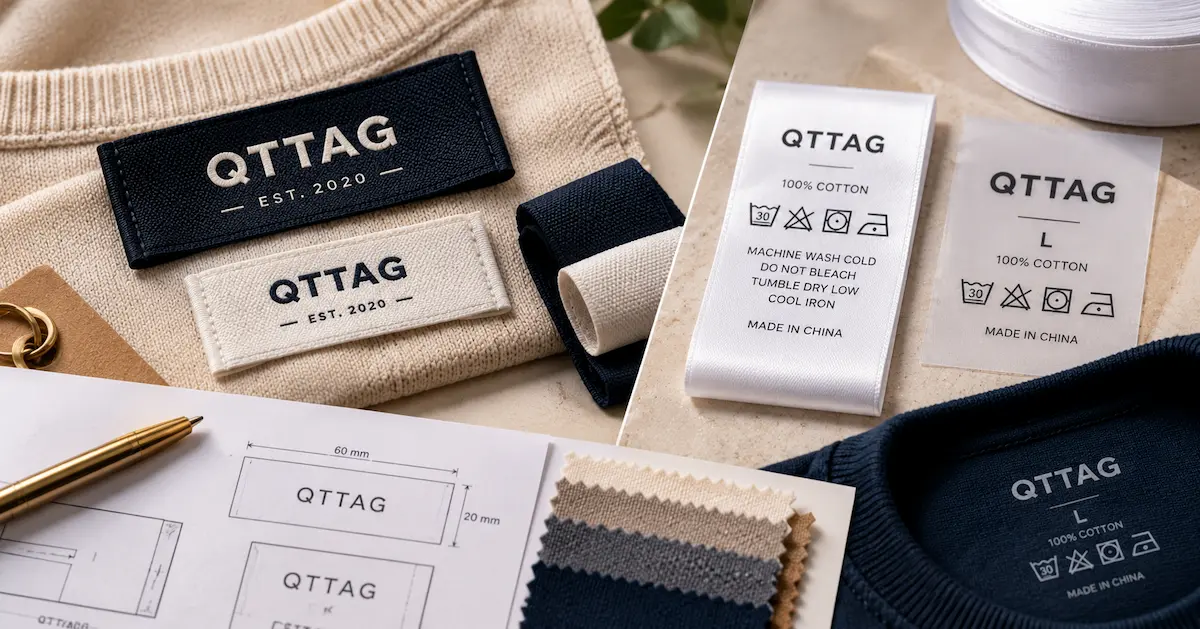
Common options include woven brand labels, printed care labels, size labels and heat transfer labels.
| Label Type | Main Function | Buyer Consideration |
|---|---|---|
| Woven brand label | Textile brand identification | Logo clarity, yarn and fold |
| Printed care label | Garment information | Accurate text and wash legibility |
| Size label | Size identification | Correct size system |
| Heat transfer neck label | Low-profile neck branding | Fabric and application compatibility |
| Decorative label or patch | Exterior identity or decoration | Material and attachment |
| Hang tag | Removable retail presentation | Paper, information and accessories |
Woven Labels
Custom woven labels may be suitable for brands seeking textile-based identification.
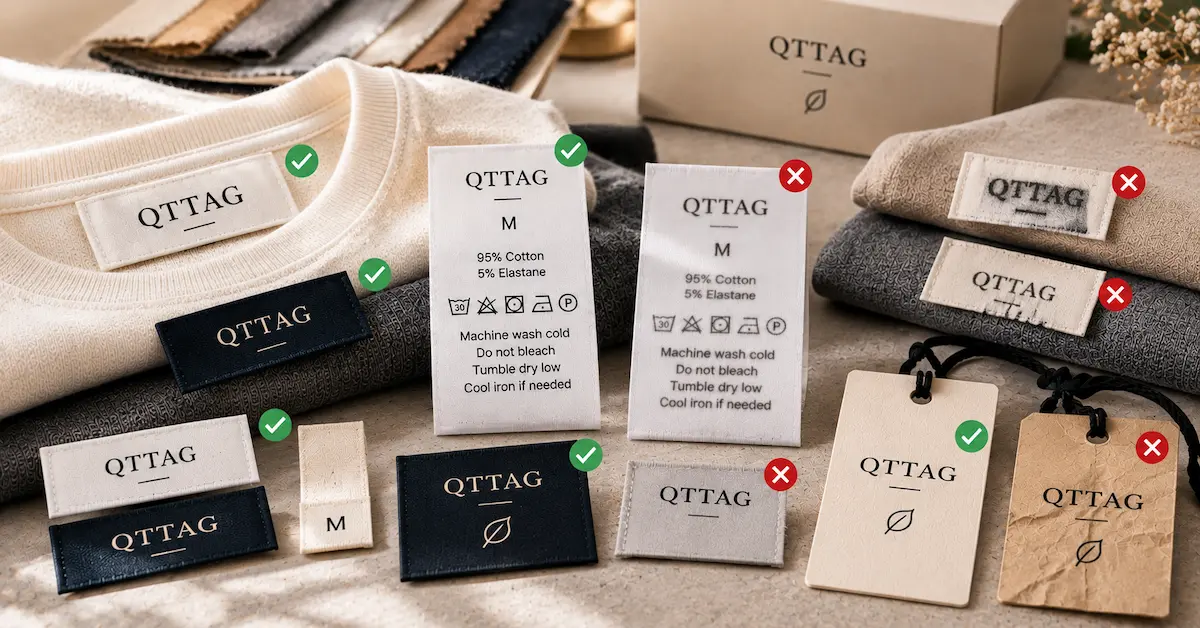
The design must be reviewed for yarn colors, small lettering, weave construction and finishing.
Printed Care Labels
Care labels may communicate fiber composition and care information, depending on applicable requirements.
The content must be based on the actual garment.
Heat Transfer Labels
Tagless neck printing may suit selected garments where a sewn brand label is not preferred.
Compatibility with fabric and application conditions must be tested.
Size Labels
Size information should match the intended garment and approved size system.
Label Placement
Brand and information labels should be designed around the garment's actual construction.
Applicable destination-market requirements must also be considered.
How to Choose Woven Labels for a Startup Fashion Brand
Woven labels can help a young brand establish a consistent identity across different products.
However, the design should be based on the final garment.
Logo Reproduction
Fine lettering and detailed symbols may require adjustments for weaving.
Yarn Selection
Available yarn colors should be compared against the approved visual direction.
Label Dimensions
The label should fit the intended placement without appearing disproportionate.
Fold Type
End fold, center fold and other constructions serve different attachment methods.
Sample Approval
Inspect a physical sample and, where possible, review it attached to the actual garment.
Repeat Orders
Retain the approved artwork and label specification for future collections.
Startups should prioritize accurate, repeatable branding rather than selecting a complex construction solely for visual impact.
Why Care Labels Require Special Attention
Care labels carry information that can affect product use and regulatory compliance.
They should not be treated as a decorative afterthought.
Fiber Composition
The declared composition must be based on the garment's verified materials.
Washing Instructions
Care guidance should reflect the product's actual characteristics and relevant requirements.
Market Differences
Countries and regions may have different requirements for fiber disclosure, care information, origin and other details.
Material Selection
The label should remain suitable for its intended location and use.
Print Legibility
Small text and laundry symbols should be checked at the actual finished size.
Approval Responsibilities
The clothing brand or other responsible party should verify the label content.
A label supplier can manufacture the approved design but should not invent unverified care or compliance information.
Hang Tags: How to Present a New Clothing Brand
Custom hang tags are often among the first branding components that customers see during product inspection.
They may carry the logo, product information and selected brand messaging.
Select an Appropriate Paper
Coated, uncoated, kraft and textured papers provide different appearances.
Choose the Right Dimensions
The tag should suit the garment and required information.
Plan the Information Hierarchy
The front may feature the brand identity, while the reverse carries product details.
Consider Finishing Options
Foil stamping, embossing and selected coatings can provide different visual effects.
Select Attachments
Strings, ribbons, eyelets and seals should be appropriate for the tag and garment.
Test the Completed Tag
Evaluate the full paper, printing and attachment combination on a representative garment.
A successful design communicates the brand clearly without unnecessary complexity.
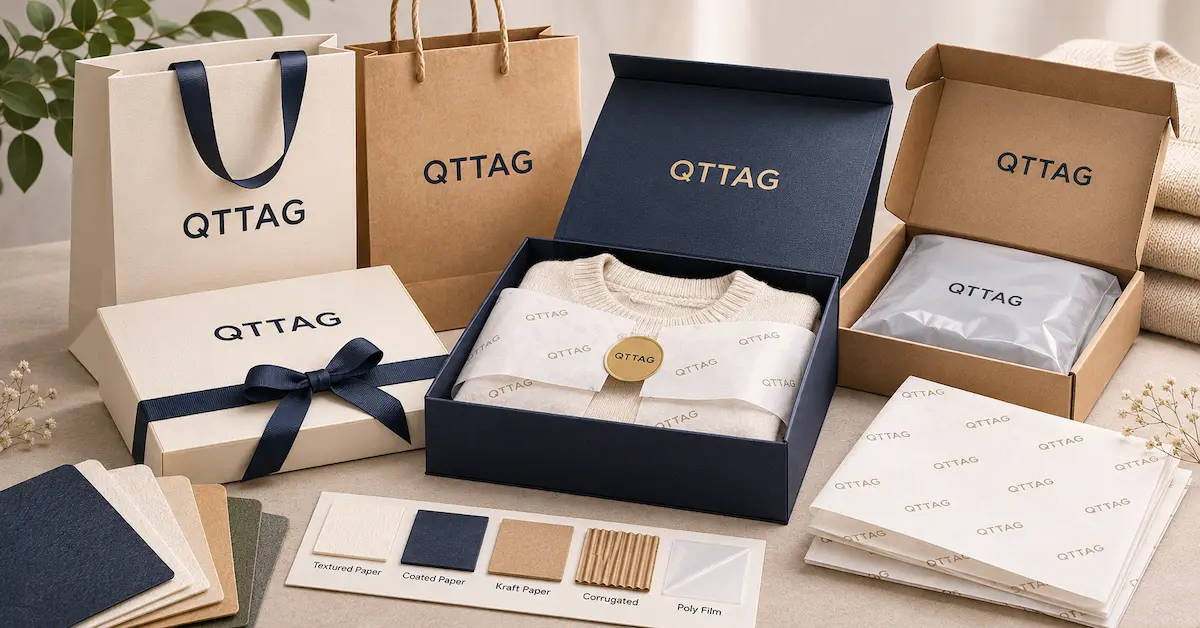
Packaging Options for Emerging Clothing Brands
Packaging requirements depend on the product and sales channel.
Not every startup needs a rigid gift box, paper shopping bag and multiple decorative accessories.
The starting point should be the actual garment and how it will reach the customer.
Paper Shopping Bags
These may be useful for boutique and retail purchases.
Bag size, handles and construction should reflect the intended contents.
Apparel Packaging Boxes
Folding cartons and rigid boxes may be considered for selected products and presentation requirements.
Protective Garment Bags
Suitable protective packaging may help organize clothing during storage and distribution.
Mailer Packaging
E-commerce orders may require packaging appropriate for the expected shipping conditions.
Tissue Paper and Inserts
These components may support presentation or protection where they serve a clear purpose.
Coordinate the Design
Packaging can use the same approved brand artwork and related colors as garment labels and hang tags.
How to Build a Consistent Label and Packaging System
Consistency helps a new clothing brand develop a recognizable presentation.
It does not require every branding component to use identical materials.
One Master Artwork Source
Use the approved logo as the starting point.
Coordinated Typography
Maintain recognizable typography where the manufacturing process allows.
Controlled Color References
Paper and textile materials may reproduce colors differently.
Use physical samples where consistency is important.
Product-Specific Specifications
Each label, tag or packaging product should have its own dimensions, materials and finishing instructions.
Common Review Process
Evaluate the garment, label, hang tag and packaging together before production.
Record Approved Versions
Store the final artwork and physical references for repeat orders.
A coordinated system is easier to maintain when the business expands into additional garments.
Low MOQ: What New Fashion Brands Should Ask
Low MOQ is a common purchasing concern for emerging apparel businesses.
However, the term has no universal numerical definition.
A supplier may offer different minimum quantities depending on materials, construction and customization.
MOQ for Garments
Ask whether the minimum applies to the total order, each style, each color or another production unit.
MOQ for Woven Labels
The required quantity may depend on label dimensions, yarns and weaving specifications.
MOQ for Hang Tags
Paper, printing and finishing methods may influence minimum production quantities.
MOQ for Packaging
A rigid box and a paper shopping bag may have very different production requirements.
Multiple Design Versions
A startup may need several sizes or color variations.
Clarify whether those are treated as separate orders.
Sampling Requirements
Ask whether physical samples or prototypes are available before bulk ordering.
Avoid Assuming One MOQ Applies to Everything
A manufacturer offering a low garment MOQ does not automatically provide the same minimum for every customized label or packaging component.
How to Budget for a Clothing Brand Launch
The first production order is only one part of the total launch cost.
Startup budgets should consider development, branding and operational requirements.
| Budget Category | What to Include |
|---|---|
| Product development | Technical work and sample revisions |
| Garment manufacturing | Approved products and quantities |
| Brand identity | Logo and artwork preparation |
| Garment labels | Woven, printed or heat transfer labels |
| Hang tags | Paper, printing and attachments |
| Packaging | Bags, boxes, mailers and wrapping |
| Quality checks | Relevant inspections or tests |
| Freight | Shipping and associated terms |
| Product content | Approved photography and product information |
| Contingency | Reasonable allowance for changes |
Calculate the Complete Product Cost
A useful estimate considers the garment together with its required branding, packaging and delivery arrangements.
Clarify Supplier Quotations
Some quotations cover only one component.
Account for Development Changes
Revisions may introduce additional work or costs.
Avoid Spending on Features Without a Clear Purpose
Special finishes and complex packaging can be attractive, but they should support the brand's intended presentation.
Preparing Label Artwork for Production
Production-ready artwork reduces the risk of inconsistent logos and incorrect information.
Vector Files
Vector artwork is commonly useful for defining logos and shapes.
The exact file requirements should be confirmed with the supplier.
Final Dimensions
Provide intended finished sizes.
Colors
Use approved brand or physical material references where available.
Font and Lettering
Check readability at the actual production size.
Different Artwork Layers
Specialty finishing such as foil stamping may require separate production references.
Care Label Information
Verify all required text and symbols before production.
Version Identification
Use clear file names or other version-control methods.
Supplier Confirmation
Ask the supplier to identify any artwork elements that may be difficult to manufacture accurately.
Do not approve changes to the brand identity without reviewing the revised artwork.
Why Physical Sampling Matters for Fashion Startups
Sampling helps turn a design concept into something that can be evaluated physically.
Digital mockups cannot fully demonstrate garment fit, label texture, paper stiffness or finished packaging construction.
Garment Samples
Review fabric, dimensions, fit and construction.
Woven Label Samples
Evaluate logo clarity, yarn colors, folds and attachment.
Printed Care Label Samples
Check the approved text, material and legibility.
Hang Tag Samples
Review paper, printing, finishing and attachments.
Packaging Samples
Test dimensions, construction and garment fit.
Complete Product Review
Where possible, evaluate the fully branded garment with its intended packaging.
This may reveal problems that individual component samples do not show.
How to Approve Samples Before Bulk Production
A structured approval process can help new apparel brands reduce preventable production mistakes.
Step 1: Confirm Product Specifications
Identify the intended garment, materials, sizes and construction.
Step 2: Review Brand Artwork
Approve logos, colors and information.
Step 3: Develop Representative Samples
Use the actual proposed materials where practical.
Step 4: Check Garment and Branding Compatibility
Evaluate how the labels and accessories appear on the clothing.
Step 5: Inspect Packaging Fit
Use representative finished garments.
Step 6: Identify Necessary Revisions
Record specific changes instead of providing only general feedback.
Step 7: Approve the Final Reference
Keep the accepted sample and specification.
Step 8: Authorize Production
Confirm quantities, versions and the approved requirements.
Step 9: Manage Changes
Significant changes after approval should be reviewed before implementation.
The buyer should understand what the final approved sample represents and whether any materials were substituted during development.
Quality Control for a First Clothing Production Order
Quality control helps a startup determine whether supplied products meet its agreed requirements.
A practical approach includes reviewing materials, dimensions, branding and final packaging.
| Inspection Area | Main Check |
|---|---|
| Garment | Construction and approved dimensions |
| Fabric | Material specification and visible condition |
| Woven label | Logo, colors and fold |
| Care label | Correct information and readability |
| Heat transfer | Placement and adhesion |
| Hang tag | Printing, dimensions and attachment |
| Packaging | Size, artwork and structure |
| Product identification | Correct SKU or size |
| Packing | Correct quantities and variations |
| Documents | Approved references and relevant records |
Establish Defect Criteria
Agree with suppliers on what constitutes an unacceptable deviation.
Check Approved Artwork
Incorrect logos or product information may affect an otherwise well-made garment.
Verify Size and Color Variations
Ensure the correct branding components are associated with the intended products.
Confirm Final Packing
Packing accuracy matters when a collection contains several styles or destinations.
Keep Records
Inspection findings can be useful when reviewing repeat orders or supplier performance.
Understanding Textile Labeling Compliance
Apparel labels may be subject to market-specific legal requirements.
A startup selling internationally should verify the rules for the intended product and destination.
Fiber Content
Applicable rules may require a particular fiber-composition declaration.
Country of Origin
Origin requirements vary by market and product.
Care Instructions
Some jurisdictions require suitable care information for covered apparel.
Responsible Business Information
Certain markets require information identifying the manufacturer or another responsible business.
Language
Required information may need to be provided in specific languages.
Label Placement and Permanence
Some obligations concern where and how the information is attached.
Product-Specific Requirements
Children's clothing and other specialized products may involve additional requirements.
A generic label template should not be assumed compliant in every market.
Brands should verify applicable requirements before finalizing the artwork.
Digital Product Passports: Should a Fashion Startup Prepare?
Digital Product Passports are becoming relevant to long-term product data planning.
In the European Union, the Ecodesign for Sustainable Products Regulation provides a framework under which product-specific DPP requirements may be introduced.
However, a conventional QR code does not automatically constitute a regulated Digital Product Passport.
Start With Accurate Product Records
Maintain the correct product specifications, materials and identifiers.
Organize Supplier Documentation
Keep relevant sourcing and technical information connected to the correct products.
Manage Versions
Fabric, style and material changes should be reflected in the appropriate records.
Monitor Applicable Requirements
Do not assume that every clothing product already has identical mandatory DPP obligations.
Evaluate Technology Only When Needed
QR codes, RFID and other digital systems serve different purposes.
A startup should define the actual business need before investing in specialized labels or software.
Common Mistakes When Starting a Clothing Brand
Launching Too Many Products Without Clear Specifications
A large collection may create additional sampling and inventory complexity.
Changing Artwork During Production
Uncontrolled changes can lead to inconsistent labels and packaging.
Choosing Suppliers by Price Alone
The lowest quotation may not cover equivalent materials, services or quality expectations.
Skipping Physical Samples
A digital image cannot demonstrate every product characteristic.
Using Incorrect Care Label Information
Label content should come from verified garment data.
Ignoring Packaging Dimensions
Packaging must fit the actual clothing.
Assuming Low MOQ Means Low Total Cost
Sampling, tooling, shipping and other expenses still need to be considered.
Ordering Branding Components Separately Without Coordination
Different suppliers may interpret logos and colors differently.
Making Unsupported Product Claims
Material, technical or environmental claims should have an appropriate evidentiary basis.
Failing to Keep Approved References
Repeat orders may become inconsistent without controlled artwork and sample records.
A Practical Fashion Startup Launch Checklist
Before placing the first production order, review the following items.
| Checklist Item | Key Question |
|---|---|
| Brand positioning | Is the target customer clearly defined? |
| Collection | Are the initial garment styles confirmed? |
| Technical specifications | Are dimensions, materials and construction defined? |
| Manufacturer | Can the supplier produce the intended products? |
| Logo artwork | Is the final version approved? |
| Woven labels | Are dimensions, colors and folds confirmed? |
| Care labels | Is the required information accurate? |
| Hang tags | Are paper, artwork and attachments approved? |
| Packaging | Does it fit the actual garments? |
| MOQ | Are minimums clear for each component? |
| Sampling | Are physical samples approved? |
| Quality control | Are inspection criteria agreed? |
| Compliance | Have relevant market requirements been reviewed? |
| Cost | Does the budget include all required components? |
| Delivery | Are the commercial terms understood? |
| Repeat orders | Are final specifications retained? |
A clear checklist cannot remove every production risk, but it helps founders establish the information needed for responsible purchasing decisions.
Frequently Asked Questions About Fashion Startups
What do I need to start a clothing brand?
You need a defined product concept, target market, garment specifications, suitable suppliers, brand artwork, appropriate labeling, packaging arrangements and a realistic production plan.
Should a clothing startup use private label manufacturing?
Private label may be suitable when existing garment constructions meet the brand's requirements. Custom development may be preferable when original patterns, materials or technical features are essential.
What labels does a new clothing brand need?
Depending on the garment and market, the brand may use woven labels, care labels, size labels or heat transfer branding. Applicable legal requirements must be reviewed separately.
Are custom hang tags necessary for a startup?
Not every startup requires them, but hang tags can help communicate brand identity and selected retail product information. The design should suit the garment and sales channel.
What packaging should a small fashion brand use?
Choose packaging according to the clothing product, presentation requirements and distribution method. Paper bags, mailers, protective garment bags and boxes serve different purposes.
Can a startup order labels in low quantities?
Some suppliers offer smaller orders, but the minimum depends on the material, manufacturing method and customization. Request a quotation for the specific product.
Do fashion startups need physical samples?
Physical samples are strongly recommended for evaluating garment construction, labels, hang tags and packaging before bulk production.
What is the difference between a brand label and a care label?
A brand label identifies the clothing brand, while a care label communicates garment information and may be subject to applicable regulatory requirements.
Can a startup use the same branding across all garments?
A consistent master identity can be used across a collection, although label dimensions, placement and construction may need to vary.
How should I choose a clothing label supplier?
Evaluate material options, manufacturing capabilities, artwork review, sample quality, inspection procedures, commercial terms and communication.
Does my fashion brand need RFID or a Digital Product Passport?
That depends on the business use case and applicable requirements. A startup should first organize accurate product information and assess whether specialized technology is necessary.
What should be included in a first clothing brand RFQ?
Include the product specifications, materials, artwork, quantities, labeling, packaging, sampling requirements, quality expectations and delivery destination.
Develop Custom Branding for Your Fashion Startup With QTTAG
Starting a clothing brand involves coordinating many decisions, but the physical branding system can be developed through a structured process.
Woven labels, printed care labels, hang tags and packaging should follow the approved identity while meeting the practical requirements of the finished garments.
QTTAG supports custom apparel branding and packaging projects for clothing businesses, including emerging brands and private-label collections.
When preparing your first collection, share your approved logo, garment categories, label requirements, packaging preferences, estimated quantities and intended sales markets.
These details provide a starting point for discussing materials, customization, physical sampling and production requirements.
Ready to Create Custom Labels and Packaging for Your Fashion Brand?
Share your logo artwork, garment specifications, preferred label materials, hang tag designs, packaging requirements and estimated order quantity with QTTAG.
Our team can discuss suitable customization and sampling options for your first clothing collection.
Request a Quote
Author
Founder at QTTAG
Jason Qiao is the founder of QTTAG, focusing on garment branding and packaging solutions. With years of experience in the apparel industry, he shares practical insights on custom labels, hang tags and sustainable packaging to help global brands grow.
Written By
Jason Qiao