Printed Labels vs Custom Printed Labels: Key Differences for Apparel Brands
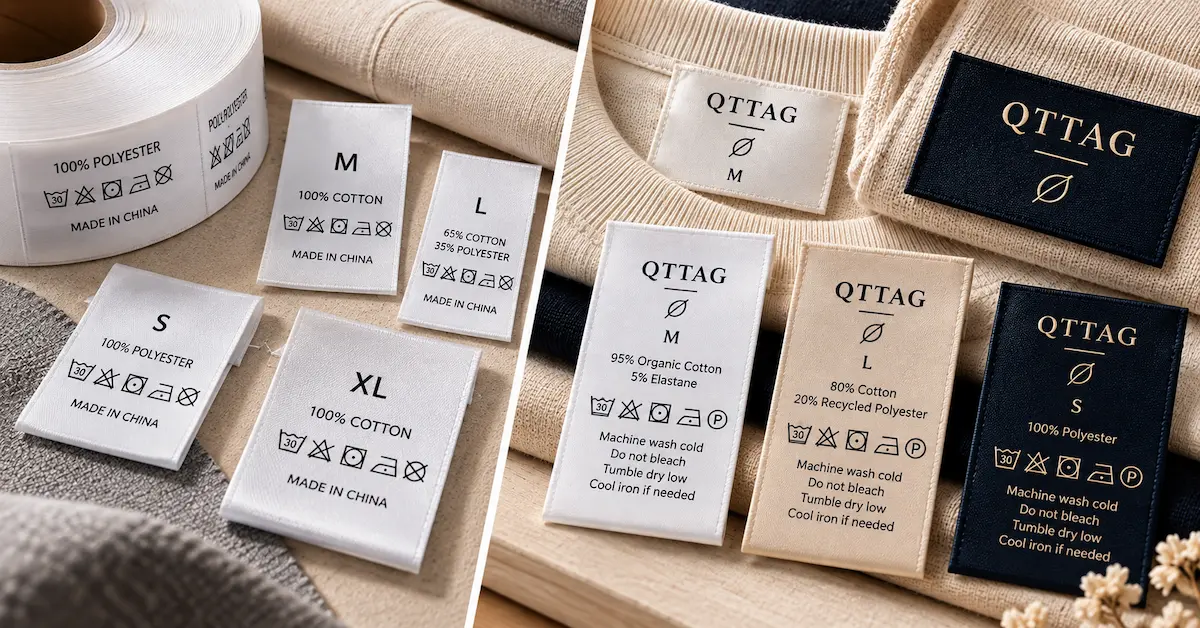
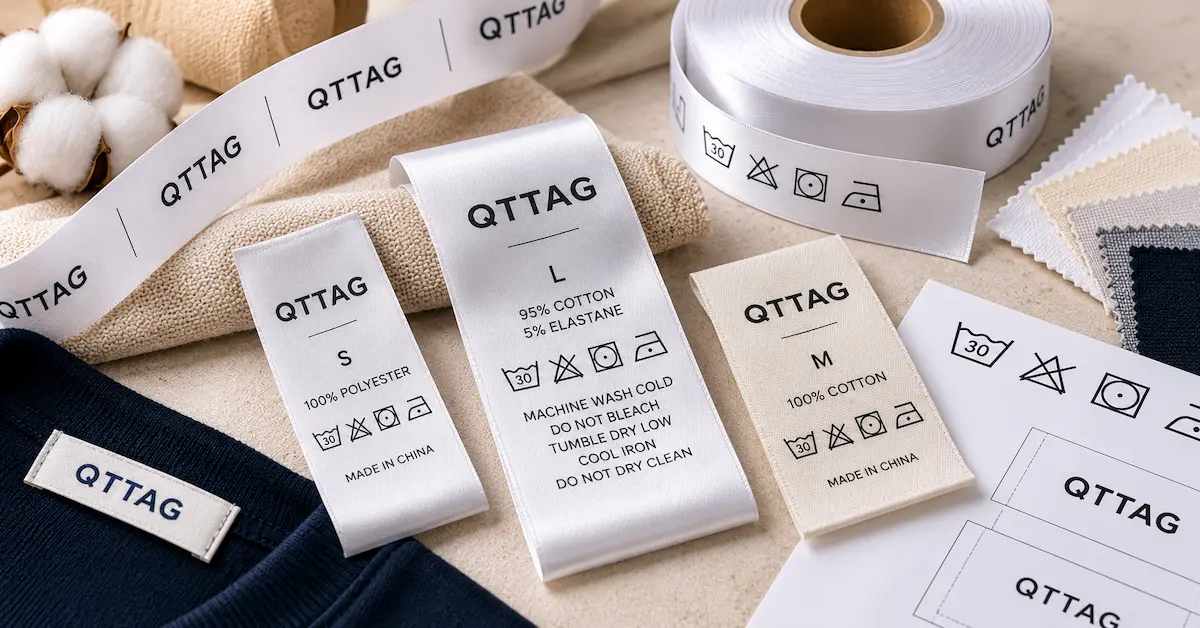
Printed labels are essential components of modern clothing production. From brand identification inside a T-shirt to detailed washing instructions on a care label, they help apparel manufacturers communicate product information through suitable textile materials.
When sourcing labels, buyers often encounter the terms printed labels and custom printed labels. Although they may appear to describe two different manufacturing categories, the distinction is usually related to customization rather than a fundamentally different production process.
Custom printed labels are printed labels manufactured according to a clothing brand's specific artwork, materials, dimensions, colors, information and finishing requirements. The broader term printed labels can refer to both standardized designs and labels developed specifically for individual apparel collections.
Neither term guarantees a particular material quality, printing technology or level of durability.
For fashion brands, the important decision is determining what information the label must communicate, which material is suitable for the garment and how the printing should perform throughout the product's intended use.
This guide compares printed and customized labels, explains common materials and manufacturing considerations, and provides practical recommendations for sample approval, quality control and supplier selection.
What Are Printed Labels?
Printed labels are identification or information components created by applying text, graphics or other markings onto a compatible substrate.
For clothing applications, these labels are commonly made using suitable textile materials.
A printed label may display:
-
Brand name or logo
-
Garment size
-
Fiber composition
-
Washing instructions
-
Bleaching instructions
-
Drying and ironing guidance
-
Country-of-origin information
-
Product identification
-
Other approved garment information
The exact content depends on the label's function and the applicable product requirements.
Where Are Printed Labels Used?
Printed labels can be found in many types of garments, including T-shirts, knitwear, sportswear, underwear, outerwear and uniforms.
They may be sewn into seams, attached at the neckline or incorporated into another suitable garment construction.
The selected material and attachment should reflect the garment's intended use.
Are Printed Labels Always Standardized?
No.
Printed labels describe a broad manufacturing category.
Some suppliers may offer commonly used layouts or standard material options, while other projects require entirely new artwork and production specifications.
The level of customization does not change the basic fact that the information is reproduced through printing.
What Are Custom Printed Labels?
Custom printed labels are printed components developed according to specifications supplied or approved by the apparel buyer.
They allow brands to control how information appears on the finished label.
Common customization options include:
-
Brand artwork and typography
-
Label materials
-
Finished dimensions
-
Printing colors
-
Text and symbol arrangement
-
Single-sided or double-sided printing, where feasible
-
Cutting and folding
-
Garment size variations
-
Language versions
-
Attachment requirements
Why Clothing Brands Choose Customization
Fashion brands often require labels that match their approved identity while providing accurate garment information.
A startup clothing collection may need customized brand labels, while an international apparel manufacturer may need several care-label versions for different products or markets.
What Makes a Printed Label Custom?
A label does not need elaborate graphics to be custom.
A simple black-and-white care label may be fully customized when its material, dimensions, information and construction are defined for a particular garment.
The customization concerns the specification, not merely the visual complexity.
Printed Labels vs Custom Printed Labels: Main Differences
The following comparison distinguishes commonly available standardized label options from buyer-specific custom production.
| Feature | Standardized Printed Label Options | Custom Printed Labels |
|---|---|---|
| Product category | Printed label | Printed label |
| Artwork | Existing or limited layouts | Buyer-approved artwork |
| Dimensions | Available standard formats | Specified for the garment |
| Material | Available supplier options | Selected from feasible materials |
| Printing colors | Standard or limited choices | Defined by artwork and process |
| Care information | Standard layout, where suitable | Garment-specific approved content |
| Language options | Existing layouts | Market-specific versions |
| Folding | Available constructions | Selected to meet garment requirements |
| Sampling | Depends on product | Important for new specifications |
| MOQ | Supplier-specific | Supplier- and design-specific |
| Main advantage | Straightforward purchasing | Greater control over requirements |
Are Custom Printed Labels Better?
Not automatically.
A standardized label solution can be sufficient when its material, size and information meet the buyer's needs.
Custom manufacturing becomes particularly relevant when a clothing brand needs specific artwork, additional information, distinctive dimensions or another construction.
What Should Buyers Prioritize?
The most important purchasing criteria are information accuracy, material suitability, print readability, durability and consistent manufacturing.
These characteristics matter more than whether a supplier describes a product as standard or custom.
What Materials Are Used for Printed Clothing Labels?
Material selection affects the label's appearance, flexibility, texture and compatibility with printing.
Different textile materials are available depending on the supplier and manufacturing process.
Satin-Style Printed Labels
Satin-style materials are often considered when a smooth surface appearance is desired.
Their feel and performance depend on the specific textile construction and finishing.
Polyester Printed Labels
Polyester-based materials are widely used in garment information labels.
They may support different printing methods and surface characteristics.
However, not all polyester substrates behave identically during washing or garment use.
Nylon and Other Synthetic Materials
Other synthetic textile materials may be suitable for particular label applications.
The actual composition and printing compatibility should be confirmed.
Cotton-Based Printed Labels
Cotton materials may be considered for selected clothing branding applications.
Their suitability depends on surface characteristics, printing technology and intended washing conditions.
Alternative Material Options
Some brands may investigate materials containing documented recycled fibers.
A recycled-content claim requires suitable product-specific evidence.
Material Comparison
| Label Material | Potential Application | Main Evaluation |
|---|---|---|
| Satin-style textile | Brand and information labels | Texture and printing clarity |
| Polyester substrate | Garment care and identification | Print durability and flexibility |
| Nylon-based material | Selected printed applications | Material and ink compatibility |
| Cotton-based textile | Selected apparel branding | Surface and dimensional behavior |
| Recycled-content material | Projects with defined sourcing requirements | Documentation and performance |
The correct choice should be based on the garment and intended label function, not only on the material name.
How Printing Methods Affect Clothing Label Quality
Printed labels can be manufactured using different printing technologies.
The available process depends on the substrate, artwork, quantity and supplier capabilities.
Thermal Transfer Printing
Thermal transfer printing uses a suitable ribbon and printing system to produce text or graphics on compatible materials.
It may be considered for applications requiring clear product information.
Actual durability depends on the ribbon, label material and process settings.
Screen Printing
Screen printing can be used for selected textile label designs.
Its suitability depends on artwork, ink system, substrate and manufacturing requirements.
Digital Printing
Digital printing may be considered for particular artwork or production requirements.
The selected process should be evaluated for the intended fabric and application.
Other Printing Systems
Additional methods may be available depending on the supplier.
Buyers should not assume that all printed label technologies produce identical results.
| Printing Method | Potential Strength | Main Quality Check |
|---|---|---|
| Thermal transfer | Clear text on compatible materials | Ribbon and substrate compatibility |
| Screen printing | Selected graphics and textile applications | Print coverage and consistency |
| Digital printing | Suitable artwork and production flexibility | Color and material compatibility |
| Other textile printing | Process-specific applications | Physical sample performance |
The preferred printing method should be selected around the label's function and required quality rather than the technology name alone.
Custom Printed Labels for Clothing Brands
Custom printed labels for clothing allow businesses to reproduce their brand identity using an approved layout.
Logo Accuracy
The printed logo should match the approved design.
Small lettering and symbols must remain recognizable at the intended finished size.
Brand Colors
The selected printing system should support the required colors on the chosen substrate.
Physical color appearance may differ from digital previews.
Typography
Text should be appropriately sized and spaced.
Material Appearance
A smooth satin-style label creates a different impression from a textured textile material.
Garment Placement
The label's finished dimensions and construction should suit the intended location.
Collection Consistency
Different garments may require different information while retaining a common logo and typography.
Artwork Management
The brand should maintain an approved source file and clearly identify all permitted variations.
Printed Brand Labels vs Printed Care Labels
Printed brand labels and printed care labels may use similar manufacturing technologies, but their principal functions differ.
Printed Brand Labels
Printed brand labels generally emphasize the brand name, logo or collection identity.
Their design may prioritize typography and visual presentation.
Printed Care Labels
Printed care labels communicate garment-care information and may include other product details.
They require careful content verification and suitable printing performance.
Comparison
| Feature | Printed Brand Label | Printed Care Label |
|---|---|---|
| Main purpose | Brand identification | Garment information |
| Typical artwork | Logo and brand text | Instructions, symbols and product details |
| Text density | Often limited | May contain substantial information |
| Material priority | Appearance and garment suitability | Readability, durability and suitability |
| Information approval | Brand artwork | Verified garment information |
| Quality concern | Logo clarity and visual consistency | Information accuracy and legibility |
A clothing brand may use both label types in one garment.
The appropriate combination depends on branding needs and applicable labeling requirements.
How to Design Custom Printed Care Labels
Printed care labels often contain relatively dense information within a limited area.
A clear layout is important.
Confirm Fiber Composition
Use the verified material specification for the actual garment.
Do not copy fiber percentages from unrelated products.
Verify Care Instructions
Care information should reflect the finished garment's requirements.
Review Laundry Symbols
Use suitable approved symbols and any applicable text.
The intended symbol system and relevant requirements should be checked.
Plan Language Versions
International apparel brands may require different languages for different markets.
Organize Information
Use a clear hierarchy so important information remains readable.
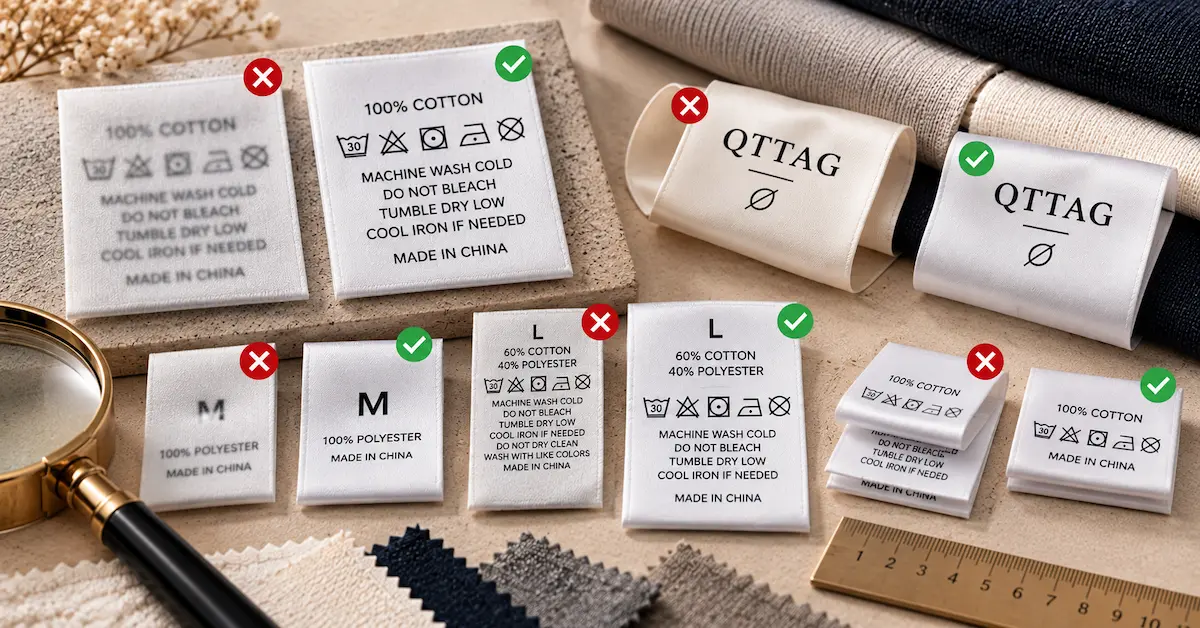
Check Printed Size
Artwork should be reviewed at its actual physical dimensions.
Validate Durability
Where relevant, test readability after laundering under defined conditions.
A clear print does not make incorrect care information acceptable. The source content must be verified independently of printing quality.
How to Choose the Correct Printed Label Size
Printed label dimensions should be established from the required information and garment application.
Brand Labels
A compact logo label may need relatively little information space.
Care Labels
Detailed composition or care information may require a larger layout or another suitable construction.
Folded Labels
Folding can provide multiple information surfaces where the construction allows.
Neckline Applications
The label should suit the garment's design and intended comfort.
Side Seam Applications
Side seam labels may provide space for care information, subject to the garment construction and applicable requirements.
Size Selection Checklist
| Requirement | Buyer Consideration |
|---|---|
| Logo readability | Clear brand artwork |
| Care text | Suitable font size |
| Laundry symbols | Recognizable printed details |
| Label dimensions | Finished width and height |
| Folding | Correct visible information arrangement |
| Sewing allowance | Appropriate attachment |
| Garment fit | Suitable placement and comfort |
Do not reduce the label dimensions so far that important information becomes difficult to read.
Printed Label Fold Types and Finishing
Cutting and folding influence how the label appears after attachment.
Straight Cut
A straight-cut label uses a relatively simple finished format.
Edge finishing should suit the material and garment application.
Center Fold
A center-fold label creates two sides that can be used for suitable artwork or information.
The finished layout must account for the fold position.
End Fold
End-fold labels include folded sections that may be used for attachment.
Multi-Panel Constructions
Some information-heavy applications may use additional folds or panels, subject to manufacturing feasibility.
Important Buying Considerations
Confirm the total material dimensions, finished folded size, artwork arrangement, edge quality and intended sewing method.
A flat artwork preview does not fully represent the finished label.
How Durable Are Printed Labels After Washing?
Printing durability is important for labels expected to remain attached and readable during garment use.
Actual performance depends on the substrate, ink or ribbon system, manufacturing process and laundering conditions.
Print Legibility
Check whether important text and symbols remain readable.
Color Appearance
Printed colors may change under certain use or laundering conditions.
Material Condition
The substrate should remain appropriate for the garment.
Cutting and Folding
Inspect edges and folds after the intended care process.
Attachment
The label should remain suitable for its intended method of sewing or application.
Testing Conditions
Testing should reflect the garment's actual care requirements.
Do not assume that all printed labels withstand the same number of washes.
An approved physical sample should establish the relevant performance expectations before bulk manufacturing.
Printed Labels vs Woven Labels: Which Is Better?
Printed and woven labels have different manufacturing methods and possible applications.
A woven label forms its design through interlaced yarns.
A printed label reproduces artwork or text on a suitable material using a printing process.
| Feature | Printed Labels | Woven Labels |
|---|---|---|
| Production | Printing on compatible material | Interlaced yarn construction |
| Main appearance | Printed graphic or text | Woven textile texture |
| Detailed information | Suitable for many text-heavy layouts | Depends on weave capability |
| Brand logos | Supported | Supported |
| Care information | Common application | Possible in suitable designs |
| Material selection | Printable textile substrates | Suitable woven yarns |
| Durability | Product-specific | Product-specific |
| Best choice | Depends on artwork and function | Depends on artwork and function |
When Printed Labels May Be Appropriate
Printed labels may be suitable when a garment requires detailed text, care symbols or a particular printed design.
When Woven Labels May Be Appropriate
Woven labels may be selected when textile texture and woven logo presentation are important.
Can a Brand Use Both?
Yes.
A woven brand label and a printed care label can perform complementary functions.
There is no need to select one technology for every labeling requirement.
Common Mistakes When Ordering Printed Labels
Several mistakes can create problems during printing or garment production.
Selecting the Wrong Material
A substrate may not be suitable for the intended garment or print process.
Using Text That Is Too Small
Detailed information may become difficult to read.
Incorrect Care Information
A label may contain unverified instructions or fiber composition.
Poor Logo Preparation
Low-quality artwork can reduce print clarity.
Ignoring Folding Allowances
The label may not fit the intended sewing construction.
Skipping Physical Sampling
Digital previews cannot fully demonstrate material feel or printed durability.
Inadequate Version Control
Different garments may receive the wrong size or care information.
Weak Production Inspection
Labels may vary from the approved reference without suitable quality checks.
Clear specifications and physical sample approval can reduce many of these risks.
How to Approve Custom Printed Label Samples
Sampling helps verify that the chosen material and printing method work together.
Step 1: Confirm the Artwork
Check approved logos, text, symbols and colors.
Step 2: Verify the Information
Confirm any garment care, composition or product data.
Step 3: Select the Material
Review the proposed substrate and intended appearance.
Step 4: Confirm Printing
Discuss the suitable printing system and production requirements.
Step 5: Produce a Physical Sample
The sample should represent the intended finished construction.
Step 6: Inspect the Print
Check clarity, alignment, colors and symbols.
Step 7: Review Cutting and Folding
Confirm finished dimensions and attachment allowances.
Step 8: Test the Garment Application
Evaluate the label on representative clothing.
Step 9: Check Relevant Performance
Conduct appropriate handling or laundering evaluations.
Step 10: Approve the Production Reference
Retain the accepted sample and final specification.
| Sample Item | Approval Focus |
|---|---|
| Logo | Accurate artwork |
| Information | Verified content |
| Material | Suitable surface and flexibility |
| Printing | Clear text and symbols |
| Dimensions | Correct finished size |
| Folding | Accurate construction |
| Edges | Acceptable finish |
| Attachment | Garment compatibility |
| Durability | Defined test conditions |
Quality Control for Bulk Printed Label Production
Bulk production should follow the approved artwork, materials and manufacturing specifications.
Incoming Material Checks
Confirm the substrate matches the selected specification.
Artwork Control
Use the latest approved design.
Printing Inspection
Check logo clarity, text completeness and visible print quality.
Color Review
Compare against approved references where relevant.
Cutting and Folding
Inspect dimensions and finishing.
Information Verification
Ensure the correct garment information appears on the correct label versions.
Sorting and Packing
Different sizes, styles and language versions should be identified clearly.
Repeat Orders
Retain approved artwork and material references.
Changes should be reviewed before production is repeated.
How Much Do Custom Printed Labels Cost?
Printed label prices depend on the specific product and manufacturing requirements.
Important factors include:
-
Label material
-
Finished dimensions
-
Printing process
-
Artwork complexity
-
Number of printing colors
-
Text and information layout
-
Cutting and folding
-
Different product versions
-
Order quantity
-
Sampling requirements
-
Packing and delivery
Material Selection
Different substrates may have different costs and manufacturing requirements.
Printing Technology
The selected process can influence setup and production planning.
Artwork Versions
Different language, size or care-label versions may affect purchasing arrangements.
Quantity
MOQ and unit prices vary by supplier and specification.
Total Product Cost
Buyers should compare fully finished labels with equivalent materials, dimensions and printing requirements.
A lower unit price does not automatically mean the label is suitable for the garment.
What Should Buyers Include in a Printed Label RFQ?
A complete RFQ helps suppliers evaluate the intended product.
| RFQ Information | What to Provide |
|---|---|
| Label type | Brand, care, size or other |
| Garment type | Intended clothing application |
| Artwork | Approved logo or label layout |
| Material | Preferred textile substrate |
| Dimensions | Finished width and height |
| Printing | Colors and required information |
| Care information | Verified text and symbols |
| Fold type | Straight cut, center fold or other |
| Attachment | Intended sewing or application |
| Quantity | Estimated order volume |
| Variations | Different sizes, languages or designs |
| Durability | Relevant washing requirements |
| Sampling | Physical approval requirements |
| Delivery | Destination and target schedule |
If the buyer has not selected a suitable material or printing method, providing the intended garment and artwork can help guide the supplier's initial assessment.
Frequently Asked Questions About Printed Labels
What is the difference between printed labels and custom printed labels?
Printed labels are a broad product category. Custom printed labels are produced according to a buyer's specific artwork, material, dimensions, content and finishing requirements.
Are custom printed labels better than standard printed labels?
Not automatically. The right option depends on the required information, appearance, materials and manufacturing specifications.
What materials are used for printed clothing labels?
Different constructions may use polyester, satin-style materials, nylon-based fabrics, cotton or other compatible textile substrates.
Can printed labels include detailed care instructions?
Yes. Suitable printed labels can carry care information and relevant garment details, provided that the content and manufacturing requirements are properly verified.
Are printed labels washable?
Some constructions are designed for repeated laundering, but durability depends on the substrate, printing system and care conditions. Product-specific testing is recommended.
What is the difference between printed labels and woven labels?
Printed labels reproduce artwork or text on a compatible material using printing. Woven labels form the design using interlaced yarns.
Can printed labels reproduce small logos?
They may reproduce fine details when the selected process, substrate and finished size are suitable. Physical samples should be checked for clarity.
What fold types are available for custom printed labels?
Possible constructions include straight-cut, center-fold, end-fold and selected multi-panel formats, depending on manufacturing capabilities.
How should printed care labels be approved?
Verify the content, material, dimensions, print legibility, folding, garment attachment and relevant durability requirements.
What is the minimum order quantity for custom printed labels?
MOQ depends on the supplier, label material, printing method, artwork and quantity requirements. Request a quotation for the specific design.
Develop Custom Printed Labels With QTTAG
Printed labels and custom printed labels belong to the same broad category of apparel labeling products.
The meaningful differences concern how the label is specified and manufactured.
A successful project combines accurate artwork, suitable textile materials, clear information, appropriate printing and consistent finishing.
QTTAG supports custom garment branding projects, including printed care labels, woven labels, heat transfer labels and related apparel identification products.
When preparing a new clothing collection, provide the approved logo, garment specifications, label dimensions, intended information, material preferences and estimated order quantity.
These details create a useful starting point for reviewing suitable constructions and sample-development requirements.
Ready to Create Custom Printed Labels for Your Clothing Brand?
Share your logo artwork, garment specifications, preferred label materials, dimensions, printing requirements, care label information and estimated order quantity with QTTAG.
Our team can discuss suitable printed label customization and sampling options for your apparel collection.
Request a Quote
Author
Founder at QTTAG
Jason Qiao is the founder of QTTAG, focusing on garment branding and packaging solutions. With years of experience in the apparel industry, he shares practical insights on custom labels, hang tags and sustainable packaging to help global brands grow.
Written By
Jason Qiao