Sustainable Labels Cost Guide: What Changes Price, MOQ and Lead Time
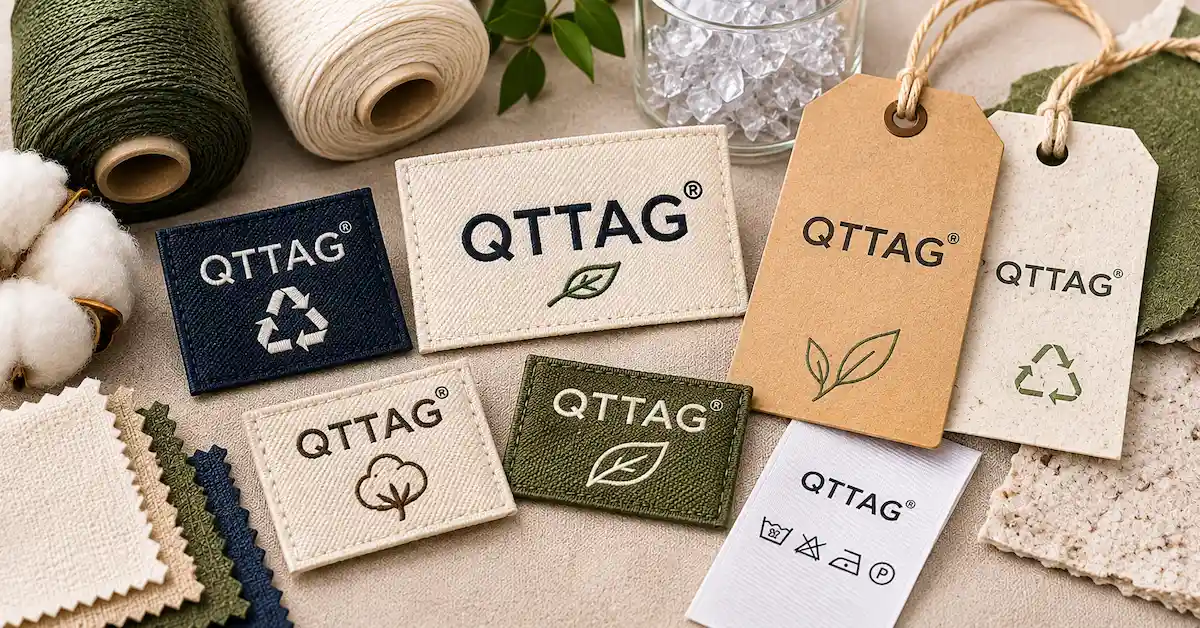
A fashion brand asks for a quotation on 3,000 recycled polyester woven labels. The design is straightforward: a two-color logo, center fold, and a finished size already approved for its existing clothing line.
One supplier offers recycled polyester yarn. Another proposes a certified recycled-material supply chain and asks whether the brand requires documentation for the finished labels.
The quotations are different, even though both suppliers may be discussing recycled polyester.
The second request involves more than yarn selection. It may require verified material sourcing, traceability through manufacturing, and documentation connecting the finished order to the certified inputs.
Sustainable labels cost depends on the actual material, label construction, required evidence, certification arrangements, artwork, order quantity, and finishing. MOQ and lead time may also change when certified materials, traceable production, or additional claim approvals are requested.
Not every label described as sustainable is certified. Nor is every certified material automatically the right choice for a particular garment.
Before comparing quotations, a clothing brand needs to decide what it is asking the supplier to prove.
What Does “Sustainable Labels” Actually Mean?
There isn't one material or production process called a sustainable label.
The term is used across different products: recycled polyester woven labels, cotton-based labels, paper hang tags, and selected alternatives to conventional packaging materials.
Those products have different functions.
A woven neck label needs to reproduce a logo and work with the garment. A care label must carry accurate information. A paper hang tag is usually removed before use.
Their material requirements are not interchangeable.
The sustainability claim also needs to be more specific than the product category.
For example, made with recycled polyester is a statement about material content. FSC-certified paper refers to a defined forest-based sourcing and chain-of-custody system. Organic cotton concerns how cotton was produced and, where certification is claimed, how that material is tracked and processed.
These terms cannot be used as substitutes for one another.
The FTC's Green Guides caution against broad, unqualified claims such as “eco-friendly” because consumers may interpret them as promises about the product's overall environmental performance.
A buyer should therefore start with a more practical question:
Which specific attribute matters to our brand, and what evidence do we need?
That decision influences both the label specification and the purchasing process.
Comparing Materials Before Comparing Prices
Different label materials create different manufacturing and sourcing requirements.
| Material or Option | Common Label Application | Important Purchasing Question |
|---|---|---|
| Recycled polyester | Woven brand labels and suitable textile labels | What recycled content is documented? |
| Organic cotton | Selected woven or printed fabric labels | What supports the organic-content claim? |
| FSC-certified paper | Paper hang tags and suitable paper components | Is the finished paper product eligible for the FSC claim? |
| Recycled paper | Hang tags and paper accessories | What is the recycled-content percentage? |
| Biodegradable materials | Selected packaging or label applications | Under what conditions does the finished product degrade? |
| Conventional material | Existing approved label designs | Does a proposed alternative meet the same functional requirements? |
This comparison is about possible material applications, not a claim that QTTAG currently offers every listed option.
Recycled Polyester Labels
Polyester yarns are commonly used in woven clothing labels.
A brand looking for recycled polyester may want to retain its current logo, dimensions, and fold while changing the yarn specification.
That sounds like a minor adjustment. In production, it still requires review.
The manufacturer needs to confirm that suitable recycled-content yarn is available in the required colors and characteristics.
A change in yarn can affect the woven appearance. Very small lettering, edges, and folded thickness should be checked against the previous label.
If the brand requires independently certified recycled content, the supplier must also establish whether the proposed supply chain can support that requirement.
Textile Exchange's Global Recycled Standard (GRS) and Recycled Claim Standard (RCS) provide systems for verifying recycled materials and tracking certified content through the supply chain.
A supplier's statement that a yarn is recycled is not identical to proof that a particular finished shipment qualifies for a specified certification claim.
Organic Cotton Labels
Organic cotton may be considered for selected textile label constructions, particularly where the brand wants a particular cotton-based material.
But organic cotton doesn't guarantee that a label will be softer, stronger, or more durable than another textile label.
Those characteristics depend on the yarn, weaving or printing method, finishing, and intended garment application.
A cotton-based label can also behave differently during cutting and laundering.
Brands requesting certified organic content should distinguish a general material declaration from a certification covering the relevant product and supply chain.
GOTS, for example, has requirements extending beyond the initial cotton input. Its finished-product labeling system includes certified processing, documentation, and approval conditions.
The buyer should confirm what the supplier can actually provide before specifying GOTS-related claims in artwork.
FSC-Certified Paper Hang Tags
FSC is relevant to forest-based materials, including suitable paper hang tags.
It does not automatically certify the textile fibers inside a garment.
A paper hang tag may use material from an FSC-certified supply chain, while the clothing item attached to it has a completely different material composition and certification status.
That distinction is important when deciding what the consumer will understand from the printed tag.
FSC chain-of-custody certification verifies eligible forest-based materials through the relevant supply chain.
If the brand wants to place an FSC mark on its paper hang tags, the finished product, supplier arrangements, and artwork approval must meet the applicable requirements.
Ordering paper described as FSC-certified is not, by itself, permission to put an FSC logo wherever the designer chooses.
Why Can Sustainable Labels Cost More—or Less?
It is tempting to assume that recycled, organic, or certified materials always command a premium.
That isn't a reliable rule.
A conventional label using an unusual specialty yarn might cost more than a recycled-content label using a commonly available construction.
A small order requiring a specially sourced material may face additional preparation costs. A larger, established production arrangement may have different economics.
The quotation depends on the actual product.
Material Availability
Suppose a brand requires a specific navy yarn for a woven neck label.
The supplier has an appropriate conventional yarn available but needs to source a recycled-content alternative.
That sourcing requirement may affect price or scheduling.
If a suitable recycled yarn is already available, the cost difference could be smaller.
Neither result should be assumed before checking supply.
Design and Manufacturing Method
A sustainable material does not remove the need to manufacture the label.
Woven labels still require weaving, cutting, and finishing. Printed labels require compatible substrates and printing.
A complex logo will not become easier to weave simply because the yarn contains recycled material.
Finished dimensions, color count, weave construction, and fold type remain relevant cost factors.
Certification and Documentation
Certification is another area where quotations can differ.
Some manufacturers may already have the required certified supply chain in place.
Others may need additional sourcing arrangements, or they may not be able to provide the requested certified finished product at all.
Documentation management and claim approval can introduce work beyond normal label production.
This does not establish that every certified label carries the same surcharge.
It means a buyer should compare two distinct offers carefully: one for a specified material and another for a product supplied with defined certification and documentation requirements.
Development and Testing
Changing materials can require physical sampling.
A brand may already have an approved polyester woven label. If it switches to a new recycled yarn, the original label sample may no longer establish the finished product's exact appearance.
The revised label should be checked for logo clarity, color, dimensions, edge finishing, and garment suitability.
Development costs matter, but approving the wrong material can create more expensive problems after bulk manufacturing.
Certified Material vs. Certified Finished Product
This is one of the most important distinctions in sustainable-label sourcing.
A supplier may show a certificate relating to a material producer. That document can be relevant, but the buyer still needs to understand whether the actual finished goods and their supply chain support the intended claim.
For Textile Exchange standards, two document types deserve attention.
Scope Certificate (SC): Helps establish that an organization is certified for specified activities or products within a defined scope.
Transaction Certificate (TC): Documents a particular transaction of certified goods, subject to the applicable standard and certification procedures.
The documents serve different functions.
A scope certificate for a supplier is not the same as a transaction certificate covering the labels delivered to a buyer.
Textile Exchange provides supply-chain certification guidance and tools for verifying certification-related information.
A Practical Document Review
Before placing the order, ask the supplier which certification is being offered and whether it covers the proposed product.
Check the certificate holder and relevant scope.
Clarify whether documentation for the particular shipment will be available.
If the buyer intends to use a certification logo or make a certified-content claim, confirm the required approvals before production artwork is finalized.
The certificate itself is not a substitute for the label specification.
A certified label can still have an incorrect logo, unsuitable fold, or poor printing.
Both technical quality and claim eligibility need approval.
How Do MOQ Requirements Change With Sustainable Materials?
MOQ is often discussed as though it were one fixed number.
In practice, a sustainable-label order may have several constraints.
The manufacturer may have a minimum production quantity for the label.
The material supplier may have its own minimum for a particular yarn, color, or paper stock.
A project may also involve artwork versions that need separate manufacturing arrangements.
These are different issues.
One Design, Several Colorways
Consider a clothing brand using the same woven label on three collections.
The artwork is identical, but the yarn colors change.
The buyer needs:
| Version | Planned Quantity | Main Difference |
|---|---|---|
| Navy and cream | 1,000 | Yarn colors |
| Black and white | 1,000 | Yarn colors |
| Beige and navy | 1,000 | Yarn colors |
| Total | 3,000 | Three colorways |
This is a hypothetical purchasing example, not an advertised QTTAG MOQ.
A supplier may be able to combine some aspects of the order commercially. Another may require separate production quantities for each colorway.
If one of the certified yarn colors is unavailable in a suitable quantity, that may influence the final sourcing arrangement.
One Label, Several Materials
A buyer may also ask for the same logo in recycled polyester and organic cotton.
Those are different material specifications.
Combining their quantities into one total does not automatically satisfy the manufacturing minimum for either material.
The supplier must confirm the minimums separately.
Questions Buyers Should Ask
A quotation should state the minimum quantity per finished design and material.
It should also clarify whether changing colors, artwork, or fold construction creates another minimum.
If a certified material is required, ask whether its availability imposes a separate sourcing minimum.
For a startup brand, the smallest possible order may sound attractive.
But a lower MOQ doesn't necessarily produce the lowest total purchasing cost. Small production quantities can distribute preparation costs across fewer units.
The right quantity depends on the collection's actual needs and the likelihood that the design will be reused.
Which Costs Are Missing From a Low Unit Price?
Consider two suppliers offering recycled polyester woven labels.
Supplier A quotes the labels and basic finishing.
Supplier B quotes a more complete arrangement that may include physical samples, selected documentation, and additional packing requirements.
Their unit prices might be different because the quotation scopes differ.
A useful purchasing calculation is:
Total order cost = label production + applicable material sourcing and development + sampling and finishing + documentation or approval charges where applicable + packing and freight.
Not every project has every charge.
Ask suppliers to identify what is included rather than assuming the presence or absence of a fee.
The Cost of a Claim
A brand may want to print a certified-content statement on a paper tag attached to clothing.
That involves an artwork and compliance question in addition to the cost of printing the tag.
The product claim needs to be accurate, eligible, and approved where the relevant standard requires approval.
If the claim cannot be supported, the safest purchasing decision is to resolve that issue before the tags are printed.
Otherwise, perfectly manufactured tags may have to be replaced because the text or certification mark cannot be used.
Repeat Orders
A repeat order may reuse artwork and approved construction.
But a brand should not assume that documentation from an earlier certified-material shipment automatically covers the new order.
Ask what needs to be reissued or verified for the new batch.
This distinction is particularly useful for brands ordering labels throughout the year rather than purchasing everything at once.
What Determines Sustainable Label Lead Time?
A sustainable-label production schedule can include ordinary manufacturing work plus any additional material sourcing and claim-verification steps.
The most important question is where the supplier starts counting.
Does the lead time begin when the buyer sends the logo, when the material becomes available, or after final sample approval?
The answer may be different for each supplier.
Material Sourcing Comes First
If a label uses yarn or paper already available in the required specification, the project may proceed through the usual development process.
A special material requirement can introduce additional sourcing work.
The supplier should identify this before promising a production date.
Sample Approval
A new material may need testing even when the artwork hasn't changed.
For a woven label, the buyer may review yarn color, weave clarity, cut edges, and finished folds.
For a paper tag, the approval could involve paper texture, print appearance, hole position, and finishing.
The sample should represent the proposed material as closely as practical.
Certification and Claim Approval
If a certified-content claim will appear on the finished label or attached hang tag, applicable approval requirements can affect the schedule.
Textile Exchange's claims guidance describes formal approval procedures for eligible product-related claims and labels.
The brand should allow for this process rather than assuming that certification artwork can be printed immediately.
Production and Delivery
Once artwork, material, and specifications are approved, the manufacturer can schedule the production work.
Finishing, inspection, packing, and shipping follow.
A short factory production period does not mean the complete order will arrive within that same period.
If the labels are needed before garment sewing or final packing, the buyer should communicate the required arrival date.
Why Environmental Claims Can Delay an Order
Sometimes the biggest delay has little to do with weaving or printing.
A brand may request an FSC logo on a paper tag, a GRS claim on a recycled-content label, or a statement that its packaging is biodegradable.
These requests need separate evidence.
Recycled Content Claims
A recycled-material statement should accurately identify the material and relevant content.
For certified claims, the applicable scheme may require a valid supply-chain arrangement, documentation, and artwork approval.
A general statement such as “made from recycled materials” may be too vague if the actual content is only partial or relates to one component.
Organic Claims
Organic cotton sourcing claims and GOTS product labeling are not the same thing.
A supplier may offer cotton described as organically grown, but the buyer must verify whether the finished product qualifies for the particular certified claim it intends to make.
The GOTS labeling system controls the use of its logo and related certified-product statements.
FSC Claims on Paper
FSC applies to eligible forest-based products and materials.
If a manufacturer supplies a paper hang tag with an FSC claim, the chain-of-custody and trademark requirements need to be met.
The label must not imply that an unrelated garment is FSC-certified merely because the paper tag has an eligible FSC attribute.
Biodegradable and Compostable Claims
These words are not interchangeable.
Biodegradability depends on the material and the conditions under which it breaks down.
Compostability has more specific performance and disposal implications.
Coatings, inks, adhesives, strings, and other components may also affect the finished product.
Before printing either claim, buyers should request appropriate evidence for the actual product and intended disposal conditions.
For U.S. marketing, the FTC's Green Guides provide important guidance on qualified environmental claims.
A supplier's marketing brochure alone may not be enough to establish what the final package or label can truthfully claim.
How to Approve Sustainable Labels Before Bulk Production
Technical sampling and material verification should run alongside each other.
A physical sample can demonstrate appearance and construction. It does not automatically establish recycled content or chain-of-custody certification.
Conversely, a certification document does not prove that the finished label's colors, dimensions, or attachment are correct.
Both need review.
For Woven Textile Labels
Check the actual yarn and weave construction.
Look at the smallest lettering and the accuracy of the approved colors.
Confirm the finished dimensions, cutting, folding, and intended sewing method.
For garments where the label contacts skin, evaluate the complete application for comfort.
For Printed Fabric Labels
Check the printing substrate and text clarity.
If the label contains care or composition information, verify that content separately.
Where relevant, assess wash durability.
For Paper Hang Tags
Review paper, printing, die-cutting, hole placement, and attachment components.
A paper tag should also carry only environmental statements the brand is entitled to make.
Keep Separate Approval Records
It is useful to retain the final approved artwork, physical reference, material specification, and applicable claim documentation.
That record can reduce confusion during bulk production.
For repeat orders, confirm which details are unchanged and which documents need renewed verification.
Can Sustainable Label Choices Reduce Overall Costs?
They can in some circumstances, but no universal saving should be assumed.
A brand may reduce unnecessary label dimensions, avoid excess design versions, or choose a suitable standardized construction.
Those changes can simplify purchasing regardless of whether the material is recycled or conventional.
The important condition is that the finished label must still perform its intended function.
Simplify the Construction
If a simple woven wordmark meets the brand's requirements, a more complicated weave may not improve the result.
For paper tags, one well-chosen material may serve the collection better than several decorative components.
Order Realistic Quantities
Buying extra labels to reach a lower price tier can create unused inventory.
That may be especially problematic when sustainability claims, garment information, or branding artwork change.
Reduce Unnecessary Variations
One approved label may work across several garment styles, provided its content and physical construction are appropriate.
That doesn't mean every garment should share the same care-label information.
Product-specific information must remain accurate.
Avoid Unsupported Marketing Claims
A claim printed without proper evidence can create rework, delays, or compliance concerns.
Reviewing the claim before production is part of sensible cost control.
Compare Like-for-Like Quotations
A certified recycled-content product with documented supply-chain requirements and an unverified recycled-content claim are not equivalent offers.
Compare each against the same purchasing requirements.
The cheaper option may not satisfy the original brief.
What Should Buyers Include in a Sustainable Label RFQ?
A clear request for quotation can prevent unnecessary back-and-forth.
| RFQ Item | Information to Provide |
|---|---|
| Product type | Woven, printed, care label, paper hang tag |
| Intended use | Garment or packaging application |
| Material | Recycled polyester, organic cotton, certified paper, etc. |
| Claim requirement | Exact statement or certification requested |
| Documentation | Required scope, transaction or product evidence |
| Artwork | Approved logo and text |
| Dimensions | Finished width and height |
| Colors | Required yarn or printing references |
| Construction | Weave, fold, cut, printing or finishing |
| Quantity | Total and amount per material or version |
| Sampling | Physical sample approval requirements |
| Performance | Relevant comfort, wash or handling needs |
| Delivery | Destination and required arrival date |
If the environmental attribute has not been decided, explain the brand's actual sourcing objective.
For example, “We need a woven neck label with verifiable recycled polyester content” is more useful than simply asking for an eco-friendly woven label.
The manufacturer can then discuss possible constructions and what it can substantiate.
Frequently Asked Questions About Sustainable Labels
How much do sustainable labels cost?
There is no universal price. Material, dimensions, manufacturing method, order quantity, finishing, documentation and certification requirements can all affect the quotation.
Are recycled polyester labels more expensive than conventional polyester labels?
Sometimes, but not always. The difference depends on material availability, construction, order volume and the supplier's sourcing arrangements.
What is the MOQ for sustainable woven labels?
MOQ varies by manufacturer, material and design. The minimum may be calculated separately for each yarn, colorway or artwork version.
Can different sustainable materials share one MOQ?
That depends on the supplier. Recycled polyester and organic cotton are different material specifications and may require separate production arrangements.
What does GRS certification verify?
The Global Recycled Standard provides third-party requirements for recycled material content, chain of custody and additional social, environmental and chemical-processing criteria.
Does an organic cotton label automatically qualify for a GOTS logo?
No. GOTS product labeling has its own eligibility, certification, documentation and approval requirements.
Can an FSC logo be printed on any paper hang tag?
No. The relevant paper product and supply-chain arrangement must meet FSC requirements, and trademark use must be properly authorized and approved.
Are biodegradable labels always compostable?
No. The terms describe different properties and conditions. Finished-product claims require suitable supporting evidence.
Why can sustainable label production take longer?
A project may require special materials, physical samples, supply-chain verification or claim approval. The actual lead time depends on the supplier and order specifications.
Do certified materials guarantee better label quality?
No. Certification of a material attribute does not replace inspection of logo clarity, construction, printing, dimensions or garment compatibility.
What should a supplier provide for a certified-material order?
The exact documents depend on the standard and commercial arrangement. Buyers should check the relevant certification scope, shipment documentation and any required claim approvals.
How can I reduce sustainable label costs?
Use appropriate dimensions and constructions, limit unnecessary variations, plan realistic quantities and compare equivalent quotations with clearly defined material and documentation requirements.
Plan Your Sustainable Label Order With QTTAG
If you're preparing sustainable labels for a clothing collection, begin by identifying the product and the claim you actually need to support.
A recycled polyester woven label, an organic cotton textile label and an FSC-eligible paper hang tag require different materials and documentation.
QTTAG supports custom apparel branding and packaging inquiries. Specific materials, certified-product availability, MOQ, documentation and production schedules should be confirmed for each project.
Ready to Plan Sustainable Labels for Your Clothing Brand?
Share your logo artwork, garment specifications, preferred label materials, certification or traceability requirements, dimensions, estimated order quantity and delivery needs with QTTAG.
Our team can review your requirements and discuss available customization, material sourcing, sampling and quotation options.
Request a Quote
Author
Founder at QTTAG
Jason Qiao is the founder of QTTAG, focusing on garment branding and packaging solutions. With years of experience in the apparel industry, he shares practical insights on custom labels, hang tags and sustainable packaging to help global brands grow.
Written By
Jason Qiao