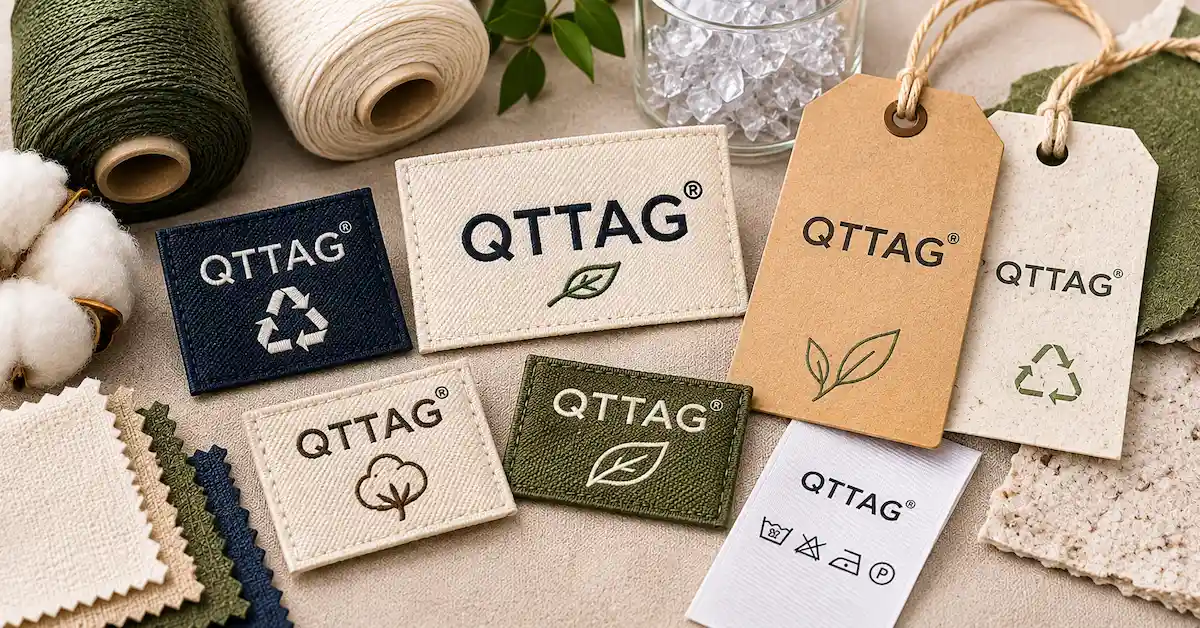
Sustainable Labels: Sustainable Options and Sourcing Considerations
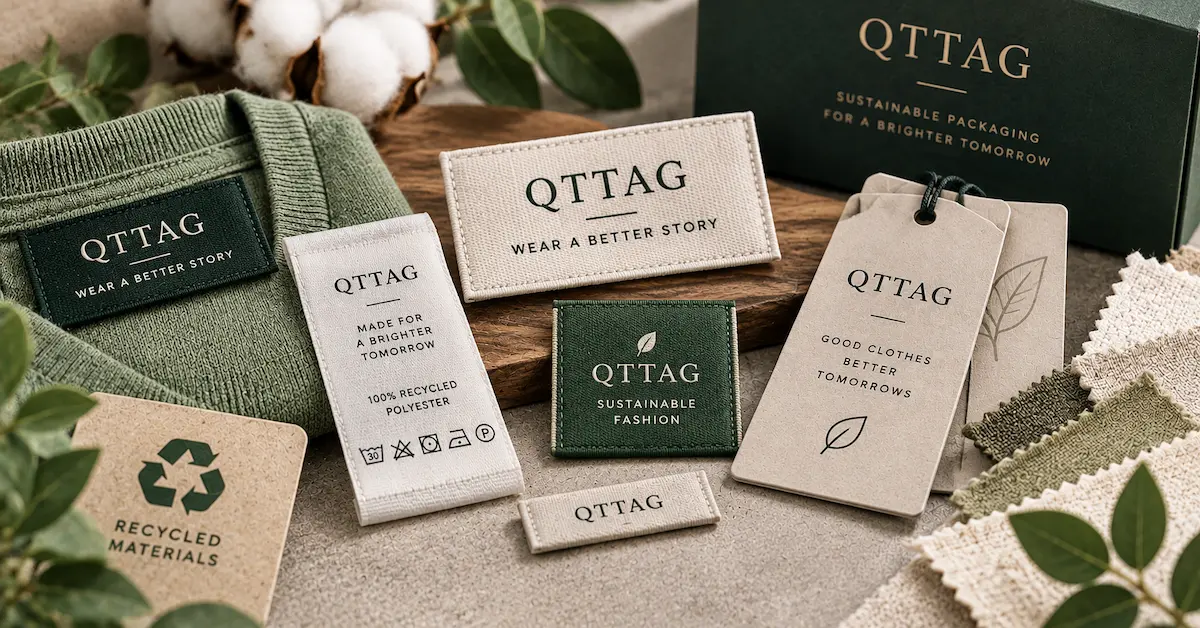
Sustainable labels are an important consideration for clothing brands that want to make more informed decisions about garment branding materials and supply chains. From woven brand labels and printed care labels to hang tags, the materials and manufacturing processes used for these components can influence a product's environmental profile.
However, choosing sustainable labels involves more than selecting a material described as recycled, organic or eco-friendly. Buyers need to understand the actual material composition, supplier documentation, manufacturing process, durability and the evidence supporting any environmental claims.
Sustainable labels for apparel should be evaluated based on verified material attributes, responsible sourcing practices, suitable garment performance and clear documentation. Recycled polyester, certified organic cotton and other alternatives may be considered, but no material should automatically be described as sustainable without understanding its specific environmental characteristics.
For fashion brands, the most useful approach is to establish clear purchasing requirements, compare material options and request appropriate evidence before approving a label for bulk production.
This guide explains sustainable clothing label materials, relevant certification considerations, supplier evaluation, quality control and practical steps for developing a more transparent garment labeling system.
What Are Sustainable Labels?
Sustainable labels are garment labels selected or developed with environmental and responsible sourcing considerations in mind.
They may include woven brand labels, printed care labels, size labels or other textile identification components.
The term does not describe one specific manufacturing method or material.
Instead, it can refer to a range of independently verifiable attributes, such as:
-
Documented recycled material content
-
Certified organic fiber sourcing
-
Traceable material supply chains
-
Reduced unnecessary material use
-
Suitable product durability
-
Responsible manufacturing practices
-
Product-specific environmental information
A material's environmental characteristics should be assessed in relation to the specific label, its production and its intended use.
Sustainable Labels vs. Conventional Labels
The physical function of a sustainable label is generally similar to that of a conventional garment label.
Both may need to display brand information, fiber composition, care instructions or other relevant details.
The key difference lies in the sourcing requirements and the evidence used to support specific material or environmental attributes.
A conventional polyester label and a label containing recycled polyester may look similar, but claims about recycled content require appropriate documentation.
Why the Definition Matters
The words sustainable, eco-friendly and green can be interpreted broadly.
Buyers should therefore replace vague requirements with measurable questions.
For example, asking for a label with documented recycled polyester content is more precise than simply requesting an environmentally friendly label.
This makes supplier evaluation and purchasing decisions easier to verify.
Why Are Fashion Brands Considering Sustainable Labels?
Clothing brands increasingly need to communicate clearly about materials, sourcing and product characteristics.
Garment labels are one component of that broader product system.
Supporting Material Transparency
A fashion brand may want information about the materials used not only in the clothing but also in associated labels and packaging.
A documented material specification helps purchasing teams understand what they are ordering.
Coordinating Brand Requirements
Brands may have internal sourcing policies covering particular fiber types, certifications or documentation.
These requirements can influence garment labels, hang tags and packaging accessories.
Improving Supplier Communication
Clear material requirements can reduce uncertainty between brands and suppliers.
Instead of requesting a generic sustainable product, buyers can specify the desired fiber composition, certification scope and evidence.
Considering the Complete Garment
A label should remain suitable for the clothing.
A material selected for an environmental attribute still needs to provide acceptable comfort, readability, attachment and laundering performance.
A label that fails prematurely may create additional quality problems.
Avoiding Unsupported Marketing Claims
Environmental terminology can affect how customers interpret a product.
Brands should distinguish between a verified material attribute and a broader claim about the complete garment or company.
Using recycled yarn in one label does not establish that the entire clothing product is sustainable.
What Materials Can Be Considered for Sustainable Clothing Labels?
Several material categories may be evaluated depending on the required label construction.
Each option has different sourcing and performance considerations.
| Material Option | Potential Sourcing Attribute | Main Verification |
|---|---|---|
| Recycled polyester | Documented recycled fiber content | Recycled content and chain-of-custody evidence |
| Organic cotton | Cotton grown under defined organic requirements | Valid certification and product scope |
| Conventional cotton | Natural fiber composition | Origin and relevant material information |
| Other recycled fibers | Recycled input materials | Actual composition and supporting records |
| Cellulosic materials | Fiber derived from cellulosic sources | Specific fiber identity and sourcing evidence |
| Mixed-fiber constructions | Combination of selected materials | Complete composition and claim accuracy |
These options should not be treated as equally sustainable or ranked without a defined assessment method.
Different environmental impacts depend on material origin, processing, chemical use, energy, manufacturing and end-of-life conditions.
Start With the Label's Function
Before selecting a material, determine what the label must do.
A woven brand label emphasizing logo detail has different requirements from a printed care label carrying small text and laundry symbols.
Material selection should account for these functional differences.
Recycled Polyester Labels: What Should Buyers Know?
Recycled polyester is one material option that clothing brands may consider for woven or printed label applications.
It is generally produced using recycled polyester feedstock rather than relying entirely on virgin material inputs.
However, the actual recycled content, source and manufacturing chain must be established for the specific product.
Recycled Polyester for Woven Labels
Where suitable recycled yarns are available, they may be used in certain woven constructions.
The supplier should confirm:
-
Yarn composition
-
Documented recycled content
-
Available yarn colors
-
Weaving compatibility
-
Artwork reproduction
-
Finished label dimensions
-
Relevant supporting documentation
A recycled yarn specification does not automatically establish suitability for every woven label design.
Recycled Polyester for Printed Labels
Selected recycled polyester materials may be considered for printed garment information labels.
Printing compatibility and laundering requirements should be evaluated.
A material's recycled content does not guarantee that printing will remain legible after washing.
What Does Recycled Content Mean?
A recycled-content claim should identify the relevant material and the proportion being claimed.
Depending on the documentation framework, buyers may also need to distinguish different feedstock sources.
The claimed percentage should refer to the correct product or component, not be applied ambiguously to an entire garment.
Verification Before Purchasing
Ask suppliers for material declarations and appropriate certification or transaction documentation where required.
Do not assume that a general company certificate automatically covers every recycled polyester product.
Organic Cotton Labels: Benefits and Sourcing Considerations
Organic cotton is another material category that may be considered for selected garment labels.
Its defining sourcing characteristic relates to the cotton's agricultural production under applicable organic requirements.
However, organic cultivation and finished textile product certification are not the same thing.
Cotton Labels for Apparel
Cotton materials may be used in selected printed or woven label constructions where manufacturing capabilities support the specification.
The resulting label should be evaluated for:
-
Surface feel
-
Dimensions and flexibility
-
Print or weave clarity
-
Cutting and edge finishing
-
Washing performance
-
Garment compatibility
Organic Cotton Claims
A claim that a label uses organic cotton should be supported by documentation appropriate to that claim.
Buyers should confirm whether the evidence covers the raw fiber, processed textile or finished label.
Certification Scope
A supplier may provide an organic cotton sourcing certificate, but that does not necessarily prove that a particular finished label is certified under a specific textile standard.
Check certificate validity, the covered organization, product categories and the relevant supply chain.
Durability and Comfort
Cotton material may offer a particular textile feel, but material composition alone does not establish superior comfort or durability.
Physical samples and garment testing remain necessary.
Recycled Polyester vs. Organic Cotton for Clothing Labels
Recycled polyester and organic cotton may both be considered within a responsible sourcing program, but they are different materials.
One is a synthetic polyester fiber derived from recycled feedstock. The other is a natural fiber grown under applicable organic production requirements.
Their environmental profiles cannot be meaningfully compared using the material names alone.
| Factor | Recycled Polyester | Organic Cotton |
|---|---|---|
| Fiber category | Synthetic polyester | Natural cotton |
| Main sourcing consideration | Verified recycled content | Verified organic sourcing |
| Typical evidence | Recycled-content and traceability records | Organic certification and chain documentation |
| Woven applications | Depends on yarn and construction | Depends on yarn and construction |
| Printed applications | Depends on textile and printing system | Depends on textile and printing system |
| Surface feel | Construction-dependent | Construction-dependent |
| Laundering performance | Must be tested | Must be tested |
| Environmental comparison | Requires defined assessment criteria | Requires defined assessment criteria |
Which Material Should a Brand Choose?
The answer depends on the specific priorities.
If a brand requires documented recycled polyester content, that requirement should be included in the purchasing specification.
If the priority is certified organic cotton sourcing, the buyer should request evidence appropriate to the selected standard.
If comfort, fine logo reproduction or print clarity is critical, physical sample testing should be included.
The best decision combines verifiable sourcing attributes with the technical needs of the label.
What Certifications Matter When Sourcing Sustainable Labels?
Certifications can help provide evidence of defined material or process attributes.
However, certification terminology is frequently misunderstood.
A supplier's possession of a certificate does not automatically establish that every product it manufactures is certified.
Global Recycled Standard (GRS)
The Global Recycled Standard is associated with recycled material verification and additional requirements defined by the standard.
Buyers should confirm the applicable standard version and the scope of the relevant certification.
When a claim concerns a specific finished product or shipment, additional traceability documentation may be necessary.
Recycled Claim Standard (RCS)
The Recycled Claim Standard addresses recycled material content and chain-of-custody requirements within its defined scope.
It should not be presented as proof of environmental performance beyond what the standard actually covers.
Global Organic Textile Standard (GOTS)
GOTS addresses defined requirements for eligible organic textile products and their processing supply chains.
A valid GOTS-related claim requires the relevant certified scope and product documentation.
Organic Content Standard (OCS)
The Organic Content Standard provides a framework for tracking certified organic input materials through a supply chain.
Its purpose and coverage should not be confused with broader environmental or social performance certification.
OEKO-TEX STANDARD 100
OEKO-TEX STANDARD 100 relates to testing textile products for certain harmful substances within its defined criteria.
It does not, by itself, establish that a material is recycled, organically grown or environmentally sustainable.
Certification Comparison
| Standard | Primary Area | What Buyers Should Confirm |
|---|---|---|
| GRS | Recycled material and additional specified requirements | Valid scope and product traceability |
| RCS | Recycled content and chain of custody | Claimed content and documentation |
| GOTS | Organic textile processing and related criteria | Certification validity and product scope |
| OCS | Organic input content tracking | Organic material and supply-chain evidence |
| OEKO-TEX STANDARD 100 | Testing against specified harmful substance criteria | Applicable product and certificate details |
Always consult the relevant standard owner for current requirements, permitted claims and verification procedures.
Important: This comparison is educational. It is not a statement that QTTAG or any particular QTTAG label currently holds these certifications.
Why Material Traceability Matters
Material traceability helps buyers connect a product's material claims to relevant sourcing and transaction records.
A product description alone may not provide enough evidence.
Raw Material Source
Buyers should identify what material is being claimed.
For example, a recycled polyester claim should refer to the appropriate recycled material input.
Material Processing
The fiber may pass through several processing stages before becoming a finished label.
The ability to substantiate a claim depends on the documentation system used across those stages.
Manufacturing and Conversion
A finished label may contain yarn, printing materials, coatings, backing or other components.
Claims should clearly identify which parts of the product they cover.
Supplier Documentation
A supplier should be able to explain the evidence supporting the requested material attribute.
This may include relevant declarations, certificates and transaction records where applicable.
Batch and Product Identification
For repeated purchasing, product references can help link the approved specification to subsequent orders.
Avoiding Overly Broad Claims
A label made with a documented recycled component does not automatically qualify the complete label, garment or packaging system for an unrestricted environmental claim.
The claim should remain accurate about what has been verified.
How to Evaluate Sustainable Woven Labels
A woven label must reproduce the intended brand design while meeting its material and application requirements.
When sourcing sustainable woven labels, buyers should evaluate both the claimed material attributes and the quality of the woven construction.
Yarn Compatibility
The selected yarn should be suitable for the intended weaving process.
Logo Definition
Small lettering and fine artwork must remain recognizable at the proposed label dimensions.
Color Reproduction
Physical yarn colors may differ from digital artwork references.
Label Construction
Cut edges, folds and stitching allowances should be evaluated.
Garment Application
The label should work with the fabric and intended attachment method.
Physical Sample Approval
The final sample should confirm both the required appearance and the applicable material specification.
A documented fiber attribute does not replace ordinary product quality control.
Sustainable Printed Care Labels: What Should Be Checked?
Printed care labels must communicate garment information clearly.
If a brand selects a material with a documented environmental attribute, the printed label still needs to meet the intended information and durability requirements.
Accurate Care Information
Fiber composition, care instructions and other required content should be based on verified garment information.
Printing Compatibility
Not all label materials respond identically to every printing process.
Text Legibility
Small typography and laundry symbols should remain readable at the finished size.
Wash Durability
The printed information should be evaluated under defined laundering conditions.
Material and Ink Claims
If a brand intends to make environmental claims about inks, coatings or printing methods, those claims need their own supporting evidence.
Destination-Market Requirements
Different markets may impose different garment labeling requirements.
The buyer should confirm the applicable rules before finalizing label artwork.
How Durable Are Sustainable Labels?
Sustainable labels must still be suitable for the intended garment.
Material attributes such as recycled content or organic sourcing do not automatically establish durability.
Washing Performance
Repeated washing can affect printed information, yarn appearance or attachment.
Colorfastness
Relevant color performance should be evaluated using the specified materials and test conditions.
Edge Finishing
Cutting and folding affect the finished label and its handling.
Attachment Durability
A label must remain suitable for its intended attachment method.
Garment Compatibility
The label's thickness, texture and placement can affect comfort and garment appearance.
Test Documentation
Buyers should request performance evidence relevant to the finished product and intended use.
Avoid assuming that sustainable material terminology provides a durability guarantee.
How Can Brands Reduce Unnecessary Label Materials?
Responsible sourcing can also involve reviewing whether the label construction uses more material than necessary.
This requires careful design rather than automatic material reduction.
Review Label Dimensions
A label should be appropriately sized for its artwork and required information.
Simplify Unnecessary Components
Evaluate whether additional layers, decorative features or accessories serve a practical purpose.
Coordinate Multiple Labels
Some garments require several types of identification.
Their dimensions and locations can be planned together to reduce unnecessary complexity.
Maintain Readability
Reducing label size should not make important care or product information unreadable.
Evaluate Production Feasibility
A design with less material may still be unsuitable if it creates excessive manufacturing defects or fails to meet the intended garment requirements.
Material optimization should balance function, production quality and documented environmental goals.
How to Choose a Responsible Garment Label Supplier
Responsible garment label sourcing involves assessing supplier capabilities, documentation and transparency.
A supplier should be able to explain both the product construction and the evidence behind any material claim.
1. Confirm Actual Materials
Ask for the composition and specification of the proposed label.
2. Review the Claimed Environmental Attribute
Identify exactly what is being claimed, such as documented recycled content or certified organic sourcing.
3. Verify Certification Scope
Where certification is relevant, check whether it applies to the intended product and supply chain.
4. Evaluate Product Samples
Compare physical samples for texture, construction, artwork reproduction and garment compatibility.
5. Confirm Quality-Control Procedures
Ask which inspection and testing methods apply to the label.
6. Review Order Documentation
Establish how the supplier identifies material versions and production batches.
7. Ask About Repeat Orders
Confirm how approved materials and specifications will be maintained when ordering again.
8. Evaluate Claim Communication
A responsible supplier should avoid overstating what its certificates or documentation prove.
What Questions Should Buyers Ask About Sustainable Labels?
A purchasing team can use the following questions to assess suppliers.
| Buyer Question | Why It Matters |
|---|---|
| What is the exact label material composition? | Defines the product |
| What recycled or organic content is claimed? | Clarifies the environmental attribute |
| Is the claim supported by current documentation? | Supports verification |
| Does the certification cover this product? | Prevents incorrect claims |
| Are relevant transaction records available? | Helps establish traceability |
| What printing or weaving methods are suitable? | Confirms production feasibility |
| Are physical samples available? | Supports technical approval |
| What durability tests are appropriate? | Evaluates garment performance |
| How are material changes controlled? | Supports repeat orders |
| What are the MOQ and quotation terms? | Supports purchasing decisions |
A supplier's answers should be specific to the actual label, not limited to general company statements.
What Determines the Cost of Sustainable Labels?
The price of a label depends on its actual material, manufacturing process and order specification.
Products with particular material sourcing requirements may introduce additional considerations.
Cost factors may include:
-
Label material and composition
-
Yarn or fabric availability
-
Weaving or printing method
-
Artwork complexity
-
Label dimensions
-
Color requirements
-
Cutting and folding
-
Order quantity
-
Material documentation
-
Sample development
-
Testing requirements
-
Packing and delivery
Material Availability
A particular material grade or certified supply chain may have different availability from conventional options.
Production Method
A woven label and a printed care label have different manufacturing requirements.
Documentation
Where special sourcing evidence or certification-related transaction records are required, clarify the associated scope and commercial arrangements.
Minimum Quantities
MOQ varies according to material and production specifications.
A brand should request a quotation based on the exact label rather than assume a standard order minimum.
Total Purchasing Value
Cost comparisons should consider the approved label quality, documentation and garment suitability.
A lower unit price is not always the most useful purchasing criterion.
How to Approve Sustainable Label Samples
Physical sampling helps confirm that the selected label is suitable for the actual clothing application.
Material documentation and product quality should be reviewed together.
Step 1: Define the Sourcing Requirement
Specify the desired material attribute and required evidence.
Step 2: Prepare the Artwork
Provide the brand logo, relevant information and intended dimensions.
Step 3: Confirm the Material Specification
Review the proposed material and any relevant documentation.
Step 4: Develop Physical Samples
Produce representative labels using the intended construction.
Step 5: Inspect the Artwork
Check logo reproduction, color, dimensions and readability.
Step 6: Evaluate the Garment Application
Attach a sample to the intended fabric.
Step 7: Perform Relevant Testing
Review applicable laundering, printing or attachment performance.
Step 8: Approve the Production Reference
Retain the approved sample, artwork version and material specification.
Step 9: Review Documentation Before Ordering
Confirm that the evidence supports the intended sourcing and product claims.
Quality Control for Sustainable Clothing Labels
The quality-control process should cover both the physical product and relevant material documentation.
| Quality Area | What to Verify |
|---|---|
| Material composition | Agreed label material |
| Claimed recycled content | Supporting evidence |
| Organic sourcing claim | Applicable documentation |
| Certification | Validity and product scope |
| Artwork | Approved logo and information |
| Dimensions | Finished label measurements |
| Printing or weaving | Visual quality and readability |
| Edge finishing | Cutting and folding |
| Attachment | Garment compatibility |
| Wash performance | Applicable test criteria |
| Repeat orders | Material and specification consistency |
Product Identification
Material references should remain connected to the intended product.
Artwork Control
Keep the final approved version of each label design.
Material Substitution
Changes in material sourcing should be reviewed before production.
Physical Inspection
A documented material claim does not remove the need to inspect the finished label.
Records and Traceability
Retain appropriate purchasing and quality records according to the agreed requirements.
Common Mistakes When Sourcing Sustainable Labels
Treating Natural Materials as Automatically Sustainable
Natural fiber composition does not, by itself, establish an overall environmental advantage.
Assuming Recycled Content Is Always Certified
A recycled-content statement and certification under a particular standard are different claims.
Using a Supplier Certificate for Every Product
A certificate may cover only defined facilities, processes or products.
Check its scope.
Ignoring Printing and Finishing
Material attributes alone do not describe the complete label construction.
Skipping Durability Testing
A label should still remain suitable for its intended garment.
Making Broad Environmental Claims
Terms such as "100% sustainable" may overstate the available evidence.
Use precise, supportable descriptions.
Failing to Verify Repeat Orders
A material used in one batch may not automatically be identical to that used in the next.
Maintain approved specifications and appropriate documentation.
What Should Be Included in a Sustainable Label RFQ?
A detailed request for quotation helps suppliers understand both product and sourcing requirements.
| RFQ Information | Recommended Details |
|---|---|
| Garment type | Intended clothing application |
| Label type | Woven, printed care or other |
| Artwork | Approved logo and information |
| Finished dimensions | Width and height |
| Material | Required composition |
| Environmental attribute | Recycled content, organic sourcing or other |
| Certification | Specific requirement, if applicable |
| Documentation | Evidence needed for the intended claim |
| Colors | Approved references |
| Printing or weaving | Preferred construction |
| Fold and attachment | Finished label requirements |
| Quantity | Estimated order volume |
| Performance | Relevant laundering and durability |
| Sampling | Physical approval requirements |
| Delivery | Destination and requested schedule |
If the buyer is uncertain which materials can meet the required conditions, provide the intended garment and specific sourcing requirements for supplier evaluation.
Frequently Asked Questions About Sustainable Labels
What are sustainable labels for clothing?
Sustainable labels are garment labels selected with defined environmental or responsible sourcing considerations. Buyers should verify the specific material claims rather than assume that the term indicates an independently certified product.
Are recycled polyester labels sustainable?
Recycled polyester may be considered as part of a material sourcing strategy. Its recycled content should be documented, and broader sustainability claims require an appropriate assessment of the specific product.
Can organic cotton be used for clothing labels?
Selected organic cotton materials may be suitable for certain label constructions. Material availability, certification scope, printing or weaving compatibility and garment performance should be verified.
Is GRS certification required for all recycled labels?
Not necessarily. Certification requirements depend on the buyer's claims, policies and intended use. GRS should only be referenced when the relevant product and supply chain meet applicable requirements.
Does OEKO-TEX STANDARD 100 mean a label is sustainable?
No. OEKO-TEX STANDARD 100 addresses specified harmful substance testing criteria. It is not, by itself, certification of recycled content, organic sourcing or overall environmental sustainability.
Are sustainable labels more expensive?
Pricing depends on material, construction, sourcing requirements, documentation and quantity. Buyers should request comparable quotations for the specific label design.
Can sustainable labels withstand repeated washing?
They may be suitable for laundering when the material, printing or weaving and attachment meet the garment's requirements. Relevant durability testing is necessary.
What is the difference between sustainable labels and eco-friendly packaging?
Sustainable labels concern garment identification components and their sourcing attributes. Eco-friendly packaging discussions concern packaging materials and systems. Both require precise, supportable environmental claims.
How can clothing brands verify recycled materials?
Request documentation that identifies the claimed recycled content, relevant product and supply-chain evidence. Where certification is used, confirm the applicable standard, validity and scope.
What should buyers ask before ordering sustainable labels?
Confirm material composition, the exact environmental claim, required evidence, label construction, garment compatibility, physical sampling, MOQ and quality-control requirements.
Develop Sustainable Label Options With QTTAG
Choosing sustainable labels requires a clear understanding of materials, sourcing documentation and garment performance.
Recycled polyester, organic cotton and other alternatives may be worth evaluating, but responsible decisions depend on the specific product and the evidence supporting its material attributes.
QTTAG supports custom garment labeling projects, including woven labels, care labels and coordinated apparel branding.
Brands exploring alternative label materials should begin by defining the required label type, artwork, garment application, material composition and documentation expectations.
The availability of specific certified or recycled materials must be confirmed for each project.
Ready to Explore Sustainable Labels for Your Clothing Brand?
Share your logo artwork, garment specifications, preferred label materials, required environmental documentation, label dimensions and estimated order quantity with QTTAG.
Our team can discuss available material options, customization requirements and physical sampling for your apparel collection.
Request a Quote
Author
Founder at QTTAG
Jason Qiao is the founder of QTTAG, focusing on garment branding and packaging solutions. With years of experience in the apparel industry, he shares practical insights on custom labels, hang tags and sustainable packaging to help global brands grow.
Written By
Jason Qiao