Tagless Labels: Application, Durability and Design Guide
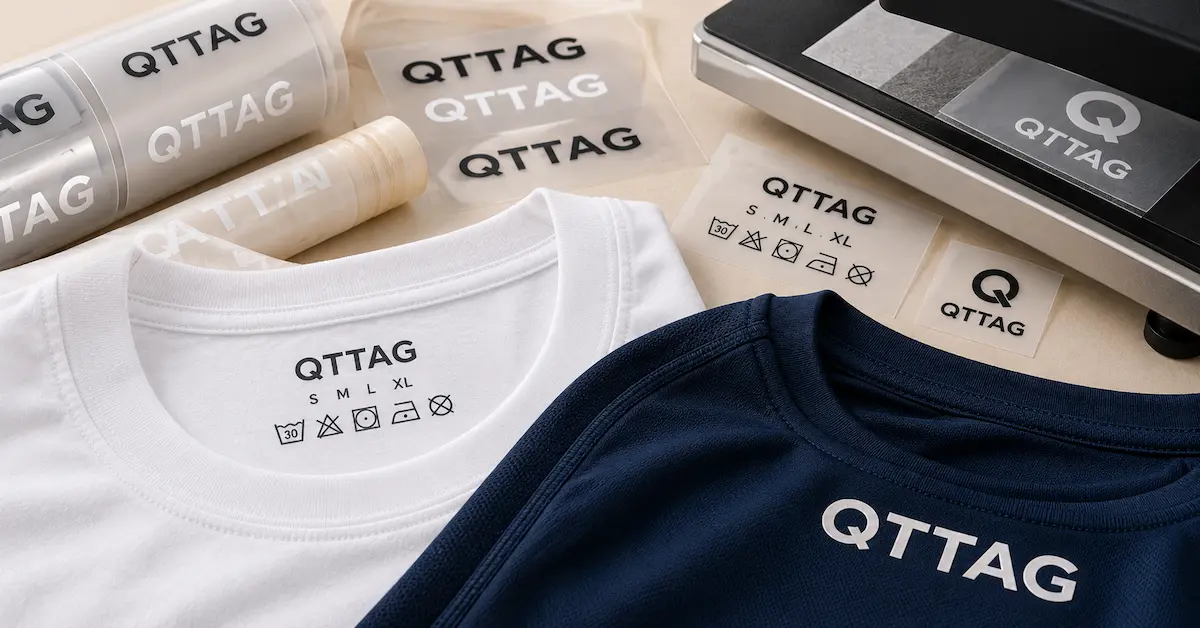
Tagless labels are a practical alternative to traditional sewn-in neck labels for clothing brands that want a cleaner appearance and less label bulk against the skin. Instead of attaching a separate woven or printed fabric label, garment information is applied directly to the clothing, commonly through a heat transfer process.
For T-shirts, activewear, underwear and other garments worn close to the body, this approach can improve the wearing experience by removing the separate neck label and its associated edges or seams. However, actual comfort depends on the transfer material, design coverage and garment construction.
The best tagless label is one that remains readable, feels appropriate against the skin and maintains its required appearance after garment washing and wear.
This guide explains the different tagless labeling options, suitable applications, design considerations, durability requirements and quality checks that apparel brands should review before bulk production.
What Are Tagless Labels?
A tagless label is a branding or identification mark incorporated directly into a garment without a separate sewn-in label at that location.
For apparel branding, tagless labels commonly use heat transfer printing to display brand names, logos, garment sizes and selected care information.
The graphic is applied to the textile surface using a compatible transfer construction and controlled application conditions.
A typical tagless neck label may include:
-
Clothing brand name or logo
-
Garment size
-
Fiber content, where required
-
Country-of-origin information, where applicable
-
Care instructions or symbols
-
Other required product identification
The exact information depends on the product and destination-market labeling requirements.
Tagless does not mean that all garment labeling regulations disappear. A printed or transferred identification mark must still satisfy applicable rules, including any requirements concerning placement, legibility and permanence.
Some brands use a tagless neck logo for branding while retaining a separate care and composition label elsewhere in the garment.
This combination can preserve a clean neckline without requiring every product detail to fit into a small transfer.
Why Do Clothing Brands Use Tagless Labels?
Removing a traditional neck label can change both the appearance and wearing experience of a garment.
Reduced Neck Label Bulk
Traditional woven and printed labels introduce an additional material component.
Depending on their construction and attachment, the cut edges, folds or stitching may be noticeable against the skin.
Tagless labels eliminate that separate sewn component from the selected location.
However, they are not necessarily completely imperceptible. A thick, heavily printed or textured transfer may still be felt against the skin.
Clean, Minimalist Branding
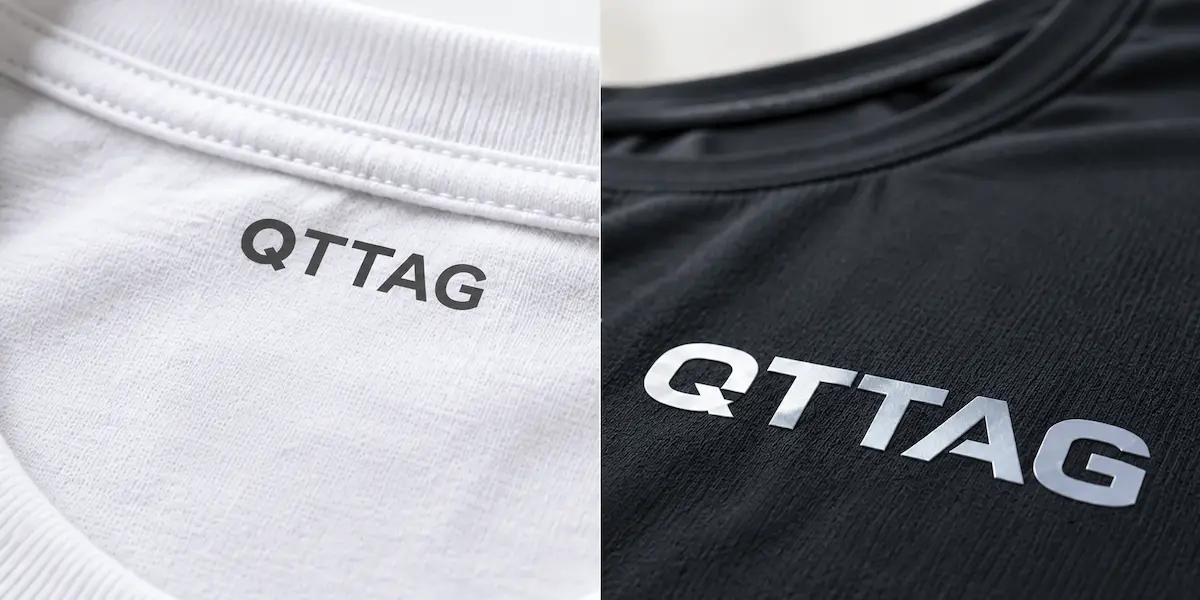
A small transfer printed directly inside a neckline can produce a restrained appearance.
This is particularly useful for brands developing minimalist T-shirts, performance clothing or contemporary basics.
The label can communicate the brand identity without drawing attention away from the garment design.
Compatibility With Selected Apparel Designs
Tagless labeling can be considered for garments where a separate neck label is undesirable.
Examples include lightweight T-shirts, fitted activewear, underwear and sleepwear.
The actual transfer construction must still be compatible with the fabric and intended use.
Integration Into Production
Tagless labels can be applied during garment finishing using suitable heat press equipment.
This may remove a separate neck-label sewing step, but it introduces a controlled application process.
Whether the change improves overall production efficiency depends on equipment, labor, throughput and reject rates.
Brands should compare complete production workflows rather than assuming that tagless labeling always costs less.
Tagless Labels vs. Traditional Sewn-In Labels
Tagless and sewn-in labels can both provide effective garment identification.
The choice depends on the brand's appearance requirements, garment construction, production methods and performance needs.
| Feature | Tagless Labels | Sewn-In Labels |
|---|---|---|
| Construction | Mark applied directly to fabric | Separate woven or printed component |
| Typical attachment | Heat transfer or another direct marking method | Stitching |
| Appearance | Integrated, low-profile branding | Visible textile label |
| Neckline bulk | No separate sewn neck label | Depends on material and attachment |
| Graphic detail | Depends on printing and transfer technology | Depends on weaving or printing method |
| Main production risk | Adhesion and application conditions | Attachment and label construction |
| Durability | Requires application and laundering validation | Requires material and attachment validation |
| Best-fit applications | Tagless apparel and selected close-to-skin garments | Garments requiring separate textile identification |
When Tagless Labels Make Sense
Tagless labels may be appropriate when:
-
A separate neck label would interfere with the intended garment appearance.
-
The brand wants small, integrated identification.
-
The garment material can tolerate the validated application process.
-
The selected transfer performs adequately during washing and wear.
-
The necessary product information can be presented clearly and appropriately.
When Sewn-In Labels May Be Better
A sewn-in label may be preferable when:
-
A woven brand label is a deliberate design feature.
-
The chosen fabric is unsuitable for the proposed transfer.
-
The garment manufacturer lacks an appropriate transfer application process.
-
Required information is better provided on a separate label.
-
Product testing favors a particular sewn-label construction.
For many clothing brands, a combination of tagless neck branding and separate garment information labels is a practical option.
Which Clothing Products Are Suitable for Tagless Labels?
The intended garment affects the design and material requirements.
Tagless Labels for T-Shirts
T-shirts are a common application for tagless neck branding.
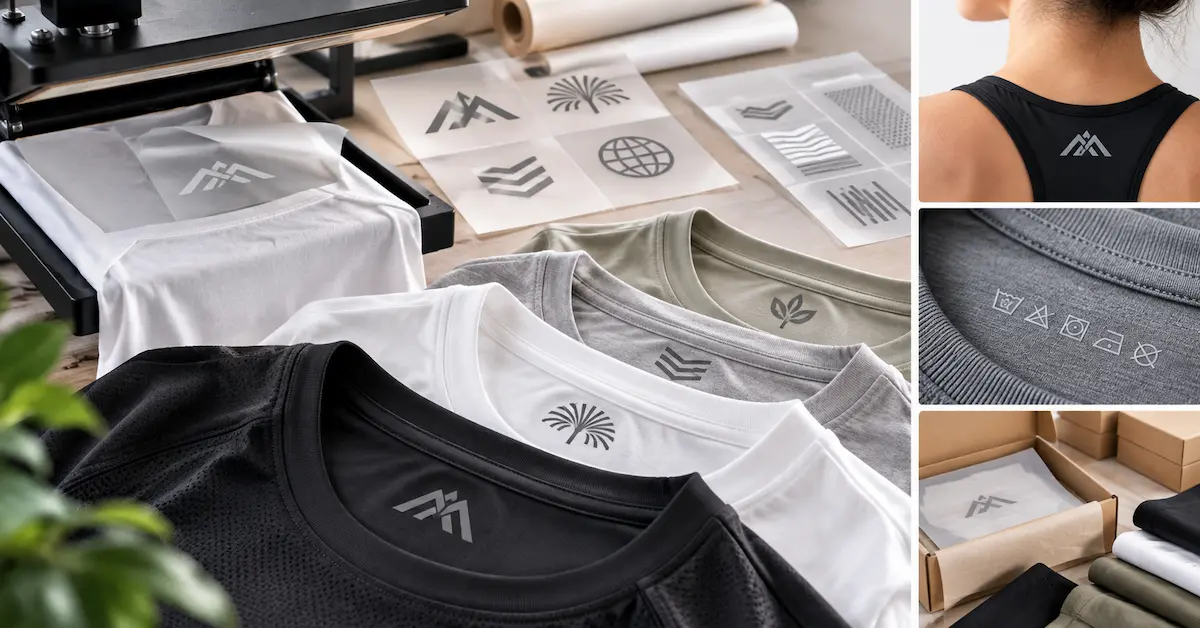
The label is typically positioned inside the back neckline, where a traditional sewn brand label might otherwise appear.
Buyers should consider logo dimensions, garment size variations, fabric surface and placement consistency.
Cotton jersey, polyester and blended T-shirt fabrics may require different transfer constructions or application conditions.
Tagless Labels for Activewear
Performance garments frequently use stretch fabrics and technical textile finishes.
A suitable tagless transfer must accommodate the garment's expected movement without unacceptable cracking, lifting or distortion.
The transfer should be tested on the actual performance fabric, including relevant stretch and washing conditions.
Tagless Labels for Underwear
Underwear often places particular importance on minimizing bulk against the body.
Small, low-profile identification may therefore be preferable to a large printed graphic.
Buyers should evaluate the applied transfer's texture and placement on the completed garment.
Tagless Labels for Children's Clothing
Tagless identification may help remove the separate neck-label component from children's garments.
However, this does not automatically establish product safety or regulatory compliance.
The garment and its labeling must be evaluated against applicable destination-market requirements.
Tagless Labels for Sports Uniforms
Uniform suppliers may use tagless identification for brands, garment sizes or specific collection information.
Repeatability is important when the same designs must be applied across different sizes, colors and production batches.
Maintain approved artwork and application specifications for future orders.
How to Design an Effective Tagless Neck Label
A tagless label has limited space, especially inside a small neckline.
A successful design should prioritize information, legibility and wearing comfort rather than trying to reproduce every detail from a larger brand label.
Keep the Logo Clear
Use artwork that remains recognizable at the intended finished size.
Thin lettering, narrow spacing and complex symbols may require adjustment.
Ask the supplier to evaluate the actual artwork at production size before final approval.
Organize the Information
A typical neck-label hierarchy places the brand identity first, followed by the garment size and any necessary additional details.
If extensive care or composition information is required, consider whether a separate label elsewhere would be more appropriate.
Avoid reducing essential text to an unreadable size simply to fit everything into the neckline.
Select Appropriate Dimensions
The label should fit the available garment area without interfering with seams or expected fabric movement.
Different garment sizes may require separate positioning references.
A small T-shirt neckline and a larger sweatshirt neckline may not require the same graphic dimensions.
Consider Printed Coverage
Large solid areas can behave differently from small, separated graphic elements.
A compact design may be less noticeable to the wearer, although actual comfort must be checked physically.
Coordinate Colors With the Garment
The fabric color affects contrast and visual appearance.
A dark logo on light cotton and a light logo on dark polyester may require different production considerations.
Request samples on representative garment colors.
What Materials Are Used for Tagless Labels?
Tagless labels are commonly produced using suitable heat transfer constructions, but there is no single material specification that defines every tagless product.
A construction may include printing inks, a bonding layer and a temporary carrier.
The selection depends on the intended fabric, print detail, transfer feel and required performance.
| Transfer Option | Potential Use | Important Consideration |
|---|---|---|
| Low-profile printed transfer | Small neck logos and sizes | Texture, legibility and adhesion |
| Flexible transfer construction | Stretch clothing | Flexibility and cracking resistance |
| Multicolor printed transfer | Detailed brand artwork | Print resolution and color consistency |
| Specialty textured transfer | Selected decorative applications | Thickness and wearer comfort |
Specialty technologies such as silicone or TPU may be useful for particular garment graphics, but they should not automatically be treated as replacements for low-profile internal neck labels.
A raised logo may be appropriate for exterior sportswear branding while being less suitable for a sensitive skin-contact location.
The preferred construction is the one that satisfies the actual garment's requirements.
How Are Tagless Labels Applied to Clothing?
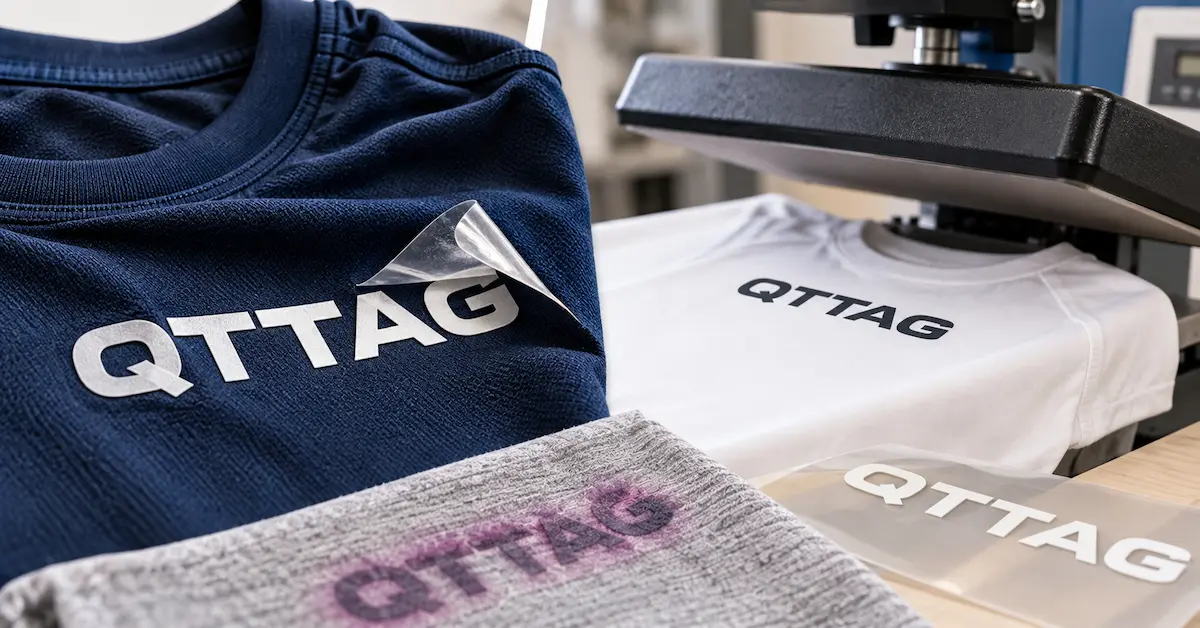
Tagless heat transfer labels are typically applied using a controlled combination of temperature, pressure and time.
The transfer supplier should provide instructions specific to the selected product.
Step 1: Check the Garment Fabric
Confirm the garment's fabric composition and relevant surface treatments.
Some polyester fabrics, coated textiles and heat-sensitive materials may require special attention.
An application approved for one material should not automatically be used on another.
Step 2: Prepare the Application Area
Make sure the fabric lies correctly on the pressing surface.
Wrinkles, thick seams or uneven positioning may interfere with consistent contact.
Follow the specified fabric preparation procedure.
Step 3: Position the Tagless Label
Align the design against the approved reference.
For inside-neck branding, check center positioning, orientation and distance from the neckline seam.
Use a consistent positioning method across garment sizes.
Step 4: Apply the Required Heat and Pressure
Follow the product-specific application instructions.
Temperature, pressure and dwell time vary between transfer constructions.
Do not use a universal heat press setting without verification.
Step 5: Remove the Carrier
Use the specified peel method.
Some constructions require hot peeling, while others use warm or cold peeling.
Incorrect carrier removal can disturb the graphic or lead to an incomplete result.
Step 6: Inspect the Finished Garment
Check whether the complete design transferred correctly.
Look for missing detail, lifting edges, distortion, discoloration and unwanted marks on the garment.
The finished sample should then undergo the relevant performance testing.
How Durable Are Tagless Labels After Washing?
Tagless label durability depends on the transfer material, garment fabric, correct application and expected washing conditions.
A visually acceptable transfer is not necessarily a durable one.
Brands should evaluate performance using a defined testing process.
Wash Resistance
Repeated laundering can expose a tagless print to detergent, water, friction and changes in temperature.
After testing, inspect whether the print remains readable and whether visible damage has occurred.
Relevant issues may include peeling, cracking, fading or incomplete graphics.
Stretch and Movement
On fitted garments, the fabric may stretch significantly during normal use.
A transfer that performs well on a relaxed garment may behave differently when repeatedly extended.
The testing approach should reflect the garment's expected movement.
Adhesion
Reliable bonding depends on the compatibility between the transfer construction and the garment surface.
Textile finishes, improper pressing or surface contamination may affect adhesion.
Drying Conditions
The finished garment may be exposed to tumble drying or other care processes.
If these conditions are relevant to the product, they should form part of the validation plan.
Readability
For tagless marks carrying product information, durability includes continued legibility.
A partially intact logo may still look recognizable, while small care text could become difficult to read.
Use appropriate acceptance criteria for each information type.
What Common Problems Occur With Tagless Labels?
Tagless labels can develop defects when the transfer system, design or application conditions are unsuitable.
| Problem | Possible Cause | Recommended Action |
|---|---|---|
| Peeling after washing | Inadequate adhesion or incompatible fabric | Recheck construction and application |
| Cracking on stretch fabric | Insufficient flexibility | Test a suitable flexible transfer |
| Blurred small text | Printing limitations or artwork detail | Revise and resample at final size |
| Misaligned neck print | Inconsistent garment positioning | Use approved placement references |
| Uneven transfer | Irregular pressing contact | Review equipment and garment setup |
| Fabric discoloration | Heat exposure or dye migration | Test on the actual garment fabric |
| Uncomfortable texture | Excessive printed coverage or unsuitable finish | Evaluate alternative construction |
Some defects have multiple possible causes.
For example, peeling does not automatically mean the transfer material is defective. Application settings or fabric treatments may also contribute.
Maintain records that allow the supplier and garment factory to investigate the actual cause.
How Should Clothing Brands Test Tagless Label Samples?
Physical sampling is an essential part of approving tagless apparel branding.
A supplier's digital preview can demonstrate the intended design, but it cannot fully establish the appearance and performance of the finished garment.
Visual Approval
Compare the applied print with the approved artwork.
Review logo proportions, line detail, color and positioning.
Comfort Evaluation
Inspect the feel of the printed area against the garment's intended skin-contact location.
Consider the transfer's thickness, flexibility and surface texture.
For products where comfort is a major requirement, organize appropriate wearer evaluations rather than relying solely on a visual sample.
Washing Evaluation
Use a defined laundering procedure appropriate to the garment.
Record test conditions and inspect the label after the specified cycles.
Stretch Evaluation
For performance clothing, evaluate relevant extension and recovery.
Check whether the label exhibits visible damage or unacceptable distortion.
Production Repeatability
Apply samples using the planned production process.
Compare multiple garments to determine whether appearance and placement remain consistent.
Document the approved result before bulk manufacturing.
What Determines the Cost of Custom Tagless Labels?
Tagless label pricing depends on the specific design and production method.
Buyers should expect suppliers to review several factors:
-
Artwork dimensions
-
Print coverage and colors
-
Transfer material
-
Order quantity
-
Number of size or design variations
-
Sampling requirements
-
Specialty application needs
-
Packaging and delivery conditions
Consider the Total Labeling Cost
Tagless labeling can remove the need to sew a separate neck label.
However, the production process still involves transfer materials, application equipment, labor and inspection.
A fair comparison with sewn-in labels should consider the complete garment-labeling process.
Ask for a Product-Specific Quote
Minimum quantities and prices vary by supplier and design.
Do not assume that a standard neck logo, multicolor transfer and specialty raised transfer will have the same pricing structure.
Provide the actual design and quantity to obtain a useful quotation.
What Should You Send a Tagless Label Supplier?
A clear purchasing brief reduces unnecessary revisions and helps the supplier evaluate whether the proposed label is suitable.
| Required Detail | Buyer Information |
|---|---|
| Garment type | T-shirt, sportswear, underwear, etc. |
| Fabric composition | Actual textile material and finish |
| Brand artwork | Logo file and required text |
| Finished size | Label width and height |
| Garment colors | All intended fabric colors |
| Placement | Inside neck or other defined area |
| Order quantity | Quantity and size breakdown |
| Care requirements | Intended washing and drying conditions |
| Performance needs | Comfort, flexibility and readability |
| Production equipment | Planned application method |
| Delivery | Destination and required timeline |
If the collection uses several fabrics, ask whether each one requires a separate application trial.
The quotation should distinguish between transfer manufacturing and garment application when these are handled by different parties.
How Can Manufacturers Maintain Tagless Label Quality in Bulk Production?
Consistent bulk application requires more than an approved transfer sample.
The garment manufacturer should be able to repeat the approved application conditions.
Establish an Approved Reference
Retain a finished garment showing the agreed label position, appearance and print quality.
Record the corresponding artwork and transfer version.
Control Application Equipment
Check that the pressing equipment can deliver the required conditions.
Changes in equipment, platen contact or operating methods may affect results.
Maintain Placement Consistency
Use suitable placement references for garment sizes and styles.
Even a correctly printed tagless label can look unprofessional when applied in the wrong location.
Inspect Finished Garments
Check representative garments during production.
Look for incomplete transfers, lifting, incorrect artwork, placement errors and visible fabric damage.
The inspection method and acceptance criteria should be agreed before production.
Manage Repeat Orders
Store approved artwork, transfer specifications and application instructions.
When garment materials or artwork change, assess whether new samples and testing are necessary.
Frequently Asked Questions About Tagless Labels
Are tagless labels more comfortable than woven labels?
Tagless labels remove the separate sewn neck-label component, which may reduce bulk or irritation associated with that component. Actual comfort depends on the applied material, print area, texture and garment design.
Can tagless labels be used on polyester clothing?
Some tagless transfer systems are suitable for polyester, but compatibility depends on the transfer formulation and fabric characteristics. Buyers should test for adhesion, heat effects and potential dye migration.
Do tagless labels fade or peel after washing?
They can fade, crack or peel if the materials, application or washing conditions are unsuitable. Durability should be verified through representative tests on the intended garment.
Can tagless labels include washing instructions?
They may display care information, provided that the content, placement and durability satisfy the relevant market requirements. A tagless print should not be assumed to satisfy every garment-labeling regulation automatically.
Are tagless labels suitable for children's clothing?
They may be considered for children's garments, but the finished product and labeling must meet applicable regulatory and product requirements. Tagless construction alone does not establish safety.
What is the difference between tagless labels and heat transfer labels?
Tagless labels describe a garment-labeling approach without a separate sewn label at the relevant location. Heat transfer labels describe a method of applying graphics to textiles. Many tagless labels use heat transfer technology, but not all heat transfers are tagless labels.
What is the minimum order quantity for custom tagless labels?
Minimum order quantities depend on the supplier, transfer construction, artwork and order specifications. Request a quotation for your exact design and planned quantity.
Develop Custom Tagless Labels With QTTAG
A suitable tagless label should fit the clothing brand's visual identity without compromising the intended garment experience.
For apparel manufacturers and private-label brands, the key decisions involve print design, garment compatibility, application conditions and sample approval.
QTTAG supports custom garment branding projects, including heat transfer label solutions for clothing collections.
Whether you are developing a new T-shirt range, activewear collection or private-label clothing program, begin with a clear specification and physical sample.
Ready to Create Custom Tagless Labels for Your Clothing Brand?
Share your logo artwork, garment fabric, label dimensions, estimated order quantity and application requirements with QTTAG.
Our team can discuss suitable customization and sampling options for your apparel collection.
Request a Quote
Author
Founder at QTTAG
Jason Qiao is the founder of QTTAG, focusing on garment branding and packaging solutions. With years of experience in the apparel industry, he shares practical insights on custom labels, hang tags and sustainable packaging to help global brands grow.
Written By
Jason Qiao