Heat Transfer Labels Cost Guide: What Changes Price, MOQ and Lead Time
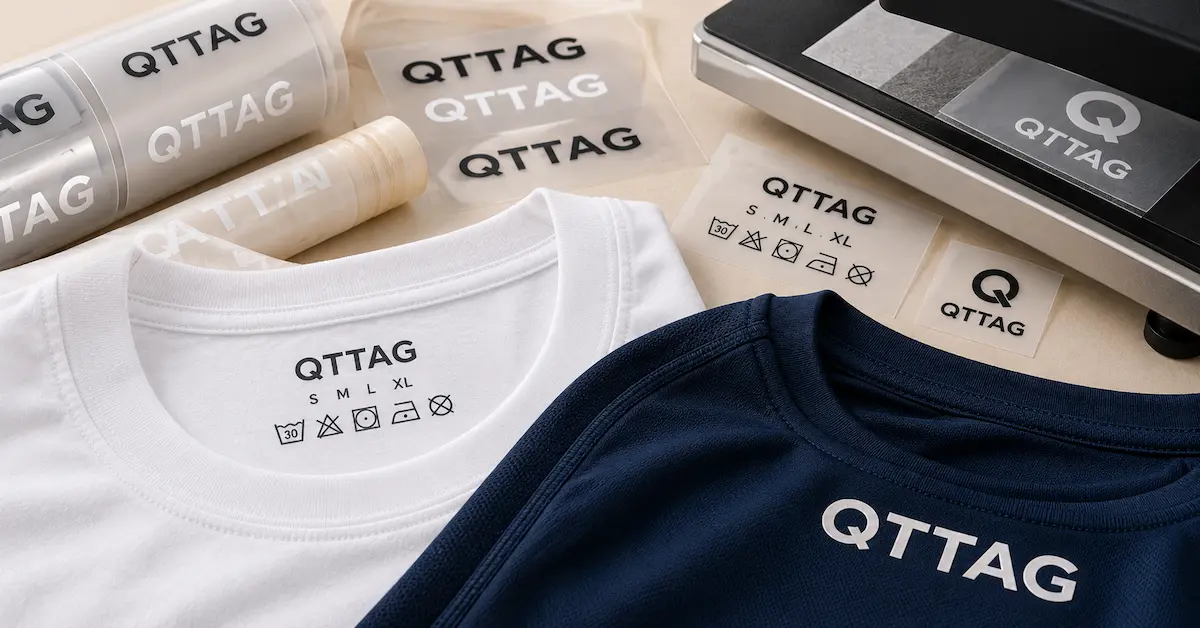
A sportswear brand requests 2,000 heat transfer neck labels for an upcoming T-shirt collection. The artwork is simple: a logo, a size mark and a short line of text.
The first supplier quotes by individual transfer. Another asks whether the buyer wants screen-printed transfers or a digital full-color process. A third wants to see the garment fabric before confirming the price.
They are all discussing the same label, but not necessarily the same manufacturing arrangement.
Heat transfer labels cost depends on the transfer method, design dimensions, number of colors, material construction, order quantity and production requirements. MOQ and lead time also vary by process, artwork versions and sample approval.
There's another cost buyers sometimes overlook: the transfer still has to be applied to the garment. A low price for transfer sheets doesn't automatically mean the lowest cost for the finished clothing.
Understanding these differences makes supplier quotations easier to compare.
Why Do Heat Transfer Label Prices Vary?
Heat transfer labels are not a single manufacturing product.
Some transfers are produced using screen-printing processes. Others use digital printing, cut films or specialty materials. The design is then applied to a compatible garment using the required heat-press process.
A small, one-color neck label may be manufactured differently from a multicolor graphic on activewear.
That choice affects pricing.
Screen-Printed Transfers
Screen-printed transfers can be useful for repeat artwork, particularly when the design uses a limited number of spot colors.
The setup and printing arrangement may influence the cost of a small order differently from a large run.
Transfer Express, a STAHLS' company, explains in its published pricing guide that its screen-printed transfer quotations depend on factors including sheet size, quantity, ink colors, transfer type and artwork source.
That is a specific supplier's pricing system, not a universal formula.
Digital and DTF Transfers
Digital transfer methods, including DTF (Direct to Film), may be suitable for detailed artwork, multiple colors or shorter production runs.
Some suppliers charge according to printed area, while others use product-specific pricing tiers.
A small logo can therefore have a different quotation structure from a larger graphic, even when the same technology is used.
Cut and Specialty Transfers
Selected film-based, silicone, TPU or reflective constructions may involve different materials and manufacturing operations.
They should not be compared solely by design dimensions.
A raised silicone logo and a flat neck transfer may have similar artwork but different production requirements.
| Transfer Option | What Influences the Quote | Typical Buying Consideration |
|---|---|---|
| Screen-printed transfer | Sheet size, quantity, colors, production setup | Repeated designs |
| Digital / DTF transfer | Printed area, quantity, artwork and product type | Detailed or multicolor artwork |
| Cut-film transfer | Material, design size, cutting and preparation | Selected logos and lettering |
| Silicone or TPU transfer | Construction, thickness, finishing and quantity | Particular surface effects |
| Reflective transfer | Reflective material and required performance | Selected activewear applications |
These are broad process differences. Available methods and commercial terms must be confirmed with the actual supplier.
For a clothing brand, the first step is to decide what the finished label needs to do, then compare quotations for suitable constructions.
Does Artwork Size or Color Affect Cost More?
Both can matter, but the relationship depends on the production process.
For a screen-printed transfer, the number of ink colors may affect the manufacturing preparation.
For an area-priced digital transfer, the printed dimensions can have a more direct role in calculating the quotation.
A larger design may consume more material than a compact neck logo.
That doesn't mean every additional millimeter produces a predictable increase in price. Sheet layouts, minimum charges and quantity tiers may also be involved.
Small Neck Labels
A tagless neck label generally contains limited artwork.
Its price may depend on how many transfers can be produced within the supplier's chosen sheet or production format.
Small text still requires review. A compact design that's too fine for the selected process may need artwork adjustments.
Larger Branding Graphics
A larger chest or sleeve transfer requires a different material area and may need more careful application.
The logo might be visually simple but still cost more to produce because of its dimensions.
Can Multiple Designs Share One Sheet?
Some digital transfer suppliers offer gang sheets, where several graphics are arranged on one sheet.
This can make material use more efficient for certain orders.
However, not every transfer method or supplier supports the same approach.
Ask whether mixed designs and sizes are permitted, how the printed area is calculated and whether the transfers arrive separated or need cutting before application.
A useful quotation should specify the finished transfer size, production format and quantity—not just the logo artwork.
Why Garment Fabric Changes the Pricing Decision
A transfer that works on one fabric may not be suitable for another.
Consider a brand using the same logo on cotton T-shirts and polyester sportswear.
The artwork may be identical, but the transfer system may need to accommodate different fabric characteristics.
Stretch, surface treatments, heat sensitivity and dye behavior can all influence the material choice.
Polyester and Dye Migration
Some dyed or sublimated polyester fabrics present a risk of dye migration into light-colored transfer graphics.
A suitable blocker construction may be recommended for certain applications.
That adds a material consideration that may affect the quotation.
The need for a blocker should be established from the fabric and transfer requirements rather than assumed for every polyester garment.
Stretch Activewear
A running top containing elastane may require a transfer that performs appropriately during movement.
The application should be checked on representative fabric.
A sample approved on stable cotton jersey isn't automatically proof that the same transfer will perform well on a stretch sports shirt.
Why Material Testing Matters
Siser, a heat-transfer material manufacturer, publishes different application and compatibility instructions for its products.
Its guidance also recommends testing before production because fabric characteristics vary.
For apparel buyers, a slightly cheaper transfer isn't necessarily the better option if it hasn't been validated for the intended garment.
Material compatibility should be discussed before the price is approved.
Heat Transfer Label MOQ: Per Design, Size or Sheet?
MOQ stands for Minimum Order Quantity.
For heat transfers, its definition can depend heavily on the production method.
Some suppliers offer very small quantities for particular digital transfer products, while screen-printed or specialty constructions may have different minimums.
For example, STAHLS' UK publishes different minimum order quantities for different transfer systems, including options that can be ordered individually and others with minimums based on a particular size or transfer type.
This illustrates why there isn't one industry-wide MOQ for custom heat transfer labels.
One Logo, Several Clothing Sizes
Imagine an apparel collection containing four garment sizes.
Each garment needs the same brand logo but a different size mark.
If the size mark is part of the heat transfer artwork, the order contains multiple versions.
The buyer should confirm whether the supplier treats them as separate designs or permits a combined production arrangement.
A quotation for 2,000 identical transfers may not apply to four versions of 500 each.
Different Logo Colors
The same issue can arise when the brand needs light-colored transfers for dark garments and dark transfers for light garments.
Depending on the process, the color variations may affect production preparation or be handled within an available digital printing arrangement.
Questions to Ask About MOQ
Before placing an order, establish whether the minimum is calculated by artwork, size, colorway, sheet format or total volume.
Ask about sample quantities as well.
A lower MOQ may be valuable for a startup clothing brand, especially if the collection is still changing.
But lower quantity and lower unit cost are not the same thing.
The Cost Buyers Often Forget: Applying the Transfer
A heat transfer is not a finished garment label until it has been applied correctly.
Someone has to prepare the shirt, position the graphic, operate the heat press and inspect the result.
That work may happen at the garment factory or through another service provider.
If the quotation covers only the transfer sheets, application labor and equipment costs may be separate.
How Much Does Application Add?
There isn't a universal charge per garment.
The answer depends on the design, application procedure, equipment, handling requirements and number of transfers per item.
A small neck logo on a prepared T-shirt may involve a different workflow from positioning several transfers on the front, sleeve and back of a garment.
Some products also require specific cooling, peeling or additional pressing steps.
The process should follow the transfer manufacturer's validated instructions.
A More Useful Cost Calculation
For purchasing purposes, distinguish the price of the transfer from the cost of the finished application.
Total applied transfer cost = transfer production + applicable preparation and sampling + garment application + inspection and other agreed charges.
Freight, packing and any relevant handling costs should also be considered when comparing delivered quotations.
This matters when suppliers offer different services.
One may supply only the transfers. Another may offer additional application or preparation work.
A lower transfer unit price isn't automatically the cheapest finished solution.
What Makes Heat Transfer Lead Time Longer?
An urgent order can be delayed before production begins.
The supplier might need to check the artwork, confirm the transfer construction and obtain sample approval.
For an unfamiliar fabric, application trials may be necessary.
If the first sample doesn't meet the buyer's requirements, a revised construction or artwork version may be needed.
That development work should not be confused with bulk production time.
A Typical Order Schedule
| Stage | Main Activity |
|---|---|
| Specification review | Confirm garment, artwork and transfer requirements |
| Artwork approval | Check dimensions, colors and design versions |
| Material selection | Confirm suitable transfer construction |
| Sample preparation | Produce representative transfers |
| Application testing | Check the proposed process on garment fabric |
| Final approval | Authorize artwork and construction |
| Bulk production | Manufacture the approved transfer order |
| Inspection and packing | Check quality and separate versions |
| Dispatch | Send the order to the agreed destination |
Not every project requires every stage.
A repeat order using unchanged approved specifications may need less preparation than a new transfer construction.
However, supplier production capacity and material availability still matter.
When Does the Quoted Lead Time Start?
Ask whether the supplier begins counting after artwork approval, sample approval, payment or another agreed milestone.
A production turnaround is also different from the final delivery date.
If the garment factory needs the transfers before sewing or decoration begins, establish when the materials must arrive.
Shipping and any applicable import procedures may extend the schedule beyond manufacturing.
The buyer should receive a realistic timeline covering approval, production and dispatch.
Is Sampling Worth the Cost?
For a new transfer application, a physical sample provides information that a digital proof cannot.
The artwork can be correct while the finished application remains unsuitable.
A transfer may feel too thick on the intended fabric. Fine lettering may not reproduce as expected. The garment may show unwanted pressure marks, or the edges may lift after suitable laundering tests.
These issues should be investigated before the bulk order is released.
What Should a Buyer Approve?
Begin with the artwork and dimensions.
Then inspect a sample applied to the intended garment fabric using the proposed production process.
Review the logo's appearance, placement, adhesion and compatibility with the surrounding material.
Where relevant, assess performance under the expected washing or stretching conditions.
Keep the approved sample and record the transfer construction and application instructions.
Why the Actual Fabric Matters
A loose transfer sheet doesn't demonstrate how the design will behave after pressing.
A sample on unrelated fabric may also provide limited evidence.
If a brand uses several materially different fabrics, additional trials may be needed.
These checks can add development work, but they help establish whether the proposed product is suitable before large quantities are ordered.
How Can Clothing Brands Control Heat Transfer Label Costs?
The most effective cost decisions usually happen before bulk production.
Start with the artwork.
A compact neck logo may not need a specialty dimensional finish. A design requiring several colors may be more appropriate for one printing process than another.
Ask suppliers to explain feasible options rather than automatically choosing the most complex material.
Keep Artwork Versions Organized
Different garment sizes, logo colors or placements may require separate files.
Clearly identify which designs belong to which products.
Choose Appropriate Dimensions
A transfer should be large enough to reproduce important details but no larger than necessary for the intended design.
Plan Quantities by Version
Providing a total quantity without a breakdown can make it difficult for suppliers to calculate the correct MOQ.
Compare Similar Finished Products
A basic transfer and a raised silicone graphic are not equivalent products, even when both carry the same logo.
Avoid Unnecessary Changes After Approval
Late artwork or material changes may require additional development or revised production arrangements.
Include Application Work in the Budget
The cost of pressing and inspecting transfers belongs in the calculation for the finished garment.
Cost control shouldn't come at the expense of transfer compatibility or product performance.
What Should You Send to a Heat Transfer Manufacturer?
An accurate quotation starts with a clear description of the finished application.
| RFQ Information | What to Provide |
|---|---|
| Product | Neck label, logo, graphic or other transfer |
| Garment | T-shirt, sportswear, underwear or jacket |
| Fabric | Actual composition and relevant finish |
| Artwork | Approved logo and graphics |
| Dimensions | Finished width and height |
| Colors | Required color versions |
| Material | Preferred transfer system or visual reference |
| Placement | Neckline, chest, sleeve or other |
| Quantity | Total volume and units per design |
| Application | Equipment or process requirements |
| Durability | Relevant washing and stretching expectations |
| Sampling | Sample and approval requirements |
| Delivery | Destination and required date |
If the transfer material hasn't been chosen, send the garment fabric and desired appearance.
The supplier can then discuss suitable constructions and testing requirements.
Before confirming the order, ask for the MOQ, quotation scope, sample arrangements and production timeline for the proposed product.
Frequently Asked Questions About Heat Transfer Labels Cost
How much do custom heat transfer labels cost?
Pricing depends on the transfer method, material, dimensions, colors, artwork, quantity and other production requirements. A finished specification is needed for an accurate quotation.
Are DTF transfers cheaper than screen-printed transfers?
Not in every situation. Digital processes may suit shorter runs and detailed artwork, while screen-printed transfers may be competitive for larger quantities of repeated designs. Compare actual quotations.
What is the MOQ for heat transfer labels?
MOQ varies by supplier and transfer system. Some digital products are offered in very small quantities, while other constructions have minimums per design, sheet or size.
Can different sizes share one MOQ?
Possibly. It depends on the transfer method and supplier's ordering rules. Confirm whether each artwork variation is counted separately.
Do silicone and reflective heat transfers cost more?
They may involve different materials and manufacturing processes from standard printed transfers. Their pricing must be checked against the actual construction and order quantity.
How long does heat transfer label production take?
Lead time depends on artwork approval, material selection, sampling, production scheduling, manufacturing, inspection and delivery. Confirm when the supplier's quoted period starts.
Does a heat transfer quotation include application?
Not necessarily. Some quotations cover transfers only. Ask whether pressing, garment handling and inspection are included.
Should heat transfer labels be tested before bulk production?
For new constructions or unfamiliar garment fabrics, representative application samples are strongly recommended. The required tests depend on the intended use.
What affects heat transfer label cost most?
The main factors are the transfer construction, design size, colors, quantity and production arrangements. For finished garments, application labor and process requirements also matter.
Plan Your Heat Transfer Label Order With QTTAG
The best starting point is the garment and the approved artwork.
QTTAG supports custom apparel branding inquiries, including heat transfer labels and related garment identification products. Specific silicone, TPU, reflective or other specialty constructions, MOQ and production schedules should be confirmed for each project.
If you are preparing a new collection, share the intended fabric, transfer dimensions, artwork versions, quantities and delivery requirements.
Ready to Plan Custom Heat Transfer Labels for Your Clothing Brand?
Share your logo artwork, garment fabric, preferred transfer materials, label dimensions, application requirements, estimated order quantity and delivery needs with QTTAG.
Our team can review your requirements and discuss available customization, sampling and quotation options.
Request a Quote
Author
Founder at QTTAG
Jason Qiao is the founder of QTTAG, focusing on garment branding and packaging solutions. With years of experience in the apparel industry, he shares practical insights on custom labels, hang tags and sustainable packaging to help global brands grow.
Written By
Jason Qiao