Textile Labeling Compliance: What Apparel Brands Need to Know
Textile labeling compliance is an essential part of bringing clothing products to international markets. A garment may have excellent fabric quality, accurate sizing and attractive branding, yet still create regulatory or commercial problems if its labels contain incorrect fiber information, unsuitable care instructions or misleading country-of-origin claims.
For clothing brands, importers and private-label manufacturers, labeling requirements must be considered before bulk production. Different countries and regions may regulate textile fiber names, composition declarations, care information, responsible business identification and label placement differently.
Textile labeling compliance means ensuring that the information displayed on a textile product meets the applicable requirements of its destination market, is accurate, readable and presented in the required form.
For example, most covered textile and wool products sold in the United States require fiber content, origin and responsible business identification, with separate care-label requirements for covered apparel. The European Union has harmonized rules for textile fiber composition, but those rules should not be confused with a universal requirement for care symbols across every EU market.
This guide explains the major labeling considerations, regional differences, common mistakes and practical approval steps clothing brands should review when sourcing custom garment labels.
Regulatory note: This article provides general sourcing and labeling information, not a legal determination for a specific product. Requirements may differ by garment category, destination country, applicable exemptions and regulatory updates. Verify the applicable rules before approving production artwork.
What Is Textile Labeling Compliance?
Textile labeling compliance refers to meeting the labeling and marking requirements that apply to textile products in a particular market.
These requirements help ensure that consumers and other relevant parties receive accurate information about the product.
Depending on the product and jurisdiction, they may concern:
-
Textile fiber composition
-
Approved fiber names
-
Country of origin
-
Manufacturer, importer or responsible business identification
-
Washing and care instructions
-
Label attachment and placement
-
Language and readability
-
Certain product-specific information
-
The accuracy of environmental or material claims
Not every market requires every item in the same way.
For this reason, a clothing brand should establish the destination market and product category before finalizing its label design.
Textile Labeling vs. Brand Identification
A woven brand label and a legally required information label do not necessarily perform the same function.
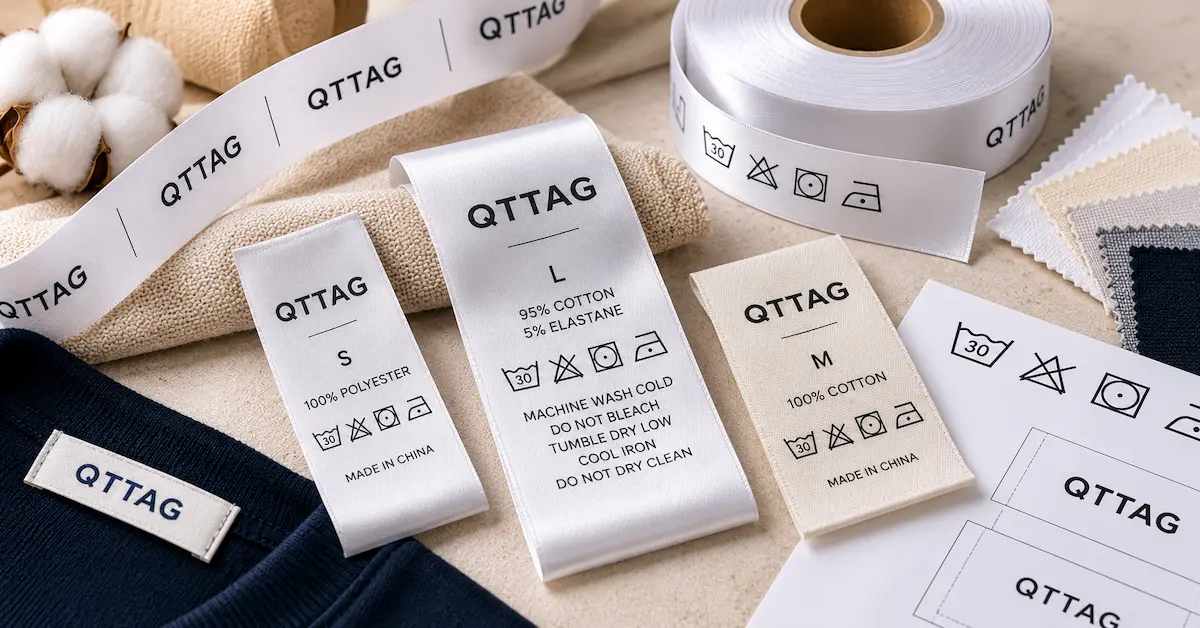
A woven label may display the brand's logo, while a printed care or composition label can provide required product information.
A hang tag may contain additional retail information but cannot automatically replace labels that a regulation requires to be attached or maintained on the garment.
The complete labeling system should be reviewed, rather than assuming that one label serves every purpose.
Why Textile Labeling Compliance Matters for Apparel Brands
Inaccurate garment labeling can create problems throughout purchasing, importing and retail distribution.
Product Information Accuracy
Customers should receive accurate information about the garment.
Incorrect fiber composition can misrepresent what the product is made from.
Import and Distribution Requirements
Some markets impose requirements on origin marking or other information associated with imported garments.
A buyer should verify these requirements before arranging shipments.
Care and Consumer Use
Where care instructions are required, they should accurately reflect suitable garment-care procedures.
Incorrect information may contribute to product damage during use.
Brand Credibility
Inconsistent or misleading information can undermine confidence in a clothing brand.
Production Efficiency
Fixing label content after garments have been manufactured may require additional work, replacement labels or changes to completed products.
Reviewing the label before bulk production is usually more practical than addressing avoidable mistakes later.
What Information May Be Required on a Clothing Label?
The precise requirements depend on the destination market, product category and applicable rules.
| Label Information | Main Purpose | What Buyers Should Verify |
|---|---|---|
| Fiber composition | Identifies textile materials | Verified fiber percentages and required names |
| Country of origin | Identifies relevant product origin | Applicable origin determination rules |
| Care instructions | Communicates suitable garment care | Correct instructions and applicable market rules |
| Business identification | Identifies a responsible company where required | Correct business name or permitted identifier |
| Language | Makes information understandable | Destination-market language requirements |
| Label placement | Ensures required information is accessible | Position and attachment requirements |
| Environmental claims | Describes supported material attributes | Evidence and permitted claim wording |
| Product-specific details | Addresses special product requirements | Applicable regulations and exemptions |
This is a verification framework, not a universal list of mandatory fields.
Avoid Using One Global Label Without Review
A single label design may work for several countries, but it should not be assumed to satisfy every market.
The purchasing team should identify which requirements are shared and which need separate artwork versions.
Textile Fiber Content Labeling Requirements
Fiber composition is one of the central subjects of textile labeling rules.
A composition declaration identifies the fibers used in the relevant textile product, subject to the applicable regulations.
Verify the Actual Fiber Composition
Label content should be based on reliable material information.
Do not copy the composition from a similar garment or previous production order without verification.
Use Appropriate Fiber Names
Different jurisdictions maintain rules or recognized names for textile fibers.
A marketing description may not be an acceptable substitute for the prescribed fiber name.
Confirm Fiber Percentages
Fiber percentages should be based on the relevant composition information and calculation requirements.
The buyer should check whether any permitted tolerances or exemptions apply.
Consider Multi-Component Garments
A garment may contain outer fabric, lining or other textile components.
Some regulations require separate composition information for particular components.
Review Decorative Materials
Certain decorations, trims or components may be treated differently under the applicable rules.
Do not assume that every textile component must always appear in the same declaration.
Example of a Composition Layout
The following illustrates a possible composition presentation rather than a certified or universally compliant label:
| Field | Illustrative Value |
|---|---|
| Main fabric | 95% Cotton, 5% Elastane |
| Lining, if applicable | Composition to be verified |
| Care instructions | Based on garment testing |
| Origin | Determined under applicable rules |
The final artwork must be reviewed against the actual garment and target market.
Textile Labeling Compliance in the United States
The United States has federal requirements affecting many textile and apparel products.
Important FTC-administered rules include the Textile Fiber Rule and the Care Labeling Rule.
Most covered textile and wool products require disclosures identifying fiber content, country of origin and the manufacturer or another responsible business. Covered apparel is also subject to applicable care-label requirements.
Fiber Content
Relevant products generally require disclosure of fiber composition using permitted terminology and applicable calculation rules.
Country of Origin
Origin declarations must follow the relevant legal rules.
The origin of a finished garment should not be assumed solely from where a label was manufactured or where the garment was packaged.
Manufacturer or Business Identification
The required responsible business information may be presented using an appropriate business name or eligible identification number under the applicable rules.
The FTC's Registered Identification Number, commonly called an RN, is not a universal requirement for every business. It can serve as an alternative identifier in circumstances permitted by the rules.
Care Instructions
The FTC Care Labeling Rule requires applicable manufacturers and importers to provide suitable care instructions for covered products.
The rules address how care information is communicated and supported.
Label Placement
Certain U.S. labeling requirements have specific placement provisions, including origin-label placement for garments with a neck.
Brands should review the relevant rules before selecting label positions.
Practical Buyer Checklist
Before manufacturing U.S.-bound clothing, confirm:
-
The exact product category
-
Applicable exemptions
-
Fiber composition and terminology
-
Correct origin declaration
-
Responsible business information
-
Care instructions
-
Label attachment and placement
-
Any applicable additional product requirements
Do not treat a generic supplier template as automatic proof of U.S. compliance.
Textile Labeling Requirements in the European Union
The European Union regulates textile fiber names and related composition labeling under Regulation (EU) No 1007/2011.
The regulation establishes requirements concerning the labeling and marking of textile fiber composition for products within its scope.
Fiber Names and Composition
Covered products must use appropriate textile fiber descriptions.
The applicable rules address how fiber composition information is presented.
Label Readability
Required information should be presented in a clear and accessible manner, following the regulation's requirements.
Language Requirements
The language requirements are connected to the EU Member State where the textile product is made available.
An English-only label should not automatically be assumed sufficient for every EU market.
Multi-Component Products
Where applicable, textile products containing multiple components with different fiber compositions may require component-specific declarations.
Non-Textile Parts of Animal Origin
The EU regulation includes an indication requirement for applicable non-textile parts of animal origin.
The product and component details must be reviewed before deciding whether this requirement applies.
Care Instructions in the EU
Regulation (EU) No 1007/2011 focuses on textile fiber names and composition labeling. It should not be interpreted as a universal EU-wide care-symbol rule.
Brands must separately investigate relevant national requirements, product-specific rules and other applicable obligations.
Online Product Information
The EU regulation also addresses making relevant fiber-composition information available to consumers before purchase, including in electronic sales contexts.
A clothing brand selling online should not focus solely on the physical label.
Textile Labeling Requirements in Great Britain
Great Britain has textile fiber-content labeling requirements applicable to relevant products placed on its market.
UK government guidance addresses responsibilities for manufacturers and retailers and the disclosure of textile fiber composition.
Identify the Destination
Distinguish Great Britain from Northern Ireland when evaluating market-specific rules.
The applicable legal framework may differ.
Verify the Composition
Use the actual garment fiber information and the relevant permitted terminology.
Consider Different Components
Certain products containing textile components of differing composition may require additional declarations.
Confirm Responsible Parties
Manufacturers and retailers should understand their obligations for products placed on the market.
Avoid Assuming Rules Are Identical Everywhere
Although there are similarities with EU textile labeling requirements, current rules and responsibilities should be checked for the actual destination.
Comparing U.S., EU and Great Britain Labeling Considerations
The table below provides a high-level purchasing comparison, not an exhaustive compliance determination.
| Requirement | United States | European Union | Great Britain |
|---|---|---|---|
| Fiber composition | Required for many covered products | Required for products within Regulation 1007/2011 | Required for relevant textile products |
| Fiber terminology | FTC and applicable rules | EU recognized fiber terminology | Applicable GB requirements |
| Country of origin | Required for many covered textile products | Not a universal requirement under Regulation 1007/2011 itself | Must be checked under separate applicable rules |
| Care instructions | FTC rule applies to covered apparel | Check applicable national and other rules | Check applicable requirements |
| Responsible business identity | Certain covered products require identification | Check applicable product and business obligations | Check applicable business obligations |
| Language | Applicable U.S. disclosure rules | Relevant Member State requirements | Applicable market rules |
| Placement | Product-specific provisions | Durable, visible and accessible composition labeling rules | Applicable product rules |
The purpose of this comparison is to show why a global clothing brand needs market-specific review.
It should not be used as a substitute for checking the relevant regulations and product details.
How to Choose Care Instructions for Garment Labels
Care instructions should reflect what the garment can reasonably tolerate during cleaning and maintenance.
They should not be copied from unrelated products simply because those products use similar fabrics.
Washing
The appropriate washing method may depend on fiber composition, fabric construction, dyes and garment finishes.
Bleaching
Bleaching instructions should reflect relevant material and color compatibility.
Drying
Drying requirements may depend on shrinkage behavior, finishing and garment construction.
Ironing
The safe ironing method can vary by textile and decorative components.
Professional Textile Care
Selected garments may require professional care instructions.
Testing and Evidence
Where required, the care recommendation should be supported by the manufacturer or relevant testing and product knowledge.
A care label supplier can print approved instructions, but it should not invent them without information from the responsible product team.
Understanding Laundry Care Symbols
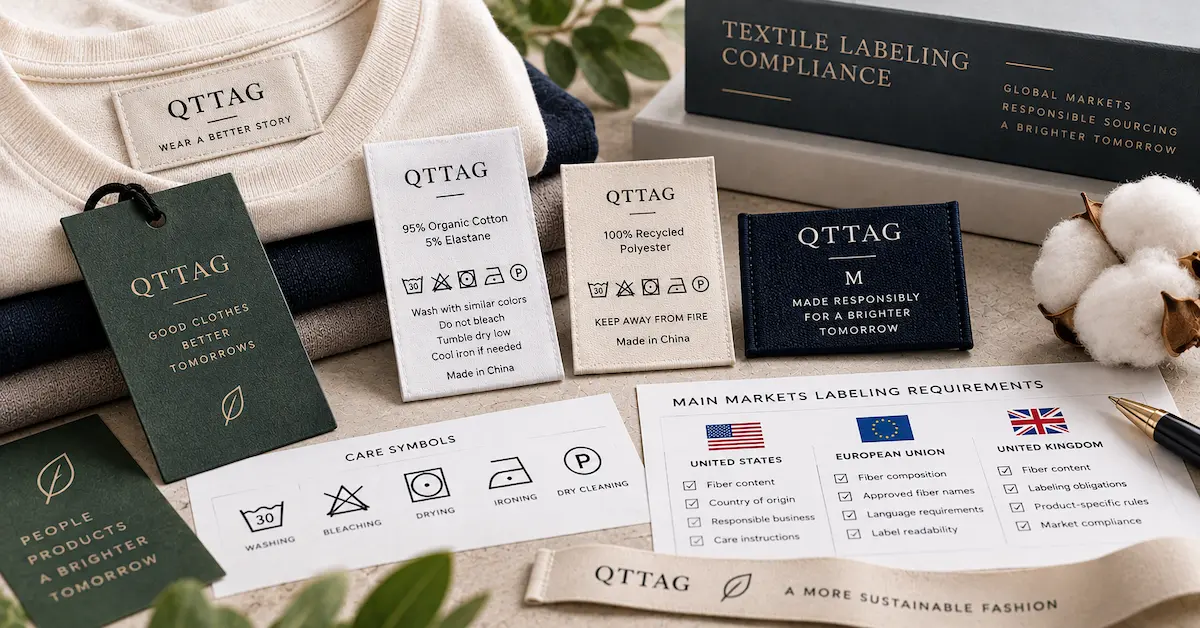
Laundry care symbols provide a compact way to communicate garment-care information.
Common symbol groups address:
-
Washing
-
Bleaching
-
Drying
-
Ironing
-
Professional textile care
However, the use and recognition of care symbols may differ by market and applicable system.
Do Not Invent Symbols
A symbol should have a defined meaning within the system being used.
Decorative icons should not be substituted for regulated or standardized symbols where specific symbols are required.
Verify the Correct System
The relevant market, standard and use rights should be reviewed.
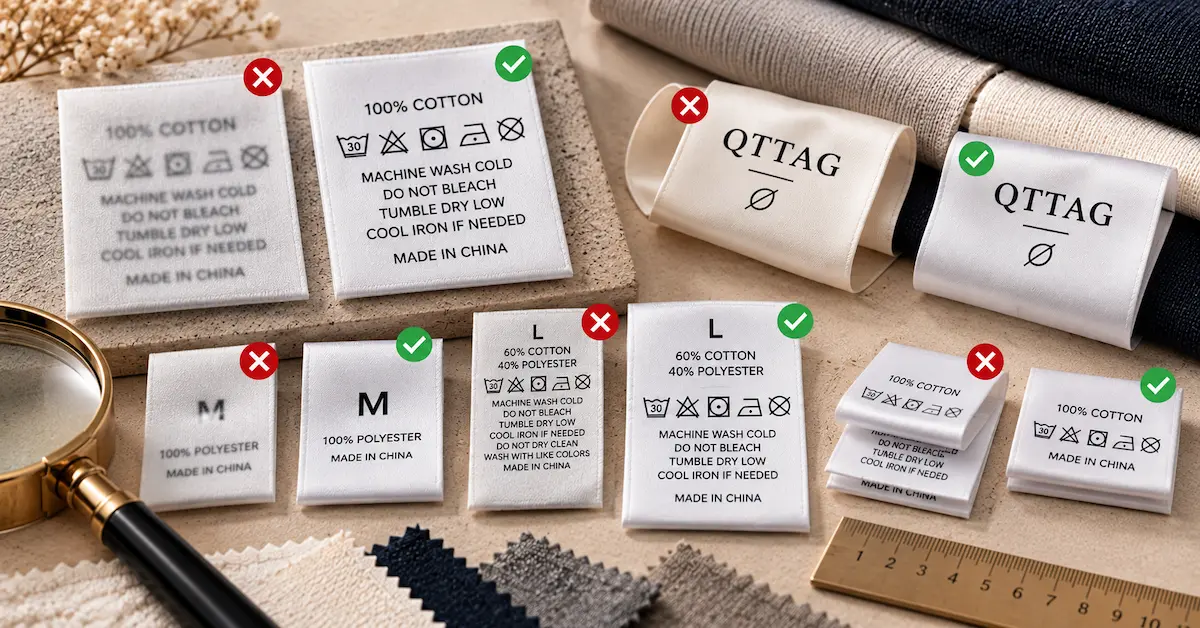
Ensure Legibility
Symbols must remain recognizable at their final printed dimensions.
Review After Washing
Where relevant, confirm that the printed information remains legible under expected laundering conditions.
Use Approved Artwork
The supplier should receive the exact symbols and approved text rather than interpret informal instructions independently.
How to Design Legible and Durable Care Labels
Label compliance involves more than choosing the correct words.
The final label must also be suitable for the intended garment and comply with applicable presentation requirements.
Select an Appropriate Material
Printed care labels may use different textile materials depending on the garment, printing method and performance requirements.
Choose Suitable Dimensions
The label must provide enough space for the required information.
Reducing the dimensions too far can make important details unreadable.
Use Appropriate Text Contrast
The relationship between printing ink and label background affects readability.
Review Fold Construction
A folded label may provide additional information space but may also affect how information is accessed.
Consider Placement
The selected location must suit both the garment and the applicable requirements.
Validate Printing Durability
Where permanence or durability is required, confirm that the printed information remains suitable after relevant use and care.
Can Heat Transfer Labels Replace Sewn-In Labels?
Heat transfer technology may be suitable for certain branding or information applications.
However, tagless construction does not automatically establish regulatory compliance.
Material Compatibility
The transfer must work with the intended garment fabric.
Information Accuracy
The printed content must match the approved specification.
Legibility
Small text and symbols should remain readable.
Durability
The transfer must satisfy any applicable permanence and wear requirements.
Placement
Some markets or product types have specific requirements for where information must appear.
Product-Level Evaluation
Determine whether the complete labeling arrangement satisfies the applicable requirements.
A tagless brand logo alone should not be treated as a replacement for all legally required information.
Can Hang Tags Carry Required Textile Information?
Hang tags can carry useful retail information, including brand details, style references and selected product descriptions.
However, a removable hang tag cannot automatically replace every required garment label.
Retail Information
A hang tag may communicate information intended to help customers choose products.
Composition Claims
Any fiber content stated on the hang tag should accurately reflect the product.
Permanent Information
Where a requirement specifies a permanent or otherwise particular label, the business must satisfy that requirement.
Avoid Contradictory Content
Information on hang tags, permanent labels, packaging and online product pages should be consistent.
Verify Market-Specific Requirements
Rules governing the presence, accessibility and permanence of information differ.
The buyer should establish which content belongs on which component.
Textile Labeling for Children's Clothing
Children's clothing may be subject to additional product requirements beyond general textile fiber and care labeling.
The applicable obligations depend on the garment type, age group and destination market.
Product Category
Infant clothing, sleepwear and general children's apparel may fall under different requirements.
Material Information
Fiber information should be verified against actual garments.
Care Label Accuracy
Instructions should reflect the material and finished product.
Attachment and Construction
Label materials and attachment methods should be suitable for the garment.
Safety and Other Regulatory Requirements
Additional laws or standards may address aspects of children's products.
These must be evaluated separately rather than inferred from a garment label alone.
Supplier Responsibilities
Apparel brands should provide accurate approved information and clarify which parties handle regulatory assessment, product testing and label reproduction.
How to Manage Labels for Multiple Export Markets
International clothing brands may need different label versions for the same garment.
A structured artwork process helps manage these variations.
Identify the Markets
List each intended destination.
Create a Requirements Matrix
Compare applicable fiber, care, origin, language and other labeling requirements.
Confirm Product Specifications
Make sure the underlying garment information is accurate.
Prepare Market-Specific Artwork
Use separate approved versions when necessary.
Control Languages
Identify which text and symbol versions are appropriate for each market.
Establish SKU References
Link the label version to the correct garment and destination.
Review Before Production
An approved artwork version should be checked against the intended production order.
Prevent Version Mixing
Packing and inspection procedures should help prevent the wrong labels from being supplied.
How to Prepare Textile Label Artwork
An accurate artwork package helps the label supplier reproduce the required information correctly.
Essential Artwork Inputs
Provide:
-
Garment style or SKU
-
Target market
-
Verified fiber composition
-
Approved care instructions
-
Correct origin statement
-
Required business identification, where applicable
-
Language requirements
-
Logo and typography
-
Label dimensions
-
Material and attachment specifications
Maintain Version Control
Use a unique reference for every approved label version.
Confirm the Finished Layout
Check how the text and symbols appear at actual production size.
Review Technical Feasibility
Small lettering may be difficult to print clearly on certain materials.
Approve Physical Samples
Printed samples help confirm readability, dimensions and finishing.
Separate Content Responsibility
The brand or relevant responsible party should approve the required information.
The manufacturing supplier should reproduce the final approved artwork accurately.
Textile Labeling Compliance and Quality Control
Quality control can help verify that labels match approved information, but it cannot replace legal review.
For textile labeling compliance, businesses should maintain controls over both the source information and the manufactured label.
| Inspection Item | What to Check |
|---|---|
| Fiber content | Matches verified garment specification |
| Fiber names | Uses appropriate terminology |
| Care information | Matches approved instructions |
| Origin | Correct statement for the product |
| Business identity | Correct approved information |
| Language | Appropriate for the market |
| Symbols | Correct and legible |
| Label dimensions | Meets the approved design |
| Printing | Complete and readable |
| Attachment | Appropriate for the garment and applicable rules |
| Version | Correct artwork for the SKU |
| Packing | Correct label quantities and destinations |
Content Approval
Confirm the legal and technical information before printing.
Material Inspection
Check the agreed label material and construction.
Printing Inspection
Review the accuracy and legibility of the final text.
Attachment Evaluation
Inspect the label on the finished garment when appropriate.
Order Verification
Confirm that the correct version has been supplied.
Common Textile Labeling Compliance Mistakes
Several mistakes can create preventable sourcing or regulatory problems.
Copying Labels From Similar Garments
The actual product may use different fibers or finishes.
Using Unsupported Fiber Descriptions
Marketing terminology should not replace required fiber names.
Incorrect Origin Statements
Country of origin should be established using the applicable rules, not guessed from supplier location.
Missing Business Information
Where responsible business identification is required, the label should provide acceptable information.
Incorrect Care Instructions
Care guidance must reflect the garment, rather than a generic template.
Assuming One Label Meets Every Market
Language, placement and content requirements may vary.
Treating Hang Tags as Permanent Labels
Removable product tags are not interchangeable with every required garment label.
Printing Text Too Small
Essential information may become difficult to read.
Failing to Control Artwork Versions
Incorrect market or SKU versions can be mixed during production.
Assuming a Digital Code Replaces All Labels
QR codes, RFID tags or other digital features do not automatically replace legally required physical information.
Do RFID Labels and Digital Product Passports Affect Compliance?
RFID and digital product-information technologies may help businesses manage product identification and associated data.
However, their use must be distinguished from existing labeling obligations.
RFID Labels
RFID technology may support identification and tracking within a suitable system.
The physical label, identifier and data association should be checked.
QR Codes
QR codes can direct customers to information pages.
Their presence does not automatically mean that every required disclosure has been satisfied.
Digital Product Passports
Digital Product Passport obligations depend on applicable legislation, product categories, implementing measures and relevant timelines.
A conventional QR code is not necessarily a legally compliant Digital Product Passport.
Physical and Digital Information
Where digital systems are introduced, the information should remain accurate and consistent with the physical garment and its applicable labeling requirements.
Why Brands Should Plan Ahead
A controlled product data system can help brands manage information across suppliers, product versions and markets.
However, new digital technology should be introduced according to actual business needs and regulatory requirements.
What Should Buyers Ask a Garment Label Supplier?
A clothing brand should evaluate whether its supplier can manufacture the required label accurately and maintain consistent production.
Useful questions include:
| Buyer Question | Purpose |
|---|---|
| Can you print our approved fiber composition? | Confirm reproduction capability |
| What label materials are available? | Check garment suitability |
| Can small text remain readable? | Evaluate print limitations |
| Can you produce multiple language versions? | Support market requirements |
| How are artwork versions managed? | Reduce production errors |
| Can you provide physical samples? | Establish approval references |
| How are labels inspected? | Understand production checks |
| Can you support specific fold types? | Confirm construction |
| What is the MOQ for each version? | Plan procurement |
| What production information is required? | Improve RFQ accuracy |
The supplier should be clear about its manufacturing capabilities and the limits of any regulatory support it provides.
What Should Be Included in a Textile Label RFQ?
A detailed request for quotation helps the supplier assess the actual project.
| RFQ Field | Information to Provide |
|---|---|
| Label type | Woven, printed care or heat transfer |
| Garment type | T-shirt, jacket, underwear, kidswear, etc. |
| Destination market | Country or region |
| Fiber content | Verified composition |
| Care information | Approved instructions |
| Language | Required versions |
| Artwork | Final text, symbols and graphics |
| Material | Preferred label substrate |
| Size | Finished dimensions |
| Construction | Fold and cut method |
| Attachment | Sewn, transferred or other |
| Quantity | Volume by design and market |
| Performance | Relevant washing and durability criteria |
| Sampling | Physical approval requirements |
| Delivery | Destination and target schedule |
If the legal or technical content has not yet been approved, identify it as pending rather than instructing the supplier to invent the missing fields.
Frequently Asked Questions About Textile Labeling Compliance
What is textile labeling compliance?
Textile labeling compliance means meeting the applicable labeling and marking requirements for a textile product in its intended market, including accurate information and required presentation.
What information must be included on clothing labels?
The answer depends on product type and destination market. Requirements may cover fiber composition, origin, responsible business identity, care instructions and other information.
Are care labels mandatory in the United States?
The FTC Care Labeling Rule requires suitable care instructions for products within its scope. Brands must check applicability and any exemptions for their garments.
Does the European Union require care labels on every garment?
Regulation (EU) No 1007/2011 harmonizes textile fiber-composition labeling, not a universal care-symbol requirement for all garments. Other applicable obligations should be checked separately.
Do clothing labels need a country-of-origin statement?
Origin marking requirements vary by market and product. Covered U.S. textiles generally require origin disclosure, while the EU textile fiber-composition regulation itself should not be treated as imposing an equivalent universal rule.
Can clothing brands use heat transfer labels instead of sewn labels?
Heat transfer labeling may be possible where it meets the applicable requirements for information, permanence, placement and product performance. The actual garment and market must be reviewed.
Can a hang tag replace a care label?
Not automatically. Removable hang tags may provide additional information, but they do not necessarily satisfy requirements for permanent care instructions or other required labeling.
What is an RN on a clothing label?
An RN is a Registered Identification Number issued by the U.S. FTC to eligible businesses. It can serve as a business identifier in situations permitted under the relevant labeling rules.
Are children's clothing labels regulated differently?
Children's products may be subject to additional requirements depending on the garment type, age group and destination market. These must be evaluated alongside general textile labeling rules.
Can a QR code replace required textile labeling?
Not automatically. The legal acceptability of digital information depends on the applicable requirements. Required physical disclosures should not be removed without establishing that an appropriate alternative is permitted.
Develop Custom Textile Labels With QTTAG
Accurate textile labeling begins with verified garment information, clear artwork and an understanding of the destination market.
Fiber composition, care instructions, origin statements, languages and label placement should be reviewed before bulk manufacturing.
QTTAG supports custom garment labeling projects, including woven labels, printed care labels and heat transfer labels.
For a new clothing collection, prepare the approved label artwork, garment specifications, intended sales markets, material requirements and estimated order quantities.
These details provide a starting point for discussing suitable materials, printing, weaving, physical samples and production requirements.
QTTAG can help manufacture labels according to approved specifications. Product-specific regulatory determinations must be confirmed by the responsible business or appropriately qualified compliance advisers.
Ready to Create Custom Clothing Labels for Your Apparel Brand?
Share your approved label artwork, garment fiber information, destination markets, care instructions, label dimensions and estimated order quantity with QTTAG.
Our team can discuss suitable label customization, construction and sampling options for your clothing collection.
Request a Quote
Author
Founder at QTTAG
Jason Qiao is the founder of QTTAG, focusing on garment branding and packaging solutions. With years of experience in the apparel industry, he shares practical insights on custom labels, hang tags and sustainable packaging to help global brands grow.
Written By
Jason Qiao