Custom Heat Transfers: Application, Durability and Design Guide
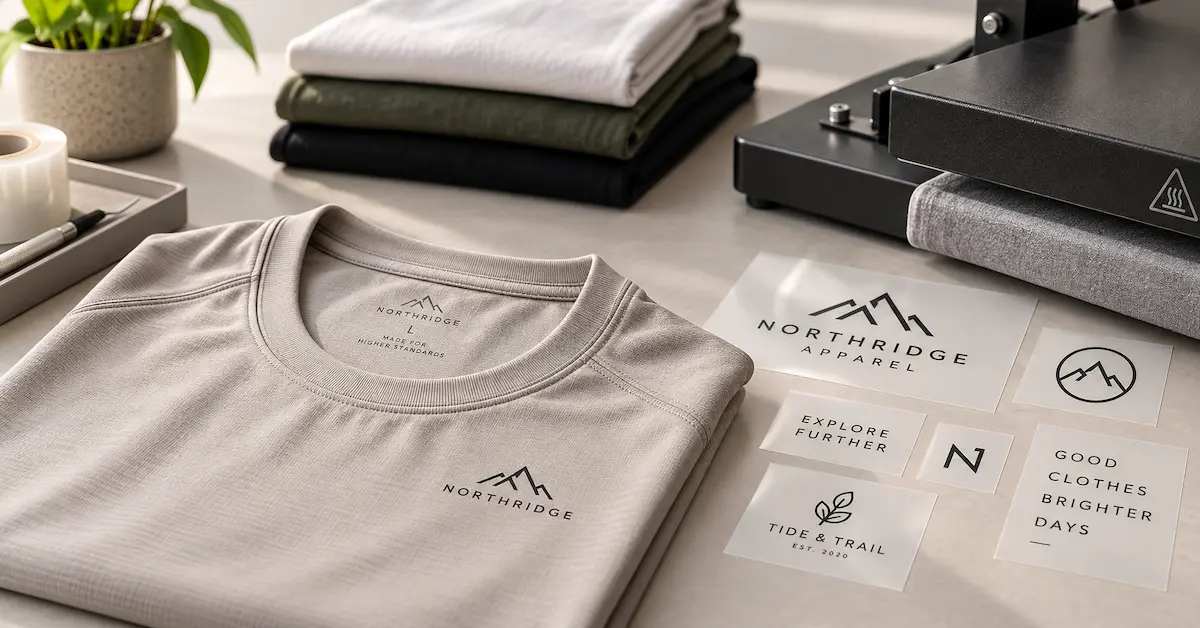
Custom heat transfers allow clothing brands to apply logos, graphics, size information and other branding elements directly to garments. They are widely considered for T-shirts, activewear, sportswear, uniforms and private-label collections where a clean, integrated appearance matters.
For buyers, however, customization involves more than uploading a logo and choosing a transfer finish.
The artwork must be suitable for production, the transfer must work with the intended fabric, and the application process must produce consistent results. Sampling is particularly important when working with stretch materials, specialty finishes or multiple garment colors.
The most reliable way to develop custom heat transfers is to approve the complete combination of artwork, transfer construction, garment fabric, application conditions and performance requirements before bulk production.
This guide explains how clothing brands can plan, evaluate and order custom heat transfers while reducing avoidable sourcing and production risks.
What Are Custom Heat Transfers?
Custom heat transfers are made-to-order graphics designed to bond to a textile surface through an appropriate heat application process.
Unlike standard ready-made designs, custom transfers are developed around a brand's specific artwork, dimensions, colors, finish and garment requirements.
They can be used for internal identification or visible exterior decoration.
Typical applications include:
-
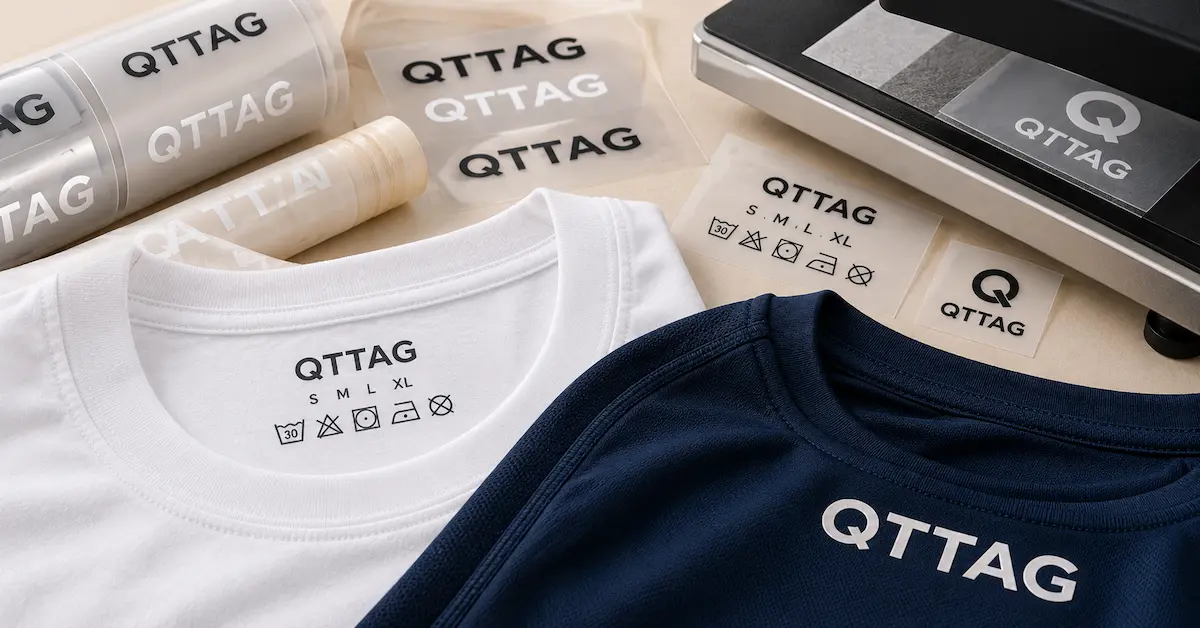
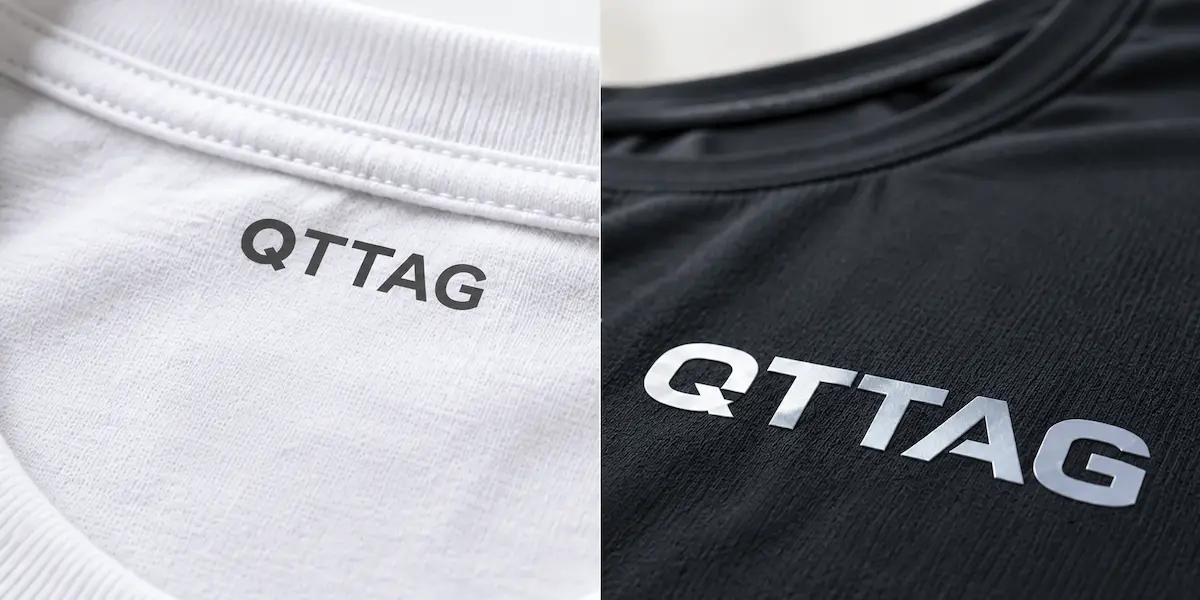
Brand logos inside garment necklines
-
Custom size labels for private-label clothing
-
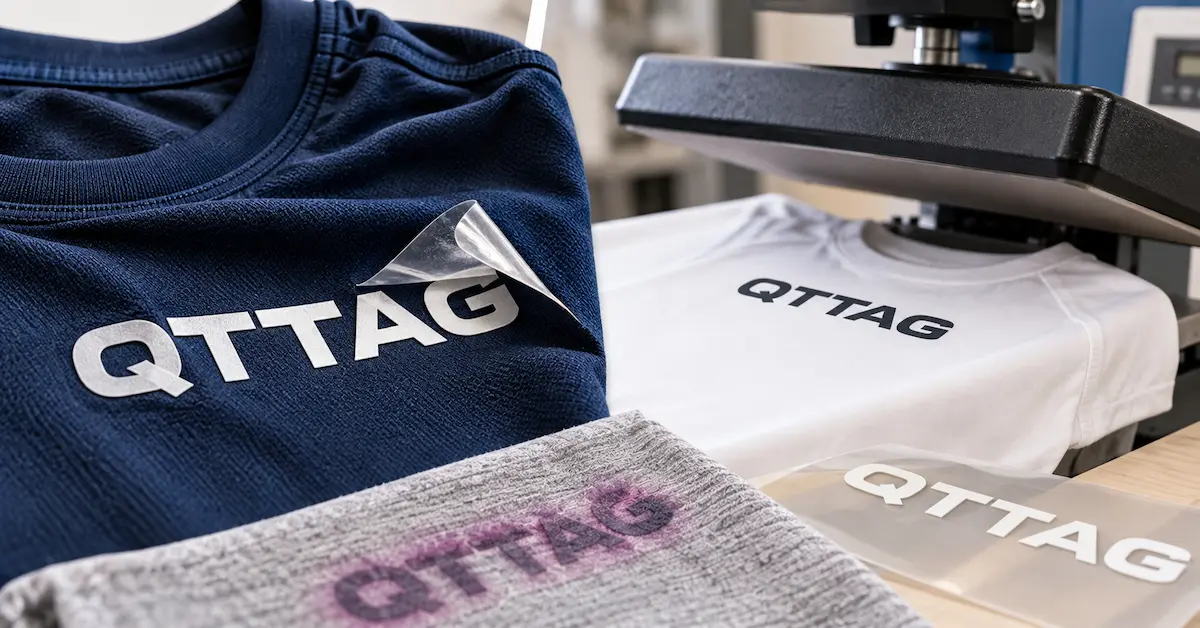
Exterior logos on sportswear and casualwear
-
Decorative graphics on T-shirts and sweatshirts
-
Team names and branding on uniforms
-
Small identification marks on clothing accessories
-
Selected specialty effects on fashion collections
The exact construction depends on the chosen transfer technology.
Some systems use printed inks and adhesive layers on a carrier. Other constructions use specialty materials or films. Their application requirements and performance characteristics are not interchangeable.
For apparel buyers, the relevant question is not simply whether a supplier can reproduce the logo.
It is whether the approved design can be applied consistently to the intended garment and maintain its required appearance during use.
What Can Be Customized on a Heat Transfer?
Custom heat transfers provide several design options, but each option introduces production considerations.
Logo Shape and Dimensions
Brands can develop transfers around their own logos, symbols, lettering and graphic arrangements.
The finished dimensions should be confirmed before sampling.
A design that looks balanced on a computer screen may appear too large on a small garment or too subtle on a larger size.
For multi-size apparel collections, buyers should determine whether one transfer dimension works across the range or whether different artwork sizes are needed.
Colors and Graphic Details
Custom transfers may reproduce single-color or multicolor artwork, depending on the production process.
Buyers should confirm:
-
Required brand colors
-
Background garment colors
-
Fine lines and small details
-
Minimum readable text
-
Separation between graphic elements
-
Whether an opaque base is required
Color appearance can change depending on the transfer system and underlying fabric.
A digital artwork file alone is not a reliable substitute for physical color approval.
Surface Finish and Texture
Different constructions can create different visual and tactile effects.
A brand might want a discreet matte logo on the inside of a shirt, while another collection may call for a more prominent dimensional graphic.
Possible finishes include flat printed, raised or selected specialty effects.
However, finish availability and performance must be confirmed for the actual product.
A raised effect may be visually appealing but unsuitable for a particular small-text design, stretch requirement or garment placement.
Placement on the Garment
Heat transfer placement is part of the product design.
Typical positions include the inside neckline, chest, sleeve, back, hem or selected accessory surfaces.
Each location introduces different considerations involving garment construction, fabric movement, pressing access and consistency across sizes.
How to Choose the Right Custom Heat Transfer Construction
The correct construction depends on how the finished garment will be used.
Instead of choosing by appearance alone, buyers should evaluate the transfer against its intended application.
| Branding Requirement | Construction to Discuss | Main Verification |
|---|---|---|
| Small internal brand logo | Low-profile printed transfer | Readability and fabric compatibility |
| Multicolor fashion graphic | Suitable multicolor transfer system | Color and detail reproduction |
| Raised exterior branding | Dimensional or silicone-based option | Flexibility, thickness and adhesion |
| Sportswear logo | Flexible garment-compatible transfer | Stretch and wash performance |
| Reflective decorative graphic | Reflective transfer option | Appearance, adhesion and intended performance |
| Textured specialty branding | Suitable TPU or other specialty construction | Surface finish and application compatibility |
The examples above are options to evaluate, not confirmation that every supplier offers every construction.
Custom Transfers for T-Shirts
T-shirt applications often prioritize comfort, a clean appearance and consistency across multiple sizes.
When developing an inside-neck transfer, buyers should review the relationship between the logo, size information and garment neckline.
For exterior graphics, overall design coverage and fabric behavior become more important.
A large printed design may feel different from a compact logo even when both use the same transfer technology.
Custom Transfers for Activewear
Activewear frequently introduces greater demands on flexibility and compatibility with stretch materials.
Before approving a transfer, test it on the actual performance fabric.
Evaluate both the relaxed garment and the material under representative extension.
For high-stretch garments, particular attention should be given to cracking, edge separation, distortion and changes in surface appearance.
Custom Transfers for Uniforms
Uniform programs often require repeated branding across garments, sizes and future production batches.
Buyers should establish a stable artwork file, dimensions, placement reference and application specification.
It is also useful to determine how replacement orders will be matched to the approved design.
Custom Transfers for Fashion Collections
Fashion applications may emphasize visual differentiation through texture, finish or dimensional effects.
The risk is choosing a visually attractive construction that does not suit the garment's fabric, drape or care requirements.
Physical samples should be evaluated on complete garments whenever possible.
What Artwork Files Are Needed for Custom Heat Transfers?
A well-prepared artwork package makes sampling more efficient and reduces interpretation errors.
Vector artwork is often preferred for logos and typography because shapes can be scaled and inspected without relying on a low-resolution image.
Common file formats may include AI, EPS, PDF or SVG, depending on supplier requirements.
Prepare Artwork at the Intended Production Size
Specify the exact finished dimensions.
For example, if the artwork will be applied inside a T-shirt neckline, provide the desired width and height rather than allowing the supplier to estimate proportions from a screenshot.
The supplier should also confirm whether fine details are achievable with the selected transfer technology.
Identify Brand Colors Clearly
Provide approved color references when available.
Explain whether exact visual matching is critical or whether a sample-based tolerance can be agreed.
Color references do not automatically guarantee an exact match across different transfer materials and fabrics.
The final appearance should be confirmed on an appropriate physical sample.
Separate Artwork From Garment Mockups
Mockups are useful for communicating position and scale.
They should not replace the actual production artwork.
A practical file package contains both the clean graphic artwork and a garment-placement reference.
Confirm the Following Before Sampling
| Artwork Requirement | Buyer Instruction |
|---|---|
| Logo file | Supply the approved artwork |
| Finished dimensions | Specify width and height |
| Colors | Include required references |
| Typography | Confirm small-text legibility |
| Placement | Provide a garment mockup |
| Garment colors | List all intended variations |
| Transfer finish | State the required appearance |
| Material | Supply fabric composition and relevant finish details |
For a collection with multiple garments, use an artwork reference or SKU code to prevent confusion between versions.
How Are Custom Heat Transfers Developed?
A controlled development process helps prevent avoidable changes after the order moves into production.
Step 1: Review the Garment and Design Requirements
The buyer provides the logo, target dimensions, fabric details and intended application.
The supplier evaluates whether the design and garment are appropriate for the proposed transfer construction.
Potential concerns should be identified before artwork approval.
These may include excessive detail, unsuitable dimensions, fabric treatments or special performance expectations.
Step 2: Confirm a Production-Ready Artwork Version
The artwork is reviewed for size, orientation, color arrangement and production feasibility.
Any adjustments should be approved by the buyer.
For example, a very thin line may require modification if the intended manufacturing method cannot reproduce it reliably.
Changes should be recorded rather than made silently.
Step 3: Produce an Initial Transfer Sample
The first physical transfer should represent the intended design and construction as closely as the agreed sampling process allows.
Inspect the sample before applying it to garments.
Check graphic definition, surface finish, dimensional consistency and visible defects.
Step 4: Apply the Transfer to the Actual Fabric
A transfer that looks good on its carrier may behave differently once applied to clothing.
Use the intended garment material, or a representative material that has been approved for evaluation.
Follow the transfer-specific application instructions.
Step 5: Complete Sample Testing
Evaluate the finished result against agreed criteria.
Depending on the garment, this may include washing, stretching, adhesion observation, color assessment and garment appearance after pressing.
Step 6: Approve the Production Reference
Once the relevant checks have been completed, retain an approved sample, artwork version and application specification.
These become reference points for production and future repeat orders.
What Application Conditions Must Be Confirmed?
Custom heat transfers require compatible equipment and controlled application conditions.
The principal variables are temperature, pressure, dwell time, garment preparation and carrier removal.
There is no single universal heat press setting suitable for all custom heat transfers.
Exact conditions should come from the supplier's validated product instructions and garment-specific trials.
Temperature
The selected temperature must be sufficient for the transfer construction while remaining appropriate for the fabric.
Excessive heat may cause visible garment changes, particularly on some synthetic or finished materials.
Insufficient heat may prevent the bonding system from performing as intended.
Pressure
The press must establish suitable contact across the complete transfer.
Uneven contact can create inconsistent bonding, particularly near seams, thick fabric areas or irregular surfaces.
Dwell Time
The transfer must remain under the specified pressing conditions for the required duration.
Reducing the cycle time without validation may affect the finished result.
Carrier Removal
Different constructions require different peel procedures.
A transfer may specify hot, warm or cold carrier removal.
Follow the actual product instructions rather than assuming that all transfer films behave the same way.
Equipment Consistency
For production orders, buyers should confirm that application equipment can repeat the approved conditions.
Press calibration, platen condition and operator procedures may affect results.
If the garment factory changes equipment or fabric, further testing may be required.
How Durable Are Custom Heat Transfers?
The durability of a custom heat transfer depends on the transfer construction, fabric surface, application conditions and intended garment use.
No supplier should be expected to guarantee a specific wash life without defining the test method, garment conditions and acceptance criteria.
Wash Durability
Repeated laundering can expose transfers to mechanical movement, detergents, moisture and temperature changes.
A wash evaluation should record the washing and drying conditions used.
The finished transfer can then be inspected for lifting, cracking, changes in appearance and loss of readability.
Stretch Durability
Stretch garments require special consideration.
A transfer must perform adequately when the fabric is extended during normal use.
Testing should reflect the expected movement rather than relying only on visual inspection of a flat sample.
Adhesion
Adhesion depends on the interaction between the bonding system and the garment surface.
Some textile finishes, coatings or contaminants can interfere with bonding.
An approved transfer for one garment should not automatically be approved for a different fabric.
Color and Appearance
The initial visual result is only one aspect of durability.
Buyers may also need to review color changes, unwanted gloss, surface cracking and dye migration.
Establish what constitutes an acceptable change before testing begins.
What Should Be Checked During Custom Heat Transfer Sampling?
Sampling should establish whether the proposed construction is suitable for the finished product.
A useful inspection plan separates appearance from performance.
| Inspection Item | What to Check | Approval Basis |
|---|---|---|
| Dimensions | Finished transfer size | Approved drawing and agreed tolerance |
| Artwork | Missing lines, typography and detail | Approved production artwork |
| Color | Visible match and consistency | Approved physical color reference |
| Placement | Position and orientation | Garment placement specification |
| Adhesion | Lifting or incomplete bonding | Agreed inspection procedure |
| Wash performance | Changes after laundering | Defined test conditions and acceptance criteria |
| Stretch performance | Cracking or distortion | Expected garment movement |
| Fabric appearance | Press marks or surface changes | Approved finished garment reference |
A common sourcing mistake is to approve only the transfer sheet without evaluating the applied result.
For apparel branding, the final garment is the meaningful reference.
Why Physical Sample Approval Matters
Digital previews can show shape, approximate color and placement.
They cannot fully demonstrate transfer feel, bonding quality, fabric interaction or behavior after laundering.
Physical samples also help align the buyer, transfer supplier and garment factory around the same production standard.
Common Custom Heat Transfer Problems and Their Causes
Several defects can become expensive when discovered after application to finished garments.
Edges Lift After Washing
Possible causes include unsuitable bonding materials, inconsistent pressing, textile surface treatments or exposure beyond validated conditions.
The investigation should compare the affected garment with the approved sample and application records.
Fine Details Disappear
Small lettering, narrow gaps or delicate graphic elements may not reproduce well with the chosen process.
This problem is best identified during artwork review and initial sampling.
The Logo Cracks When Stretched
The transfer construction may not provide the flexibility required by the garment.
A different material or design arrangement may be necessary.
Color Appearance Changes
The transfer may look different on various garment colors.
Certain dyed fabrics can also introduce migration or heat-related appearance changes.
Test against the actual fabric and color combinations.
Bulk Production Looks Different From the Sample
Possible causes include artwork revisions, changes in transfer material, application equipment, pressing conditions or garment specifications.
Version control and approved production references help buyers identify these differences.
How Much Do Custom Heat Transfers Cost?
Custom heat transfer pricing depends on the production requirements rather than the logo alone.
Important cost factors include:
-
Transfer dimensions
-
Artwork coverage and complexity
-
Printing or transfer construction
-
Color requirements
-
Specialty materials and finishes
-
Order quantity
-
Number of artwork variations
-
Sampling and development work
-
Packaging configuration
-
Delivery requirements
Why Quantity Matters
Order volume may affect manufacturing efficiency and cost allocation.
However, suppliers use different production methods and pricing structures, so a specific quantity discount should not be assumed.
Ask for quotations using the same dimensions, artwork, finish and order specifications.
Consider Total Applied Cost
The transfer unit price is only part of the purchasing decision.
Garment application introduces labor, equipment time, process control and potential rejection costs.
A lower-priced transfer may become expensive if it requires rework or performs inconsistently.
For a fair comparison, assess the cost of an acceptable finished garment.
Ask for Clear Quotation Terms
A useful quote should identify what is included.
Clarify whether artwork preparation, sampling, packaging, tooling where applicable, shipping and other charges are separate.
Also confirm whether the quoted product is the same construction used in the approved sample.
How to Choose a Custom Heat Transfer Supplier
A suitable supplier should be able to explain not only how the transfer is manufactured but also what information is required to apply it correctly.
Useful supplier evaluation questions include:
-
Can the proposed construction be tested on our actual garment fabric?
-
What artwork formats and design limitations apply?
-
Are physical samples available before bulk production?
-
What application instructions will be supplied?
-
How should the completed transfer be inspected?
-
What performance testing is relevant to our garment?
-
How are artwork and material versions controlled?
-
What happens if the bulk transfer differs from the approved reference?
-
Can repeat orders follow the same documented specification?
-
Which costs, minimum quantities and delivery conditions apply to our design?
A supplier's answers should be specific to the product under consideration.
General statements about durability or quality are less useful than clear specifications, samples and documented approval criteria.
What Should You Include in a Custom Heat Transfer RFQ?
An incomplete request often results in additional questions, unsuitable recommendations or quotations that cannot be compared fairly.
A practical RFQ should include the following information.
| Requirement | Information to Provide |
|---|---|
| Brand artwork | Approved logo or graphic file |
| Garment type | T-shirt, leggings, sweatshirt, uniform, etc. |
| Fabric | Composition and relevant fabric finish |
| Garment colors | Planned color variations |
| Transfer size | Finished width and height |
| Quantity | Order volume and artwork variations |
| Branding location | Inside neck, chest, sleeve or other position |
| Finish | Flat, dimensional or selected specialty effect |
| Performance needs | Washing, stretching and wear conditions |
| Production equipment | Planned heat press or application process |
| Sample requirements | Quantity and approval criteria |
| Delivery | Destination and required timeline |
For multi-SKU clothing collections, provide a reference table connecting each design with its garment, size, color and order quantity.
This makes order coordination easier and reduces the risk of applying the wrong branding version to a garment.
How Can Apparel Brands Maintain Consistency Across Repeat Orders?
Consistency becomes more important as a clothing brand introduces additional sizes, colors and seasonal collections.
A documented approval process helps establish what should remain unchanged.
Maintain an Approved Artwork Library
Store the final production artwork with clear version identification.
Do not rely on screenshots or informal file names when placing repeat orders.
Retain Physical References
An approved transfer and finished garment sample provide more reliable comparison references than digital images alone.
Store samples under suitable conditions and identify their version and approval date.
Confirm Changes Before Production
Fabric changes, new garment colors, different pressing equipment or modifications to the transfer material can affect the finished result.
Review significant changes before repeating a previous specification.
Establish Inspection Responsibilities
The transfer supplier and garment factory may control different stages of production.
Clarify who checks the transfer before application, who validates the pressing process and who inspects the finished garment.
This becomes especially important when the transfer is manufactured separately from the clothing.
Frequently Asked Questions About Custom Heat Transfers
Can I order custom heat transfers using my own logo?
Yes. Custom transfers can be developed from brand artwork, subject to the supplier's production capabilities. Provide an appropriate file, dimensions, colors, garment details and expected performance requirements.
What is the difference between custom heat transfers and standard heat transfer labels?
Custom heat transfers are developed for a specific design and application, whereas standard heat transfer labels may refer more broadly to the product technology or common labeling formats. Many custom heat transfers are themselves heat transfer labels.
Are custom heat transfers suitable for activewear?
They can be suitable when the chosen construction works with the performance fabric and passes relevant stretch, adhesion and washing evaluations. Actual fabric testing is important.
How do I know whether my artwork can be reproduced?
Submit the original design at the intended finished size. Ask the supplier to confirm line detail, text readability, color limitations and material compatibility before approving a physical sample.
Can custom heat transfers be applied to different fabrics?
A transfer may be suitable for more than one textile, but compatibility should be verified for each relevant fabric construction and finish. Do not assume that successful application to cotton establishes suitability for polyester, nylon or coated materials.
What is the minimum order quantity for custom heat transfers?
Minimum quantities depend on the manufacturing process, construction, design and supplier. Request confirmation for your exact artwork and order requirements.
Should I approve a sample before ordering in bulk?
Yes. Approving a physical sample on the intended fabric helps confirm appearance, placement, application compatibility and relevant durability requirements before bulk production.
What information is most important when requesting a quotation?
Provide the approved artwork, finished dimensions, garment fabric, order quantity, color requirements, intended finish, application method and delivery destination. These details allow suppliers to evaluate the order more accurately.
Develop Custom Heat Transfers With QTTAG
A successful custom heat transfer should do more than reproduce a logo.
It needs to match the garment design, work with the selected textile and provide a repeatable production result.
QTTAG supports custom garment branding projects, including heat transfer label solutions for apparel brands and manufacturers.
When discussing a new project, share your artwork, garment fabric, finished dimensions, estimated quantity and intended application.
These details provide a starting point for reviewing customization options, sample requirements and production feasibility.
Ready to Develop Custom Heat Transfers for Your Clothing Brand?
Share your logo artwork, garment specifications, required transfer dimensions, estimated order quantity and application requirements with QTTAG.
Our team can discuss suitable customization and sampling options for your clothing collection.
Request a Quote
Author
Founder at QTTAG
Jason Qiao is the founder of QTTAG, focusing on garment branding and packaging solutions. With years of experience in the apparel industry, he shares practical insights on custom labels, hang tags and sustainable packaging to help global brands grow.
Written By
Jason Qiao