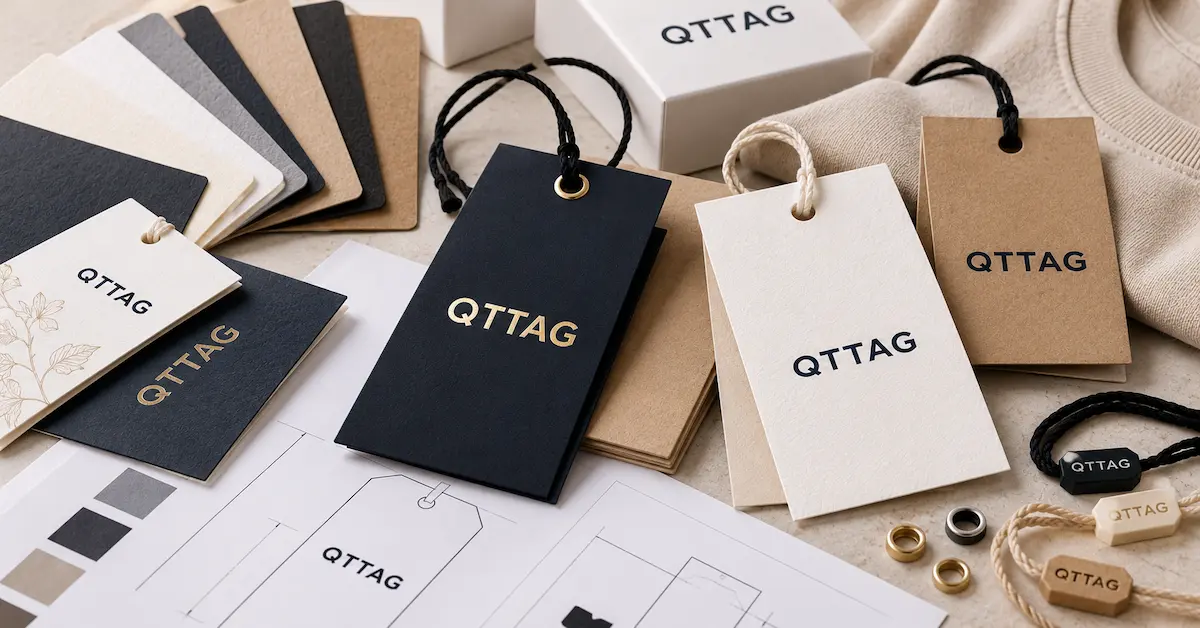
How Hang Tags Improve Apparel Branding and Retail Presentation
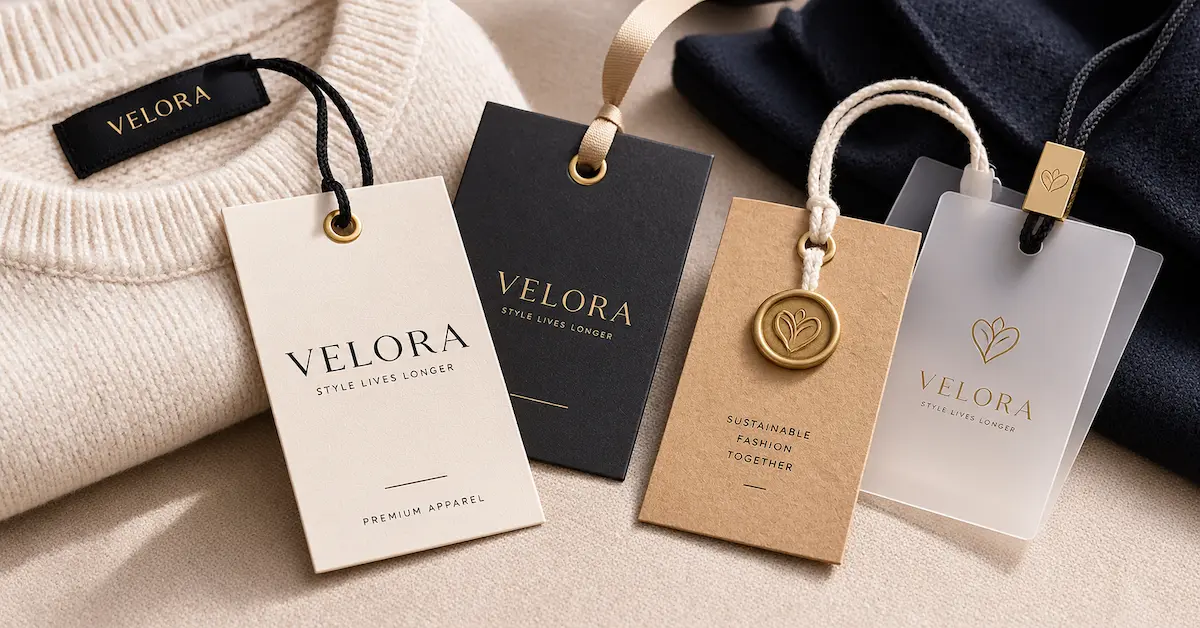
A clothing hang tag is one of the few branding elements customers can examine before trying on or purchasing a garment. It connects the product to the brand through its logo, material, printed information, texture and presentation.
For fashion brands, hang tags improve apparel branding by making products easier to identify, communicating relevant information and creating a consistent visual experience across clothing collections. In retail environments, thoughtfully designed hang tags can also help shoppers understand a product's identity, collection and key attributes.
A premium appearance, however, depends on more than using expensive paper or decorative finishes. The size, typography, information hierarchy, attachment method and relationship with the garment all matter.
This guide explores how apparel brands can use custom hang tags more effectively, which design decisions influence retail presentation and what buyers should verify before ordering.
Why Are Hang Tags Important for Apparel Branding?
Hang tags are removable product identification and presentation accessories commonly attached to garments before sale.
Unlike woven brand labels or printed care labels, a hang tag is usually designed to be visible during product display and handling.
Its purpose can extend beyond showing a brand logo.
A well-designed hang tag may help customers:
-
Identify the clothing brand.
-
Recognize the product or collection.
-
Find relevant size, style or product information.
-
Understand selected material or product features.
-
Locate a website or other brand information.
-
Connect the garment to its wider packaging identity.
For clothing brands, the hang tag also provides a consistent branded surface across products that may have very different fabrics, colors and silhouettes.
A T-shirt, jacket and dress can all carry a coordinated hang tag design even when their garment construction differs.
Hang Tags as a Physical Brand Touchpoint
A hang tag gives customers something tangible to examine.
Paper texture, dimensions, finishing and print quality can contribute to the impression created by the garment.
This does not mean that heavier paper or metallic foil automatically makes a brand more premium. The design must match the intended market, product and overall visual identity.
The strongest approach is to treat the hang tag as part of the product experience rather than as an accessory added at the final production stage.
How Hang Tags Influence Retail Presentation
Retail presentation involves how a product looks, communicates and functions while it is displayed for purchase.
A hang tag can influence each of these areas.
Creating Visual Consistency
A clothing collection may use different fabrics, prints and colors.
Coordinated hang tags provide a recognizable element that links the products together.
Consistent logo proportions, typography and colors help establish a unified appearance across the collection.
Communicating Product Information
Shoppers may want to know a garment's size, material, product line or other attributes.
A hang tag can provide a convenient location for selected information without crowding the visible garment design.
However, information printed on a removable hang tag does not automatically replace permanent garment labeling required by law.
Supporting Product Differentiation
Fashion collections often contain products with similar appearances.
A carefully organized hang tag can help distinguish styles, product ranges or seasonal collections.
This can be useful for both retail presentation and product identification.
Connecting Offline and Online Experiences
A hang tag may include a website address or QR code directing shoppers to verified brand information.
The destination should be useful, accurate and maintained by the brand.
For example, a QR code might lead to a product information page, styling guide or official brand website.
Avoid directing customers to temporary or incomplete pages.
What Makes a Hang Tag Design Effective?
An effective hang tag combines visual identity, clear information and practical construction.
It should look appropriate for the garment while remaining readable and easy to handle.
| Design Element | Why It Matters | What to Check |
|---|---|---|
| Logo | Communicates brand identity | Proportion and clarity |
| Typography | Organizes information | Readability at finished size |
| Colors | Supports brand recognition | Consistency across materials |
| Paper | Determines surface appearance and feel | Texture and construction |
| Dimensions | Influences presentation and handling | Proportion to garment |
| Finishing | Adds selected visual or tactile effects | Reproduction quality |
| Attachment | Connects tag to clothing | Placement and suitability |
| Product information | Helps identify the garment | Accuracy and legibility |
A Clear Visual Hierarchy
The design should guide the reader toward the most important information.
For many fashion brands, the logo is the primary visual element.
Product information can appear on the reverse side or in a separate area.
Trying to place every product detail on the front may make the tag look crowded.
Appropriate Dimensions
The ideal size depends on the clothing category.
A small fashion accessory may require a different tag format from a winter coat.
The tag should feel proportional to the garment without being unnecessarily large or difficult to handle.
Consistent Artwork
Use approved artwork files for the brand logo and typography.
An established design system helps prevent variations between different garments, packaging products and production orders.
Choosing Paper Materials for Custom Hang Tags
Paper selection affects how a tag looks and feels, as well as how it performs during printing, finishing and attachment.
Several material options may be considered.
Coated Paper
Coated paper can be useful for certain printed designs requiring controlled surface characteristics.
The selected coating should be compatible with the planned printing and finishing processes.
Uncoated Paper
Uncoated paper may provide a more natural or understated visual appearance.
Available stocks differ in texture, stiffness and print behavior.
Textured Paper
Textured materials can introduce a tactile quality.
However, strong surface textures may affect small printed details or specialty finishing.
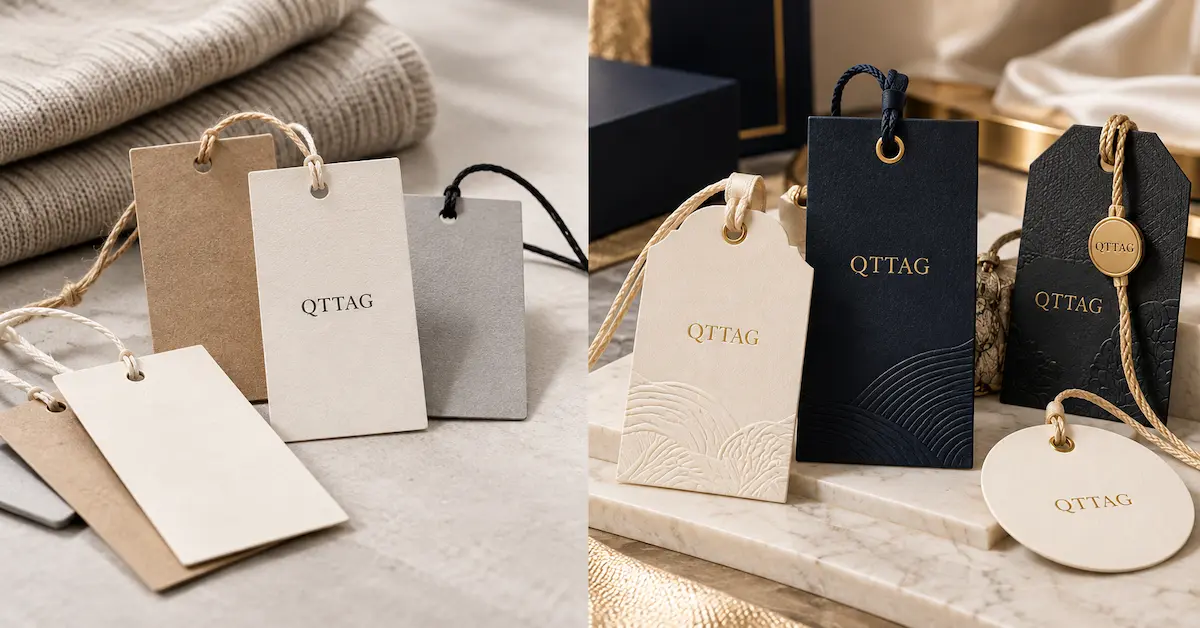
Kraft Hang Tags
Kraft hang tags are often considered for brands seeking a natural-looking paper appearance.
They may suit casualwear, workwear, lifestyle collections or packaging designs that emphasize earthy colors and restrained graphics.
Nevertheless, the appearance of kraft paper does not establish that the finished product contains recycled material or meets an environmental certification.
Any sustainability claim requires appropriate supporting evidence.
Specialty Paperboard
Specialty stocks may provide unusual colors, textures or other visual effects.
Buyers should review availability, printing compatibility and manufacturing consistency before selecting these materials.
| Paper Type | Typical Design Direction | Main Consideration |
|---|---|---|
| Coated paper | Refined printed graphics | Printing and finishing compatibility |
| Uncoated paper | Natural or minimalist presentation | Surface and print detail |
| Textured paper | Tactile branding | Artwork clarity |
| Kraft paper | Rustic or natural-looking branding | Paper color and printing contrast |
| Specialty paperboard | Distinctive fashion presentation | Availability and production consistency |
For larger clothing collections, approved physical paper references are particularly helpful when maintaining consistency across repeat orders.
How Printing and Finishes Elevate Clothing Hang Tags
Printing and finishing can create differentiation when they support the brand's design language.
Different techniques produce different appearances.
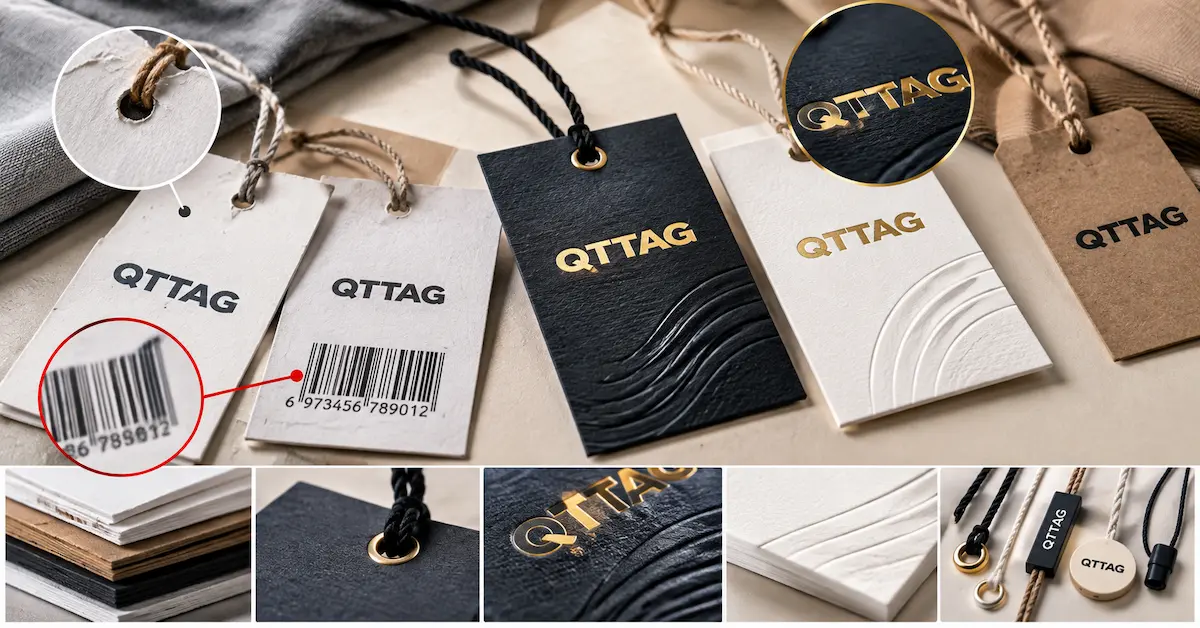
Foil Stamping
Foil stamping can introduce metallic or specialty decorative effects.
It may be used for logos, monograms or selected graphic elements.
The outcome depends on the foil, paper, artwork and production process.
Embossing
Embossing creates a raised impression.
This can provide a tactile element for brands that want the paper surface to communicate part of their identity.
Debossing
Debossing creates a recessed impression.
It can support subtle branding when used with suitable paper and artwork.
Spot UV
Spot UV may create selected gloss effects on compatible printed materials.
It can emphasize certain areas of the artwork, although alignment and coating compatibility must be assessed.
Matte and Gloss Lamination
Lamination can modify the surface appearance or handling characteristics of compatible paper stocks.
The final material should be tested for folding, cutting and other required operations.
Die-Cutting
Custom die-cutting allows brands to create shapes beyond a standard rectangle.
However, complex shapes may require additional tooling and more careful inspection.
| Finish | Visual or Tactile Effect | Production Check |
|---|---|---|
| Foil stamping | Metallic or decorative highlight | Foil coverage and registration |
| Embossing | Raised surface texture | Detail and impression consistency |
| Debossing | Recessed texture | Definition and positioning |
| Spot UV | Selected glossy areas | Registration and compatibility |
| Lamination | Modified surface appearance | Finish and folding behavior |
| Die-cutting | Custom outline | Shape and edge quality |
The most effective finish is not necessarily the most complex one.
A simple hang tag with excellent paper, clear typography and precise printing may be more appropriate than a design containing several competing decorative effects.
Hang Tag Design for Different Clothing Brands
Different clothing brands serve different customers and retail environments.
Their hang tag requirements may therefore vary.
Luxury Fashion Brands
Luxury fashion collections may emphasize restrained typography, distinctive paper texture and carefully controlled finishing.
A premium paper stock or subtle embossed logo can support this design direction.
The physical quality of the finished tag is especially important when the artwork is minimalist.
Contemporary Casualwear
Casualwear brands may prefer bold logos, straightforward product information and practical tag constructions.
The design should be recognizable across T-shirts, sweatshirts and other garments.
Activewear Brands
Activewear collections may use hang tags to communicate relevant product features or material information.
Any technical performance claim should be supported by the garment's actual specifications and evidence.
The attachment should be suitable for the intended garment construction.
Sustainable Fashion Collections
Brands emphasizing environmental attributes may choose materials supported by documented recycled-content or sourcing information.
Avoid relying on brown paper, natural colors or leaf graphics as proof of environmental performance.
Emerging Private Label Brands
New clothing brands often need hang tags that present a consistent identity while remaining practical to source and manage.
A clearly defined standard design can support multiple garments without requiring a completely different tag for every style.
Hang Tags vs. Clothing Labels: What Is the Difference?
Hang tags and clothing labels may contain similar branding elements, but they perform different functions.
| Feature | Hang Tags | Garment Labels |
|---|---|---|
| Typical location | Externally attached to garment | Sewn or applied to garment |
| Main purpose | Retail presentation and product information | Brand identification or garment information |
| Common materials | Paper, paperboard and selected accessories | Woven, printed or heat transfer materials |
| Removal | Usually removable | Often intended to remain attached |
| Branding opportunity | Larger graphic surface | Integrated garment identification |
| Main quality concern | Printing, construction and attachment | Material, legibility and application |
For a coordinated clothing collection, these products should work together rather than compete.
A woven brand label may communicate identity inside the garment, while a custom hang tag provides additional space for retail presentation.
A separate care label may carry required garment information.
Each component should be selected according to its purpose.
Choosing Strings, Seals and Hang Tag Attachments
The attachment system affects both the appearance and handling of a hang tag.
Common options include cotton cords, polyester strings, ribbon, eyelets and custom seals.
Cotton Strings
Cotton strings may complement natural-looking paper and textile-oriented branding.
Consider the thickness, color and attachment construction.
Polyester Cords
Polyester cords can offer other surface textures and design options.
Material selection should reflect the tag's intended use and visual direction.
Ribbon Attachments
Ribbon can provide a softer decorative presentation, particularly for selected boutique or gift-oriented collections.
The width and construction should suit the tag dimensions.
Hang Tag Seals
Custom seals can introduce a small additional brand detail.
They should be checked for assembly compatibility and the required finished appearance.
Eyelets
An eyelet may reinforce or decorate the attachment hole.
Its size and material should be appropriate for the selected paperboard.
For sampling, always evaluate the complete combination of tag, punched hole, cord and attachment.
How Hang Tags Connect With Apparel Packaging
Hang tags become more effective when they coordinate with other branding components.
For QTTAG's product categories, the relevant elements may include woven labels, care labels, paper shopping bags, poly bags and packaging boxes.
Consistent Brand Artwork
Use an approved master logo across the garment and packaging materials.
The design may need production-specific adjustments, but the underlying identity should remain recognizable.
Coordinated Color Direction
A printed paper tag and a woven textile label may not reproduce colors in exactly the same way.
Approved physical references can help establish a consistent overall appearance.
Related Printing Finishes
Hang tags and packaging boxes may use similar decorative concepts, such as metallic highlights or restrained embossed logos.
Feasibility should be confirmed separately for each material.
Collection-Level Presentation
For a premium apparel collection, the garment, hang tag and packaging should appear related when displayed together.
This helps create a coherent experience from product inspection to purchase and unboxing.
How to Improve Hang Tag Information Layout
A good hang tag should be visually attractive without hiding information that customers or retailers need.
The required information depends on the garment and market.
Front-Side Information
The front may contain the logo, collection name or a primary visual element.
Avoid unnecessary text when it interferes with the brand presentation.
Reverse-Side Information
The back may provide product information, style references, size details, a barcode or a QR code.
All information should be accurate and readable.
Product Claims
Descriptions of material composition, functional performance or environmental characteristics should be based on verified specifications.
Do not place unsupported claims on printed tags.
Regulatory Requirements
A removable hang tag may supplement product information but should not automatically be treated as a replacement for legally required garment labels.
Applicable requirements depend on the destination market.
Multi-Language Layouts
International brands may require multiple languages or market-specific versions.
These should be identified during artwork planning before bulk production.
Common Hang Tag Design Mistakes
Several problems can reduce the effectiveness of a hang tag.
Too Much Information
Crowded artwork can make the brand difficult to recognize.
Use a clear hierarchy and distribute information appropriately.
Incorrect Size
An oversized or undersized tag may look disproportionate on the garment.
Test the intended dimensions physically.
Poor Logo Reproduction
Fine artwork may not reproduce clearly with the chosen printing or finishing method.
Check the artwork at its actual production size.
Incompatible Paper and Finishing
Certain paper surfaces can create difficulties for selected printing or decorative processes.
Confirm compatibility before production.
Unsuitable Attachments
The wrong cord thickness, hole position or seal can affect the completed appearance.
Approve the full assembly.
Inconsistent Designs Across a Collection
Uncontrolled artwork versions can cause differences between tags used on related garments.
Maintain approved production files.
How to Evaluate Physical Hang Tag Samples
Digital mockups are useful for reviewing layout, but physical sampling remains important.
A finished tag should be evaluated for both appearance and production suitability.
Step 1: Review the Artwork
Confirm the logo, text, dimensions, colors and any specialty finishing requirements.
Step 2: Select Paper Samples
Compare suitable stocks for texture, stiffness and print behavior.
Step 3: Produce a Representative Sample
Use the proposed paper, printing method and finishing where practical.
Step 4: Inspect the Details
Check logo clarity, color reproduction, cutting and decorative finish.
Step 5: Attach It to a Garment
Review how the tag hangs and looks against the intended clothing.
Step 6: Approve the Production Reference
Keep the approved physical sample and relevant specifications.
| Sample Check | What Buyers Should Evaluate |
|---|---|
| Logo | Clarity and proportion |
| Paper | Texture, shade and stiffness |
| Dimensions | Finished size |
| Printing | Alignment and completeness |
| Finishes | Coverage and definition |
| Die-cutting | Shape and edge condition |
| Attachments | String, eyelet or seal |
| Garment application | Placement and overall appearance |
An approved sample can help align the brand, purchasing team and manufacturer before bulk production.
Quality Control for Bulk Hang Tag Orders
A successful sample does not automatically establish consistency across a production order.
Quality control should follow the agreed specifications.
Paper Consistency
The material should correspond to the approved reference.
Printing Accuracy
Compare production samples with the approved artwork.
Finishing Quality
Inspect selected finishes for visible differences beyond agreed tolerances.
Die-Cutting and Hole Punching
Check dimensions, edge quality and hole placement.
Assembly
Confirm the correct cords, eyelets or seals are used.
SKU Identification
For collections involving multiple tag versions, establish clear sorting and packing instructions.
Repeat Orders
Retain the approved artwork, material and finishing specifications.
If important production conditions or materials change, assess whether resampling is needed.
What Determines the Cost of Custom Hang Tags?
Hang tag pricing depends on the design, material and complete finished construction.
Important variables may include:
-
Paper stock and paper weight.
-
Finished tag dimensions.
-
Number of printing colors.
-
Artwork complexity.
-
Foil stamping or embossing.
-
Lamination and specialty finishing.
-
Die-cut shape and tooling.
-
Attachment materials.
-
Order quantity.
-
Number of designs or SKU variations.
-
Sampling requirements.
-
Assembly, packing and delivery.
Compare Complete Products
A quotation for printed paper without the required attachment may not reflect the total purchasing cost.
Ask suppliers to clarify what is included.
Consider Design Complexity
Additional finishing can involve separate production operations.
Choose processes that support the desired brand result.
Review Order Variations
Different seasonal designs or product versions may affect production planning and quotation terms.
Minimum quantities and lead times should be confirmed for the actual specification rather than assumed.
What Should Apparel Buyers Include in a Hang Tag RFQ?
A clear request for quotation helps suppliers evaluate the project and recommend appropriate construction options.
| RFQ Requirement | Information to Provide |
|---|---|
| Brand artwork | Approved logo file |
| Clothing category | T-shirts, dresses, jackets or other products |
| Dimensions | Finished width and height |
| Paper material | Preferred stock or physical reference |
| Paper weight | Required grade, if known |
| Printing | Artwork, colors and information |
| Finishing | Foil, embossing, coating or other details |
| Shape | Standard or custom die-cut |
| Attachments | String, ribbon, eyelet or seal |
| Quantity | Estimated order volume |
| Variations | Different designs or product information |
| Sampling | Sample approval requirements |
| Delivery | Destination and target schedule |
For brands unsure about paper or finishing options, sharing the intended garment and visual reference is a useful starting point.
Frequently Asked Questions About Hang Tags
Why are hang tags important for clothing brands?
Hang tags help communicate brand identity, provide selected product information and create a coordinated retail presentation. Their effectiveness depends on design clarity and suitability for the garment.
Do custom hang tags make clothing look more premium?
They can support a premium presentation when materials, typography and finishing match the brand identity. More expensive materials do not automatically create better branding.
What paper is best for clothing hang tags?
The choice depends on appearance, printing requirements, stiffness, finishing compatibility and cost. Coated, uncoated, textured and kraft materials may all be suitable for different projects.
Are kraft hang tags suitable for fashion brands?
Kraft hang tags can support brands seeking a natural-looking paper aesthetic. Environmental claims about the material must be supported by specific evidence.
Can hang tags include QR codes?
Yes. QR codes may link customers to product or brand information. The code should be readable and the linked destination should remain accurate and accessible.
How are hang tags different from care labels?
Hang tags are generally removable accessories used for retail presentation and selected product information. Care labels commonly carry garment information intended to remain available during the product's use.
Can hang tags match apparel packaging?
Yes. Approved logos, typography, colors and design references can connect hang tags with paper bags, boxes and other branding products.
What is the minimum order quantity for custom hang tags?
Minimum order quantities vary by supplier, material, construction and design. Request a quotation based on the final specification.
Create Custom Hang Tags With QTTAG
Effective hang tags combine brand identity, clear information and suitable physical construction.
The paper, dimensions, printing, finishing and attachments should be planned together to support the intended clothing collection and retail environment.
QTTAG supports custom garment branding and packaging projects, including hang tags, attachment accessories, woven labels and coordinated apparel packaging.
When developing a new collection, prepare your brand artwork, preferred tag dimensions, paper requirements, finishing options and estimated order quantity.
These details help establish the design and sampling requirements before production.

Author
Founder at QTTAG
Jason Qiao is the founder of QTTAG, focusing on garment branding and packaging solutions. With years of experience in the apparel industry, he shares practical insights on custom labels, hang tags and sustainable packaging to help global brands grow.
Written By
Jason Qiao