Hang Tags vs Custom Hang Tags: Key Differences for Apparel Brands
A clothing brand is preparing its first retail collection. The logo is finished, the garments have been approved, and the buyer needs hang tags before packing begins.
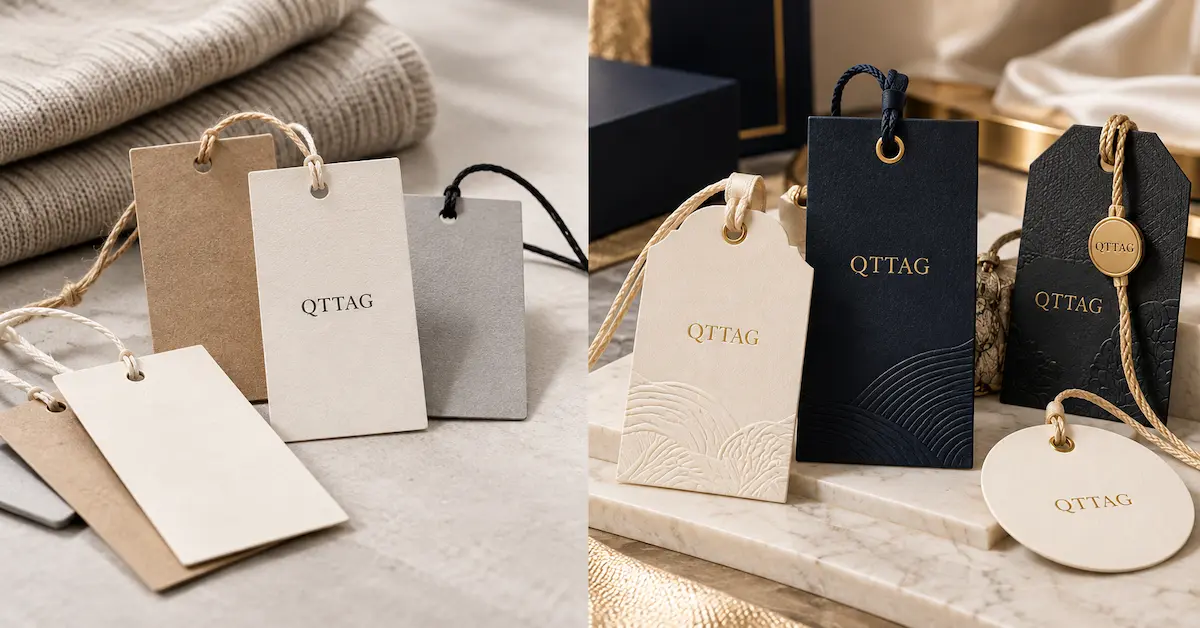
A supplier offers a rectangular paper tag in several sizes. Another offers custom shapes, textured stock, foil stamping and matching cords. Both describe their products as hang tags, but the quotations cover different levels of work.
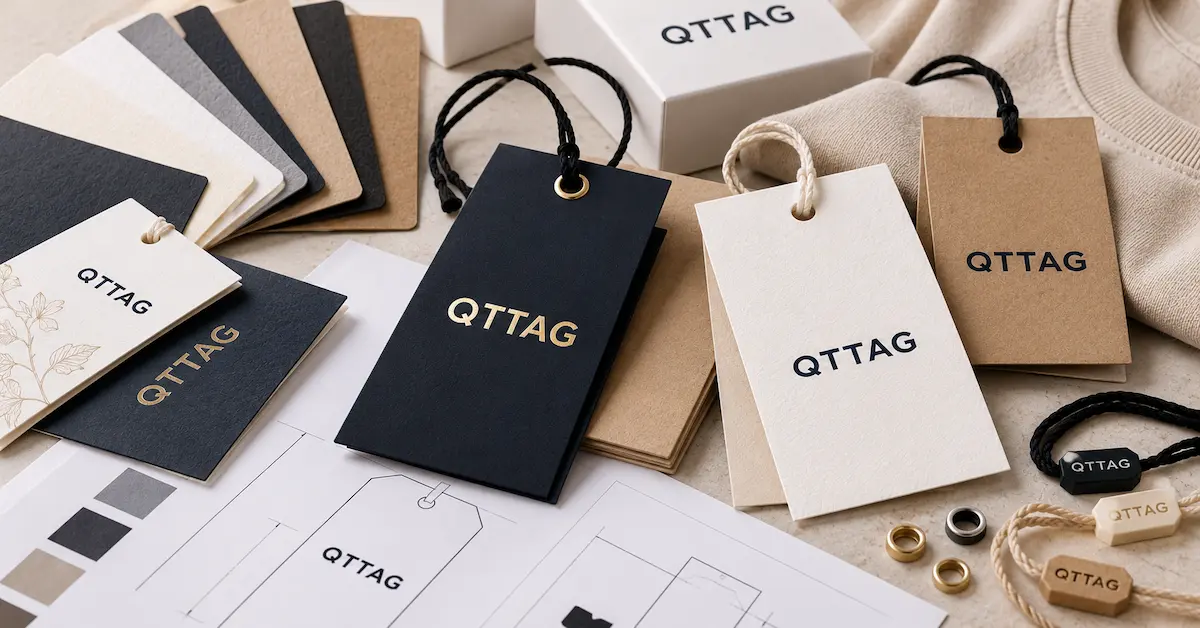
Hang tags are removable tags used for garment branding and product information. Custom hang tags are made to a buyer's chosen artwork, dimensions, materials and finishing specifications. The distinction isn't a different printing technology. It's how much of the finished tag the brand wants to control.
That matters when comparing suppliers. A simple branded tag can be entirely appropriate for one collection, while another may need a more involved construction.
The best choice depends on what the tag needs to communicate, how it will appear on the garment and what the buyer is prepared to approve before production.
Are Hang Tags and Custom Hang Tags Different Products?
Not necessarily.
Hang tags is the general product name. It covers the paper or other suitable removable tags attached to clothing and accessories.
A hang tag might display a brand name, product size, style number, barcode or other approved information.
Custom hang tags are part of that same category. They are developed to meet particular design and production requirements.
For example, a supplier may offer an existing rectangular tag format that a brand can order with a printed logo. At the other end of the range, a buyer could specify the paper stock, shape, printing colors, decorative finishes and attachment details.
There is plenty of room between those two options.
A custom-printed rectangular tag doesn't become a standard product just because it uses a common shape. And an unusual shape doesn't necessarily make a hang tag better.
| Buying Consideration | Existing Hang Tag Format | Custom Hang Tag |
|---|---|---|
| Shape | Available supplier shapes | Buyer-defined within production limits |
| Dimensions | Existing size options | Specified to suit the product |
| Artwork | Blank or limited personalization, depending on supplier | Approved custom layout |
| Paper | Available standard stocks | Selected compatible stock |
| Printing | Limited or offered as an option | Artwork-specific printing |
| Finishing | Available options | Selected foil, embossing or other finish |
| Attachments | Supplier's available strings or fasteners | Coordinated cords, strings or seals |
| Development | May require less custom preparation | May require additional proofing or tooling |
The actual commercial difference depends on what the supplier already manufactures.
Before comparing prices, make sure both quotations describe equivalent finished tags.
When Is a Standard Hang Tag Enough?
A brand doesn't always need a distinctive die-cut shape or several decorative processes.
Consider a casual clothing collection with a straightforward logo and product information printed on the reverse.
A rectangular tag using a suitable paper stock may do everything the brand needs. The front carries the logo; the back has room for a style reference and barcode.
If that format fits the clothing and retail requirements, adding further complexity may offer little practical benefit.
This is especially worth considering when a collection has several sizes and color variations. Every extra design version can affect artwork management and order preparation.
What matters is whether the selected format works.
Check the available dimensions against the actual garments. A tag that looks balanced on a jacket may be too large for a small accessory.
Also ask whether the supplier's standard option includes printing and attachments. Some quotations cover only the paper tag; others may include the finished assembly.
The word standard does not tell you what is included.
What Can Be Customized on a Clothing Hang Tag?
The most useful customization decisions usually concern paper, dimensions, artwork and finishing.
Paper Stock: Look Beyond GSM
GSM describes paper weight per square metre. It doesn't tell you everything about thickness or stiffness.
Two paper stocks with a similar GSM can feel different because their composition and construction differ.
A smooth coated stock may reproduce printed graphics differently from a textured uncoated paper. Kraft paper creates another appearance, although its brown color alone says nothing about recycled content or environmental performance.
For a new design, request physical stock samples.
Hold them next to the garment. Check the surface, stiffness and print appearance rather than choosing from a material name.
Shape and Dimensions
Rectangular tags are familiar for a reason: they provide a straightforward area for artwork and product information.
Custom die-cutting offers more freedom, but shapes with narrow extensions or complicated outlines may need additional review.
The hole position matters too.
A tag can have an attractive outline and still hang awkwardly if the attachment point is poorly placed.
For folded tags, confirm the dimensions after folding, not just the flat artwork size.
Printing and Decorative Finishes
A brand might use a single-color logo on uncoated paper. Another may choose metallic foil or a recessed logo.
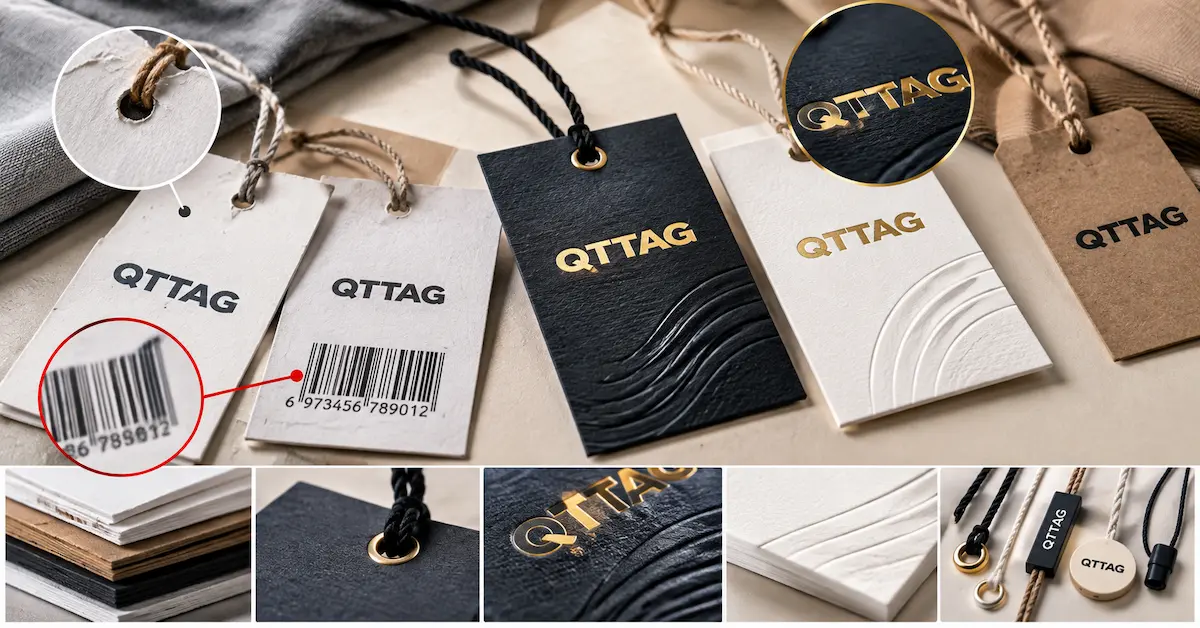
Foil stamping, embossing, debossing and selected coatings create different effects, but each needs to be evaluated against the intended stock.
Fine lettering can be particularly demanding.
A small foil-stamped wordmark may not reproduce exactly as it appears in the digital design. Heavy paper texture may also affect certain finishing details.
Choose a finish because it serves the artwork, not because it appears on a list of premium options.
Strings, Eyelets and Seals
The attachment completes the product.
Cotton strings, polyester cords, ribbons, eyelets and seals may be available depending on the construction.
Their colors and materials can be coordinated with the brand. But appearance isn't the only consideration.
Check how the cord passes through the hole, whether any reinforcement is required and whether the finished assembly is suitable for the garment.
A tag intended for delicate knitwear may need a different attachment approach from one used on a structured outerwear product.
A Good Design Still Has to Work in Retail
A hang tag is rarely viewed in isolation.
It's attached to clothing, handled by store staff and customers, and sometimes scanned during retail operations.
That creates requirements a digital mockup may not reveal.
Think About How the Garment Will Be Displayed
A folded T-shirt, a hanging jacket and a handbag offer different places for attaching a tag.
The position should make the tag accessible without hiding important product details or creating unnecessary interference.
A large tag on a small garment can look disproportionate. A very small tag may leave inadequate space for information.
Test the proposed dimensions on a representative product.
Don't Treat the Barcode as Decoration
A barcode needs correct encoded data and sufficient print quality to scan reliably.
Printing it in an attractive color or placing it too close to a border may affect readability.
GS1's barcode guidance identifies issues such as insufficient quiet zones, poor contrast, unsuitable dimensions and printing defects.
If the hang tag will carry a retail barcode, confirm its final size, position and print quality with the relevant retail requirements.
The physical sample should be tested using suitable scanning equipment.
A barcode that looks visually correct is not necessarily a barcode that scans reliably.
Why Custom Hang Tags Often Need More Preparation
Custom production can introduce work that isn't necessary for an existing supplier format.
For a new die-cut shape, the supplier may need tooling. Specialty printing or finishing can require additional artwork preparation.
Even a simple design might need revisions before the first physical sample is approved.
The buyer should understand which steps are included in the quotation.
A useful project brief can identify the following:
| Specification | Information to Provide |
|---|---|
| Garment | Clothing category and intended retail use |
| Artwork | Approved logo and text |
| Finished dimensions | Width, height and shape |
| Paper | Preferred stock or physical reference |
| Printing | Colors and information layout |
| Finishing | Foil, embossing, coating or other |
| Hole and attachment | Position, cord, ribbon or seal |
| Variations | Different artwork or product references |
| Quantity | Estimated order volume by version |
| Sampling | Proof and physical sample requirements |
| Delivery | Destination and required schedule |
If the paper or finishing hasn't been selected, it's better to say so than to invent a specification.
Provide the visual reference and intended garment. The supplier can then discuss feasible options.
Approving the Sample
Look at the finished tag, not just the printed sheet.
Check the paper, cut shape, hole position, artwork, finish and attachment together.
If the project involves several tag versions, verify that each one carries the correct information.
Keep an approved physical sample and the corresponding artwork reference.
That gives the production team something concrete to work from when the bulk order begins.
Are Custom Hang Tags More Expensive?
They can be, but not always.
A custom-printed design using an existing rectangular format may be simpler to produce than a tag requiring a new shape and several finishing operations.
Pricing depends on the actual specification.
A larger tag can use more material. Specialty paper may have different availability. Foil stamping, embossing and custom cutting can introduce additional production steps.
Order quantity matters, as does the number of artwork versions.
For instance, a brand may order one design in several garment sizes. The supplier needs to know whether the printed information changes for each size and how the versions should be packed.
There is also the attachment to consider. A quote for printed hang tags without strings isn't directly comparable to one for assembled tags with custom seals.
When choosing a supplier, request the cost of the complete finished tag.
Ask about sample charges, any tooling, minimum quantities, production lead time and what happens if the approved design changes.
Those answers are more useful than a price comparison based solely on paper size.
Frequently Asked Questions About Hang Tags
Are hang tags and custom hang tags the same?
Custom hang tags are a type of hang tag. The difference is the extent to which the buyer specifies the artwork, size, materials, finishing and attachments.
Can I customize a standard rectangular hang tag?
Yes, where the supplier offers that service. Custom printing, paper selection or other changes may be possible without creating a new shape.
What paper is best for clothing hang tags?
There is no universal best paper. The choice depends on the required appearance, printing, stiffness, finishing and garment application. Physical samples are useful for comparison.
Are kraft hang tags always environmentally friendly?
No. Kraft describes a paper type or appearance, not proof of a particular environmental attribute. Recycled content and other claims need appropriate evidence.
Should a clothing brand use foil stamping or embossing?
These finishes can support particular designs, but they aren't necessary for every collection. The selected artwork, paper and finished appearance should guide the decision.
Can hang tags include barcodes and QR codes?
Yes, provided the selected design and printing process support readable codes. The encoded information, print quality and intended scanning environment should be checked.
What is the MOQ for custom hang tags?
There is no universal minimum. MOQ depends on the supplier, materials, printing, finishing, number of versions and other production requirements.
How do I compare hang tag manufacturers?
Compare finished specifications, physical samples, quotation scope, quality requirements, MOQ, development costs and delivery terms. Confirm that each supplier is quoting an equivalent product.
Preparing Your Hang Tag Project for Quotation
The easiest starting point is the garment and the brand artwork.
If you already have a suitable tag sample, provide its dimensions and construction. If you're developing something new, send the logo, preferred design direction and estimated quantity.
A supplier can then discuss available paper stocks, printing, finishing and attachment options.
QTTAG supports custom apparel branding projects involving clothing hang tags, attachment accessories, labels and related packaging. The exact materials and finishing capabilities should be confirmed for each project.

Author
Founder at QTTAG
Jason Qiao is the founder of QTTAG, focusing on garment branding and packaging solutions. With years of experience in the apparel industry, he shares practical insights on custom labels, hang tags and sustainable packaging to help global brands grow.
Written By
Jason Qiao