How Clothing Hang Tags Improve Apparel Branding and Retail Presentation

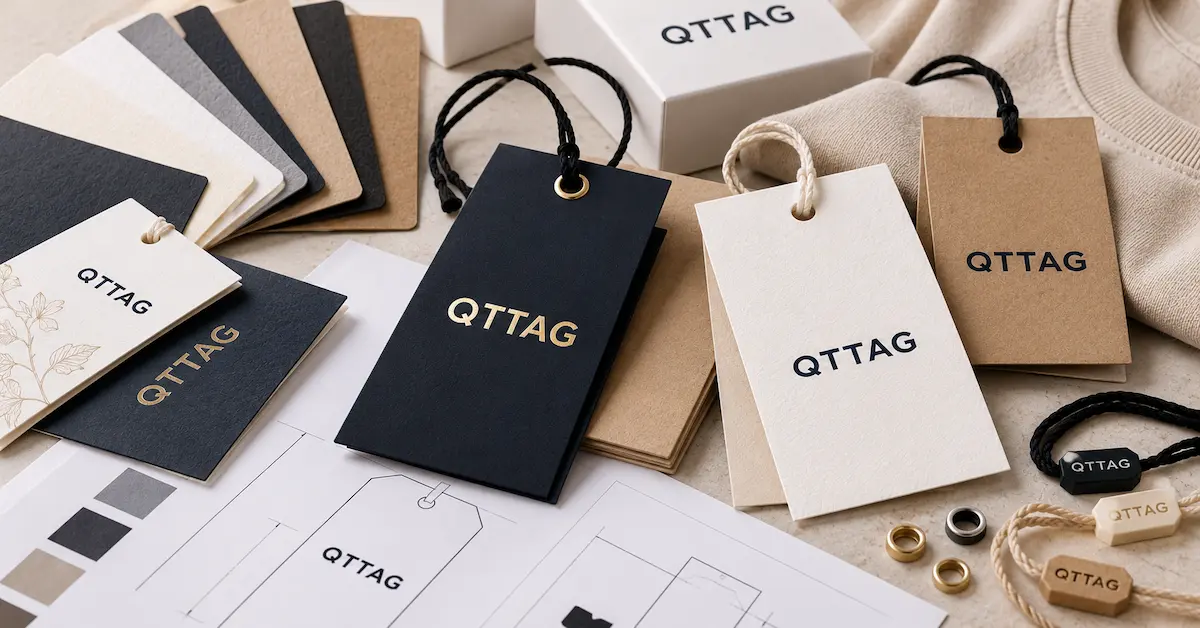
Clothing hang tags are more than removable pieces of paper attached to garments. They help fashion brands communicate identity, organize product information and present clothing consistently across retail stores and apparel collections.
For clothing manufacturers and private-label brands, the right hang tag should complement the garment rather than distract from it. Its size, paper material, artwork, attachment position and printed information should be selected with the actual clothing product in mind.
Clothing hang tags improve apparel branding and retail presentation by making garments easier to identify, supporting a consistent brand image and presenting useful product information at the point of sale.
Their effectiveness depends on how well the complete tag works with the garment. A beautiful design can become inconvenient when the tag is oversized, poorly positioned or attached with an unsuitable string.
This guide explains how to select, design and apply clothing hang tags for different apparel products, with practical recommendations for retail display, physical sampling and production quality control.
What Are Clothing Hang Tags?
Clothing hang tags are removable branding or information accessories attached to garments using strings, cords, ribbons, fasteners or other suitable attachments.
They are commonly made from printed paper or paperboard, although materials and construction methods vary.
A clothing hang tag may display:
-
The clothing brand's name and logo
-
Garment size or style identification
-
Collection or product line information
-
Relevant fabric or material details
-
Product features supported by verified specifications
-
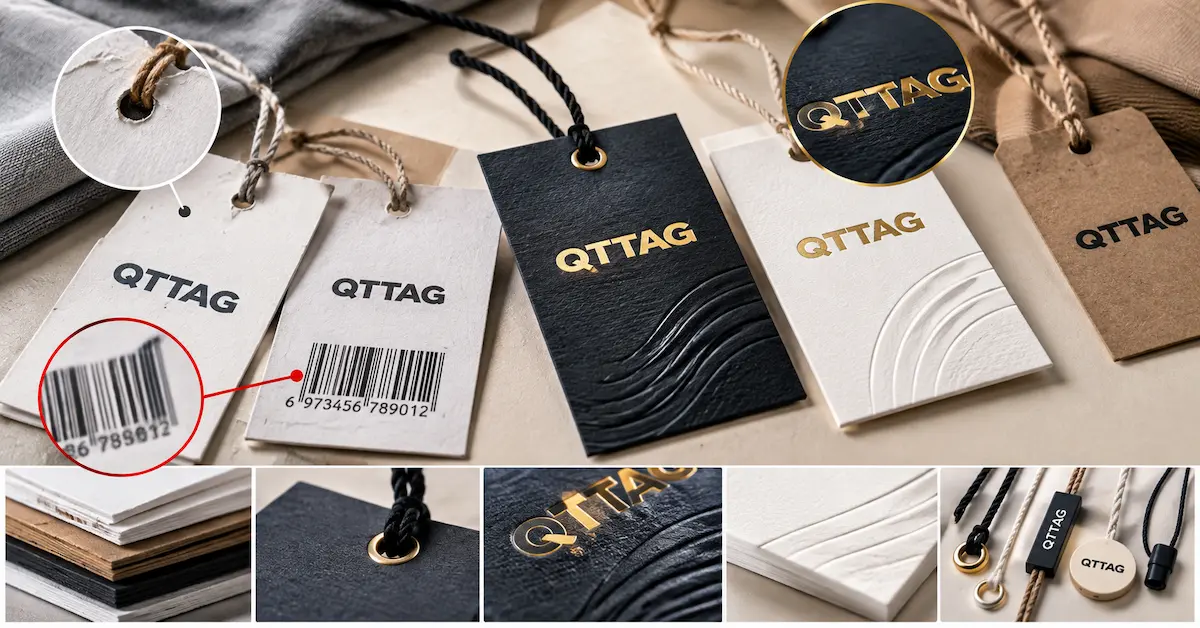
Barcodes, stock references or retail identifiers
-
A website address or QR code
-
Selected branding messages
Unlike permanent woven or printed garment labels, hang tags are generally designed to be removed after purchase.
Their primary role is to support product identification and presentation before the garment is worn.
Clothing Hang Tags vs. Regular Packaging Tags
Not every paper tag serves the same purpose.
A packaging tag may identify a gift box or accessory, whereas a clothing hang tag should be designed around the garment's shape, fabric, attachment location and retail handling.
For example, a tag attached to a lightweight shirt may require different dimensions and attachment details from one used on a heavy jacket.
This is why garment-specific design matters.
How Clothing Hang Tags Build Brand Recognition
Brand recognition depends on customers repeatedly encountering recognizable design elements.
Clothing hang tags provide one of those elements across different products.
A Consistent Logo Across Collections
A fashion brand might sell shirts, dresses, knitwear and jackets.
Each product can have a different construction, fabric and color, but the hang tags can maintain a consistent logo and typography.
This helps connect the products visually.
Brand Colors and Typography
The selected colors, fonts and spacing should follow the approved brand identity.
A consistent layout can make different garments appear part of one coordinated collection.
However, the physical appearance of colors may change depending on the paper stock and printing process.
Physical sample approval is important when precise visual coordination is required.
A Distinctive Material Experience
A textured paper tag produces a different tactile impression from a smooth coated tag.
Similarly, a restrained embossed logo creates a different effect from a brightly printed graphic.
These choices can support the brand's positioning when they are appropriate for the intended market.
Consistency Without Identical Products
A brand does not necessarily need the same hang tag size for every garment.
Different dimensions or constructions may be necessary.
What matters is maintaining recognizable design elements while adapting to the actual clothing.
Why Hang Tag Placement Matters in Retail Display
Tag placement affects how the garment looks on a hanger, folded on a table or displayed on a mannequin.
A correctly designed tag may still create problems when attached in an unsuitable location.
Neckline Placement
Some garments have hang tags attached near the neckline.
This can make the tag visible when the garment is displayed on a hanger.
However, attachment should avoid unnecessary interference with the collar, decorative details or fabric.
Side Seam Placement
Selected clothing styles may use a side attachment position.
This can keep the front of the garment visually clear.
The correct approach depends on garment construction and how the product is displayed.
Button or Loop Attachment
Certain garments provide buttons, loops or other existing features that may be appropriate for tag attachment.
The attachment should be reviewed to ensure that it does not damage or distort the garment.
Consider the Display Method
A hang tag may behave differently when a garment is:
-
Suspended from a hanger
-
Folded on a retail table
-
Displayed on a mannequin
-
Placed inside retail packaging
-
Presented in an online product photograph
For clothing hang tags for retail display, the placement should be evaluated using the actual garment and its intended presentation.
Choosing Hang Tags for Different Clothing Products
Different garments require different decisions about tag size, material and attachment.
| Clothing Product | Primary Consideration | Suggested Evaluation |
|---|---|---|
| T-shirts | Lightweight garment and simple branding | Tag proportion and placement |
| Shirts | Collar and button construction | Attachment and product display |
| Knitwear | Fabric texture and delicate surfaces | Suitable attachment method |
| Jackets | Larger structure and garment volume | Tag size and readability |
| Dresses | Fabric drape and visual presentation | Tag position and movement |
| Sportswear | Product information and consistent identity | Layout and attachment |
| Children's clothing | Applicable product requirements | Safety and labeling review |
| Fashion accessories | Smaller product dimensions | Compact tag construction |
T-Shirts and Casualwear
T-shirts often benefit from clear, compact hang tag designs.
A large and heavy tag may be unnecessary for a lightweight garment.
Buyers should evaluate how the tag appears when the T-shirt is folded or displayed.
Knitwear
Knitted fabrics can be sensitive to unsuitable attachment methods.
Avoid assuming that a standard fastener can be used without considering the fabric construction.
Outerwear
Jackets and coats may accommodate larger hang tags, particularly when additional product information is needed.
However, tag size should still correspond to the brand's visual requirements.
Dresses and Delicate Garments
The attachment should be selected to avoid unnecessary interference with the garment's drape or surface.
Use a representative finished garment during sampling.
How to Design Clothing Hang Tags for Better Readability
A good clothing hang tag should communicate useful information without making the design feel crowded.
The layout should establish a clear hierarchy.
Prioritize the Brand Logo
The logo usually acts as the primary identification element.
Its proportions and placement should remain consistent with the brand's approved artwork.
Organize Product Information
Information can be divided between the front and back of the tag.
For example, the front may focus on brand identity while the reverse contains style references or product information.
Choose Readable Typography
Very small lettering may be difficult to read on textured or dark paper.
Check typography on a printed sample at its actual finished dimensions.
Use Contrast Carefully
The relationship between paper color and printed ink affects readability.
A light gray logo on white paper may create a subtle appearance, but important text still needs sufficient contrast.
Leave Appropriate Space
Whitespace can make a design easier to understand.
However, unnecessary empty space should not force essential information into unreadably small areas.
Plan for Multiple Sizes and Styles
A clothing collection may contain different size codes or product references.
Use a consistent template with controlled variable fields to reduce artwork errors.
Selecting Paper Materials for Clothing Hang Tags
Paper material influences the tag's appearance, stiffness, printing compatibility and handling.
The right choice depends on the intended design and garment.
Coated Paper
Coated paper may be considered for selected multicolor graphics or surface finishes.
The specific coating should be compatible with the intended printing and finishing processes.
Uncoated Paper
Uncoated stock may suit minimalist or natural-looking branding.
Its actual printing behavior depends on the paper grade.
Kraft Hang Tags
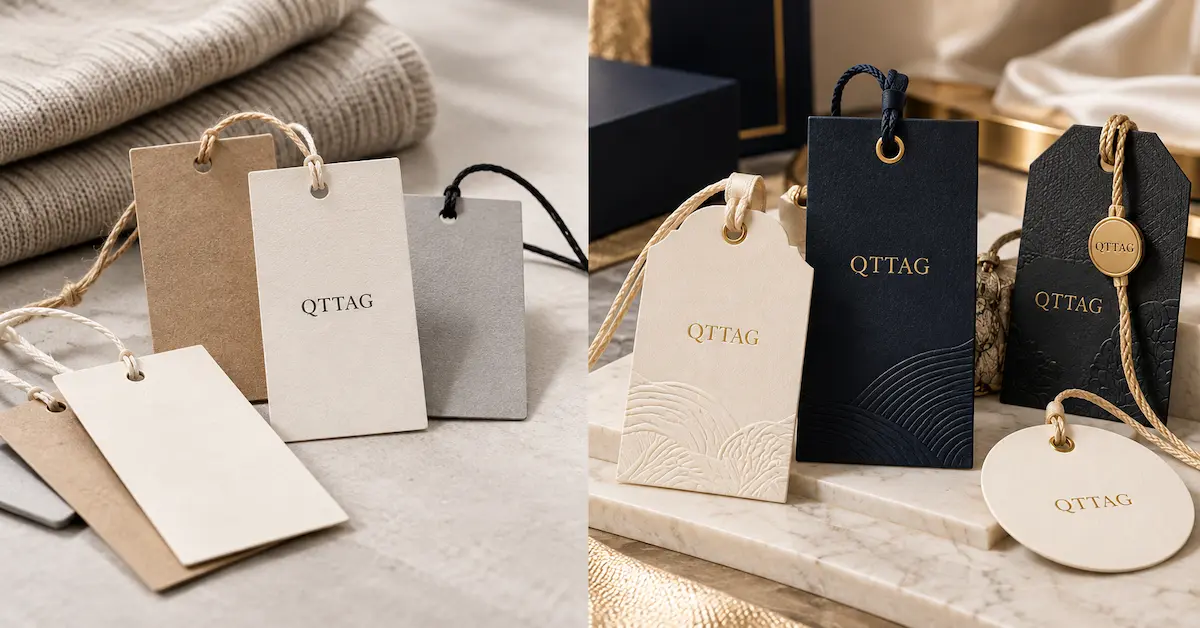
Kraft hang tags are often considered for casualwear and lifestyle collections that favor natural-looking paper tones.
They may work well with simple typography and selected print colors.
However, kraft paper's appearance alone does not prove that the material is recycled or has particular environmental benefits.
Textured Paper
Textured paper adds a tactile element to the design.
Strong textures may affect printing detail, so sample testing is useful.
Specialty Paperboard
Colored or specialty stocks may support a distinctive presentation.
Availability, paper consistency and finishing suitability should be confirmed before production.
| Paper Material | Design Direction | Main Quality Check |
|---|---|---|
| Coated paper | Controlled printed appearance | Print and coating compatibility |
| Uncoated paper | Understated branding | Ink appearance and texture |
| Kraft paper | Natural-looking design | Color contrast and consistency |
| Textured paper | Tactile identity | Reproduction of fine details |
| Specialty paperboard | Distinctive presentation | Availability and finishing |
The best material is the one that supports the approved design and the intended garment application.
How Hang Tag Size and Shape Affect Clothing Presentation
Hang tag dimensions should be determined by both design requirements and garment proportions.
Standard Rectangular Tags
Rectangular tags provide space for logos, text and barcodes.
They are suitable for many clothing collections because the layout is straightforward to manage.
Rounded-Corner Tags
Rounded corners can soften the overall appearance.
The selected radius and cutting method should be included in the production specification.
Die-Cut Hang Tags
Die-cut hang tags use custom outlines rather than standard rectangular shapes.
They can support a distinctive brand identity but may require additional tooling and inspection.
Folded Hang Tags
Folded hang tags provide additional information space.
They may be considered for collections with more product information, although folding adds material layers and construction requirements.
Multiple Tag Sizes
Some collections benefit from one standard format.
Others require different dimensions for accessories, lightweight clothing and larger garments.
A consistent brand layout can be maintained across these variations.
What Buyers Should Check
Before approving a size or shape, evaluate the tag on an actual garment.
Check that it does not obscure important garment details or create an awkward retail presentation.
Choosing Strings, Seals and Attachments for Clothing
The attachment system is part of the finished hang tag.
It affects appearance, handling and compatibility with the garment.
Cotton Strings
Cotton strings may complement paper textures and natural-looking fashion branding.
The actual construction, thickness and color should be evaluated.
Polyester Cords
Polyester cords may offer different surface effects or colors.
The selected specification should suit the tag and intended garment.
Ribbon Attachments
Ribbon can create a decorative presentation.
It may be appropriate for selected boutique or gift-oriented clothing collections.
Eyelets
Eyelets may reinforce or decorate the attachment hole.
Their suitability depends on the paper thickness and overall tag construction.
Hang Tag Seals
Custom seals can provide another branding element.
The supplier should confirm assembly compatibility and available design options.
Preventing Garment Damage
A fastener or attachment should not be selected without considering the fabric.
Delicate knits, coated materials and other specialty garments may require different attachment approaches.
Test the actual combination before bulk use.
Coordinating Hang Tags With Apparel Labels and Packaging
Clothing hang tags are most effective when they belong to a recognizable branding system.
For apparel brands, that system may include sewn labels, care labels and packaging.
Woven Brand Labels
A woven label identifies the brand on the garment itself.
The hang tag can use the same master logo, adapted to the paper printing process.
Care Labels
Care labels typically communicate garment information.
The content and permanence requirements can differ from those of a removable hang tag.
Do not assume that a hang tag replaces required permanent labeling.
Shopping Bags
Branded paper shopping bags can use related typography, colors and finishing details.
The materials may differ, so physical color references are useful.
Apparel Packaging Boxes
Packaging boxes can reinforce the same identity through coordinated artwork and materials.
The goal is consistency rather than making all components identical.
A Unified Brand Presentation
When the garment, hang tag and packaging share a clear design direction, the complete collection can appear more coordinated.
This depends on design quality and accurate execution, not simply on adding more packaging components.
How Clothing Hang Tags Help Retailers Identify Products
Beyond branding, clothing hang tags can help retailers identify merchandise.
The specific information depends on the brand, sales channel and inventory system.
Style Numbers
A tag may show a product style reference.
This helps distinguish related garments.
Sizes
Size information can be included where useful for retail identification.
It should correspond to the actual garment.
Barcodes
Barcodes can support retail identification when integrated with the appropriate inventory system.
The artwork must provide adequate scanning quality.
QR Codes
QR codes can direct customers to the brand's website, product page or additional information.
The code should be tested at its actual printed size.
Material and Product Information
Relevant details can be provided where accurate and appropriate.
Any claims about fiber composition, functionality or environmental performance must be supported by verified product information.
Common Clothing Hang Tag Design Mistakes
Several preventable mistakes can weaken the appearance or usefulness of a hang tag.
Oversized Tags
A tag may look attractive in isolation but feel disproportionate when attached to clothing.
Check the finished size on the actual garment.
Excessive Information
Too much information can make the tag difficult to read.
Organize content according to importance.
Poor Placement
Tags can obscure decorative details or interfere with retail presentation.
Evaluate placement during sample approval.
Inappropriate Attachment
An unsuitable attachment can affect the garment or create a poor finished appearance.
Review compatibility with the fabric.
Inconsistent Artwork
Different logo proportions or typography across products may weaken the intended brand consistency.
Maintain approved artwork references.
Unverified Product Claims
Technical or environmental claims should not be printed without supporting evidence.
A removable tag is still part of the information presented to customers.
Physical Sampling: What Should Apparel Brands Approve?
A physical sample is more useful than a digital preview when evaluating the finished hang tag.
The sample should demonstrate the complete construction wherever possible.
Step 1: Confirm the Artwork
Review logos, typography, colors and product information.
Step 2: Select Materials
Compare the proposed paper stocks and finishing options.
Step 3: Approve Dimensions
Verify the width, height, shape and hole position.
Step 4: Inspect Printing and Finishing
Check logo clarity, color appearance, foil coverage or other relevant details.
Step 5: Review Attachments
Confirm strings, seals, eyelets or other selected components.
Step 6: Apply the Sample to Clothing
Evaluate appearance, proportion and placement.
Step 7: Document the Approved Sample
Retain the finished sample and production specification.
| Inspection Item | What to Check |
|---|---|
| Logo | Artwork clarity and positioning |
| Paper | Surface, stiffness and appearance |
| Size | Finished dimensions |
| Printing | Text and color reproduction |
| Die-cutting | Shape and edge quality |
| Attachments | Material and assembly |
| Garment placement | Position and suitability |
| Product information | Accuracy and readability |
Approving the full assembly helps buyers identify problems before ordering large quantities.
Quality Control for Bulk Clothing Hang Tag Orders
Bulk production should follow the approved specifications.
Quality control can include paper inspection, printing, finishing, cutting and assembly.
Material Consistency
Compare production stock with the approved paper reference.
Printing Accuracy
Check that the logo, text and other artwork match the final approved version.
Cutting and Folding
Verify finished dimensions and construction.
Attachment Assembly
Confirm correct strings, cords and seals.
Version Management
Different sizes, products or collections may require different tag versions.
Use clear SKU references to prevent mixing.
Packing Inspection
Check that the correct tag quantities and designs are packed according to the order requirements.
Repeat Orders
Retain the approved artwork and material references for future production.
Review changes before repeating an earlier specification.
What Determines the Cost of Clothing Hang Tags?
Clothing hang tag prices depend on the actual materials and manufacturing requirements.
Relevant cost factors include:
-
Paper material and grade
-
Finished size
-
Shape and die-cutting
-
Printing colors and coverage
-
Foil stamping or embossing
-
Folding or layered constructions
-
Strings, eyelets and seals
-
Order quantity
-
Number of artwork variations
-
Sampling requirements
-
Tooling where applicable
-
Assembly and packaging
-
Delivery destination
Material and Finish
Different paper stocks and decorative processes may involve different production costs.
Dimensions and Shape
Larger dimensions and custom shapes can affect material usage and tooling.
Design Variations
A collection with multiple product references may require additional artwork management.
Complete Finished Cost
Compare quotes for fully finished hang tags, including attachments where required.
Do not compare incomplete specifications as though they were equivalent.
What Should Buyers Include in a Clothing Hang Tag RFQ?
A clear request for quotation helps suppliers evaluate the project and recommend suitable options.
| RFQ Item | Information to Provide |
|---|---|
| Garment type | Intended clothing products |
| Brand artwork | Approved logo |
| Finished size | Width and height |
| Paper material | Preferred stock or sample |
| Printing | Colors and artwork requirements |
| Shape | Standard or custom die-cut |
| Folding | Folded or single-panel construction |
| Finishing | Foil, embossing or coating |
| Attachment | String, ribbon, eyelet or seal |
| Placement | Intended garment attachment location |
| Quantity | Estimated order volume |
| Versions | Sizes, styles and collection variations |
| Sampling | Physical sample approval |
| Delivery | Destination and target schedule |
Providing a representative garment can help the supplier understand the intended tag application.
Frequently Asked Questions About Clothing Hang Tags
What are clothing hang tags used for?
Clothing hang tags are removable accessories used to display brand identity and selected product information before purchase. They also contribute to the overall retail presentation.
How do clothing hang tags improve branding?
They create a recognizable branded element across different garments and can help communicate product information consistently.
What is the difference between clothing hang tags and apparel labels?
Hang tags are generally removable and used for retail presentation. Apparel labels are commonly sewn or otherwise applied to clothing for brand identification or garment information.
What paper is suitable for clothing hang tags?
Coated, uncoated, kraft and textured papers may all be appropriate. The choice depends on design, printing, finishing and handling requirements.
Are folded hang tags useful for clothing brands?
Folded hang tags can provide additional information space. They should be evaluated for proportions, paper suitability and attachment.
Where should a hang tag be attached to clothing?
The preferred location depends on garment construction and display requirements. It should not unnecessarily damage, obscure or distort the clothing.
Can clothing hang tags contain QR codes?
Yes. QR codes can direct customers to approved product or brand information. Their printed size and readability should be tested.
What is the minimum order quantity for custom clothing hang tags?
Minimum quantities depend on the supplier, materials, design and finishing. Request a quotation using the complete specification.
Develop Clothing Hang Tags With QTTAG
Effective clothing hang tags combine recognizable branding, readable information and suitable garment attachment.
Paper selection, dimensions, finishing and placement should be developed together rather than treated as separate decisions.
QTTAG supports custom garment branding projects, including clothing hang tags, attachment accessories, woven labels and coordinated apparel packaging.
For a new collection, prepare your logo artwork, clothing types, tag dimensions, preferred materials, attachment requirements and estimated quantity.
These details help establish suitable customization and sampling requirements.
Ready to Create Clothing Hang Tags for Your Fashion Brand?
Share your logo artwork, garment types, preferred paper materials, hang tag dimensions, finishing requirements, attachment options and estimated order quantity with QTTAG.
Our team can discuss suitable clothing hang tag customization and sampling options for your apparel collection.
Request a Quote
Author
Founder at QTTAG
Jason Qiao is the founder of QTTAG, focusing on garment branding and packaging solutions. With years of experience in the apparel industry, he shares practical insights on custom labels, hang tags and sustainable packaging to help global brands grow.
Written By
Jason Qiao